Racism in the KCPD: There’s no thin blue line for Black officers, Star investigation finds
READ MORE
Racism in the KCPD
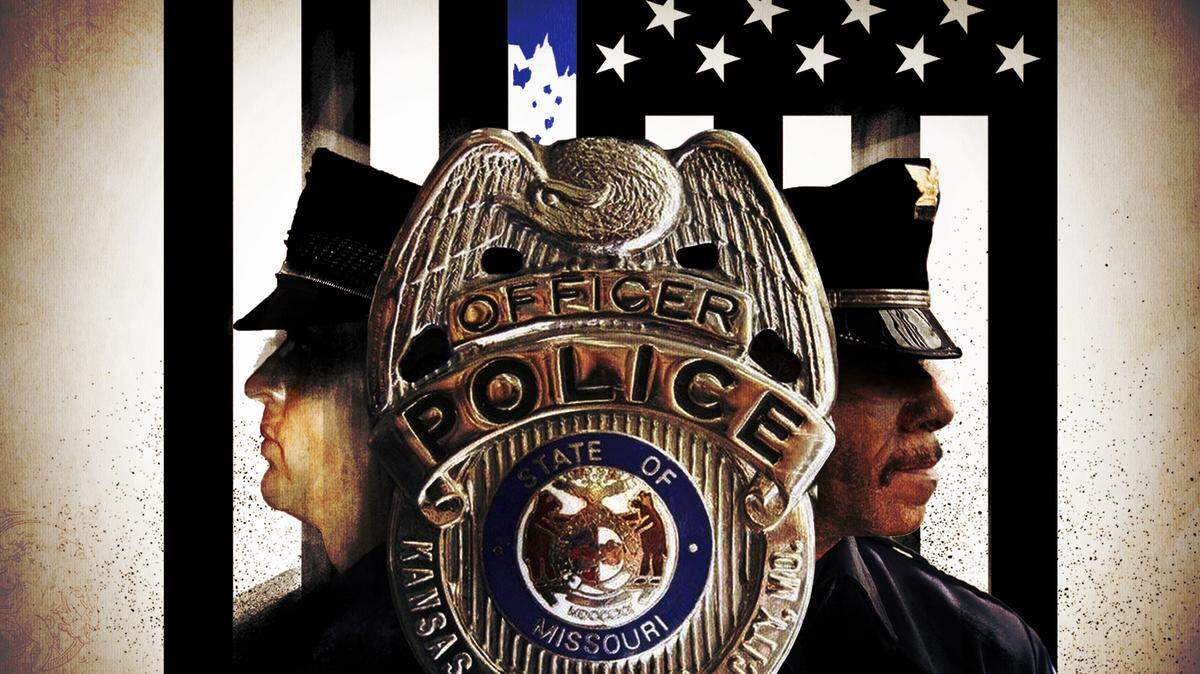
A Star investigation found discrimination, racist abuse and unfair discipline in the KCPD. White cops are accused of using slurs and racially profiling Black members of the force.
Expand All
Editor’s note: This story includes quotes containing an offensive racial slur.
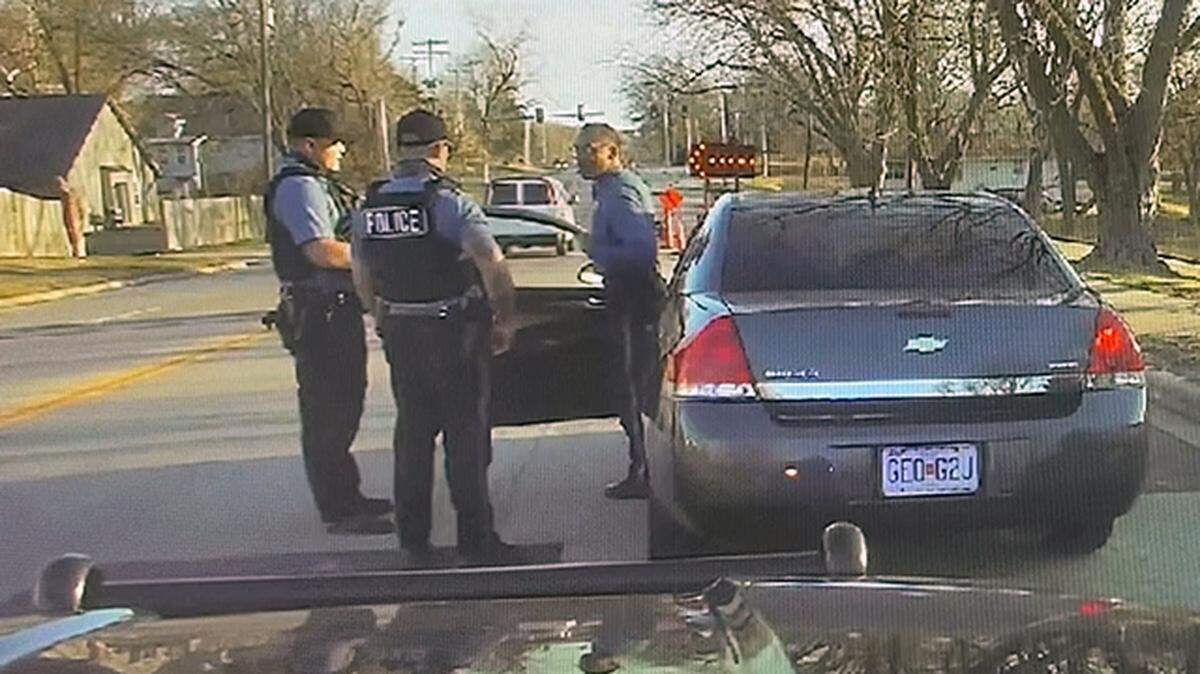
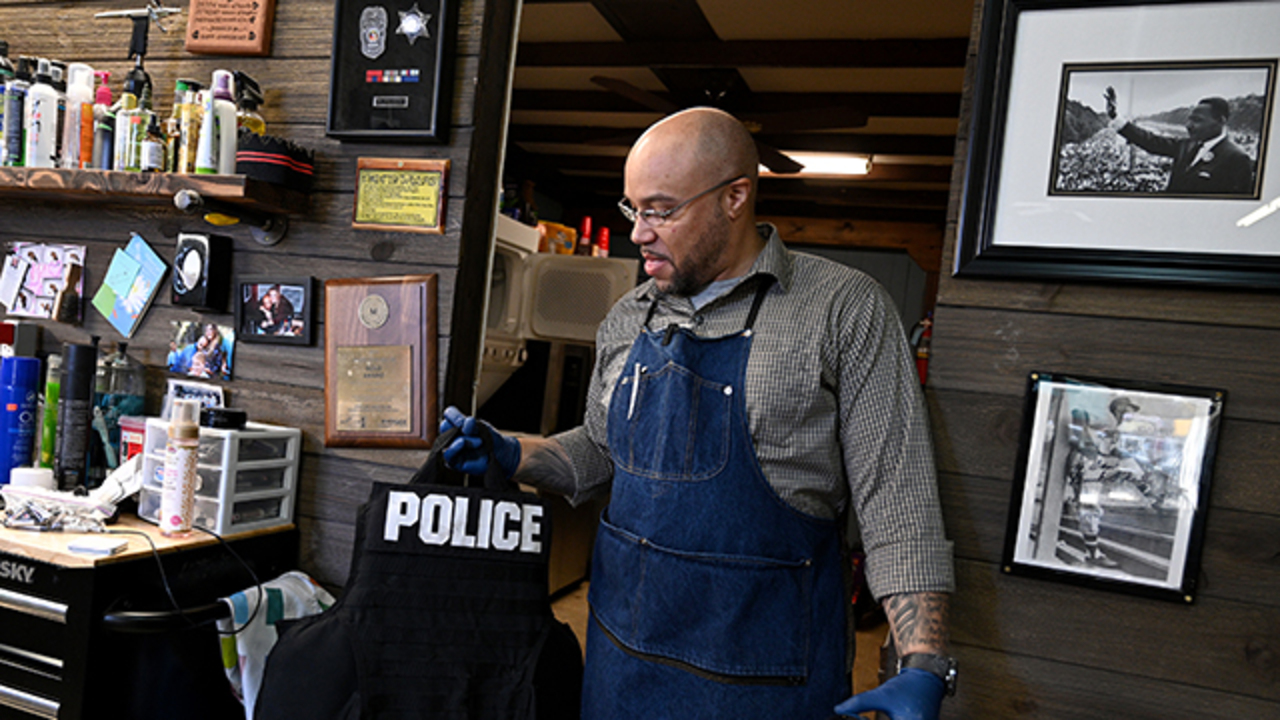
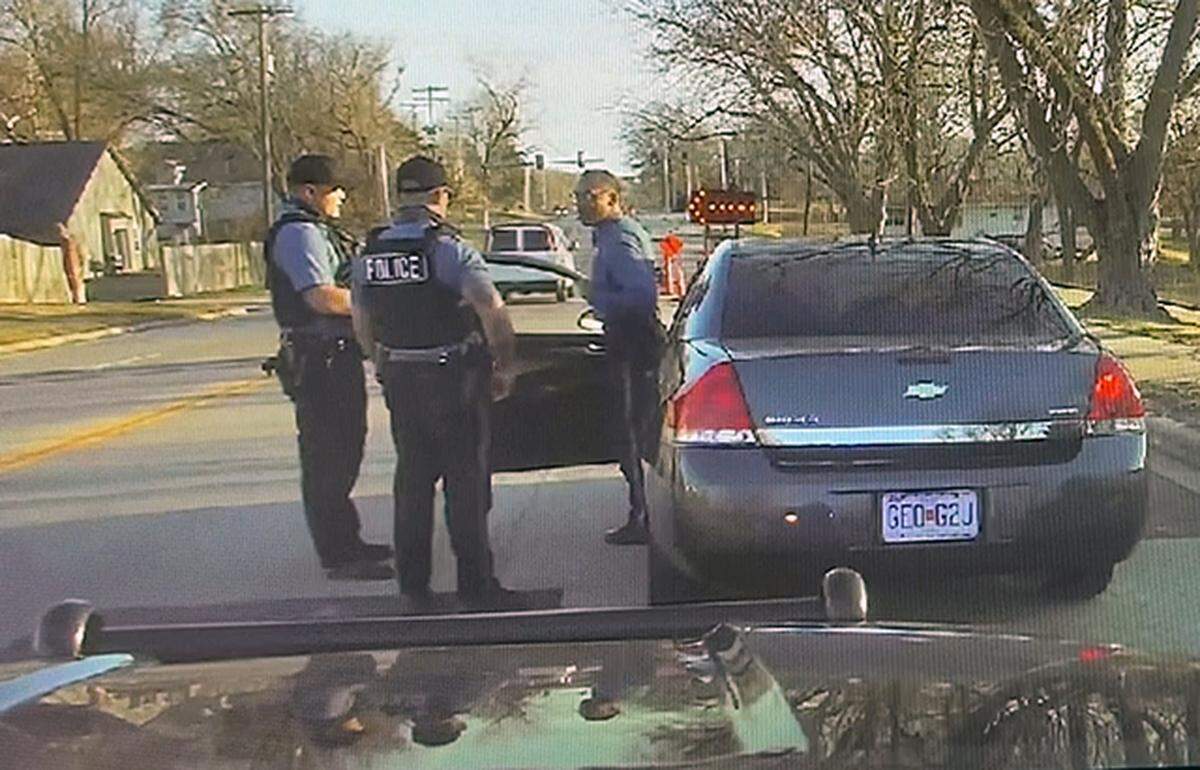
Herb Robinson, a Black Kansas City detective, was in uniform and driving an unmarked police car when two officers pulled him over.
Robinson wasn’t speeding. He had not violated any traffic laws. The registration was up to date. He knew as soon as the lights flashed behind him that it was racial profiling.
When the 59-year-old police veteran stepped out of the car in his blue and navy uniform, a tense exchange followed — the two officers complaining that he startled them by getting out, and Robinson pointing out his rank.
Robinson’s heart pounded with fear. The incident was one of the most frightening of his career, he said.
“I might have been taken down to the ground. I might have been shot,” he said. “I might have reached in my car to get my ID to prove (that he was a police officer) and been shot.”
The officers — Cole Modeer, who is white, and Marco Olivas, who is Hispanic — did not write him a ticket or issue a warning. The only reason they gave for stopping Robinson was that the license plates on the unmarked car did not register in their computer when they ran it.
As Robinson drove away, the two officers cursed and insulted him behind his back, calling him a “dumbass” and a “retard.”
The traffic stop, captured on the officers’ dashboard camera on March 11 last year, showed that a Black person in Kansas City is not immune to police harassment even if they are a veteran cop who, like Robinson, has taken a bullet in the line of duty.
In Kansas City, the solidarity behind the thin blue line does not apply if you are Black, a yearlong investigation by The Star found. The racism festering in the Kansas City Police Department does not spare even its own members, driving many Black officers to leave the force.
One former officer, Scott Wells, said being Black in KCPD was like “being a mouse in a snake cage.”
“You’re constantly watching your back 24/7,” he said.
For many officers, the question lingers: If this is how police treat their own, what chance does a regular Black citizen have?
Twenty-five current and former Black officers of various ranks told their own stories of discrimination, racist abuse and a system that forces Black officers out of the department on flimsy pretexts while keeping the upper leadership mostly white. Their accounts are backed up by scores of department emails, internal police memos, legal documents, lawsuits and video.
In 2009, the U.S. Department of Justice announced it was investigating why the number of Black officers in the KCPD was lower than expected. But the agency never released any results and declined to comment on its findings.
Thirteen years later, The Star’s investigation shows one major reason for the lack of Black officers: rampant racism inside the department.
The newspaper’s investigation found:
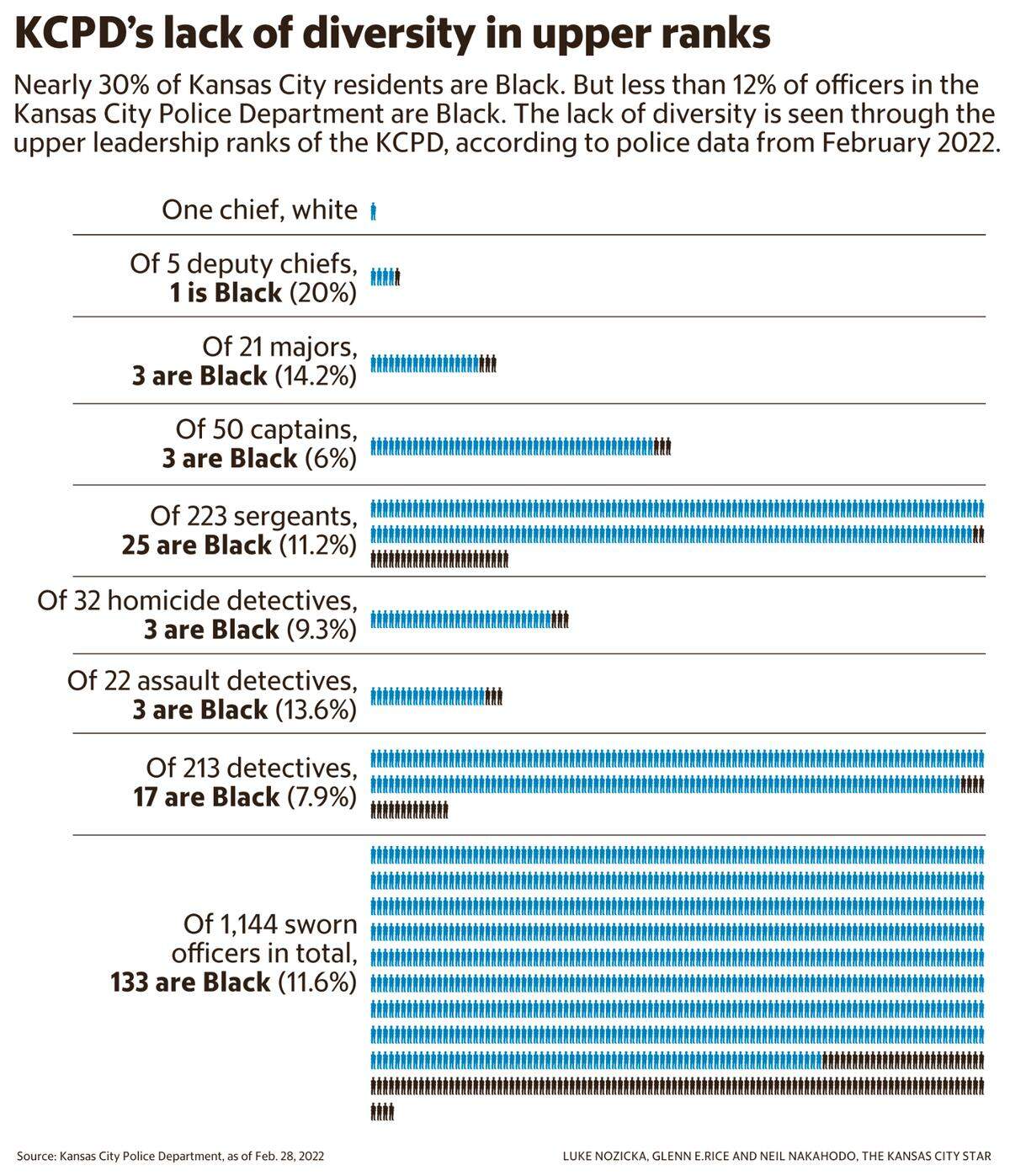
The KCPD has fewer Black officers today than it did decades ago. Just 11.6% of officers are Black in a city that is 28% Black. In 1998, the department was 12.3% Black.
Police leaders have known since at least 2009 that discipline in the ranks is meted out unequally. An internal assessment never made public by KCPD showed Black officers made up 11% of the force but received 18% of the discipline, according to court records.
Over the past 15 years, at least 18 Black officers identified by The Star have left the department because of the racist treatment they endured.
White officers have called their Black colleagues “Nigger” and “boy,” made insulting comments about eating fried chicken and said Black people were lazy.
Only about 9% of homicide detectives, who hold a coveted position in the department, are Black. And the unit produces unequal results: Detectives send cases to Jackson County prosecutors for about 51% of victims who are Black men but 73% for white women.
From the day they enter the police academy, Black recruits live with a target on their back as white instructors seek to fail them out on technicalities they give others a pass on. If they make it onto the force, Black officers say they join a department where white officers make derogatory comments or use racial slurs against them with impunity.
Before long, many find themselves singled out for unfair disciplinary action again and again until they are either forced out of the department or quit in disgust — a process commonly known inside KCPD as being “papered out.”
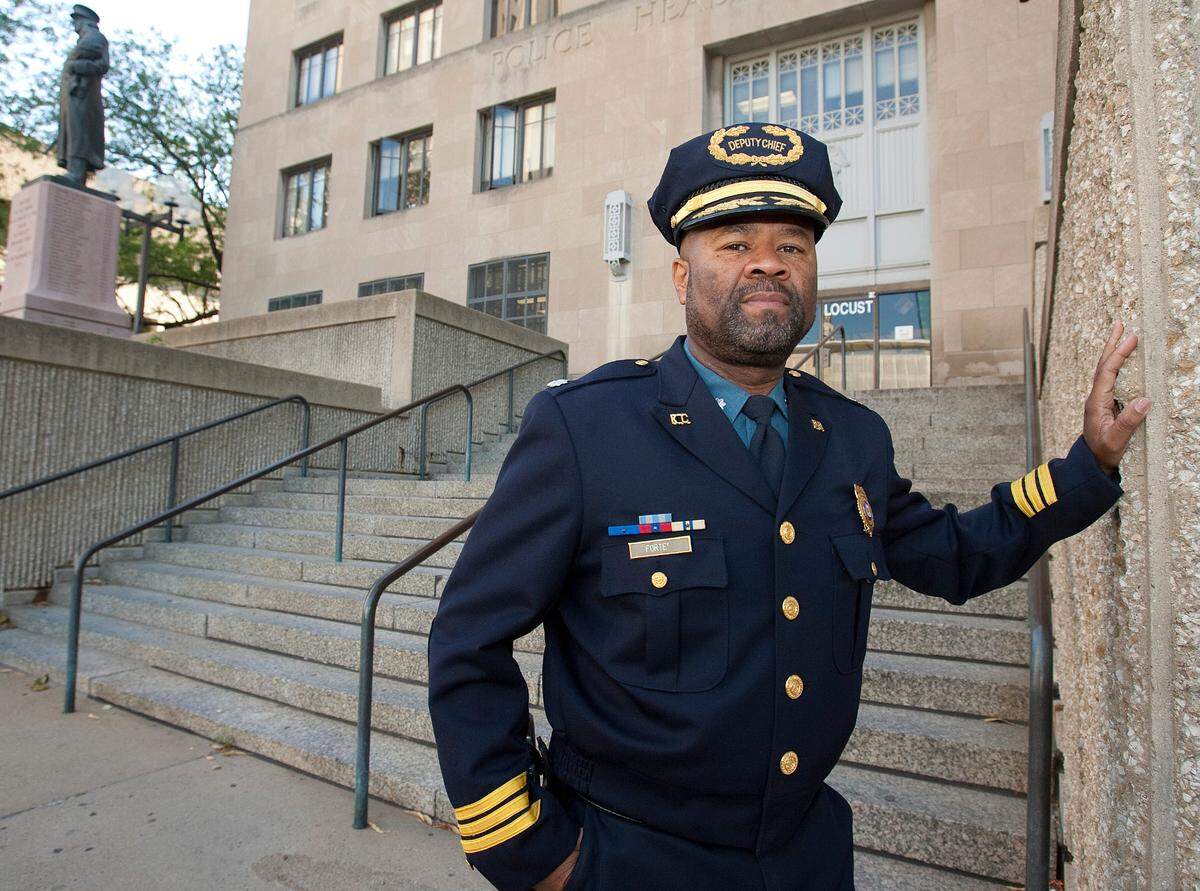
Hopes that all this could change were raised under Darryl Forté, the city’s first and only Black police chief, who led KCPD from 2011 to 2017, Black officers and community leaders say.
Under Forté, Black officers saw an ally at the helm. He created a diversity officer position and implemented de-escalation tactics to address problems of police brutality that fall disproportionately on Black residents.
He spoke out about racism he faced from coworkers and engaged residents through public forums and on social media. He asked the rank and file to challenge their assumptions about race and intervene if fellow cops behaved unprofessionally.
At one point during Forté’s tenure, KCPD had more diversity in its top leadership than it does today.
When Rick Smith, who is white, followed as chief in 2017, many cops compared it to the change from Barack Obama to Donald Trump.
In Smith, Black cops see a leader resistant to reform, with attitudes from the past. The diversity officer position? Empty. De-escalation tactics? Publicly overshadowed by a series of charges against white officers accused of violent crimes against Black people. And when Smith sought to protect those white officers, many inside the department noticed.
Smith, who on Friday said he will officially step down from his duties next month, declined numerous interview requests for this story. In response to dozens of written questions about The Star’s findings, he provided a five-sentence statement saying he recognized the importance of diversity in the police department. He said the force strives to “recruit and retain a diverse workforce.”
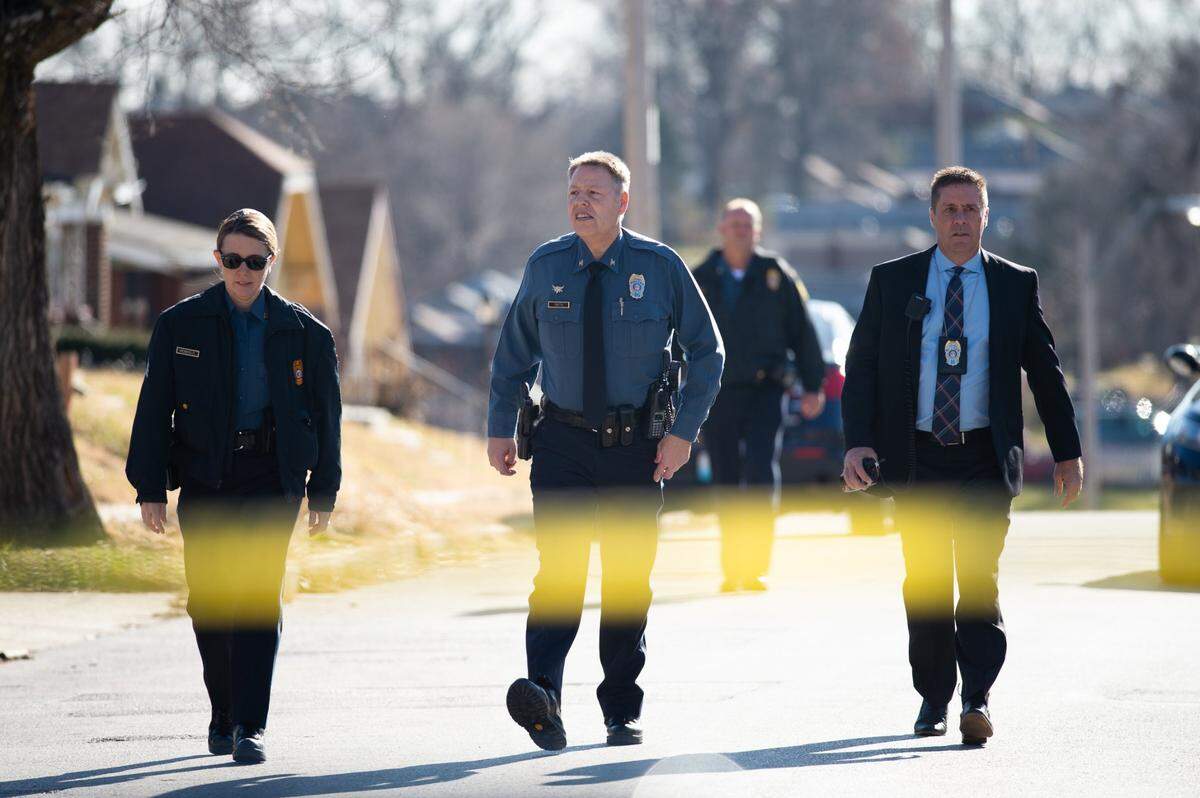
“The department remains focused on building relationships in our community,” Smith said in the written statement. “Community outreach and trust is key to our service to the citizens of Kansas City and we understand a diverse workforce is part of the equation.”
Now that Smith is being forced out, the Board of Police Commissioners, which oversees KCPD, will appoint a new top cop. Many hope that will bring about change.
Told of The Star’s findings, city officials and community leaders expressed outrage and urged the police board to act.
Gwen Grant, CEO and president of the Urban League of Greater Kansas City, said racism in the police department is “a huge problem that the current leadership perpetuates” — and one the police board fails to address.
“It is difficult to recruit Blacks and Latinos to work in law enforcement when they are subjected to racial profiling and excessive use of force in their communities,” Grant said, citing her conversations with Black officers.
“And when minorities do pursue a career in KCPD they are met with racism and microaggressions that make it very difficult for them to thrive in the department. Ultimately, they leave.”
Fourth District Councilman Eric Bunch suggested bringing Smith into a city council session to question him about what KCPD is doing about racism in its ranks — similar to the inquiry of the Kansas City Fire Department following a 2020 Star investigation.
“It’s horrific to think that we have any institution, let alone law enforcement, that would create an environment that is unwelcome and sometimes outright hostile towards our Black officers,” Bunch said.
“I’m hoping the next police chief will be of a different mindset and have an absolute zero tolerance policy on racism.”
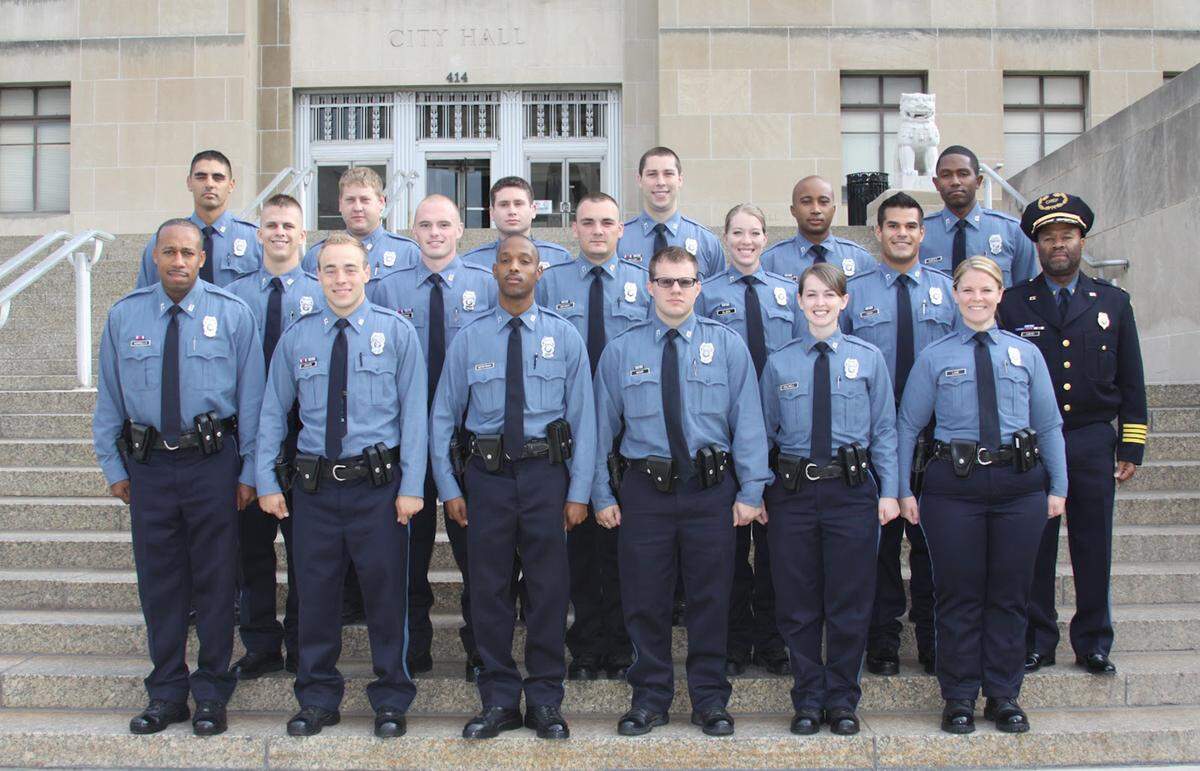
To be Black in the police academy
Becoming a Black police officer in Kansas City means beating the odds. That’s true even for those who seem made for it.
Growing up on the East Side, Kevin Sorrells believed he was destined to become a cop. Friends and neighbors routinely told him he had the demeanor, patience and caring spirit for it. They looked forward with pride to having another officer on the force who looked like them.
Plus, he had a role model and mentor right at hand: His stepfather, Herb Robinson, was on the force.
But Robinson warned him it would be difficult. He could not just score 90% on a test. He had to be better than everybody else.
“You can’t just be regular,” Robinson told Sorrells.
Sorrells took up the challenge.
But the police academy he joined is a place where just about everything is stacked against the Black recruit, according to those who have gone through it.
There are no Black instructors who recruits can turn to during their basic training. And there is just one who works in in-service training for current officers.
Strong candidates are pushed out early because of racial discrimination, Black officers say.
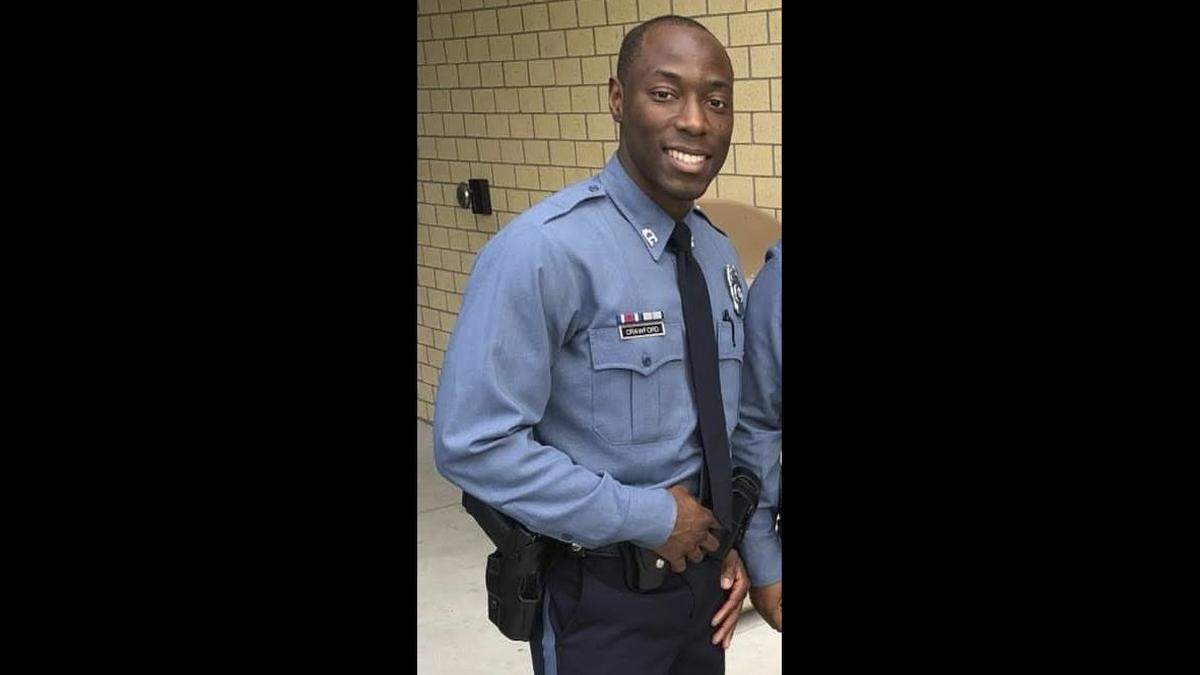
Desmond Crawford, for example, was a probationary officer at KCPD in 2016 when his captain recommended he be terminated, he said, because he could not pass a geography test.
Crawford, who is Black, had been asked to drive to 10 addresses in a certain amount of time, and while he could get to as many as eight, he could not get to 100% of them, he said.
Full-time officers are allowed to use GPS. White female cops who have trouble locating addresses are transferred to areas where it is easier to meet the geography requirement, according to one current Black officer, who asked to remain anonymous out of fear of retaliation.
But as a probationary officer, Crawford was at the mercy of his field training supervisor, who told other cops that he was not going to make it: “I don’t understand why he just won’t quit.”
Crawford, now 30, said he felt racism played a role in how he was treated. He left KCPD before his supervisor could fire him.
He moved to Richmond County, Georgia, and became a sheriff’s deputy in the Augusta area. He is a supervisor now and has trained other deputies, which he said he enjoys because of his own experience in Kansas City.
“It’s not my loss, it’s their loss. You don’t kick somebody when they’re down, when they’re struggling,” Crawford said.
“When it came down to it, it’s just like, they pick and choose.”
Making it on the force
Sorrells made it through the academy. A former teacher, he joined KCPD in January 2012.
And he wasn’t just regular, as his stepfather warned him about. Over the next several years, Sorrells became the poster child for Black Kansas City police.
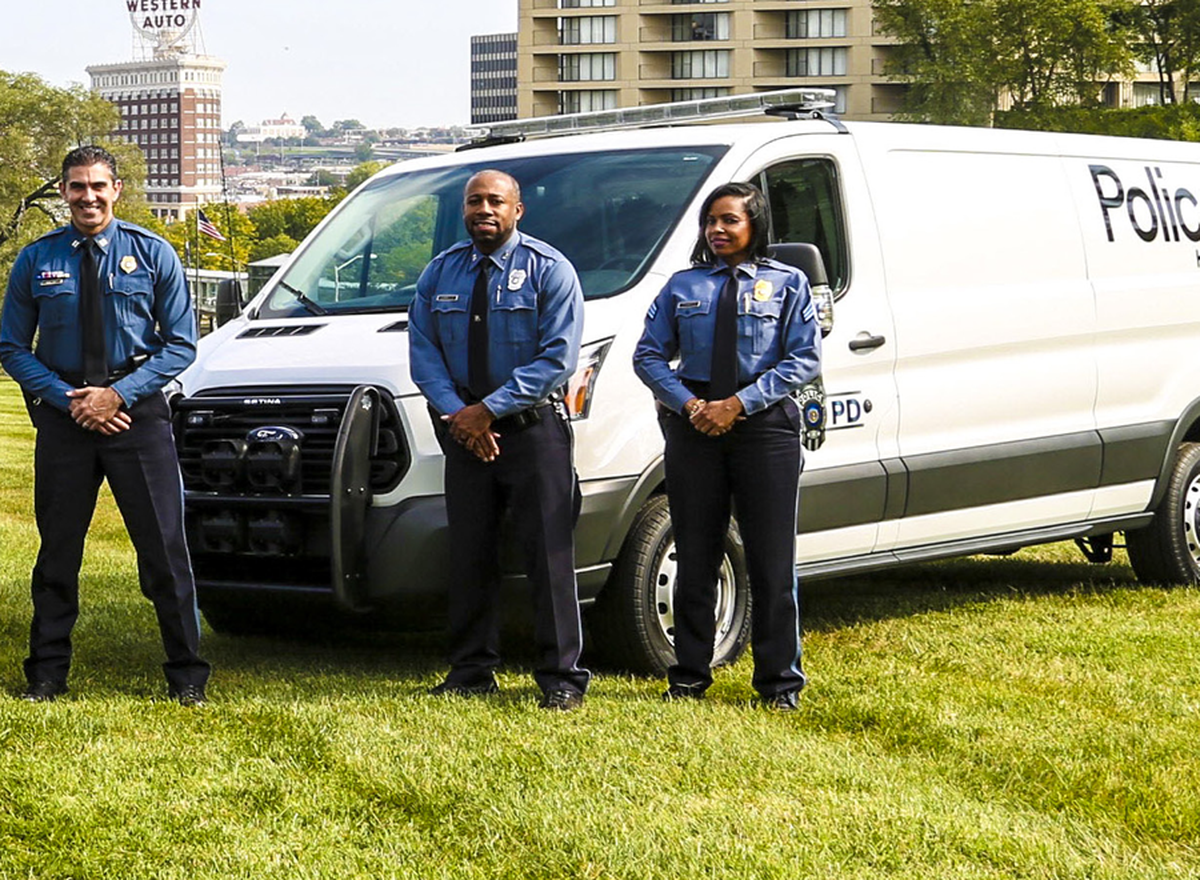
Sorrells appeared on the cover of KCPD’s 2017 annual report, standing in front of police cars on the lawn of the National WWI Museum and Memorial. He was featured in KCPD’s anti-bullying public service commercials.
At Kauffman and Arrowhead stadiums, he hoisted a flag, serving as an honor guard member, while the national anthem played. On an episode of the TV show “COPS,” he chased down a driver having a medical emergency.
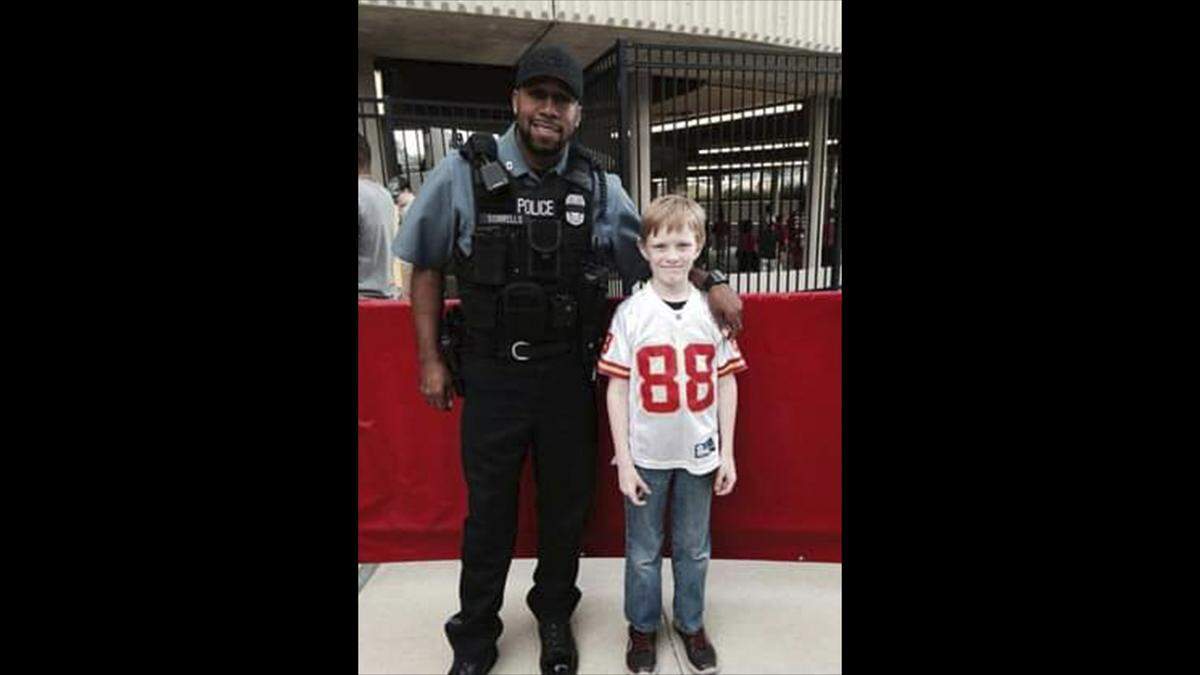
“You never know,” he told national viewers. “Could be saving someone’s life, getting somebody out of a situation where they feel like they didn’t have a way out.”
He felt like a superhero.
But before long, he would find out how hard it is to be Black in his own police department.
Racist comments and retaliation
Many Black Kansas City police officers find that, once on the job, it can be hell.
Scott Wells, a former officer who is Black, said a white sergeant made a racist comment as he and others harassed and berated him about his diabetes.
“You wouldn’t be diabetic if you didn’t eat fried chicken every day,” remarked Sgt. Brian Schoen, according to Wells.
Wells said the sergeant had never seen him eat anything.
“I mean it was racism that — it was unbelievable,” Wells, 51, told The Star.
In Wells’ nearly two decades at KCPD, sergeants nitpicked his every move, he said. They would criticize him if he left a soda cup in a wagon or kept the radio on a station that appealed to Black listeners. Many cops forgot to log off of computers, but he said he was the only one yelled at.
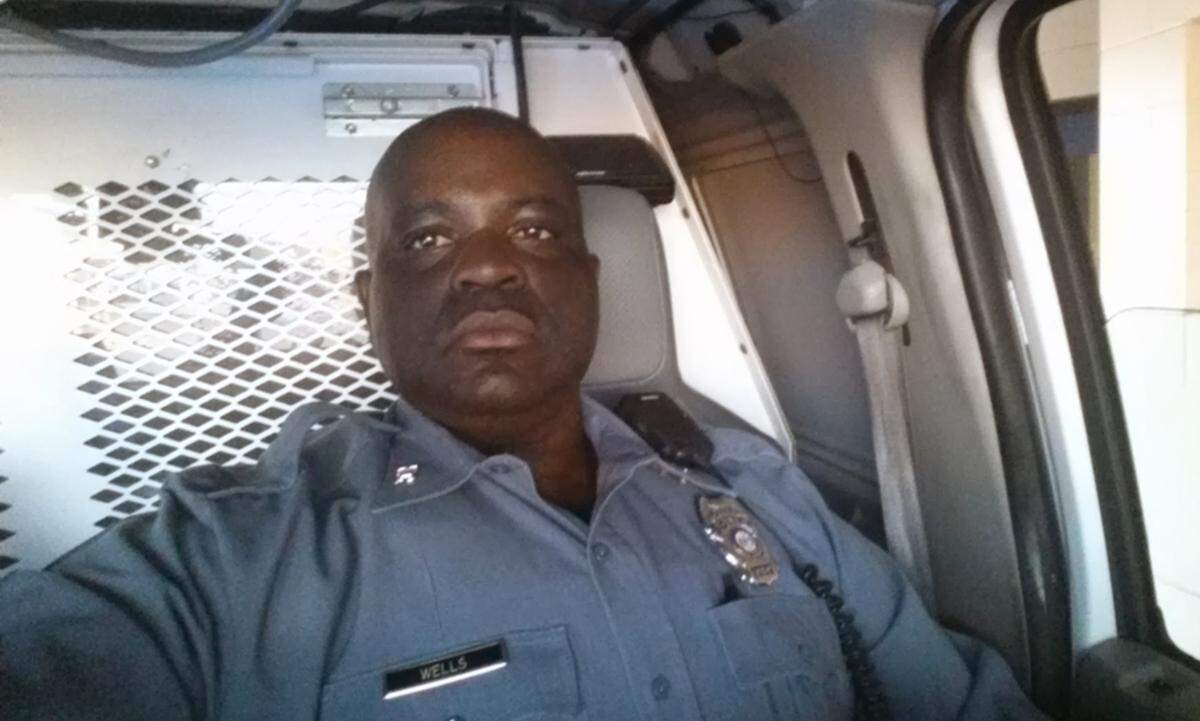
Two sergeants in particular, Schoen and Greg Manning, started harassing Wells about his diabetes in 2012, according to a disability discrimination lawsuit Wells filed against KCPD three years later. His lawsuit did not claim racial discrimination, but Wells alleged the sergeants frequently made comments insinuating he was lazy in front of other officers.
Wells’ diabetes required he take precautions in frigid weather, which brought painful sores and cysts to his feet. But he was accused of faking it, he said.
“Uh-oh, winter is here,” Manning allegedly commented. “Looks like your foot is going to start hurting and you’ll be riding the desk again like you do every year.”
In court, Manning and Schoen denied making bullying comments.
Wells said he noticed that many officers stopped talking to him after he filed a complaint. The changed mood in the Central Patrol Division made him feel unsafe.
“You hear all of these officers getting killed and shot and hurt,” he said during a deposition in 2016. “The people who I’m depending (on) to back me up … are now not even speaking to me or talking to me.”
Wells’ sergeant at the time, Jim Swoboda, who is white, stood up for him and testified in support of his lawsuit.
Swoboda looked into complaints lodged against Wells that accused him of improper overtime use, among other things, but found them “frivolous,” according to police memos.
“After a while,” a captain wrote to a major about the situation, “(Swoboda) … felt that Wells was a target by a select group of officers and sergeants for some reason.”
Before he testified, Swoboda was warned by a KCPD attorney that he needed to think about his career and how his testimony might hurt the force, according to a lawsuit Swoboda, now a captain, filed against KCPD in 2019.
Swoboda alleged the department retaliated and placed him on limited duty — stripping him of his gun and department vehicle — until Wells’ case settled for nearly $515,000.
Sergeants Schoen and Manning remain assigned to the patrol bureau. Attempts to reach them were not successful. Capt. Leslie Foreman, a police spokeswoman, said the two were not “available to respond” to questions.
Other officers told The Star they have faced similar discrimination on the job, including being called racial slurs by superiors.
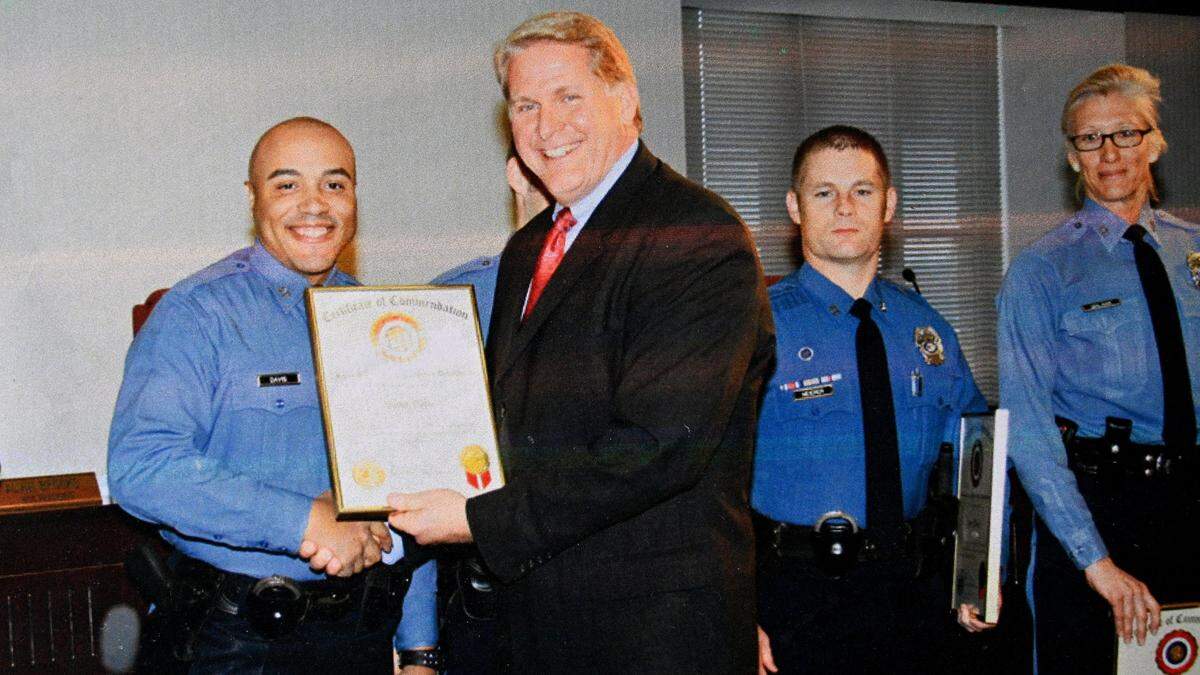
David Davis, who worked for KCPD from 2004 to 2018, said he was regularly called “boy” as a civilian employee. Davis said after he became a sworn officer, his sergeant, Jason Cote — who is now a captain — asked Davis’ wife, who is white, why she was with “this nigger.”
Cote did not respond to an email seeking comment.
More recently, one Black officer, John Wyatt, claims in a lawsuit he was unjustifiably disciplined for investigating drug activity at a park near his house while off duty.
Wyatt was later ordered to paint a patrol station, which he considered a “demeaning” task.
He was forced to paint in an undersized suit that exposed his underwear, Wyatt alleges in the race discrimination and harassment lawsuit, which remains pending.
One Black officer recalled sharing a Middle Eastern-inspired meal with a friend in 2010 at a south Kansas City cafe when he noticed an unmarked police car pull up and park nearby.
The officer, who asked not to be identified for fear of retaliation by KCPD, soon learned that commanders became concerned when he returned from a 2008 vacation to a Muslim country. They accused him of becoming a radicalized “terrorist” and plotting an attack back home in the U.S., the officer said.
Police supervisors placed the officer under surveillance and followed him in unmarked cars, jotting down notes and surreptitiously snapping pictures of him, he said.
“It makes me feel like, am I the enemy?” the officer asked. “Y’all think I’m the enemy in this police department, that I’m al-Qaida or ISIS in your midst?”
A former KCPD official independently confirmed the officer’s story.
Foreman, the police spokeswoman, said KCPD could not discuss internal investigations. But she said KCPD “does not investigate personnel based on either religious affiliation or race.”
BEHIND THE STORY
MOREHow we reported the story
Over the past year, The Star interviewed 25 current and former Black officers as well as a host of community activists, faith leaders, attorneys, legal scholars and experts on race and policing. While some officers needed to remain anonymous to protect themselves from retaliation, 15 spoke to The Star on the record about the racist abuse they faced at KCPD.
Reporters spent a year combing through scores of legal documents and internal police memos, revealing decades of systematic and institutional racism and discrimination against generations of Black officers.
Among the most striking discoveries: Documentation and testimony of an internal department audit that found discrimination in discipline dating back to 2009, while police dashcam video from last year showed a Black detective in uniform being pulled over for no reason by two KCPD officers. The newspaper identified 18 Black officers who were forced out of KCPD or left because of the racist treatment they endured.
Throughout the reporting, The Star made multiple requests for face-to-face interviews with Police Chief Rick Smith and public information officers. Those requests were denied.
In response to dozens of detailed questions sent in writing, Smith responded with a five-sentence statement that did not answer most of them.
The project was published with six stories, nine videos and a graphic showing the lack of diversity through the hierarchy of the police department. Read more by clicking the arrow in the upper right.
About the reporters
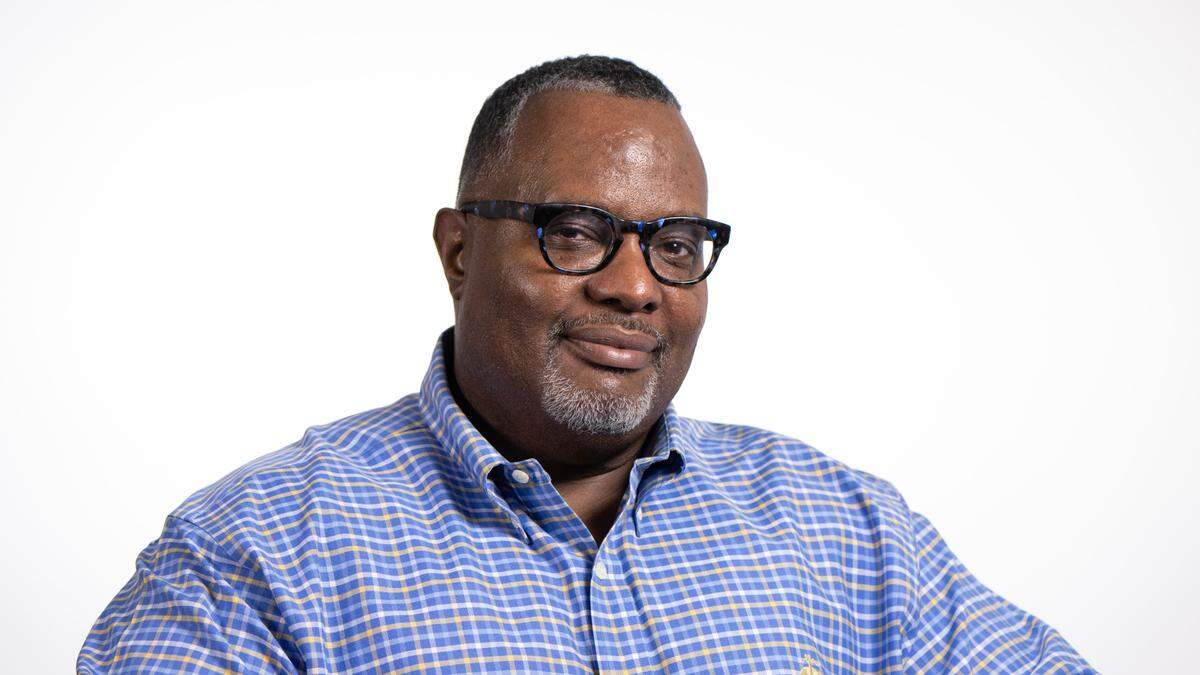
Glenn E. Rice is an investigative reporter who focuses on law enforcement and the legal system. He has been with The Star since 1988. In 2020 Rice helped investigate discrimination and structural racism that went unchecked for decades inside the Kansas City Fire Department.
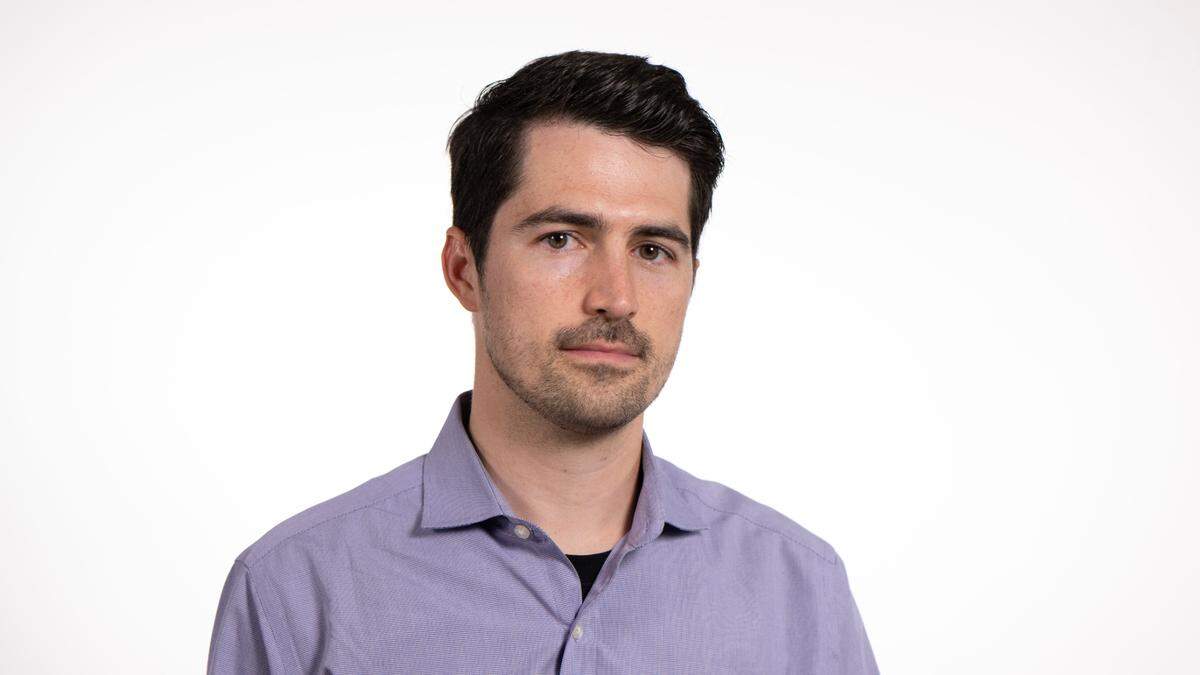
Luke Nozicka is an investigative reporter who focuses on criminal justice. He has covered crime, police and prosecutors in Jackson County. His reporting was credited in 2021 with helping free Kevin Strickland, an innocent Missouri prisoner.
Katie Moore is an editor on the breaking news team. Previously, she covered crime and justice issues for The Star. She is a University of Kansas graduate and began her career as a reporter in her hometown of Topeka, Kansas.
The officer, who plans to retire in 2026, said he has not quit because the police department needs to be diverse in order “to make a difference.”
“If we all quit, it’s going to be the same good old boys’ system,” he said.
And in that system, Black officers feel less protected than their white counterparts.
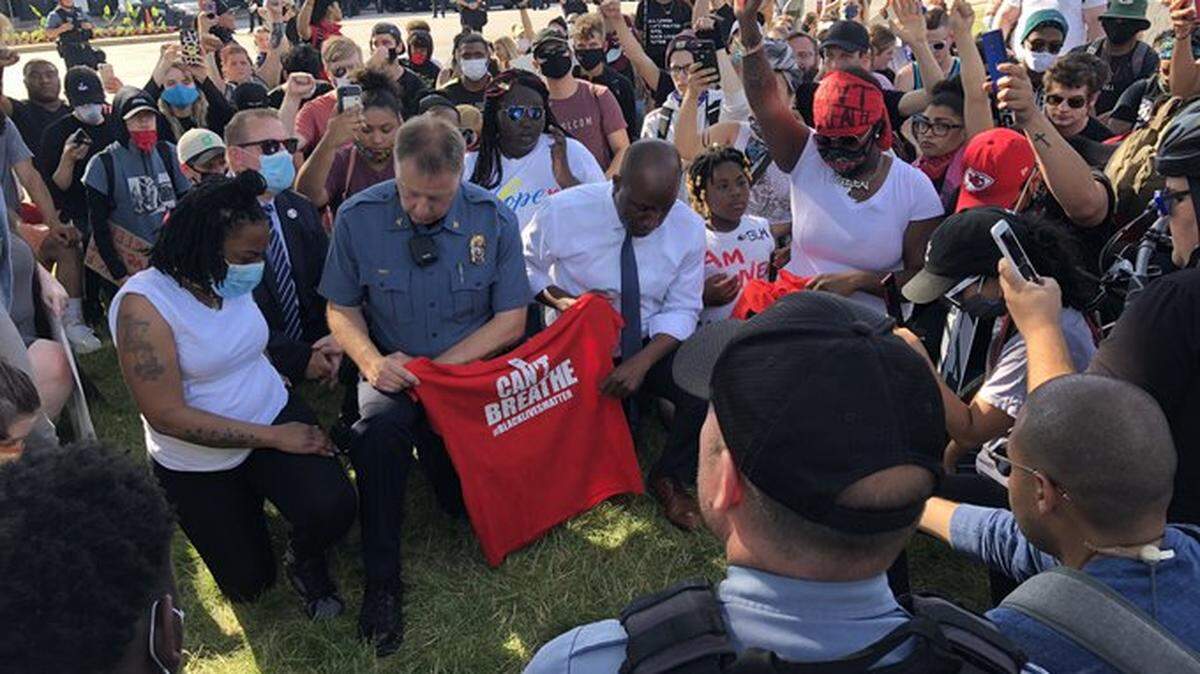
That feeling was only reinforced last year when Smith stood before dozens of commanders and said that, while he took a knee in support of Black Lives Matter during the 2020 protests, he did it only to shield his officers from further criticism.
Three commanders who were in the room confirmed Smith’s comments to The Star.
‘Unwelcome and afraid’
During those same protests against police brutality, a homicide detective on the seventh floor of KCPD headquarters watched on a monitor along with other officers.
“I think I figured out why there aren’t any Black people out here,” detective Heather Leslie mused aloud June 2, 2020, according to an internal police memo obtained by The Star. “They’re too damn lazy.”
“They’d have to get off their asses,” she allegedly added.
The remarks, reported the next day by another officer, so devastated one Black detective that she had to leave the room several times to gain her composure. It made the detective feel “unwelcome and afraid.”
“This comment made me extremely uncomfortable and displayed an apparent prejudice that not only affects the working professional relationships within the office, but casts doubt on an ability to investigate fairly without bias,” detective Sean Martin wrote.
Leslie also allegedly used a police computer to look up the home address of Mayor Quinton Lucas last year, five sources in a position to know confirmed. Jackson County prosecutors are reviewing the incident for potential criminal charges.
“Nobody should be using racist language in our police department,” Lucas said. “It’s unacceptable. It’s the sort of thing that undermines the work of their colleagues on the department, of all our other officers and frankly, the reputation even of this city.”
Leslie, a KCPD officer since 2005, has since been moved to the patrol bureau. She did not respond to an email or return a call seeking comment.
Sgt. Jacob Becchina, a KCPD spokesman, said the department could not comment on the accusations against Leslie or whether she was disciplined. He cited a section of the Sunshine Law that prohibits releasing identifiable personal information.
Lauren Bonds, legal director for the National Police Accountability Project, said the detective who reported Leslie’s alleged remarks made “an astute comment questioning” her ability to conduct investigations without bias.
“There are also legitimate concerns about her ability to conduct her new patrol duties without bias,” Bonds said.
After prosecutors informed him of the alleged search months later, Lucas filed a complaint with the Office of Community Complaints, which is charged with independently investigating grievances against KCPD officers.
In a letter responding to Lucas, which was obtained by The Star, the office said the incident had been investigated and resolved by KCPD officials, meaning it did not have authority to investigate.
OCC Director Merrell Bennekin did not return calls or emails last week seeking comment.
To Lucas, the letter told him: “It’s handled and you can’t know anything about it.”
Forced off the job
The Star identified at least 18 Black officers who were either forced out of the department or left because of the racist treatment they endured. Another officer is still with the police department but is facing termination now.
The departures are not tracked by KCPD officials but were attested to by current and former officers as well as one former leader of the police department. KCPD does not ask Black officers why they leave, or survey them for information about how to retain them, department officials have said.
Many say they leave because of the process Black officers call being “papered out” — targeted for discriminatory discipline until they decide to leave.
The trumped-up complaints caught up with Sorrells, the cop who became the poster child for Black officers, in 2018.
When a student at Lee A. Tolbert Community Academy was robbed at gunpoint while waiting at a bus stop, he told school officials that he would only explain what happened to Sorrells.
Sorrells had credibility: He had previously worked at the school as a teacher and since becoming a cop he had begun working off-duty security there.
“I wanted kids to see, especially as an African-American, I want the kid to see that a Black officer looks like them,” he recalled. “Let them know, you can do this.”
A fellow officer asked Sorrells to add the conversation with the student to his report. But a white police supervisor accused Sorrells of double-dipping because he worked on the report while he was off-duty. Sorrells maintained he did nothing wrong, but his supervisor recommended he be terminated.
“I know white officers who beat the crap out of their wives, stole,” Sorrells said. “Nothing’s happened (to them), but I start a report to help a kid I knew, and you want to fire me?”
But that wasn’t the end of his trouble.
In September of that year, Sorrells and another Black officer arrived late to an off-duty security job at a Westport nightclub. A white female officer said she should keep part of their money because they were not on time, but she ultimately gave them the full amount.
Only later did Sorrells learn internal affairs was investigating him for strong-armed robbery based on the incident.
The accusations, Sorrells told The Star, “just took the wind out of my sails.”
“I was one of those who always had the shiniest boots; always looked the cleanest in uniform.”
Investigators examined nearly a year’s worth of off-duty assignments to see if Sorrells made sure that he showed up on time or violated any department policy.
Demoralized, Sorrells quit several months later, before he learned an internal investigation exonerated him, he said.
Sorrells now works as a supervisor at the Ford auto plant in Claycomo.
His experience epitomized a belief held by many Black cops: that they are reprimanded at rates higher than colleagues of other races.
One department-wide assessment from 2009, the only of its kind found by The Star, showed that Black cops made up 11% of the force but 18% of the discipline.
In response to a public records request from The Star, Becchina, a police spokesman, said in an email there was “no disciplinary study” but that it was part of a consultant’s assessment report. Becchina said he was not sure if it still existed.
But multiple officers, commanders and two former police chiefs confirmed the disciplinary survey was conducted as described in court documents. It came to light during a federal civil rights lawsuit filed in 2013 by Kevin Masters, who is Black and was a deputy chief at the time.
Masters alleged that former Chief James Corwin unfairly disciplined him in 2009.
He was disciplined for telling a Lee’s Summit dispatcher that KCPD would not enforce traffic warrants pending against Masters’ barber, who had been pulled over for a traffic violation. Masters said it would have meant bringing in the barber’s 5-year-old son with autism to a police station, which he determined to be “potentially dangerous.”
Masters maintained that white commanders who were accused of more questionable actions were not disciplined.
Under Smith, the lack of discipline for white officers extended even to those facing criminal charges.
Former detective Eric DeValkenaere, for example, remained on the payroll more than two months after being convicted of second-degree involuntary manslaughter in the 2019 killing of Cameron Lamb, who he shot while Lamb was backing his pickup into his garage.
Four others continued to work for months while facing prosecution, including some charged with felony assault.
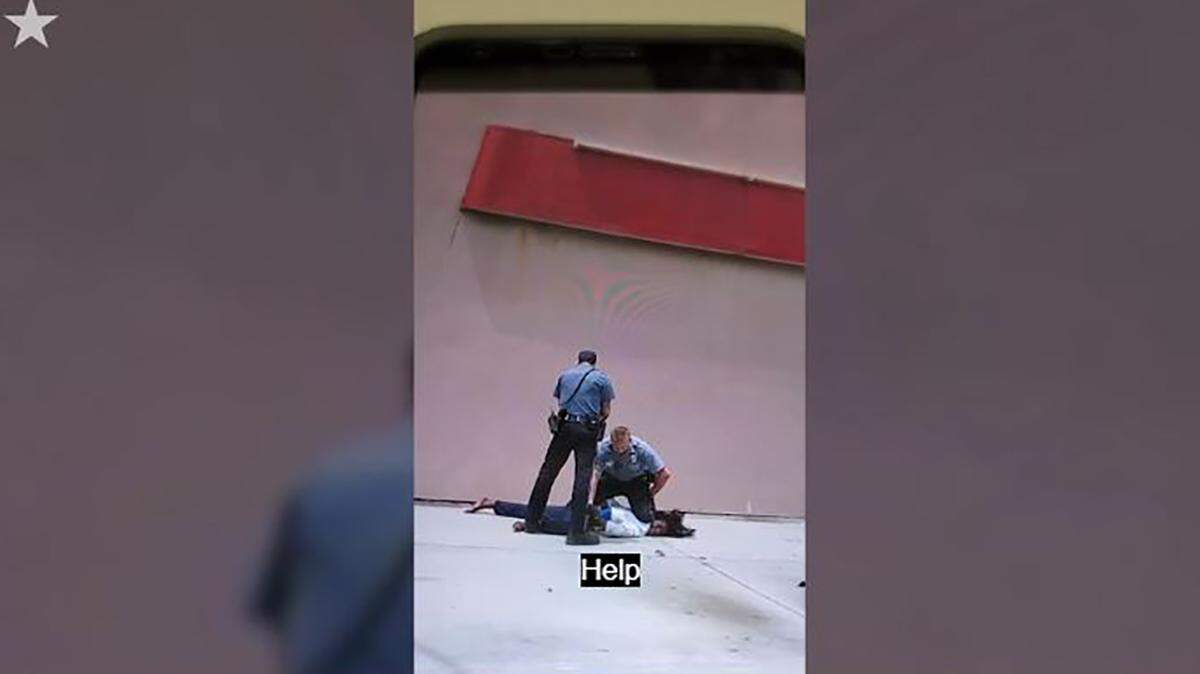
For a time, that included officers Charles Prichard and Matthew Brummett, who were charged with assault in 2020 for their parts in a widely-criticized arrest of a Black transgender woman whose face was slammed on the pavement.
One Black officer was frustrated when he saw the two moving items at the East Patrol Division Station weeks after they were indicted. At the time, the officer was involved in opposing a new KCPD order that banned officers from having facial hair even though many Black officers have skin conditions that make shaving painful.
“This department has stood behind their actions and they are still allowed to come to work and carry their duty weapons and badge,” the officer wrote to the Internal Affairs Unit.
“I as a Black officer was put on limited duty for not being able to shave due to my medical condition.”
Prichard and Brummett have since left the department. The police department has never said whether they were fired or quit.
Lack of diversity
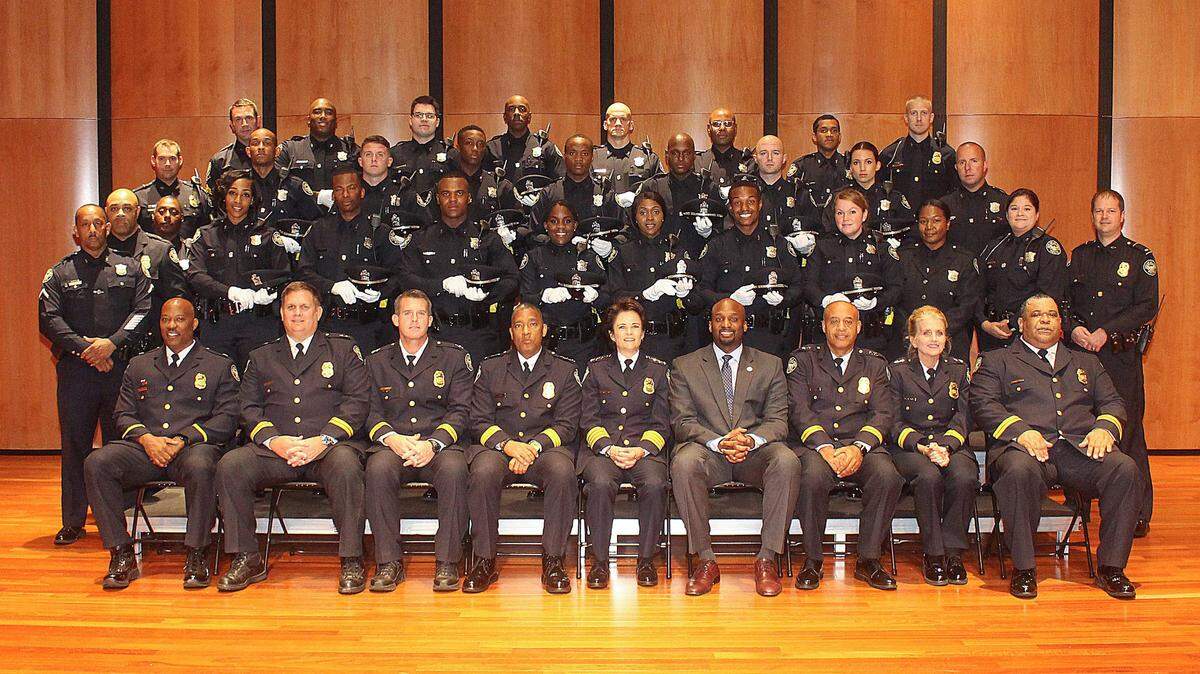
The loss of officers like Sorrells and Crawford is reflected in the lack of diversity throughout the department.
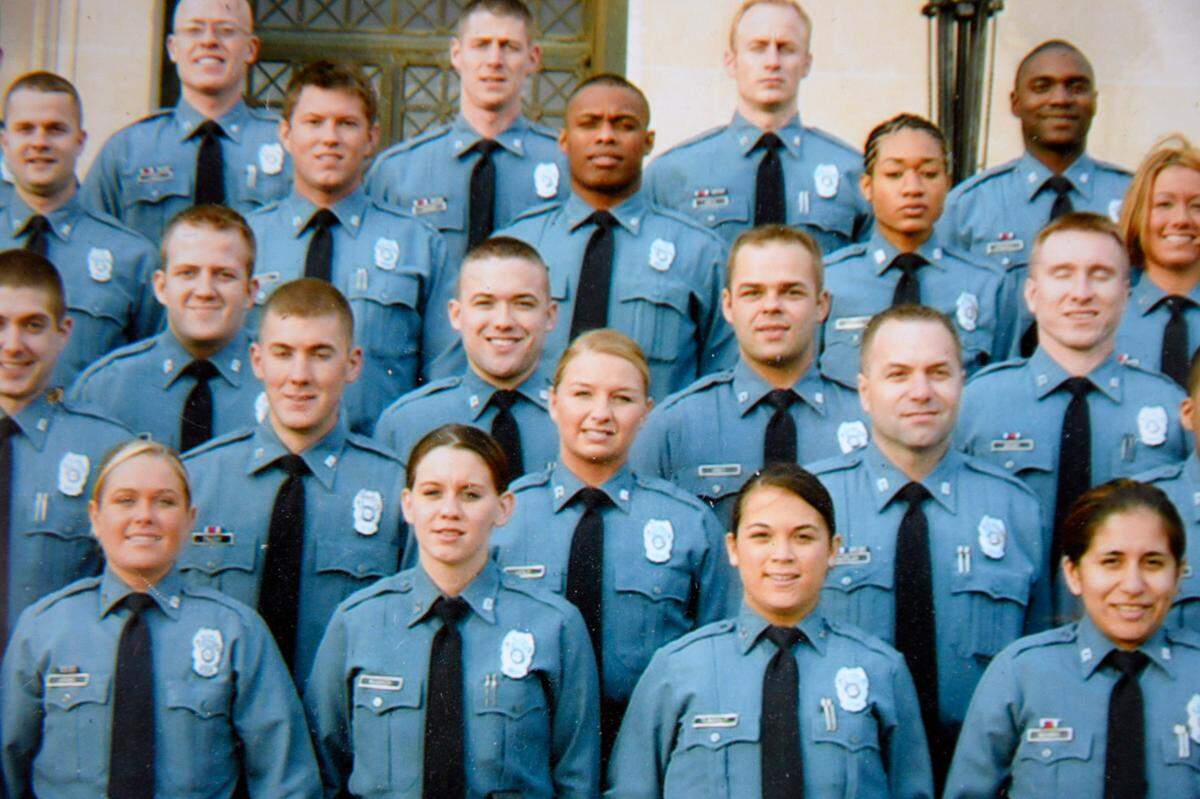
Just three of the 50 captains in the department are Black, as are only three of 21 majors. Of the five deputy chiefs, one is Black.
While a majority of Kansas City’s homicide victims are Black, just three of the 32 detectives who investigate their killings are Black.
“They will hire minority officers,” said David Davis, who worked at KCPD for 13 years and is now running for Leavenworth County sheriff, “they won’t keep minority officers.”
Over the past five years, 16% of candidates to graduate from the police academy were Black. But the overall percentage of Black cops in KCPD remains under 12%.
Councilwoman Heather Hall, a fierce supporter of the department, said KCPD has several programs aimed at minority youth and teens to help attract recruits. But encouraging minorities to consider a career in law enforcement is an ongoing challenge for Kansas City and other departments, she said.
“So they, I believe, are trying to (diversify) but I would also say, they can’t beat people up to get them to apply,” said Hall, who is vice chair of the city’s finance, governance and public safety committee.
“They can’t knock on people’s doors and go, ‘Hey Joe, you need to come and apply.’”
Some members of the police board, including President Mark Tolbert, who is Black, did not respond to requests for comment on The Star’s investigation.
One commissioner, Cathy Dean, said the force has tried “tirelessly” to diversify its ranks, saying KCPD would be “a better department” if it had more Black and female officers.
The local chapter of the Fraternal Order of Police declined to comment.
In 2009, the Justice Department announced plans to investigate whether KCPD discriminated against Black and Hispanic people in hiring and promotions.
At the time, DOJ officials said KCPD’s percentages of Black and Hispanic employees were “lower than would be expected for an agency of this type.” By then, Black officers accounted for about 10% of the force.
During the federal investigation, the police department voluntarily stopped its hiring process.
It remains unclear what came of that probe. KCPD referred questions to the Justice Department, which declined to comment on the inquiry.
Future with next chief
After The Star’s 2020 investigation on racism in the fire department, city council members were able to call KCFD leaders to testify at City Hall. Council members worked with KCFD leadership and its unions, and imposed new requirements on them.
But in the case of KCPD, the City Council does not have the same power. The police department is controlled by the mostly governor-appointed police board, which will make the decision on who to hire as the next chief.
That person, some Black officers hope, could improve the force’s culture. They could crack down on racism and recruit a more diverse force.
City Council members called on the police board to act on The Star’s findings.
“I would implore the Board of Police Commissioners and leadership of the police department to take this seriously,” said Councilwoman Andrea Bough, 6th District at-large, who called The Star’s findings “unacceptable.”
Councilman Lee Barnes Jr., 5th District at-large, said KCPD sounded “worse than the fire department.” He called for local control of KCPD.
“I don’t care what nobody says,” said Barnes, who is Black. “This stuff is ridiculous.”
Talib Ntwadumela Muwwakkil, chairman of the National Black United Front-Kansas City, urged the next police chief to “immediately” hold a town hall to hear from citizens. Then, the top cop should try to catch racism before officers are hired.
“When officers are interviewing they should have to interview with a seven-person panel of interested tax-paying citizens and be approved prior to interviewing with the chief of police,” he said.
The Rev. Darron Edwards, who has worked with KCPD on community initiatives, said the next chief should call for an outside firm to audit KCPD.
“And use their findings as a template for change,” he said.
In fact, Kansas City’s auditor, as part of an annual plan, in January proposed examining KCPD’s “policies, processes and efforts for recruiting, hiring, retaining and promoting a diverse and qualified workforce to recommended practices.”
City Auditor Doug Jones said the audit, which was suggested by the public, will be his office’s first into KCPD’s hiring practices.
One Black officer said that effort would need follow-up and accountability.
“You also have to go back to those discipline packets where people were discriminated against or punished more severely than other officers,” the cop said, “and rectify that because that stopped officers from getting promoted, from moving to certain divisions.”
In a letter last year to Smith and the police board, Leland Shurin, an attorney and former board member, made proposals for how KCPD could rebuild trust.
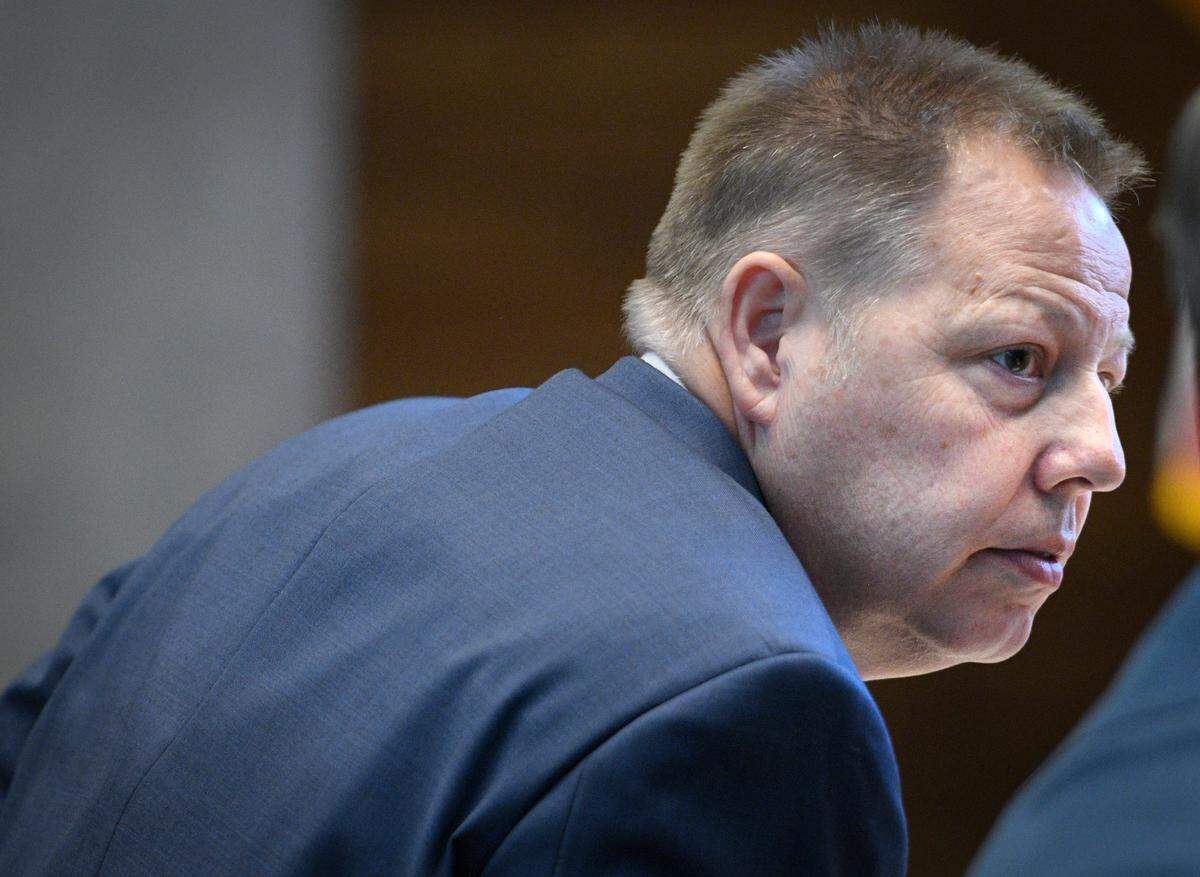
One called for a rotating committee of community leaders from minority communities to regularly meet with senior KCPD employees for “open and frank conversations about ongoing challenges and opportunities.”
Another suggested KCPD invite representatives of Black Lives Matter, the Southern Christian Leadership Conference of Greater Kansas City and other groups to speak at police training events at the academy.
“It is important the police fully understand the arguments and principles of these organizations and have an opportunity to listen and discuss,” Shurin wrote.
Black officers who have been disappointed by their own department for decades are watching, some with cautious optimism.
On the one hand, one officer said he feared it will take a “miracle” to truly change the department.
Others say at minimum the KCPD needs new leadership to avert disaster.
“We do another Rick Smith,” said one Black officer, who spoke on the condition of anonymity out of fear of retaliation, “Ferguson’s just right around the corner.”
This story was originally published March 27, 2022 at 5:00 AM.