With overloaded Missouri public defenders, you only get a ‘sliver of an attorney’
READ MORE
Defenseless
Missouri’s public defender system is one of the worst in the country.
Expand All
By 9:45 a.m. on a Tuesday, Kansas City public defender Walter Stokely has already appeared in court with two defendants and met two others for the first time ahead of their appearances at another courthouse down the block.
They faced charges ranging from felony drug possession to a double stabbing. All told, Stokely was representing people in 74 cases including nine murders and five sex crimes.
Defending this many people at once is almost impossible, Stokely said.
“On bad days, it’s absolutely hopeless,” Stokely said. “You’ve got to accept defeat before you even really start, because you know you’re not going to be able to help everybody.”
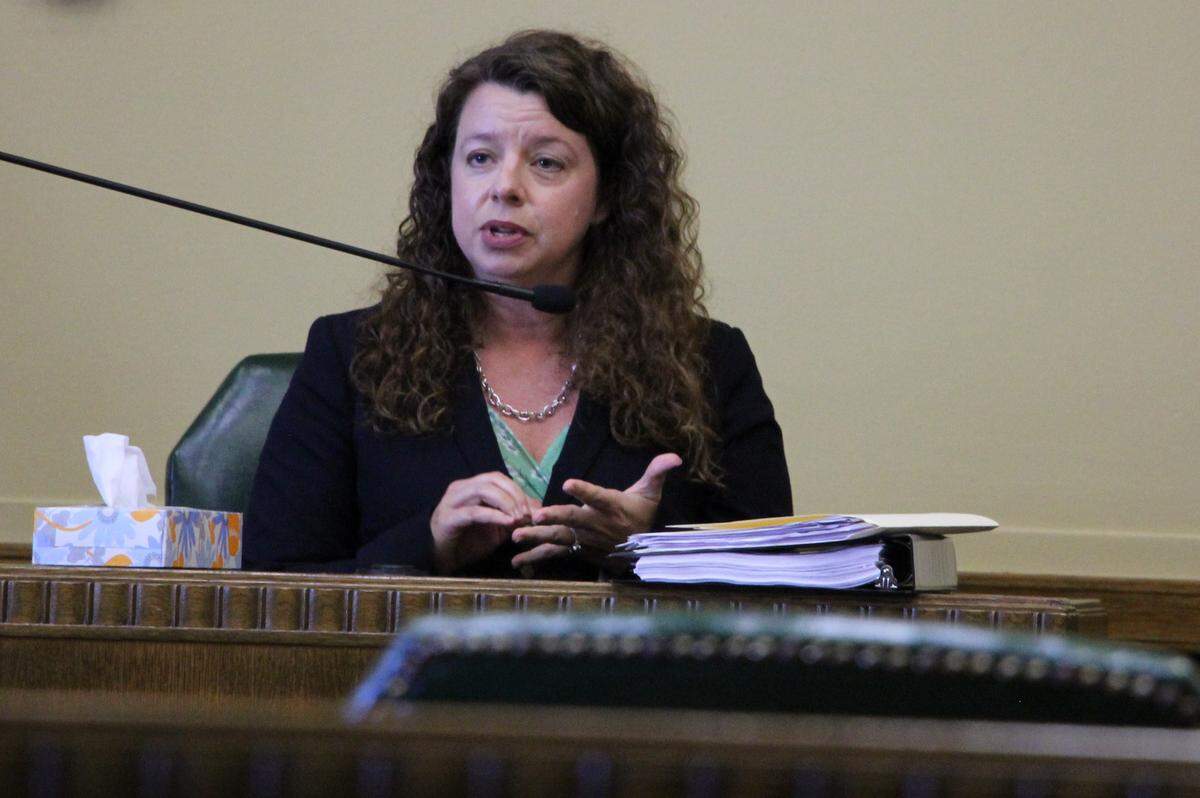
Stokely’s not alone. His boss, head public defender Ruth Petsch, said the state is facing a “25-year emergency.”
The system’s failures are harming people, especially the most vulnerable. Public defenders fail to show up for their clients. They miss important deadlines. Children appear in court with no lawyer.
The lawyers take on this work sometimes at the risk of their mental health and law licenses, with no legal immunity from civil liability or disciplinary action for the ethical violations they are forced to commit.
But they cannot keep up. They are doing a bad job and they know it. The result is despair and burnout.
Anywhere from 15 to 18 percent of the public defenders are leaving each year.
Petsch has filed an ethics complaint against herself because she is forced to keep assigning work to overloaded lawyers. Some of them have told her they were thinking of harming themselves, she told a judge.
“It really breaks some people,” Petsch said. “Especially people who come here and really want to help people. Especially people who don’t want more people to get the shaft. They come here with a goal to help people who no one else is helping and when they can’t do it, it’s crushing.”
A ‘farce’
Missouri’s slow-motion disaster of indigent defense has been decades in the making.
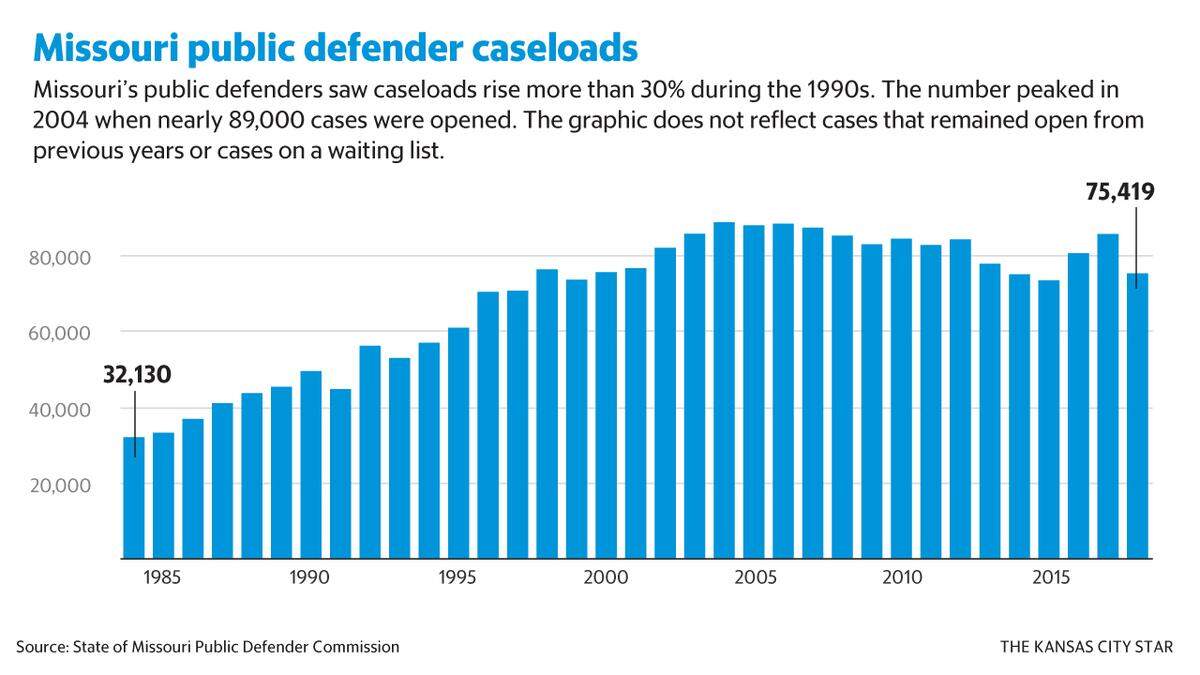
Fueled by the war on drugs and tough-on-crime policies, the number of criminal cases grew more than 30% during the 1990s, peaking in 2004 when Missouri’s public defenders took on nearly 89,000 cases.
“The caseload issue has been a concern — I started working for the public defender in January of 1998 — the entire time I’ve been there,” Petsch said.
As a result, public defenders across Missouri are blowing past professional standards of how many people a lawyer should try to represent at once.
Studies have shown they don’t have enough hours in the day to represent their many clients the way the law demands, and spend just 21% of the time needed on their cases, according to a lawsuit against the state system.
“You’re not getting an attorney,” Stokely said. “You’re getting a sliver of an attorney.”
Defenders in St. Louis County are at 250% the recommended capacity.
At Sedalia’s public defender office, which covers three counties, attorneys carry up to 134 cases. Last year, an average of $228 was spent on a case, the lowest in the state.
What do clients get for $228?
“Not much,” said district defender Max Mitchell.
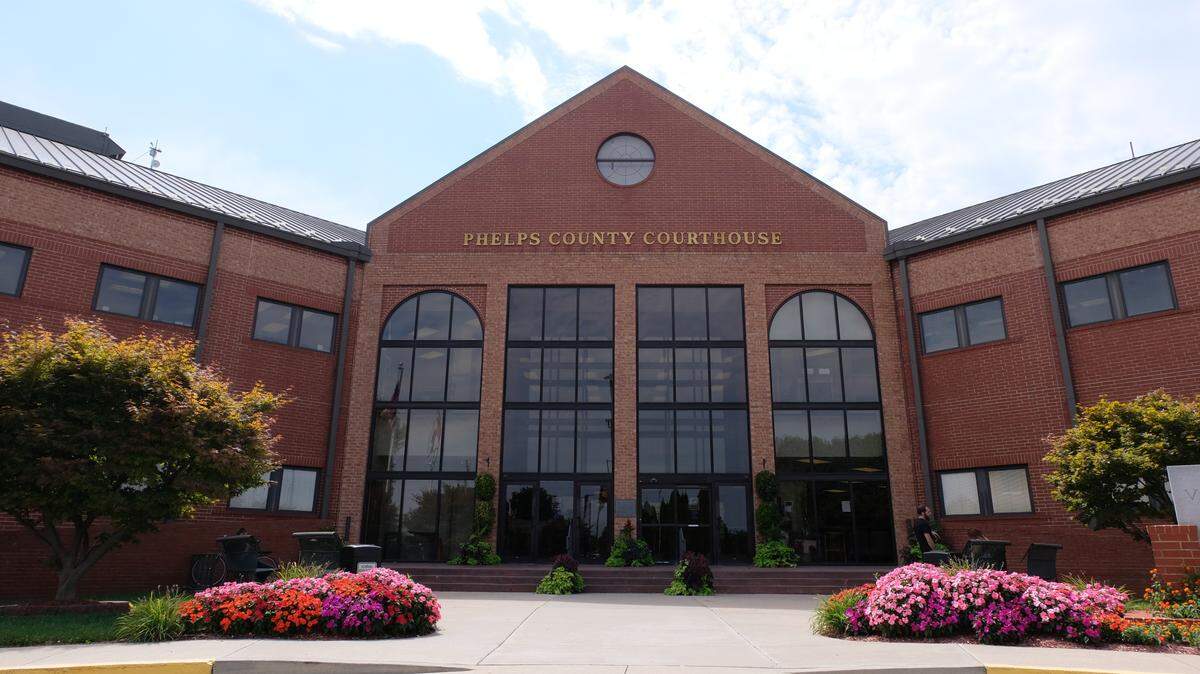
In 2018, the 14 public defenders responsible for Phelps, Pulaski, Crawford, Dent, Maries and Texas counties closed more than 3,500 cases — about one every weekday for every attorney.
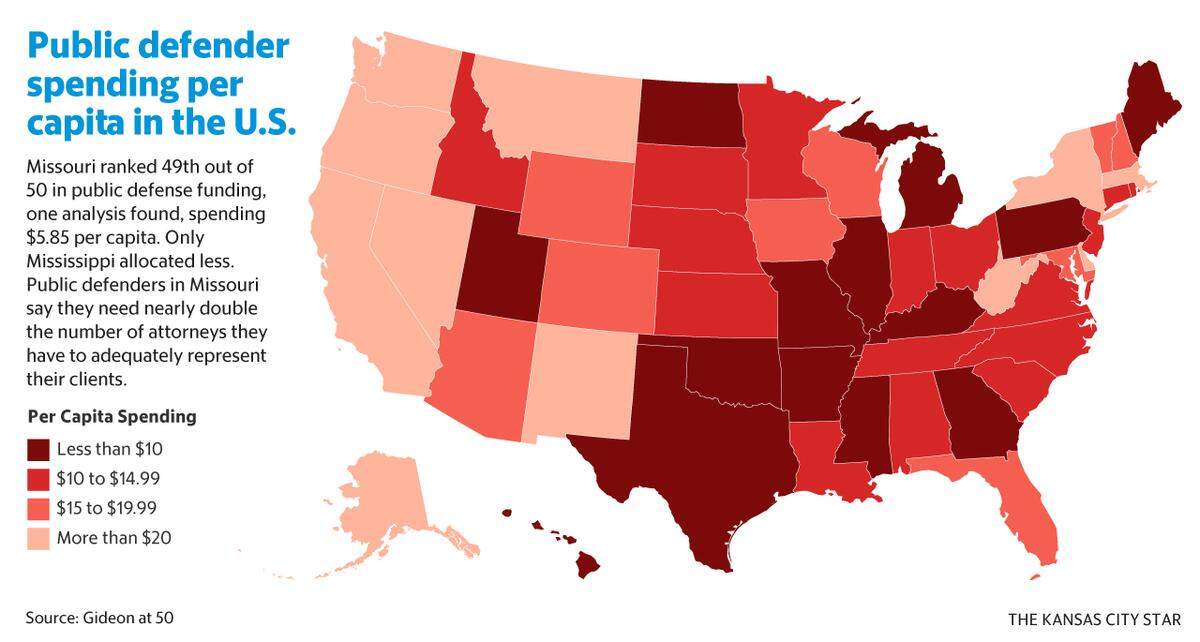
To fulfill the constitutional right to an attorney, Missouri public defenders say they need 327 more lawyers. That would be roughly double what they have now.
And it’s even harder to be fully staffed when attorneys are always headed out the door.
Why are they leaving? One wrote in a 2017 resignation letter of being afraid to lose their law license because of the unethical operation of the state defender system.
That person took a job as a defender in Indiana, where the system “is ethically supported,” pays better and offers more opportunities for advancement.
Another wrote of being afraid to have an innocent client go to prison. The lawyer left to preserve their conscience, calling Missouri’s system a “farce” and a “gilded procedure masquerading as effective assistance of counsel.”
The failures have consequences that reach far beyond the courthouse.
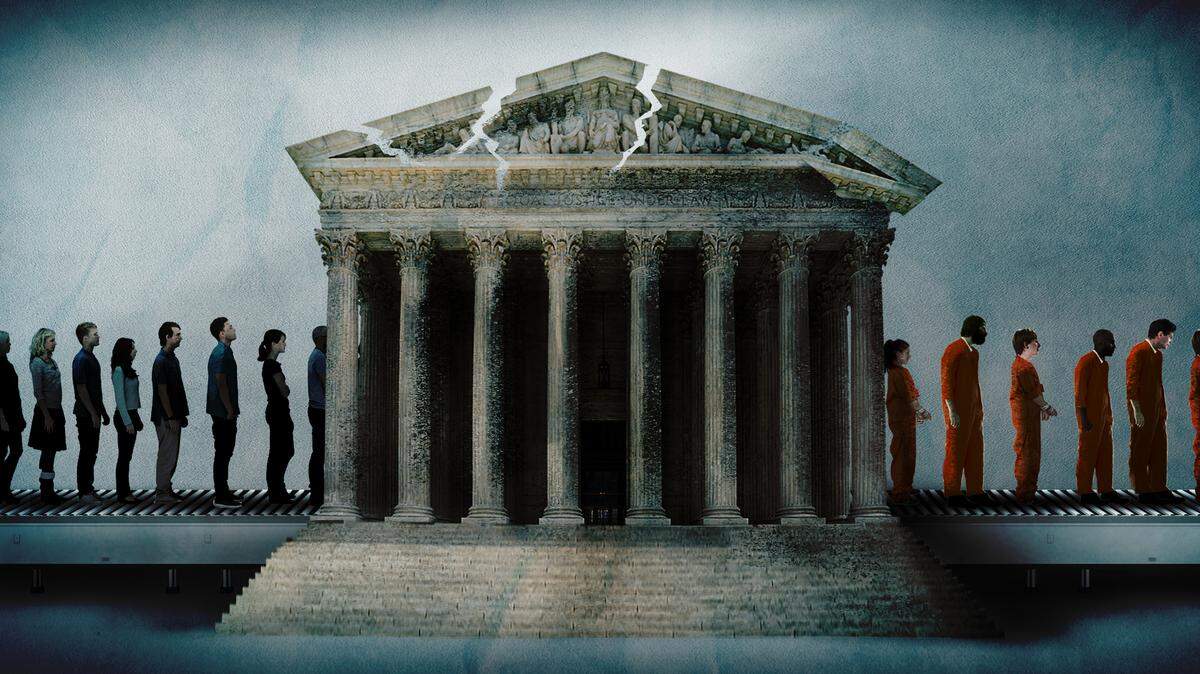
“When we have indigent defense systems that are simply a conveyor belt to put people into jail, there’s distrust in communities,” said David Carroll, executive director of the Sixth Amendment Center, a national organization that advocates for equal access to justice.
In some cases, it also means the true perpetrators of crimes go free.
Held in contempt
John Picerno is one of the most prominent private criminal defense attorneys in Kansas City, with a downtown office overlooking the courthouse and a long track record of trial victories.
Over the years, he’s gained renown from high-profile cases: the Baby Lisa disappearance, the false jail records in the death of Richard Degraffenreid, the cold case homicide of Summer Shipp.
But he remembers when being a public defender was his dream job.
“You’re the last person there before some poor person — and that’s who you’re representing are poor people — loses his liberty,” Picerno said. “There’s no job that’s more important than that.”
It’s the job Picerno had more than 20 years ago, as a public defender in Jackson County.
He started running into trouble in May 1995, when the state assigned him a 16-count case with a man accused of rape and kidnapping.
The trial was in two months — too soon for him to be ready, Picerno said. A judge denied his repeated requests for more time.
Three days before trial, on a Friday, Picerno received 30 pages of evidence. He conducted depositions late into the night. On Monday, he refused to proceed.
“I didn’t think there’s any reason for any individual not to get a fair trial or to go to trial with a lawyer that’s not prepared,” Picerno said. “That’s not what the United States of America is all about.”
A judge held Picerno in contempt and sent him to jail, where he spent Father’s Day weekend. His two daughters, who were 9 and 10, visited him there.
“I didn’t think that my actions necessarily warranted jail time,” Picerno said. “I did what I did based on the principle.”
The public defender’s office fired him.
So he established a private practice. He’s been successful, winning acquittals in five murder trials, as well as robbery and assault cases. In many others, he’s fought prosecutors to a hung jury or a lesser charge.
Unlike public defenders, he can refuse cases if he’s too busy. It allows him to work for the clients he has. He also can pass on cases if the evidence is overwhelming.
On the same day Stokely, the public defender, had 74 cases, Picerno had about 30.
Picerno still works long hours. That same Tuesday, he argued at a 9 a.m. preliminary hearing in Platte County and spent the rest of the day conducting depositions for an Independence murder case.
His high-powered defense work comes with this guarantee: “I will risk my liberty to save yours!”
Despite the way he left the public defender’s office, and all that’s happened since, Picerno is still a believer.
“We have to have a vigilant and vigorous and zealous representation at the public defender level to ensure that the criminal justice system runs the way the United States of America’s Constitution says it should.”
‘Right side of the fight’
High turnover weakens public defender offices across Missouri. Low pay, long hours and abuse from the courts drive good attorneys away all the time.
In Jefferson City, public defenders have approached district defender Justin Carver and said, “We’re drowning in cases.”
In a short time, Carver found himself replacing six of the eight attorneys in his office, which covers Cole, Moniteau and Miller counties.
“I distinctly remember having had a client who I was the fifth lawyer on the case,” Carver said. “Of course his question was, ‘How long are you sticking around?’ It was really terrible.”
Stokely will be changing jobs soon, too, though he isn’t giving up. He can’t.
“For most of us, it is easy to assume that a person would not be in jail if they had not done something wrong in the first place. So these are problems that it is easier to just not think about,” Stokely said.
“Nobody is winning elected office by promising to fully fund the public defender system. People win elected office more often by promising to be very tough on crime.”
In January, Stokely will leave his position and his cases will be reassigned. But he’ll continue to be a public defender, in a newly-formed special unit representing children.
He said he keeps working in the system for the sake of social justice.
“I just feel like I’m on the right side of the fight,” he said.
BEHIND THE STORY
MOREHow we did this story
The Star newsroom and editorial board collaborated on a long-term investigation of Missouri’s public defender system, resulting in this series of news stories and opinion columns. Star journalists traveled across Missouri, interviewing public defenders working in more than two dozen counties, including one who represented a man wrongly convicted of murder. Read more by clicking the arrow in the upper right.
They followed one public defender for an entire day and interviewed another who, after being jailed for standing on principle, left to become a private defense lawyer. They spoke with seven judges, a half-dozen prosecutors, Gov. Mike Parson, several lawmakers, and more than 20 people who had been charged with crimes, including one exonerated from death row.
Visiting courthouses around the state to watch proceedings, they pored over thousands of pages of documents, including transcripts, police records, judges’ emails, budget reports, lawsuits, rulings, opinions and research studies. They heard from experts in Missouri and at the national level.
Why did the news and editorial sections do this project together?
This was a unique news and opinion partnership at The Star. At the outset of many projects, you don’t know where the reporting will take you. But this time, we knew we were investigating a broken system. To make a difference, the project needed deep reporting combined with a strong call for action.
The project grew out of the separate efforts of a reporter and an opinion columnist who had both written about the issue. Katie Moore, who has been covering crime and courts for years, began working on a story around the same time Dave Helling, a veteran journalist who has spent much of his career covering politics and the Missouri public defender system, wrote an editorial revealing that the state was nowhere near solving the problem.
Both dug in for months of independent reporting, with the results presented here together.
Do you have a story tip?
If you want to share your experience with the Missouri public defender system, contact reporter Katie Moore by phone at 816-234-4312 or send email to kamoore@kcstar.com. Columnist Dave Helling can be reached at 816-234-4656 or dhelling@kcstar.com.