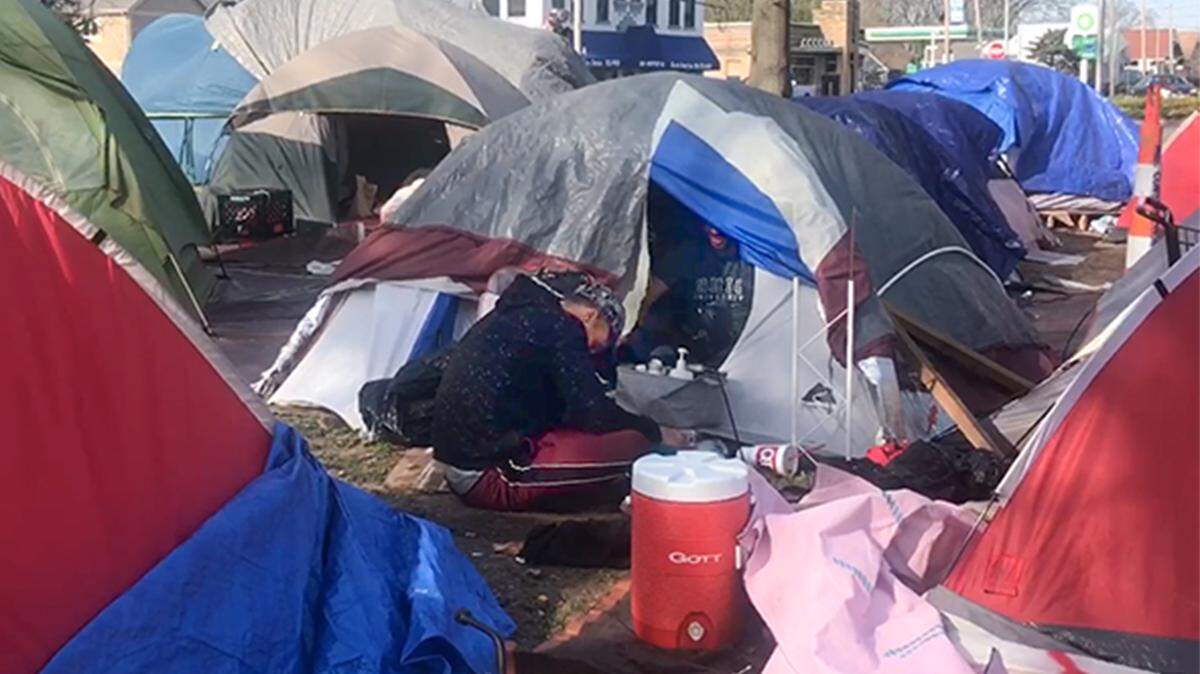
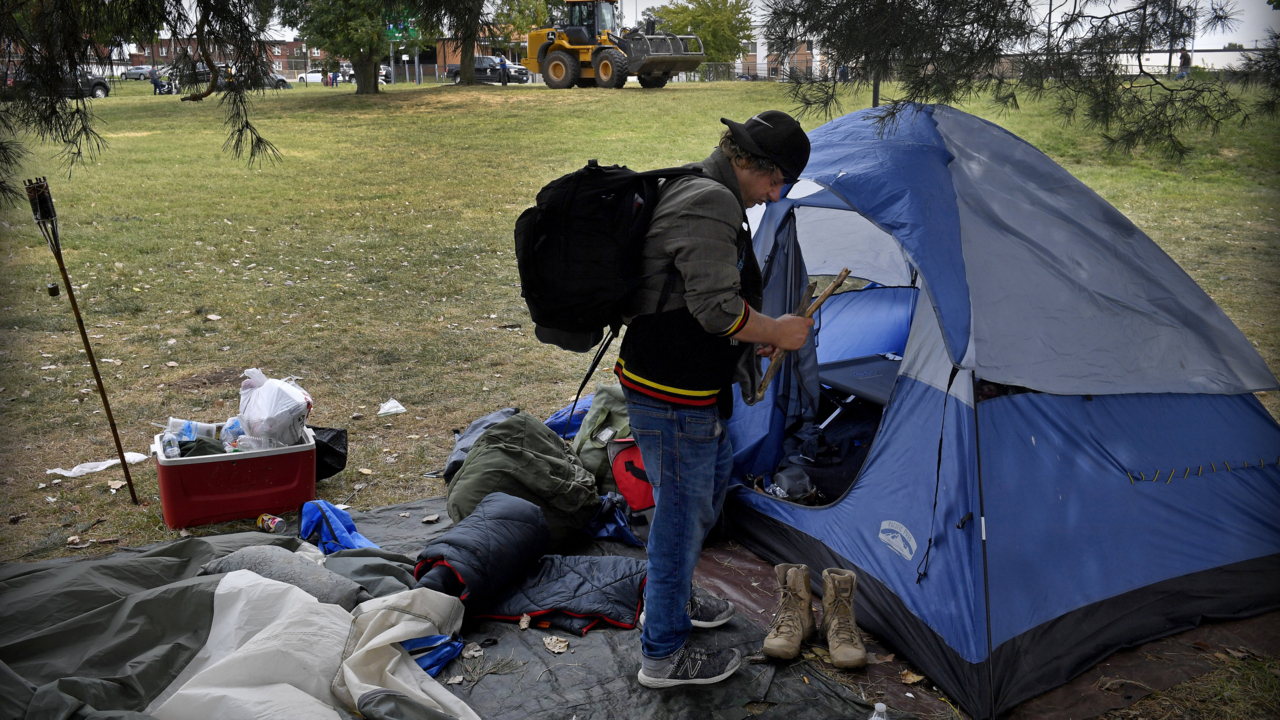
As word of a sweep by Kansas City Police and Parks & Recreation spread throughout the camp, Lulu Livingston, along with help from Matt Hollingsworth, packed her belongings as fast as she could. In less than two hours, about two dozen homeless people living in the small park on the northeast side of downtown, would need to have everything they could carry off the property. Livingston estimated they are one of about 76 camps around the metro, and she is one of anywhere from 1,800 to 2,500 people living without houses in Kansas City.
Rich Sugg
rsugg@kcstar.com
READ MORE
Fighting for survival: Homelessness in Kansas City
Expand All
There are no formal walls in Lulu Livingston’s home.
The tent she sleeps in is empty aside from an inflatable mattress, a couple grocery bags, and a few items of clothing. A mesh partition splits the living area — capable of holding a couple guests comfortably — in two.She apologizes for the lack of seating. Her camping chairs were stolen recently.
Theft has been an issue — it’s one she’ll address later when she calls for a camp meeting.
Roughly two dozen people live beside herat the camp in Margaret Kemp Park near East 10th and Harrison streets, just to the northeast of downtown Kansas City. It sits on a bluff above the roar of Interstate 70.
Livingston, 40, estimated theirs was one of about 76 homeless camps around the metro — she is one of an estimated 2,000 people living without a house in Kansas City.
Earlier this year, Livingston and the rest of her houseless community fought for a platform through which to advocate for themselves — to tell their own stories, which has historically been left to politicians, activists and experts.
Livingston isn’t interested in anyone speaking for her. Over the course of 24 hours, she told her story — what led her to houselessness and her experience creating a community and surviving — to The Star in the hopes of illustrating the daily struggles, but also joys, that she and those who walk beside her face.
First of all, Lulu Livingston isn’t her real name. She donned the new moniker after moving to Kansas City, having left everything behind in St. Louis during a mental breakdown. Livingston, who grew up in the foster care system, continues to battle with the aftermath of the childhood trauma she endured and the toll it took on her psychologically.She suffers from borderline personality disorder, PTSD, severe anxiety and manic depression, she said.
Among the houseless in the Kansas City metro, Livingston is a leader and she has a reputation for being a fierce advocate within the Kansas City Homeless Union. Some call her the camp’s “mother hen.”
“I’ve learned to thrive in chaos, and there is no greater chaos than a homeless camp,” Livingston said.
The homeless union’s monthslong encampment and demonstration, which began earlier this year on City Hall’s south lawn in the hopes of bringing the plight of houseless individuals to the top of the city’s agenda, prompted city leaders to seek permanent solutions and meet their needs.
Livingston didn’t think it would come back to this; to living in a tent, worried about how much longer she’d be allowed to stay. They’d seemingly won a victory through protest camps at City Hall and Westport. Yet here they are again, wondering when the next sweep will come.
During a meeting of those living at the encampment, Livingston, middle, lays down the law about camp rules and doles out helpful advice about keeping their encampment safe from thieves. In recent days, groups from other camps came by and nabbed food and water. There’s room for generosity, she told them, but if they take everything, there’s nothing left for her camp. “We are a union,” she reminded them. “We work together.” Rich Sugg rsugg@kcstar.com
Building a community on the bluff
It’s the first of September and on this particular Wednesday night, a volunteer with Harvesters, a local community food network, handed out plastic bags filled with sandwiches for dinner. The camp was gifted some relief from August’s sweltering heat as a breeze swept away the humidity, carrying with it music playing from a nearby speaker. One woman danced along, smiling.
Livingston, a cigarette pinched between her fingers, gestured to her neighbors in tents surrounding hers in a half moon shape.
“Can I get an arm please?” Livingston hollered across the grass as a van pulled up carrying donations. A few people hustled over to help unload a couple boxes of La Croix and bags of ice.
At Livingston’s camp is a woman with Asperger’s syndrome who feels safest sleeping in her car. There’s a mother with her two grown sons; her daughter died of suicide, then they lost their home in Overland Park. There are addicts, families who have been evicted and young people who’ve been booted from their parents’ homes.
The camp was twice as large just two weeks before. But the threat of camp sweeps by the city had their numbers dwindling, Livingston said.
“Ms. Kim, are you home?” Livingston asked outside one tent after dodging a clothes line strung between trees. “Camp meeting, 10 minutes.” “Mr. George?” “Mr. Walter?”
Livingston, the de facto camp mayor of sorts, addresses everyone with titles. It’s a courtesy in a world where they are granted little.
Soon, about 15 people gathered under a cluster of pine trees, their focus directed at Livingston.
She thanked them for being diligent about wearing masks, then dove into a list of concerns, including groups from other camps recently taking armfuls of food and water.
One man quickly offered to work as security for the camp, for $100.
Livingston laughed. It’s not in the cards. Even her role in the union is unpaid.
She ended the meeting and two men, new additions to the camp, stayed behind as Livingston recited the camp rules, loud and clear: No stealing, no fires, no set-tripping (violence with other camps), and “if you don’t help, you don’t eat.”
“What we get is the people who fall off the edge,” she said of those living unsheltered around the city. “Some people are thieves, some people are assholes, and some people are the smartest people you’ll ever meet, are the sweetest people you’ll ever meet.
“If you can learn to just have some compassion and understanding, you can work with everybody,” she said. “That’s my goal. I just want to help everybody.”
After tearing down her tent and quickly packing what belongings she could, Lulu Livingston, the leader of an encampment of about two dozen homeless people, stood defiantly in front of a massive front loader, while taking exception with the amount of force being shown by the Kansas City Parks & Recreation Department, and KCPD during a recent sweep of the camp. It’s criminalizing homelessness, she said. Rich Sugg rsugg@kcstar.com
Another day, another sweep
After guiding a couple through some impromptu marriage counseling in her tent on the morning of Sept. 2, LIvingston grabbed her crossover bag, stuffed a pack of cigarettes in her pants pocket, and set off on the half-mile walk to Hope Faith Homeless Assistance Campus on Virginia Avenue.
“Mr. Ryan, how are you,” Livingston asked a nearby man wearing a Nirvana T-shirt and bandana.
“Horrible,” he was quick to reply. He lost his backpack. There was $500 in cash in it.
Livingston has to sign in at the front desk, walk past two security guards and through a metal detector in order to enter Hope Faith where she has a mailbox. The facility offers showers, haircuts and a clothing closet, among other necessities, plus some areas meant more for fun — like an art studio.
It’s 9:30 in the morning and she’s digging into breakfast while pointing out the regulars.
A man in short shorts standing in the cafeteria line — he can’t get into many shelters because he cross-dresses, she said. There’s the veteran who suffered a traumatic brain injury. He has more needs than are being met. And an older man with a felony record.
Livingston nods at one woman, who she said is a known thief and addict.
“Sweet chick otherwise,” Livingston said. “I hope she gets her shit together.”
She’s watched many people try unsuccessfully to get jobs, to get housing, to get help. It used to break her. But Livingston has learned to accept it. It takes immense work to regain footing.
Livingston believes that maybe for some people, the streets are their destiny. It’s where she feels she’s supposed to be, too — at least for now.
In an act of defiance, Joey Taylor climbed into the scoop of a front loader that the Kansas City Parks & Recreation Dept., drove into the park in order to help clear the homeless camp where Taylor and about two dozen others were living. . Rich Sugg rsugg@kcstar.com
Years ago, she made a promise to not let the street change her.
“If I let it make me cold, then it wins,” she said, scooping up another forkful of powdered eggs.
Livingston set off for home mid-morning. She planned to make a pit stop at reDiscover, a community health center, to get her medication refilled to address her psychiatric needs.
A few blocks from Hope Faith she stopped to marvel at a boarded up home on Forest Avenue, just south of the interstate. Brick. Three stories.
“Every time I see one of those, I see opportunity, chance,” she said. “There’s no reason for that building to be vacant. It’s beautiful.”
Houses need people and people need houses, after all, she said; if only the red tape and bureaucracy didn’t get in the way.
Her daydreaming ended abruptly when a man from the camp found her. He struggled to catch his breath.
“The whole park is full of cops,” he said.
She took off toward the park. The medication would have to wait.
Andrew Taylor, who lives in the camp with his mother and brother, suffers from schizophrenia that requires medication that is sometimes difficult or impossible to get. On the day that Kansas City Parks & Recreation and KCPD swept the park near 10th Street and Harrison, Taylor got distressed while trying to gather his belongings as authorities moved a large front loader onto the property. Rich Sugg rsugg@kcstar.com
Livingston arrived at the camp to police cars lining the sidewalk. She made a beeline to Officer Andy Hamil, a community resource officer who confirmed they would have to move.
Kevin Evans, a superintendent for parks and recreation, was nearby asking everyone to vacate the park on the grounds that city ordinance doesn’t allow camping or homesteading in city parks.
They had roughly two hours to collect their whole lives and leave.
“We aren’t even doing anything,” one woman said to Livingston, as her voice broke.
“I know baby,” Livingston replied.
Livingston went tent to tent, reminding people that anything left behind would be thrown away. A sign left near one pile of belongings read “solutions not sweeps.”
“You could have a Fabergé egg... and they wouldn’t care,” she said.
Qadhafi — the outspoken leader of the homeless union, and whose real name is James Shelby — considers sweeps an act of terror. Livingston says they are devastating. They agree the act is traumatizing, shattering individuals’ sense of safety and community.
As the number of unsheltered people around the country grows — compounded by the eviction crisis and the fear of the coronavirus causing some people to avoid shelters— many cities continue to push them from one location to the next.
“Not only is it not ending homelessness, you’re actively damaging the work to end homelessness by doing the sweep,” said Steve Berg, vice president for programs and policy at National Alliance to End Homelessness in Washington, D.C. “So the right way to do it is ‘don’t do it.’ Get housing for people instead.”
In cities like New York, houseless residents were also offered temporary hotel stays. But once that program ended, and people returned to the streets, the city swept in with forceful removals, too. A similar situation played out at Livingston’s camp.
“I’m tired of doing this,” Walter Jenkins, 39, said as he rolled up a tarp. “They can’t make up their damn mind. Yeah, we don’t have a home, but at the same time, it wasn’t our choice to be homeless.”
He and his girlfriend of half a dozen years were supposed to get a mailbox that afternoon at Hope Faith. Instead, there they were packing up their things.
The couple had been at the camp for several weeks, her service dog by their side. They staked out a plot of grass beside Livingston’s tent in the hopes of finding enough stability to get a job and save some money. They had been working on getting her paperwork needed for housing. Progress halts each time they have to move.
During a sweep of the camp, James Shelby, middle, the leader of the Kansas City Homeless Union, who goes by Qadafhi, and camp resident Kimberly Taylor, plead with a Kansas City police officer and Kevin Evans, a superintendent for parks and recreation, who demanded everyone vacate the park on the grounds of an ordinance that doesn’t allow camping or homesteading in city parks. Rich Sugg rsugg@kcstar.com
Through the city’s eyes
More than half a dozen city vehicles and nearly as many police cars pulled up alongside a garbage truck and front loader.
Anton Washington, an advocate and member of the city’s houseless task force, paced nearby — the distress was etched across his faceas he juggled phone calls from City Hall. Despite his efforts, there was nothing he could do.
A city worker, just barely out of high school, watched as someone’s abandoned belongings were thrown out. He felt bad, he said, because he’d been through tough times himself. He didn’t know his job would require this of him today.
By late afternoon, the camp was quiet again, save for one lingering police car. Livingston dozed in the front seat of a friend’s truck, which had been packed full of tents and tarps. The items that remained were folded and scattered a few dozen yards from where they’d been before.
Roosevelt Lyons, interim director of KC Parks, said his department’s role is to clean and maintain city park land, a job that’s difficult if people are camping on it.
“We’re just seeing a much bigger uptick in it right now and much larger campsites than we’ve experienced in the past,” he said, adding that the camp at Kemp Park was one of the largest he’d seen. “In an ideal world, we’re finding people housing because that’s the long-term fix here.”
Maggie Green, media relations manager for the city, said that since mid-August, outreach workers have referred six homeless individuals to housing programs, and at least 20 people have been relocated to permanent housing or shelters. However it’s a drop in the bucket.
Councilwoman Ryana Parks-Shaw, 5th district, who chairs the city’s houseless task force, said while they’re also working on long-term solutions, figuring out how to get individuals sheltered through the winter is a priority.
The pandemic has shone a light on the affordable housing crisis in Kansas City, she said. And it if not mitigated, it will only get worse.
“It doesn’t take a rocket scientist. You drive down any major street downtown, you’re going to see tents. You’re going to see people that are unsheltered,” said Parks-Shaw, who has made numerous visits to the camps these past several months. “It’s opened my eyes to the drastic need that we have in our community. I feel like I’m peeling an onion. There’s so many different layers that impact people’s lives, so you know, this is going to be a tough challenge, a tough battle, but I’m committed.”
Within the walls of City Hall, the work to address houselessness continues. Outside, despite pushback from advocates and the homeless community, so do the sweeps.
From a parks perspective, Lyons said, they took into account that the people camping at Kemp Park were without running water, restrooms and exposed to the elements.
“It’s hard to condone allowing people to live in that kind of condition when you know about it and you know it’s unsafe,” he said. “I think it would be extremely difficult for the city to turn a blind eye and allow people to continue to live like that, knowing that they’re out there.”
Shortly after the sweep, Jenkins attempted suicide. The following week found him in better spirits, but he said he was still tired in every way.
The fight for more
The Kansas City Homeless Union is a rarefeat, according to experts and local advocates. Qadhafi has been the movement’s face and leader since it began in February. When he met Livingston at the beginning of the year, he quickly asked her to lead with him.
Motivated in part by the death of Scott “Sixx” Eike, who froze while living unsheltered after his camp was swept, the union set up camp in full view of City Hall, drawing the attention of local politicians and media.
In April, staked out in front of the mayor’s office, they laid out their list of demands to city officials: Homes, jobs, access to clean water and a seat at the table. Livingston played a major role in the push. But five months later and Qadhafi and Livingston say none of the demands have yet been met in full.
John Baccala, a spokesman for Kansas City’s housing and community development department, said at the program’s end in mid-July that the city in that time connected 120 people with first-time benefits such as Social Security, Medicare and Medicaid, and put some 350 people in touch with housing services providers.
But when the 90 days were up and the hotel doors closed, many still ended up back on the streets, shuffled around numerous times by city sweeps, moving from one park to the next. Livingston was among them.
Many of them have tried to secure housing, but they either don’t have the necessary paperwork or don’t qualify.
In late August, the city council approved a resolution directing City Manager Brian Platte to create a housing plan and a community needs assessment. He has 120 days to do so.
By then, Qadhafi pointed out, it will be the depths of winter again.
While the city has the luxury of time, he said, those on the streets don’t. He worries more people will die.
In a world where survival is a daily challenge for some of its members, the union is demanding more, and sooner.
“Being homeless actually changes the way your brain works,” Livingston said. “You can only focus on your next immediate need.”
James Shelby, right, who goes by Qadafhi, stops by the camp to see Livingston, whom he met in February after she left an emergency warming shelter at Bartle Hall to join his camp, and then union, on the lawn of City Hall. He quickly made her second in command. “Lulu got the power,” he said, pulling up his sleeve and flexing his bicep. “She’s like a mother hen.” Rich Sugg rsugg@kcstar.com
Torn between two homes
Livingston could be in a house soon.
She went to Hope Faith on Sept. 1 in part to meet with a housing intake coordinator who said Livingston is in the final stretch of getting the keys to her own home.
Kathy Elmore, a coordinated entry manager at Hope Faith, said Livingston is out for referral for permanent housing. She could have a place of her own before the month is up.
In most cases, the process can take years, but because Livingston is part of the camps being swept, her application has been expedited, Elmore said.
“Things are moving quicker than they ever have right now,” Elmore said. “We need momentum to be building.”
The prospect brings Livingston both hope and trepidation. She doesn’t know if she’s going to take it. She worries that being housed right now could mean losing her connection to the community. Losing her sense of place.
“I want to make sure I can still be here for the most vulnerable. That they can still trust me. They can still believe in me,” she said. “I don’t want to be just another one of these people that shows up from their houses and doesn’t really understand, and feels sorry for the poor homeless people. I don’t want to do that.”
She falls asleep most nights feeling fulfilled for doing good in the world. She feels at home in the camp, which she said is her community. Her purpose.
A few hours after the sweep, Livingston was surprised to see people so cheerful. One woman pulled out the grill, cooking up chicken. Others sat around talking, laughing.
Most had no idea yet where they’d be laying their head next. (The camp would later split into three smaller locations, erecting tents within a few blocks of one another. Livingston checks on each; so far, they’ve not been approached by the city or police about moving again.)
They’ve found a way to have a voice, demanding a presence at the table. And though there’s work to do to see their goals realized, the union has compelled people to listen. In a way, Livingston said, they have a family; a catalyst for change.
“It gave me a purpose in life,” she said of the past several months. “I didn’t have anything before I had the union.”
Livingston’s fourth grade teacher used to tell her she never knew when to quit, she recalled with a laugh.
So it goes, she said. Tomorrow would be another day.
Lulu Livingston is the organizer and leader of the union, a camp of unhoused people living on the northeast side of downtown Kansas City. They share a city park, a home, with a common purpose: to survive the turmoil, stresses and strains of living without a house with the hopes of one day rising up to meet one. Livingston estimated they are one of about 76 camps around the metro, and she is one of anywhere from 1,800 to 2,500 people living without houses in Kansas City. Rich Sugg rsugg@kcstar.com
This story was originally published September 22, 2021 at 5:00 AM.
Anna Spoerre covers breaking news for the Kansas City Star. Before joining The Star in 2020, she covered crime and courts for the Des Moines Register. Spoerre is a graduate of Southern Illinois University Carbondale, where she studied journalism.

 "KCM_KChomelessRPSep92021me0 (18)")