‘They’ve got to see’: KC’s Westport and City Hall homeless camps rise as protests
On Valentine’s Day weekend, Kansas City awoke frozen, as the sun rose in deadly cold — wind chills biting at 20 below zero.
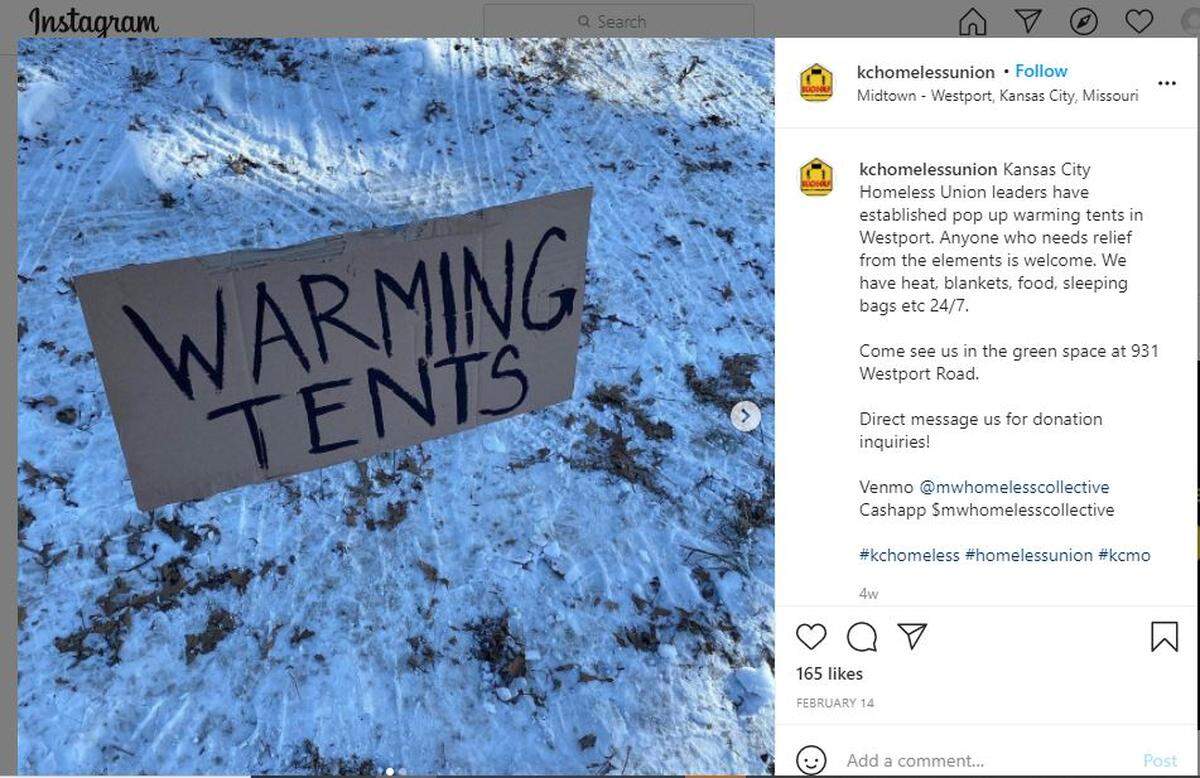
Few were surprised to see two impromptu tents, with a rumbling generator, pop up at the intersection of Westport Road and Southwest Trafficway, to give comfort to the homeless.
“The initial purpose was to provide shelter and warmth,” said Amanda Eisenmann, a Kansas City social worker who, side by side with homeless leaders of a group known as The Midwest Homeless Collective, helped erect the tents.
But what started as a refuge for the homeless against the weather has become one of the two most visible homeless encampments in Kansas City — where at least 18 men and women live in just as many red, brown and blue tents on a grassy triangle of public land at one of the busiest and, some insist, dangerous intersections in Kansas City.
It is not going without notice any longer. Nor is another, even larger enclave with more than two dozen tents, which since early February has been occupying and expanding across the south lawn of Kansas City’s City Hall.
More than encampments, both were also purposefully formed to be what they are: in-your-face, hard-to-ignore political protests calling on City Hall to do more to help those without houses. Though complaints are mounting, and spring has arrived, organizers insist the camps will not be dismantled.
“They don’t want to see us, so we went to where they’ve got to see,” said James Shelby, 60, who also goes by the name Qadhafi, and has risen as a voice for the camp at City Hall.
The Westport camp, located where some 20,000 to 30,000 vehicles pass each day, has drawn particular attention.
“This area has the largest number of complaints I’ve ever seen in the last five years in this position,” Kansas City Police Officer Andy Hamil said. He’s a community interactions officer who patrols homeless camps throughout the city and attempts to connect people to resources. Advocates also use the term “unhoused,” noting that many people have homes, such as their tents, but what they really lack are houses.
Complaints from residents, businesses and motorists, Hamil said, number in the “hundreds” along with concerns, as the intersection is a common site of collisions.
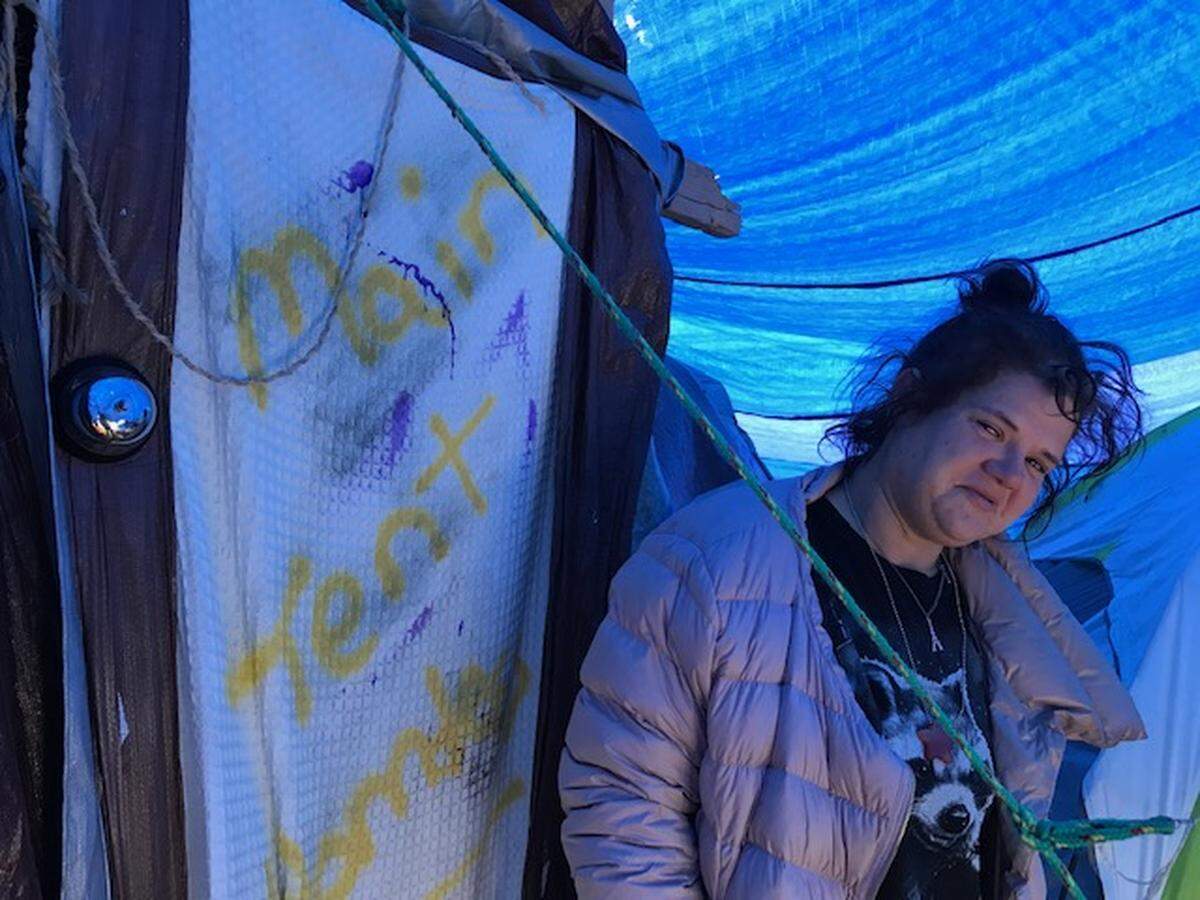
A doorbell and mailbox
Located across from the covered wagon marking “Old Westport,” a plywood sign names the encampment “Camp 6ixx,” in memory of Scott “Sixx” Eicke, who died homeless at age 41, found on New Year’s Day in Kansas City. Advocates insist that he died after police swept him from his camp and the resources he needed to survive.
The city’s warming center at Bartle Hall, which from mid-January until it closed this month provided meals, beds and showers for an average of 300 people per night, is also named after Eicke.
At Westport, at least nine two-person tents sit outside on tarps, as a gas generator churns 24 hours a day. Heavy-duty extension cords along the ground run power to electric space heaters inside many tents. Nine other tents are sheltered beneath an expansive blue tarp, forming a bulging blue hillock propped up by two-by-fours.
There are bicycles underneath. A large tent with the word “Storage” painted across the top holds donated food, like granola bars and bottled water, along with a bucket that the camp members use as a toilet when bathrooms at local stores or the filling station aren’t available. The “main” tent of one homeless resident, Ashlea Gray, 33, who helps run the camp, has a heater, lawn chair and portable CD player.
“It’s kind of a mess ’cause I had a fire in here,” she said recently inside her tent.
Just outside its flaps, she’s affixed a silver hotel call bell as a doorbell. Whereas many homeless shelters limit the time people can stay, allowing them to remain overnight, but then sending them on their way with their belongings in tow, this camp does not.
People drink alcohol there, but the camp rule is to keep it inside their tents.
“We feed them, make sure they stay warm, give them clothes,” Gray said. “It’s like a hotel for the homeless, but it’s free.”
James Hanson, 58, homeless for two years and who acts as the camp’s handyman, pointed to a large nearby oak tree. A fire extinguisher hung on a nail there alongside another item.
“We have a mailbox,” Hanson said, urging people who want to support the homeless to write. “Our address is 931 Westport Road. If we could get a letter here, it could give us a chance, we could almost homestead. Push our fight to the max.”
The “fight” Hanson is speaking of is for recognition and for more effective resources to help unhoused people obtain homes.
Homeless union
The local movement to organize began on Jan. 28, less than a month following the death of Eicke. That is when local leaders among the unhoused and advocates joined to form the Kansas City Homeless Union and the Midwest Homeless Collective to force change.
Homeless unions go back to at least the early 1980s, according to a 2020 piece in The Nation, as large public housing developments and institutions for the mentally ill were destroyed, forcing millions of people onto city streets.
What evolved into the National Union of the Homeless logged victories, “including the right for homeless people to vote without an address, municipal programs and services led by the homeless, and commitments from the Department of Housing and Urban Development to make 10,000 housing units available for the homeless.”
In Kansas City, the Midwest Homeless Collective has its own Facebook and Instagram pages, with several mottos: “Services Not Sweeps,” “Hotels Not Graves,” “Housing Not Handcuffs.” The Kansas City Homeless Union has a page. Camp 6ixx, or Kamp 6ixx, as it’s also known, has its own GoFundMe site.
Qadhafi has become one of the Kansas City movement’s loudest voices. He left prison in 2019 after serving 22 years for armed robbery.
“I got out of prison August 9th, 2019. You know, on August 10th, I became homeless,” he said.
On Feb. 27, he spoke before a City Council public budget hearing.
“I reside at 414 East 12th Street, City Hall, southeast lawn,” he said, and stated the reasons he and others are now “occupying” the spot.
“The homeless do not get heard,” he declared to scattered whoops and applause. “Everybody speaks for the homeless. Even the City Council says they’re doing things on behalf of us, but it’s not on behalf of us, because they don’t consult with us, and they don’t know us and they don’t deal with us.
“Everybody do things and pass money around and try to make themselves look good. But with the same money they pass around every year, the homeless problem would be solved.”
Their demands are plain: real houses instead of temporary shelters. Employment instead of being ejected from shelters soon after the sun rises.
Who should get the money?
It’s estimated that about 2,000 people are homeless in Kansas City.
Dozens of nonprofit organizations, including reStart Inc. (which allows some unhoused people to stay up to 30 days, or even longer), City Union Mission, Metro Lutheran Ministry and others offer food, shelter, showers, medical care and services for mental health, addiction, veterans, children and survivors of domestic violence.
Kansas City divvies up some $1.5 million in federal money each year to about two dozen organizations, nearly all nonprofits that must raise the vast majority of their budgets on their own. This past year, in light of job losses because of the COVID-19 pandemic, HUD gave Kansas City an added $7 million grant to spread among organizations.
Unhoused protesters insist that the money is just being squandered, contributing to numerous nonprofits that, in the end, have done little to solve the problem of homelessness.
“Instead of passing out $7 million to homeless shelters,” Qadhafi told the council, “…we could take that $7 million and go to Land Bank and buy some of the 10,000 homes that’s empty in Kansas City and we would have a damn home.”
He suggested the money could be used to bring abandoned homes up to par and employ homeless people as part of the construction crews to repair them. His voice rose. He spoke emphatically, jabbed his finger toward council members.
“There would be no homeless problem in Kansas City at all,” he said. “Give us a budget. Those who are closest to the problem are closest to the solution.”
He finished his speech. “We tired of dying. And we ain’t going to let you keep killing us with your decisions.”
His supporters clapped and cheered.
“That’s what I want is a building to house people,” said Luke Banks, a friend of Eicke’s who helped set up Camp 6ixx. “Because, man, you know, these people are not dogs, cats or horses or any of that. You know what I mean? They are still human beings. We want a building — not run by the city, run by the homeless.”
Solutions are rarely so simple.
In fact, Kansas City Land Bank, which takes possession of abandoned or tax delinquent properties that the private market does not want, does not possess 10,000 empty homes. It currently possesses about 2,700 vacant lots and 111 homes.
Almost all need major and time-consuming repairs.
“It’s not for the faint of heart,” said John Baccala, spokesman for Kansas City’s Neighborhoods & Housing Services. “It is a difficult proposition. Unless you have a really highly specialized set of skills to transform one of these homes, people always seem to be biting off more than they can chew because they just don’t know what they’re getting into. They may have a certain expertise in drywall and cabinetry, but when it comes to electrical or plumbing, foundation work, everything else, they may not.”
Banks insists that until the city addresses homelessness in a more comprehensive fashion, the encampments are staying put. If the occupants were forced to leave, they would rebuild.
“No one’s going anywhere,” Banks said.
The city takes steps
At this point, said Chris Hernandez, chief spokesman for Kansas City, there is no plan to remove or force anyone to leave.
“I’ve heard zero discussion of that,” Hernandez said.
Instead, the city has provided electrical access and a portable toilet for the protesters downtown (Camp 6ixx protesters say they could also use one). Police visit the camps with lists of dozens of organizations willing to help, offering to connect homeless people to services. City leaders, including Mayor Quinton Lucas, who made affordable housing a chief issue in his campaign for mayor prior to COVID-19, have also met with and spoken to the protesters.
“Don’t mean nothing,” Qadhafi said this past week of the visits by Lucas and others. “Nothing’s changed. Policy hasn’t changed. You can appease me, but if you don’t put it on paper then it don’t mean nothing.”
In January, Lucas formed a homeless task force composed of City Council members, police, staff and representatives from various agencies that deal with people who are homeless. Soon after, in early February, City Councilman Brandon Ellington declined the mayor’s invitation to be on the task force, calling it “a P.R. related stunt.”
Lucas emailed a statement to The Star.
“Even with dangerous winter weather behind us, we remain committed to ensuring that all Kansas Citians have access to shelter,” the mayor wrote. “We have made sure there is a bed available for every person who needs and wants it, whether that be at a partner organization or in the hotel rooms that the City has reserved. We continue our outreach to connect folks at encampments with the resources our community has available, including not just shelter, but also social services, COVID vaccinations, and job access.”
Councilwoman Ryana Parks-Shaw, chair of the task force, likewise emailed The Star, noting that last week she co-sponsored legislation establishing a city housing department to focus on houselessness and affordable housing and that she is committed “to finding collaborative solutions to this epidemic.”
“I recognize that members of our community are frustrated with the current status of things,” the statement read, “but the right solution will take time. Houselessness is a multi-dimensional issue intersecting with many other sectors like healthcare, mental health, housing affordability, employment, and workforce development etc.”
She said the task force in April will host a strategy session with service providers and people experiencing houselessness to try to develop strategies that can be implemented quickly.
A need for housing
Stephanie Boyer, chief executive of reStart, said that although she thinks the protesters’ demand to be given abandoned houses and a city-supplied budget is “not very realistic,” she does have sympathy for the greater cause.
Homelessness has risen amid the pandemic. In 2020, she said, their outreach teams counted 100 homeless camps in Kansas City. Now they count 170. Fifty calls per month from families fearing homelessness turned into 150 per month. Emergency assistance went from five to 25 per day.
“We get what they’re saying,” Boyer said of people in the camps. “What they are really trying to say is that they’re tired or trying to figure out how to become housed again in a very broken system. … They’re tired of being sheltered and having to ship out every day and wander around the city. They are tired of not being able to move forward.”
In 2018, Kansas City released a report saying that the city needed 7,000 housing units for families making less than $15,000 a year, and 10,000 more units for those in the $50,000 to $70,000 range.
“What have we done to start accomplishing those 7,000 units?” Boyer asked. “Absolutely nothing three years from the study. And it’s probably even greater now that we’ve come out of a pandemic.”
Boyer understands why homeless people have decided to come out of the shadows and speak up. Kansas City has yet to develop a comprehensive plan, she said.
“I think we have to keep it at the forefront of the conversation,” she said. “Typically, what we hear is, ‘Well, it’s warming up.’ Well, so what? People die in homelessness year-round. People don’t just die of homelessness in the winter. People die in the extreme heat. People die because they’re not accessing health care. People die because of injuries.
“Are we really saying as a city, OK, it’s warm, so we’re OK with thousands of people just sleeping outside and thousands of people being in shelters with absolutely no pathway out?”
Tolerance in Westport
A survey of a fourteen businesses surrounding Camp 6ixx in Westport found the great majority were either supportive of, or little bothered by the encampment. Managers or owners of Solar Nails, Sarpino’s Pizza, Sport Clips, Fast Signs, Subway, Mattress Firm, Working Class Tattoo, Westlake Hardware, Half-Price Books, State Beauty Supply, Dollar Tree and Donutology said they had sympathy for the occupants who caused little to no trouble.
Some said they did hope, as the weather warms, the camp will disband. They think the city should work to find a more permanent spot.
“Winter, extreme weather, I think it would be nice to support them, when they’re in need,” said Solar Nails manager Kim Liu, “but when the weather is like this, I think there should be like an area, a place to go, instead of settling where they like.”
Marcus Carson, owner of Fast Signs, worried about traffic collisions and the potential of the occupants being hurt. “It’s a dangerous spot for them to be in,” he said. “Sometimes these individuals are not all together, and I’ve seen some just wander out into the street.”
He’s not enthusiastic about the look. “It’s been growing,” he said. “I’d hope they would figure out a more organized way of doing it.”
Eddie Staffan, 42, owner of Working Class Tattoo, hasn’t minded the camp, as long as it’s temporary. “I mean I wouldn’t want a permanent encampment there by any means,” he said.
Of the dozen businesses, two — a neighborhood liquor store and Nature’s Own, a health market, both of which sell alcohol — have had issues with attempted or actual thefts or interactions that turned contentious.
“We’re constantly having to run them out of there,” said Craig Moncrief, the general manager of Nature’s Own.
Last week, Taylor Gifford, 24, was at work at the nearby Mattress Firm for the second time.
“My first time was actually last week and it was a gorgeous sunny day,” she said. “I pulled into my parking spot and that was the first time I noticed that camp. It just absolutely ripped my heart out.
“For me, I don’t feel like it’s up to us to be able to tell them it’s time to move on, especially with their circumstances being what they are. For me, I think them being out there forces the community — especially in this area, where people go out and have a good time and live their lives to the fullest — to be forced to look and realize that these are people within our own society, in our own city, that we’re letting fall through the cracks.”
Hanson, the camp’s handyman, said many others apparently feel the same. Tents, sleeping bags, tarps, food, piles of clothes have all been donated by supporters.
“This is a blessed place,” Hanson said. “We have three more tents coming tonight.”