Who will be weeded out? Inside Missouri’s coming race for recreational marijuana licenses
READ MORE
Legalized recreational marijuana in Missouri
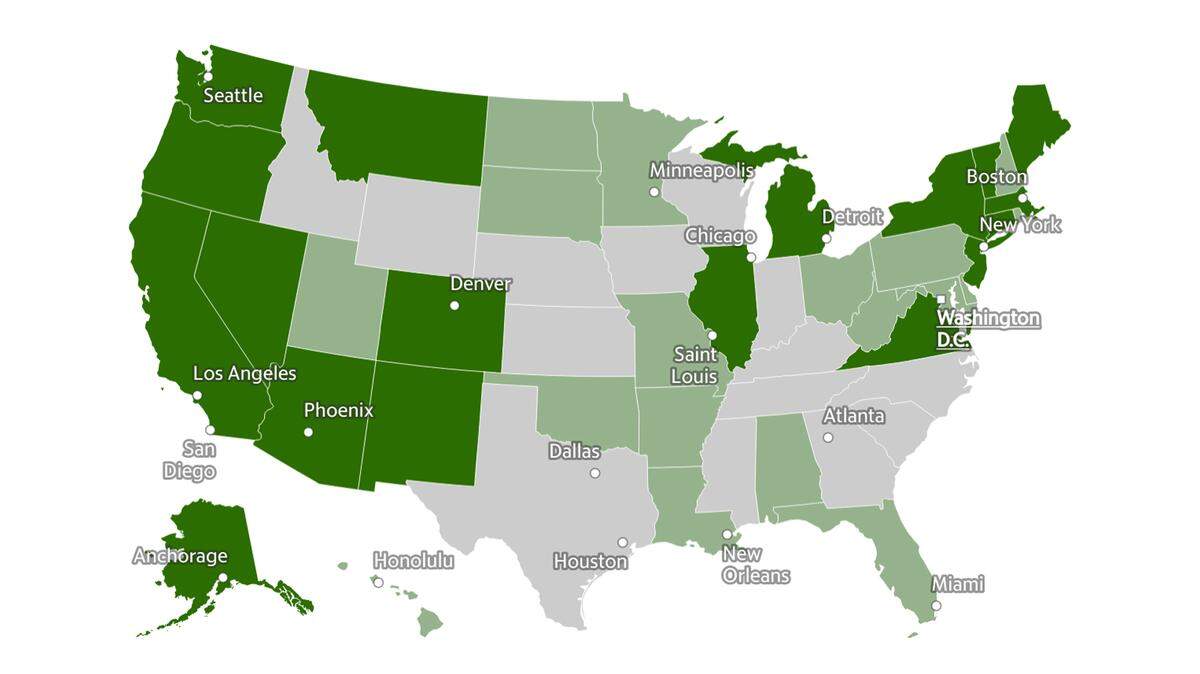
Voters in Missouri will decide in November whether to legalize adult recreational marijuana use, paving the way for Missouri to potentially become the 20th state to legalize and tax the drug.
Expand All
Raytown business partners Andrew McDowell and Roderick Pearson Jr. have long dreamed of building a legitimate marijuana business.
So after Missouri voters legalized medical marijuana in 2018, the pair explored what it would take to transform Funky Skunk, their smoke shop selling CBD products, into a dispensary providing marijuana to their community.
But they balked at the endeavor after estimating it would cost at least half a million dollars to meet the state’s strict licensing regulations.
Now, they see what could be another shot. But they have doubts.
On Nov. 8, Missouri voters will decide whether to approve a constitutional amendment that would legalize marijuana for adults over the age of 21. If it’s approved, small, Black-owned mom-and-pop shops like Funky Skunk will be part of the mad dash to scoop up newly created micro-licenses to sell marijuana.
The Funky Skunk proprietors have reservations about the proposed changes, mainly that the state’s marijuana industry will remain largely under the control of established players who have built up their businesses over the last four years. With only micro-licenses available, they fear that minority-owned businesses like theirs won’t have an equal opportunity to get involved.
While McDowell has campaigned against the amendment, he said he will try to get a license to sell marijuana if it passes.
If Funky Skunk were to win one of the micro-licenses, the pair would be competing against operators like Nate Ruby, who won several coveted medical licenses while attending law school in 2020.
A single grow room inside his Illicit Gardens outside of Kansas City contains 450 cannabis plants – eclipsing the 250 plant limit the state will impose on micro-licenses. Ruby also holds five dispensary licenses, allowing his company to sell its own harvest as well as a variety of products from other growers and manufacturers across the state.
“It definitely helps people that are here,” Ruby said. “We’re already here and we can flip to rec.”
Ruby acknowledged that it won’t be easy for small timers to break into the heavily regulated industry that can require millions of dollars in capital. Especially at a time when existing marijuana growers and sellers say the business is already overbuilt for the demand they’re seeing from Missouri patients.
“It’s going to be extremely difficult,” Ruby said. “I think the hardest thing for that program is going to be access to capital.”
Many opponents of the ballot measure philosophically support legalizing marijuana. But they say the current language tilts the scale in favor of existing operators like Ruby, rather than smaller operations like Funky Skunk who are trying to break into the market. Rather than creating a wide open market, the ballot measure would allow the state to restrict licenses, which critics say would effectively enshrine a monopoly market into the Missouri Constitution, giving existing industry players an unfair advantage.
“What could be a good constitutional amendment is turning out to be a double down on a lackluster medical program,” said McDowell, the Funky Skunk co-founder. “It’s hard for minorities like myself to feel like we’re being included, to feel like we have a fair opportunity and shake.”
Just like the larger businesses, micro-licensees will face financial pressures funding their operations. Marijuana businesses cannot access traditional banking, because federal laws still classify marijuana as a Schedule I drug. That means businesses must raise their own funds from family and friends or seek high-interest loans from marijuana lenders.
Ruby and other existing players wanted to see that addressed with zero-interest loans for micro-licenses funded by state fees, but that language didn’t make it in the final ballot language.
He envisioned small upstarts partnering with big operations like his to learn the business.
“It would have been nice to see something like that to help everyone to get up and running quickly and easily, instead of trying to sit there and figure out how to raise money or structure different deals,” he said. “Because at the end of the day, when you win this, you just want to start growing and selling marijuana.”
The ‘pop-and-pop’ business
Without a license to grow or sell medical marijuana, Funky Skunk owners McDowell and Pearson have had to carve their own lane in the marijuana industry – constantly adapting to fill voids in the market.
When they first started Funky Skunk in early 2016, they sold various smoking accessories like blunt wraps and rolling papers. The two childhood friends turned business partners thought the name was funny – a nod to the pungent smell of smoked marijuana and the Looney Tunes skunk Pepé Le Pew.
The business, tucked in a nondescript strip mall in Raytown, has morphed over the years into what the two men describe as a “pop-and-pop” community business and marijuana brand. They view Funky Skunk as a way to give back to the community they grew up in.
They sell T-shirts and hoodies with their logo – a skunk with a toothy smirk. They partnered with a doctor out of St. Louis to help people schedule telehealth visits to get medical marijuana cards. They started a podcast to talk about the cannabis industry and marijuana culture. And in 2021 they opened up their business as a private member social club where people can rent out the space for weed-smoking events.
“We’ve always had to go with the flow of the industry,” McDowell said. “That’s the only way for us to survive. That’s the only way.”
But the one thing missing from their dream of being a one-stop-shop for all things marijuana? Selling actual marijuana.
McDowell is torn about the Nov. 8 ballot question that asks voters to legalize recreational marijuana. While he’s waited years for full legalization, he doesn’t think the constitutional amendment will give small and minority-owned businesses a fair opportunity to get a license.
Last month, he joined a coalition backed by state Rep. Ashley Bland Manlove, a Kansas City Democrat, that, among other concerns, criticized the amendment for not offering social equity provisions for minority-owned businesses.
Supporters of the amendment, however, say micro-licenses are an example of social equity because they will allow people harmed by marijuana-related arrests to break into the market.
Under the amendment, existing medical marijuana businesses would have the right to convert their licenses to allow recreational sales — a guaranteed spot in the lucrative marketplace.
The Missouri Department of Health and Senior Services, which will oversee the program, has near-total discretion to issue additional licenses but has given no indication it would grant a large number of new licenses.
That leaves new entrants like Funky Skunk to compete in a pool of new micro-licenses. The state will use a lottery system to award licenses to qualified micro-license applicants.
“I don’t believe it’s a good faith effort because we’re getting what’s left over,” McDowell said. “We’re not getting first dibs.”
The micro-licenses are built for smaller businesses and are more restrictive than full licenses. The state will be required to issue at least 144 divided among the state’s eight congressional districts. Among other criteria, those micro-licenses target lower income individuals and those who have been previously arrested for nonviolent marijuana offenses.
If a business like Funky Skunk gets a micro-license, it will be competing in an industry alongside people like Josh Mitchem.
The established marijuana industry
An entire wall of Mitchem’s office is lined with hats. Sporting names like Flora Farms, Easy Mountain and Swade Cannabis, the hats represent the reach of Mitchem’s marijuana empire.
His Clovr creates dozens of manufactured marijuana products like pre-rolls, edibles, and concentrates. The Kansas City company’s products are sold across 83 Missouri dispensaries. And crucially, Clovr holds exclusive licensing agreements with some of the best known national marijuana brands in the country.
That means his company is the only one that can manufacture and sell marijuana-infused Keef sofa or Wana gummies. Mitchem is already making plans for expanding his sweeping facility set in an industrial area south of the Missouri River.
“We’re all going to benefit from the passage of adult use,” he said.
Mitchem, who chairs the medical marijuana trade industry’s government affairs committee, is well aware of the criticisms against the ballot measure. But after an attempt to legalize marijuana in the Missouri General Assembly failed this spring, he said the ballot box could be the state’s last chance.
Republicans in Jefferson City are eyeing major challenges in how proposed constitutional amendments win their way onto statewide ballots, “which means getting something on the constitutional ballot will become impossible,” Mitchem said.
Mitchem believes the proposed micro-licenses will encourage smaller players to get their foot into the industry. He views the micro-license as a way for people without years of experience or millions of dollars on hand to start small and eventually grow their business to compete for a traditional license.
In fact, those smaller players may be able to specialize in unique marijuana strains that are difficult for big players to mass produce. Just like craft breweries experiment with ingredients and brewing techniques, smaller marijuana growers may draw customers for their unique products.
“There are these strains of flower that are really incredible strains, but they’re also very challenging to grow,” Mitchem said. “A lot of times, full-size cultivators don’t want to grow craft flower. Craft flower can be very finicky. But that’s also why it demands top dollar.”
Critics view the micro-licenses as a separate and unequal category of marijuana businesses since they can’t sell or buy products from larger players. But Mitchem still views those who win micro-licenses as competition with his company.
“These micro-licenses, they are going to take business away from existing dispensaries and from existing manufacturers,” he said. “And you know, we’re just prepared for that. It’s just part of doing business.
“The cannabis pie is large enough for everyone to have a slice of it.”
John Payne, campaign manager for Legal Missouri 2022, the group which crafted the amendment, said some micro-license holders will eventually have the opportunity to convert their businesses into full licenses.
“This amendment is going to bring tens of millions of dollars in new revenue to the government of Missouri and local governments, and also hundreds of millions and, in fact, probably billions of dollars in the long run in new economic opportunity for workers and for business owners,” he said.
That opportunity could be a glimmer of hope for some small business owners — but some see a tough climb ahead.
Uphill battle
About 50 miles from downtown Kansas City, in the rural city of Holden, Mike Holtz sees generational wealth in his future if he wins one of the new micro-licenses.
“If I get it and I become sick, or I die or whatever, my kids can take it over and it’s something they can lean on,” he said.
Holtz was one of the hundreds of applicants denied a license after Missouri legalized medical marijuana in 2018. He’s appealing that decision while he operates a small CBD and vape store in his city of about 2,000 people.
“We have customers that come in that can’t afford the current medical marijuana facilities,” he said. “They’ve been there once or twice, but the prices are outrageous. They’re gouging people. It’s a terrible program.”
If the amendment passes, Holtz said he hopes a micro-license could transform his shop into a dispensary. He likes the amendment, but said he worries the monopoly it would create will shut out average people like himself.
“I think it’s a great opportunity for anybody who has the drive and the willing to try it and a little bit of money to get into it,” he said. “I just hope that they give the average people a chance.”
But Brennan England fears that small operators like Holtz will face an uphill battle.
“It’s going to be parceled out to a very fortunate very few,” said England, who is the Missouri Chapter President of Minorities for Medical Marijuana.
England wanted to apply for a medical license at the outset, but he was dissuaded by the state’s regulations and costs.
“I knew there was no way for a blue-collar Black man to have an opportunity in that competitive space, he said.
Instead, he founded the St. Louis Cannabis Club, a social and business club centered around marijuana.
England backed legislative efforts to legalize marijuana. But he thinks the ballot language is too limiting for micro-license holders.
In addition to limitations on volumes, the ballot language would keep micro-licenses separate from the overall market. And it even bars them from holding multiple licenses – licenses to grow and sell, for instance – which is permitted for existing commercial license holders.
“A lot of it feels like trying to pacify a really big problem with a really small solution,” he said. “And that doesn’t sit right with me and many other people of color.”
But England said he still plans to apply for a license if Missourians approve the constitutional amendment. And he hopes to build his business into an incubator of sorts to help other minorities get new marijuana endeavors up and running.
“We have to make damn sure we get the most out of it,” he said.
An oversupplied industry
The industry is counting on the passage of the ballot initiative in November.
Currently, growers and sellers say the medical marijuana market is oversupplied with too few customers to go around. Growers in particular, are sitting on piles of marijuana flower just looking for customers.
At Illicit Gardens, for instance, Ruby’s team has actually scaled down its production and staffing as the market softened. While the building is abuzz with workers tending to plants, harvesting buds and packaging dried flower, parts of the facility remain idled.
Ruby expects to ramp back up hiring and production once the ballot initiative passes.
“I think there are a lot of companies that are struggling a lot right now,” he said. “The demand is there. But there’s too much supply.”
In St. Joseph, Christopher McHugh says his company is just breaking even.
“I don’t know if anyone is in the black,” he said. “I know I’m not.”
His company, Vertical, holds licenses to grow cannabis, manufacture infused products and sell in retail dispensaries. But that kind of integrated model won’t be available to micro-license holders, who must stick to one part of the industry.
Currently, the state reports nearly 200,000 active medical marijuana patients.
“If it wasn’t for adult use on the horizon, I think there’s a lot of people out there who might throw in the towel,” he said. “Because it’s not worth it.”
Still, he sees the micro-license as a meaningful opportunity for niche growers or those looking to make homegrown operations legitimate.
“Right now, there are a lot of home growers out there selling marijuana,” he said. “I think this micro-license is a great solution for people who are in the black market to get into the legal market.”
‘You can’t play with us.’
Missouri’s marijuana market is still in its infancy. Many operators who won licenses never opened their doors. Others sold the coveted licenses.
Mike Wilson, co-founder and chief executive of Franklin’s Stash House, thinks some operators overestimated the demand and weren’t prepared for the ultra-competitive market.
“It is the most competitive industry I have ever seen,” Wilson said. “I think you could draw a comparison to early post-prohibition with alcohol.”
He said the recreational vote, if approved, will provide a major boon to Missouri businesses. Not only will it make it easier for resident adults to buy pot, but the recreational market is expected to draw customers from other states like Kansas, where marijuana is still strictly outlawed.
In addition to mainstays like pre-rolls, Franklin’s Stash House produces marijuana-infused lemonade and will soon roll out a partnership with Kansas City’s Guy’s Snacks. Wilson expects to offer 100 different products by the end of the year.
“It’s one of the biggest economic booms the state is going to see in this decade,” he said.
McDowell, the Funky Skunk co-founder, said that in a perfect world, a micro-license could be great for his business. Customers would rather eat at a local mom-and-pop food spot than McDonald’s, he said.
But he worries about the limits the license would place on his business compared to the big time players. There would be two kinds of micro-licenses under the proposal: dispensaries, which would sell marijuana, and wholesalers, which would grow and process the plant.
Those micro-licenses holders would only be able to transact with each other.
“It’s almost as if they’re trying to appease us,” he said. “It’s like ‘alright, we got all these people that say they’ve been disenfranchised and saying that they don’t have any equity, so here’s your equity bone, right? Go over there and play. You can’t play with us.’”
This story was originally published September 18, 2022 at 5:00 AM.