New Jackson County prosecutor makes lifesaving change on charging domestic violence | Opinion
For years, serious domestic violence cases have been handled in municipal court in Kansas City. And for years, that’s been a serious problem.
I first wrote about this insanity five years ago, in February of 2020:
“When you think of municipal court, maybe you think of unpaid parking tickets or various lawn-related violations. But think again, because Kansas City’s Domestic Violence Court handled 867 strangulation cases last year. And these weren’t felonies, or even misdemeanors, but city ordinance violations, right up there with jaywalking.”
As a result, “Domestic Violence Court Judge Courtney Wachal deals all day every day with the city ordinance violation of whipping your partner with a power cord, the city ordinance violation of shooting at your partner but missing, the city ordinance violation of stalking and the city ordinance violation of violating a protective order.”
“I don’t understand why these cases are filed here,” Wachal told me then. “‘Not only because of their severity, but the people who come in over and over and over” with cases involving strangulation and guns. “This is a high lethality docket.” As many as 1 in 5 homicides in our city involves domestic violence, Mayor Quinton Lucas told me for that column.
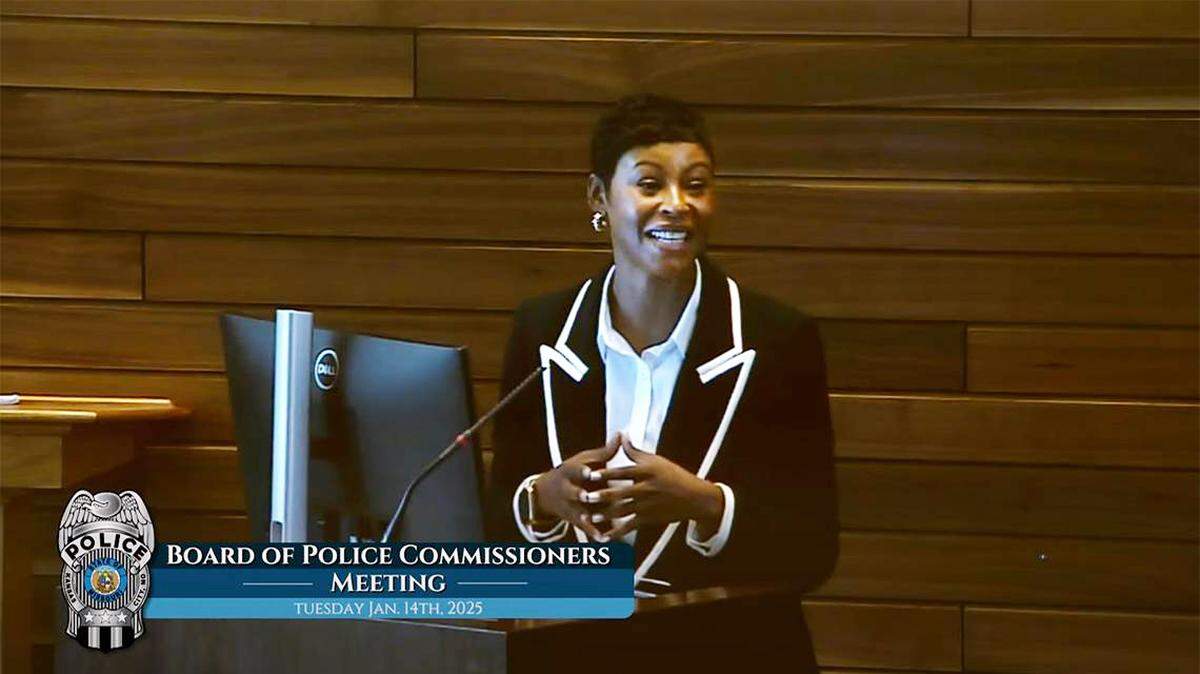
And nothing had changed since then. Until Tuesday, that is, when our new Jackson County prosecutor, Melesa Johnson, who was only sworn in on Jan. 3, announced a couple of major changes at the monthly meeting of the board of police commissioners.
In her previous job as the city’s director of public safety, Johnson said, she’d seen for herself that “too many domestic violence cases are handled at the municipal level and not at the felony level,” where cases involving strangulation and other serious injuries belong.
So effective immediately, she told the KCPD, “those cases should be submitted at the felony level.”
This is lifesaving news for victims, and will make our city safer for everyone, since domestic abusers tend to commit other violent crimes as well.
Also starting now, Johnson said, “all drug distribution cases should be worked up and submitted to my office for charging. That’s a slight deviation from my predecessor’s policies,” she told KCPD Chief Stacey Graves and others at the meeting, “so I want to make abundantly clear that whether there’s a nexus to violence or not, please work up those drug distribution cases so we can evaluate and charge accordingly.”
Both of these changes are a lot more than tweaks to the policies of her predecessor, Jean Peters Baker. And both are going to save lives.
‘Homicides that could have been avoided’
In an interview, Johnson told me that she had come to see how necessary it was to overhaul how domestic violence cases are being charged. Because “in my prior position, I had the good fortune to get to know Judge Wachal.”
In Wachal’s courtroom, Johnson saw the rolling disaster caused by the fact that “90% of DV cases are handled at the municipal level.” The ultimate indictment of that situation is what Johnson called “the homicides that could have been avoided.”
Since she was appointed to the bench in 2015, Wachal said, that’s “been a constant.” But this absurd situation actually goes back much further: “I’ve been told it’s been since the ‘80s.”
On Tuesday, Wachal, the presiding municipal judge, said she was floored, in the best possible way. “I’ve been talking about this for so long, and so have you,” she told me. But now “she’s coming in and giving it attention. She listened,” she said, “and I’m on cloud nine.” Especially for victims, but also for perpetrators, and for public safety.
“With a smaller caseload” of less serious offenders in her DV court, she said, intervention programs will have a better chance of succeeding. “We can focus on high-risk people, and serious cases will be in felony court where they belong.”
At the meeting of the board of police commissioners, Mayor Lucas told Johnson that her “policy change on domestic violence is one of the most important and transformational things I’ve heard in this jurisdiction for some time.” Which it is.
Board president Dawn Cramer said she knows all too well that domestic violence can happen in any family: “My niece was murdered.” And Chief Graves said “I echo” the kudos from commissioners.
Seriously violent repeat abusers
Of the eight domestic violence cases on Wachal’s Tuesday docket, she said, three involved strangulation and another was an attempted strangulation. One of the defendants had pleaded guilty to four separate strangulation charges.
Yet the most she’s ever been able to do in response is issue a warrant that leads to an arrest only if the offender is pulled over for something else and police run a check. Even when trials are held, the maximum sentence Wachal can give is six months — less, really, because of jail overcrowding.
“There are many concerns with detention in Kansas City,” the mayor said at Tuesday’s meeting. “Something the City Council and I are astonished by is how many people who are very serious violent offenders who repeatedly abuse their families and loved ones are being processed on ordinance violations. Thank you for making this change,” he told Johnson.
Did somebody say “concerns with detention?” Those are so serious, too, particularly since all of the city’s male detainees are currently sent to the jail in Vernon County, where inmates and others, including the jail’s former chaplain, have described beatings and other serious mistreatment, including the racially motivated abuse of men from Kansas City, many of whom are Black.
If this change means that fewer city detainees are violent offenders, then it should make it easier for Kansas City to find other options in the year or so before even a stopgap local detention center can be built in the KCPD’s downtown headquarters.
When I asked Johnson about that possibility, she said, “We’re speaking the same language.”
This story was originally published January 15, 2025 at 5:05 AM.