Johnson County school board considers banning LGBTQ-themed books. Here’s what’s in them
READ MORE
LGBTQ issues in Kansas City
This June, we’re answering your questions about local LGBTQ topics and resources. Here is some information to check out:
Expand All
A parent in the Blue Valley school district is calling for the removal of two graphic novels from school library shelves: “Fun Home” by Alison Bechdel and “Gender Queer” by Maia Kobabe. Both books deal with topics of gender, sexuality and the LGBTQ experience.
On Thursday night, the board voted to keep the books in school libraries.
But what is really in these books, and why does this parent find them so offensive? Here’s a closer look at the titles.
“Gender Queer” by Maia Kobabe
Published only a few years ago in 2019, this memoir recounts the author’s experience exploring and defining eir identity as a nonbinary and asexual person. The book deals with awkward experiences familiar to many adolescents, from Kobabe getting eir first pap smear at the doctor’s office to reading steamy fanfiction with friends.
BEHIND THE STORY
MOREPronouns
Kobabe uses the pronouns e/em/eir, which offer a gender-neutral way to talk about em in the third person. The author is a nonbinary person, meaning that e doesn’t identify with either of the binary genders of “male” or “female.” Other common nonbinary pronouns include they/them/their, xe/xem/xyr and others. Learn more about alternative pronouns here.
Kobabe also identifies as asexual, which is an identity defined by the absence of sexual attraction. Learn more about asexuality here.
The graphic novel only references Kobabe’s sexual experiences very briefly, mostly sticking to discussions of exploring eir gender identity. But e says that the book’s title and format have made it an easy target for angry parents around the country.
“I think my book is uniquely vulnerable to these challenges, because it is a graphic novel,” Kobabe told Slate in an interview published on Tuesday. “People can flip it open and very quickly see one or two images that might make them uncomfortable… they don’t have to actually read the whole book to find the parts they’re not going to like.”
“Gender Queer” has been labeled “one of the most-banned books in the U.S.” by NBC News, and Kobabe has penned an opinion piece in the Washington Post in its defense. Nevertheless, groups in at least ten states are pushing for its removal on the grounds that it is inappropriate for teenagers.
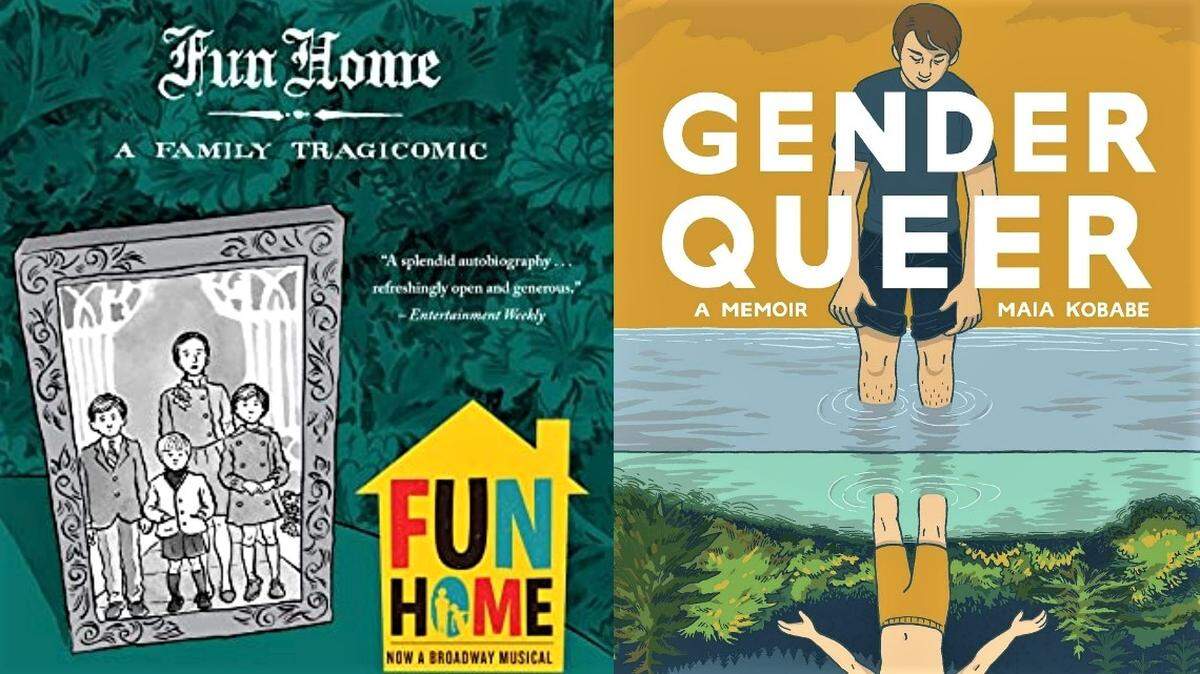
“Fun Home” by Alison Bechdel
Considered a seminal work in the queer graphic novel canon, “Fun Home” was first published in 2006 and later adapted into a Broadway musical. Its author, Alison Bechdel, is a celebrated lesbian cartoonist who, like Kobabe after her, based her graphic novel directly on her own life.
“Fun Home” labels itself “A Family Tragicomic,” and focuses largely on Bechdel’s relationship with her father, who ran a funeral home during her childhood. It also chronicles the author’s journey coming to terms with her own sexuality as a child, teenager and young adult.
Missouri was the first state where “Fun Home” was publicly challenged: In 2006, the year of its publication, Marshall, Missouri, resident Louise Mills requested the book’s removal from her local public library. This led the library to adopt an official materials selection policy, which then approved the book to stay on shelves.
Since then, the graphic novel has been repeatedly challenged for its discussions of sexuality, suicide and brief depictions of sexual encounters. The author told The Comics Journal that the Missouri controversy was likely inspired by the book’s graphic novel genre.
“I think it had everything to do with the fact that it was illustrated,” she said in the 2007 interview. “I’m sure that library’s got all kinds of gay material in it. But if they’re just regular books with no cartoon illustrations, there’s not the same kind of concern about it.”
What’s next for these books?
The Blue Valley school board voted 5-2 to keep the graphic novels on school library shelves.
Cristy Bolton, district library media coordinator, said officials reviewed the entirety of both books to determine whether they met district policy.
She added that the titles are “offering an opportunity for others to understand the journey of someone who identifies as LGBTQIA+, and an opportunity for others to learn about someone who may or may not be different than them. This author and their story represents some of our Blue Valley students who identify as LGBTQIA+.”
Experts at the Kansas City Public Library have also spoken out about the importance of books that explore a variety of experiences for youth, even when they include controversial topics like sexuality.
“To those who would restrict a child’s access to books, particularly books concerning marginalized communities, we offer this reminder: Within the pages of a book, we not only see ourselves and feel less alone, we also gain perspective on those whose lives are nothing like our own,” library leadership wrote in a statement on Nov. 24, 2021, in response to a proposed book banning in the Northland.
Kobabe agrees, telling Slate that the best way to determine whether a book is appropriate is to read it thoroughly before making a judgment on its contents.
“I think that as a parent, if there’s something you’re not sure about, reading the whole thing yourself first is of course a good start,” Kobabe said in the Slate interview earlier this week. “Parents have a right to have a certain amount of say in what their own children read and experience. But you can’t make that decision for everyone else’s children as well.”
Here’s a list of resources for LGBTQ youth in Kansas City.
Sarah Ritter contributed to this reporting.
Do you have more questions? Ask our service journalism team at kcq@kcstar.com.
This story was originally published March 24, 2022 at 9:01 PM.
.jpg)