Sex trafficking survivors need more help escaping ‘the life,’ KC area advocates say
READ MORE
Trying to survive
Sex trafficking in particular leaves victims with specialized needs to address their trauma. And while the extent of the problem is hard to know, service providers in Kansas and Missouri say it’s clear the need for programs far outweighs what’s available.
Expand All
A black SUV turned into the parking lot of a Dollar Tree and came to a stop. A woman with long, bleached blond hair quickly climbed inside.
Branded on the woman’s arm was the name of the man who trafficked her for sex, an ever-present mark of his control and possession. She had endured a decade of forced sex and regular beatings.
“Once I started getting more manipulated into it and being brainwashed,” she said, “I kind of just did what I had to do to survive, and it was pretty hard. I thought for the rest of my life this was what I was going to do and I would probably die in it.”
Hours earlier, she had called a human trafficking hotline and made arrangements to get picked up. As the SUV door shut, the 33-year-old woman hoped that her escape would mark a turning point that would take her life in a new direction.
A few months later, in early 2020, she landed in a long-term residential program outside Kansas City, where she has had the time and support to process the traumas she survived and to begin building a better life.
“It’s a battle,” she said of her experiences, something she would always be healing from. “It’s never going to go away.”
Advocates in Missouri said the state does not directly allocate any funding for survivors of trafficking, who need both emergency services and long-term programs that address substance abuse, mental health and housing.
Trafficking — the use of force, fraud or coercion to compel labor — is a $150 billion industry worldwide, according to Homeland Security Investigations, which estimates about 20% of trafficking cases in the U.S. involve sex, while 80% are forced labor. But the true breadth of the criminal enterprise is hard to define — in Missouri, Kansas and across the country — as so many cases go unreported. Estimates put the number of people trafficked globally each year in the millions.
Sex trafficking in particular leaves victims with specialized needs to address their trauma. And while the extent of the problem is hard to know, service providers in Kansas and Missouri say it’s clear the need for programs far outweighs what’s available.
That leaves the work of helping victims to places like Restoration House in Harrisonville, where the woman who was picked up at the Dollar Tree was taken. It has six beds for adults and is expanding to a capacity of 18. Women can stay up to three years, giving them the chance to get counseling, go to school and start a career.
The organization received more than 650 requests for help from service providers and individuals last year, president Rodney Hammer said.
“There have not been adequate funds at all for residential services,” he said. “We’re seeing people step up to the plate in the private sector. It would be helpful for the government sector to do so as well.”

Restoration House is eligible for reimbursements from the state for minors who are in state care. But they get no funds for other children or any adults. Last year, they were largely supported by about $800,000 in donations from individuals, businesses, churches and foundations.
On average, Kansas has awarded about $232,430 in grants annually for law enforcement training and services for trafficking victims, according to the Kansas Attorney General’s Office.
In 2019, the year the woman called the national hotline, more than 11,000 trafficking situations were identified in the U.S. Kansas and Missouri accounted for more than 300 cases, though reports from local service providers show trafficking is several times more prevalent than the incidents the hotline captures.
The two states have a combined total of 69 beds for trafficking victims, according to a survey from Saint Francis Ministries, a social services organization operating in Kansas and five other states.
Victims range in age. At particular risk are youths in foster care, the unhoused, those without legal immigration status and the LGBTQ community.
In Kansas City, after Children’s Mercy Hospital began asking screening questions about trafficking in 2018, the hospital discovered the number of reported patients experiencing exploitation or at high risk for exploitation jumped from two to at least 50 per year.
Both Kansas and Missouri are behind on making services accessible, relying heavily on community-based groups with limited funding, said Sarah Bendtsen, director of state legislative advocacy for Shared Hope International, an organization working to end child sex trafficking.
“That’s such a huge need that just isn’t being filled,” Bendtsen said. “That’s a huge legislative gap that needs to be addressed.”
Kansas City is a community where people still are being exploited, said Lucy Bloom, executive director of Veronica’s Voice, a local nonprofit service provider. The organization, founded in 2000 by a trafficking survivor, has a residential program for five women and several area drop-in centers, which served 98 people last year.
“We still need to take an honest look at the causes — the root causes of the victims, but also the root cause of demand,” Bloom said. “We have consumerism that is resulting in the exploitation of many, many souls. And the ones that are being counted are just the tip of the iceberg.”
’The life’
After years in what is referred to as “the life,” the woman now at Restoration House had grown resigned to being a victim of sex trafficking.
She was not trafficked in Kansas or Missouri and did not want the location where she was trafficked disclosed because of her fear of retribution and ongoing legal issues. The Star generally does not name victims of sexual abuse.
Her childhood had been rough: Her mother was raped and became pregnant. Because of that, she said she never felt love from her mother and thought of herself as a burden. She was removed from her home, because her mother suffered from serious mental health issues. She was in and out of foster care until her grandmother got custody of her.
As a child, she was a sweet girl with a little bob haircut and blue eyes, a cousin recalled. But her unstable family life and bullying issues led her to begin skipping school and hanging around the wrong crowd.
“She’s definitely has been dealt a really shitty hand of cards, and I think she’s just had to navigate that on her own,” her cousin said.
She ended up hanging around gang members for protection. At 17, she ran away when her uncle tried to sexually abuse her and she was told to keep quiet after telling a relative.
With few options, she fell in with a gang member who trafficked her.
“I ended up getting sold to a pimp,” she said. “And ever since then, I was stuck in it.”
At first, she thought he truly loved her. But he became more controlling and abusive. Later, she was under the control of a second trafficker. She lived with him in a two-bedroom apartment with as many as nine other girls.
He took her documents, she said. He monitored her phone calls. He immediately confiscated any money she made. He manipulated her, forcing her to rely on him, and made threats. He beat her and, once, attempted to drown her in a bathtub.
Her “normal routine” was to pick an outfit for the night and then the trafficker would take her and the other women out. When the sun started to come up, he would take them back to the apartment, where she said she was trapped, and he would bounce from bedroom to bedroom having sex with them.
A confluence of factors prompted her to escape in August 2019, including witnessing the trafficker rape a 13-year-old girl. It was a harrowing experience, even as she had become numb to her own abuse.
“I remember him saying this comment, he was like: ‘Beating you doesn’t even work anymore.’ He said, ‘I’m eventually going to end up killing you,’” she recalled. “And I knew that my time — that I needed to go.”
Most importantly, she had just found out she was pregnant.
She had been given a flier for the National Human Trafficking Hotline and stuffed it in a knapsack. Now she pulled it from the bag and dialed the number, 1-888-373-7888, and got connected to local help.
As she was picked up by two women in the SUV at the Dollar Tree, she was happy but also scared of what lay ahead — mostly a lot of unknowns.
After some months in temporary housing, she arrived in Kansas City. She said she wanted to go somewhere out-of-state and that coming to the area was “a leap of faith.”
Trafficking in Kansas and Missouri
It’s difficult to pin down numbers on trafficking because it is under-reported and some people may not even realize their situation would be considered trafficking.
But the National Human Trafficking Hotline provides a snapshot of trafficking in the U.S. In 2019, the hotline identified 11,500 human trafficking cases. In Missouri, 233 cases were reported. Kansas had 92.
The work of local providers appears to indicate the numbers are higher, however.
In fiscal year 2020, Kansas organizations served 503 victims, according to Jennifer Montgomery, chair of the Human Trafficking Advisory Board, which is part of the attorney general’s office.
BEHIND THE STORY
MOREWhy did we report this story?
In June, 31 sex trafficking victims were rescued in a federal law enforcement operation in Kansas City, Independence and Wichita. The Star wanted to take a closer look at this issue to see how Kansas and Missouri are addressing trafficking in the region. In particular, we wanted to find out what services were available for survivors, how law enforcement handle trafficking investigations and what more needs to be done in each state. We also wanted to talk to a survivor to hear her firsthand experience in the recovery process. The story’s development coincided with the launch of The Star’s Reimagined Print initiative, which features in-depth stories and visual elements including photos, videos and graphics. Read more by clicking the arrow in the upper right.
How did we report this story?
A reporter from The Star began researching this story by contacting organizations that help survivors of trafficking. Rodney Hammer, the president of Restoration House, invited a reporter and a photographer to the organization’s campus near Harrisonville. They spent a day in July there, touring the facilities and a church building that is being renovated into a residence for 18 women.
They sat down with a survivor at Restoration House and discussed what elements of the story, such as her name, she wanted to remain private. Then she began to tell them her story, recounting her ordeal and what it has been like to come to the Kansas City area for her healing process.
To better understand the issue, the reporter also interviewed an agent with Homeland Security Investigations, members of state advisory boards and advocates, and representatives of national organizations such as Polaris and Shared Hope International.
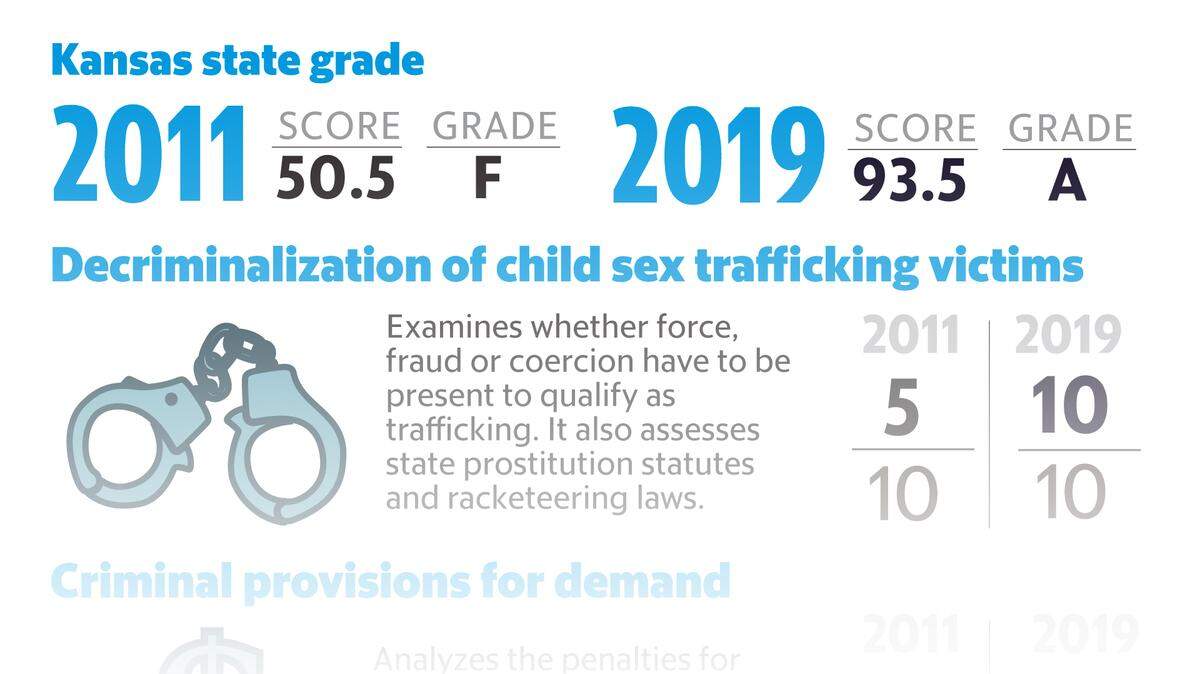
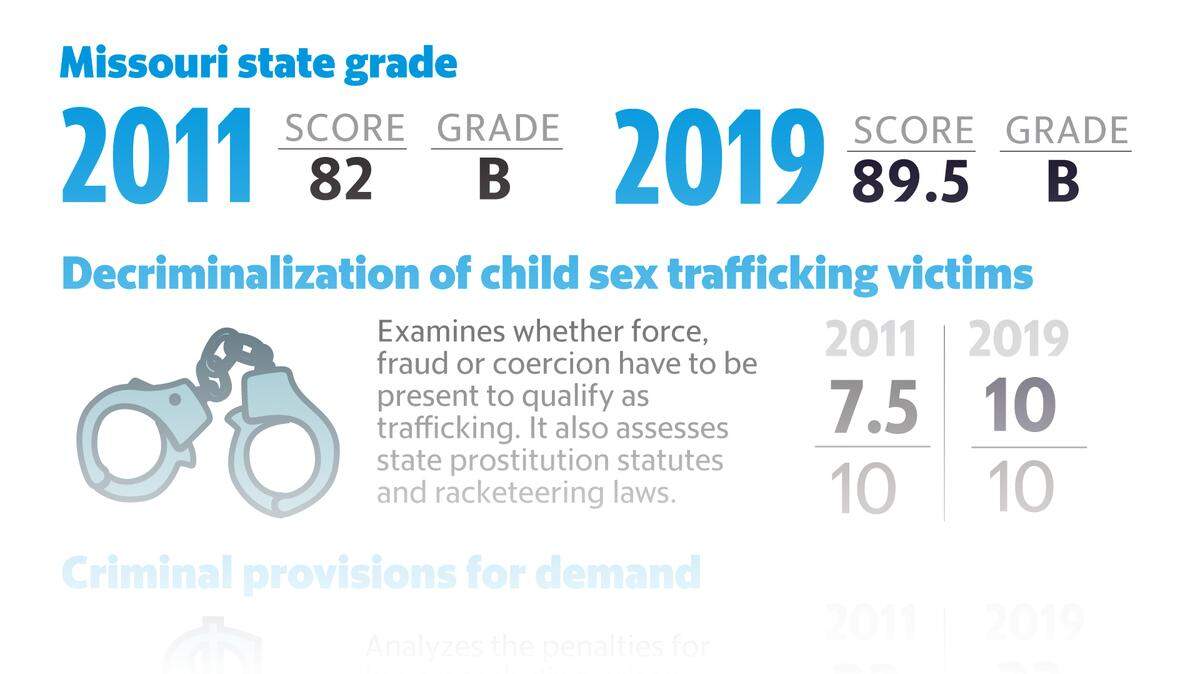
Kansas and Missouri illustrate two different trajectories in addressing child sex trafficking.
In 2011, Shared Hope International began issuing annual state grades based on criminal provisions, training, victim-centered responses and other factors.
Missouri earned a B. In 2019, the most recent year data was released, the state was again given a B.
On the other hand, Kansas has improved from an F to an A.
Both states continue to allow juveniles to be charged with prostitution, which advocacy groups say needs to change. The majority of states do not prosecute minors for prostitution.
According to Bendtsen, Kansas and Missouri provide strong services through a network of local organizations and groups like the Missouri Coalition Against Trafficking and Exploitation.
“I think in some ways because that exists, systems have just defaulted to that,” she said.
“There’s very little being done at the legislative level to support those service providers.”
There is no state revenue stream that goes directly to agencies serving trafficking victims, said Linda McQuary, director of the Missouri Coalition Against Trafficking and Exploitation.
Organizations instead must rely on federal and state grants as well as private donations, which are not guaranteed sources of income.
One particular area of concern is housing.
“There definitely needs to be more housing opportunities, whether that’s an actual physical location that folks live in with others and gain services, or whether it’s assistance with getting an apartment, or even if it’s just emergency housing to keep them safe from their trafficker,” McQuary said.
The coalition as well as other stakeholders are in the early stages of collecting data and identifying other gaps in services.
“Over the past 10 years, Missouri has not moved the needle at all, and many states have jumped over us and been doing really good work,” McQuary said.
“We’re hopeful with a different-pronged approach that in a couple of years, we will definitely be in a better place.”
Like Missouri, resources for survivors in Kansas for housing and other services are not adequate.
“There just isn’t a good system right now,” said Sharon Sullivan, a member of Kansas’ Human Trafficking Advisory Board and a professor at Washburn University. “And it’s going to take money and it’s going to take will.”
Bloom, with Veronica’s Voice, said other gaps exist in funding for counselors and access to health insurance and primary care.
This year, the advisory board has worked on creating a comprehensive plan to address trafficking.
Kansas has implemented strong laws, according to Sullivan, but more needs to be done to increase penalties on the demand side of trafficking.
“It’s the buyers that propel this crime,” she said.
Education, as well as broader cultural shifts about how women and girls are valued, also needs to be supported, she said.
‘A delicate balance’ of blame
In June, Homeland Security Investigations announced 31 sex trafficking victims were rescued during an operation in Kansas City, Independence and Wichita. Fourteen of those were children who had been listed as missing, including a 4-year-old, said James Wright, deputy special agent in charge.
Although 82 people were arrested, it’s unclear whether charges have been filed. The Western District of Missouri said it had not filed any charges or indictments related to the operation. The District of Kansas declined to comment on the case.
The Independence Police Department was one of several local agencies that partnered with Homeland Security on the investigation. Fifteen people were arrested in Independence in connection with prostitution, while seven were arrested on suspicion of patronizing prostitution, according to Officer Jack Taylor, a spokesman for Independence police. Additionally, three of the human trafficking victims were rescued in Independence.
Taylor said victims reached out for help during the investigation, reporting they were being trafficked for sex.
In some instances, experts said, it can be difficult for people to identify as victims or reach out for help, because they may fear consequences from their trafficker or from the criminal justice system. Sullivan said the “victim offender crossover” is a complex issue that presents law enforcement with a difficult task.
The case from Independence is still under investigation and charges are pending, according to Taylor.
Sgt. Brad Dumit, who oversees the Kansas City Police Department’s vice unit, said task force officers partner with the FBI on human trafficking investigations. Cases can take several months, and there’s usually at least one open at any given time.
In Kansas, the majority of human trafficking is run by individuals and small groups, not major criminal organizations, said Melissa Underwood, spokeswoman for the Kansas Bureau of Investigation.
Wright and Officer John Lacy, a spokesman for the Overland Park Police Department, said one of the biggest challenges law enforcement faces in addressing trafficking is gaining the trust of victims, especially those who have been arrested or fear being prosecuted.
The matter can be further complicated because victims may be coerced into criminal activity such as theft, fraud and even recruiting others into being trafficked.
“It is a delicate balance to determine culpability in a case,” Lacy said in an email. “Special dynamics present in human trafficking cases warrant special considerations for victims.”
In recent years, agencies have taken steps to implement a victim-centered approach. Cutter, with the National Human Trafficking Hotline, said that means recognizing trafficking takes away autonomy and allowing survivors to make decisions about their needs. Sometimes that means they may not be ready or able to leave their situation.
Other professions have also supported efforts to combat trafficking.
In 2017, Kansas became the first state to require those with commercial driver’s licenses to take a course in trafficking awareness. More than 36,000 drivers have been trained, the attorney general’s office said.
A path to healing
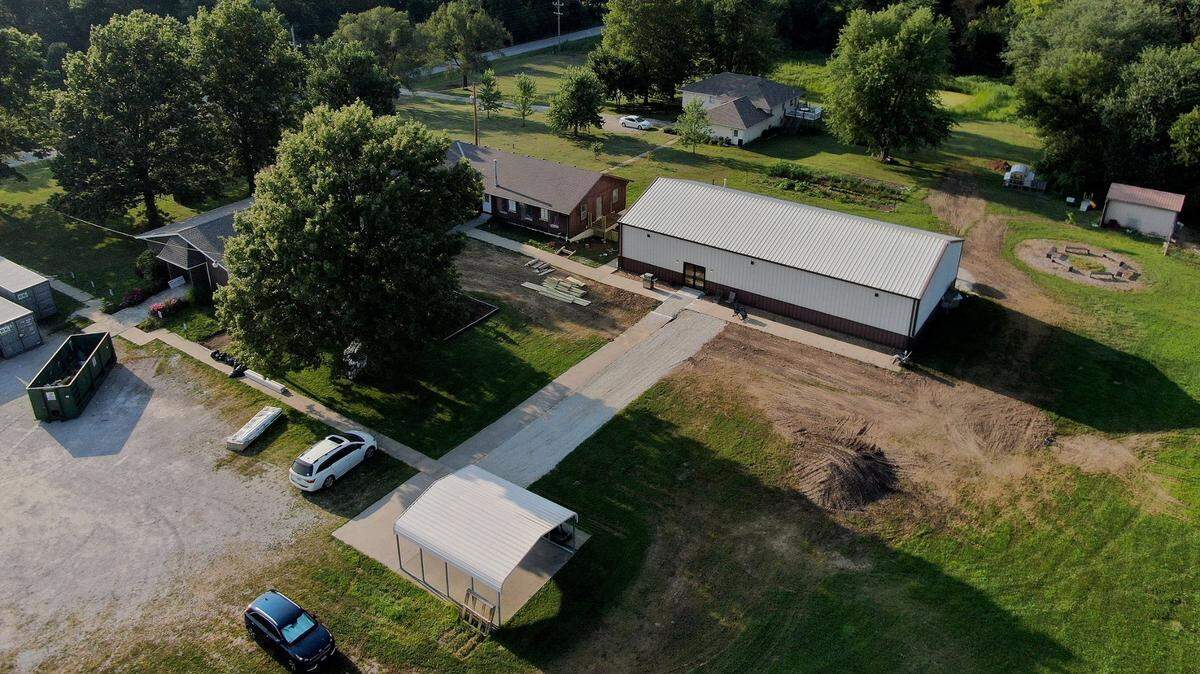
Restoration House, which was founded in 2015, sits on 7 acres of land near Harrisonville, about 40 miles south of Kansas City. A church donated its old building on the grounds, which is being renovated into housing for 18 women. The organization also has a house for minors at an undisclosed location.
The campus includes a garden along with goats, chickens, a cat and a friendly boxer name Remi. Participants can engage in horticulture and animal therapies and what program director Roxie Loyd calls “healing arts” in the Life Center building, which houses areas for painting, soap and candle making and other crafts. Some of the products are sold at Rehope Market and Cafe in Greenwood, with proceeds benefiting Restoration House.
The first phase of the program is focused on safety and any medical issues. Participants help develop a recovery plan, and eventually, many get jobs and start saving so they can buy a car and get an apartment once the program is over.
The house where the women live feels like a home. In the bedroom of the woman picked up at the Dollar Tree is a sign that reads “Darling, you belong here.” On her dresser sits a collection of fancy perfume bottles.
“I shower a lot and I stay clean. And I like perfume smells because I think from knowing that when I was trafficked and stuff, I always felt dirty,” she said. “So it’s just a constant habit that I still have out of that life.”
Shortly after she arrived at Restoration House in early 2020, she gave birth. Her daughter, now about 18 months old, smiles easily and has a sassy side.
“She saved my life,” the woman said.
Last year, the woman began taking steps to repair her relationship with her family. Her cousin learned more about what she had survived, and they reunited in November.
“We cried, we laughed, we hung out for the weekend,” her cousin said. “There were some tough love conversations. There were cousin conversations.”
Her cousin said it was eye-opening and heart-wrenching to learn more about what the woman had endured.
“I think she just needs to keep fighting the fight,” her cousin said. “I’m definitely in her corner.”
The name of the woman’s trafficker, branded across her left forearm, was covered up last year through Soul Survivor Ink, a nonprofit that removes or covers up tattoos for survivors of trafficking and for former gang members.
In 2020, the Phoenix-based organization transformed nearly 1,000 tattoos through its network of artists.
“I think it provides healing,” said Gina Jernukian, CEO of Soul Survivor Ink. “They don’t have to see this reminder of their painful past every single day they look in the mirror.”
A significant part of the woman’s recovery has been her faith.
“I just look at things different because of God,” she said.
The recovery process, though, has its ups and downs, even after more than a year of intensive services. Earlier this month, the woman said she thought she was healed but “hit a rock bottom part” when she realized that was not the case and began processing where her anger comes from.
“Being out of that life, I don’t have physical abuse no more, but I still have that prison trap in my mind.”
She described that trap as a spider’s web that she can get lost in, taking her joy away as she becomes more enmeshed. Through trauma counseling, she is learning coping skills, such as how to identify when that web begins to be spun and tools to get out of it.
In June, she earned her high school diploma and is enrolled in a peer support program that starts this fall.
“I want to be able to help other women,” she said. “I know that’s my calling and my purpose. I know that’s the reason I went through what I went through.
“I don’t know where God’s going to take me, but I know it’s just going to keep going farther and farther.”
If you or someone you know needs help, the National Human Trafficking Hotline can be reached at 1-888-373-7888 or text “help” or “info” to 233733.
This story was originally published August 29, 2021 at 5:00 AM.