Why didn’t Wyandotte, Johnson county voters get to weigh in on the Chiefs deal?
As plans to bring the Kansas City Chiefs over to Kansas come with an ask for nearly $3 billion in public financing, residents in Johnson and Wyandotte counties — and specifically in Olathe where the team hopes to build a new practice facility — are wondering why they didn’t get to sign off on the massive deal.
“Why were we not given the opportunity to vote on this matter?” Olathe resident Nichole Cook asked. “Whenever it will be a direct impact to the people, why was this a sealed (proposal) for two years (that) we didn’t get to find out about until just recently?”
Cook was one of a handful of Olathe residents who shared similar questions regarding the Chiefs’ plans to move to Kansas in response to a Star reporter’s post in Olathe Connect, a public Facebook group with 24,000 members.
“Just as Jackson County residents were given the opportunity to vote, why were we not given the same right?” she asked.
While Jackson County needed voters’ support to add on a new sales tax to pay for a Royals stadium in 2024, Kansas’ plan to pay for a Chiefs stadium is possible with funding tools that state lawmakers already approved without requiring input from voters.
Kansas plans to publicly finance $1.8 billion of construction costs for a new domed stadium in Wyandotte County and up to $975 million for a new training facility and headquarters in Olathe thanks to a special incentive program that state lawmakers passed in Topeka nearly two years ago.
Shifting tax money instead of adding a tax
In June 2024, Kansas lawmakers passed a new law that authorized the state to expand the use of a controversial funding tool called sales, tax and revenue bonds, or STAR Bonds, to pay for the bulk of construction costs for new professional sports stadiums. Issuing the bonds does not require a public vote.
The Kansas law first came forward in 2024, just two months after Jackson County voters across the state line rejected a 40-year, 3/8-cent sales tax, which would have helped pay for construction of a Royals ballpark in the East Crossroads and a major renovation of Arrowhead Stadium for the Chiefs.
Unlike Jackson County’s 2024 initiative, Kansas’ plan did not include a general sales tax increase, and a ballot initiative wasn’t necessary to approve the stadium package, said Rep. Sean Tarwater, a Stilwell Republican who chairs the House commerce committee and played a key role in crafting the STAR bond stadium incentive bill.
“It’s the same sales tax no matter where you go in Kansas. So, if we were to increase sales tax, we would probably have to do a vote, but we deliberately didn’t do that,” Tarwater said on Wednesday.
Rather than adding a tax, the stadium STAR bonds change where state sales tax dollars go — redirecting sales tax money that would otherwise go to the state’s general fund to pay for highways, schools and other services to instead pay off the stadium project’s debt and retire the bonds.
Rep. Wanda Brownlee Paige, a KCK Democrat who took office after the Kansas Legislature approved the supercharged STAR bond package, said she would have liked for local residents to be given a chance to vote on the plan.
“It would have been nice,” she said. “But knowing our (Unified Government), no, I’m not surprised.”
Why these STAR bonds are special
The crux of how these stadium STAR bonds would work is not necessarily new. Kansas has used STAR bonds since 1999 to front a portion of construction costs for major development projects aimed to attract tourism. Tax money from sales at the attraction and within a surrounding district are then used to pay back the bond amount over several decades.
STAR Bonds funded the construction of things like the Kansas Speedway in Wyandotte County — touted as one of the most successful uses of the program — and Prairiefire in Overland Park, which defaulted on its bonds in 2023 after not generating enough money to pay the debt back.
But the special incentives lawmakers passed to help pay specifically for stadiums — often referred to as a supercharged bond agreement — goes beyond what regular STAR bonds offer developers.
The proposed deal with the Chiefs offering nearly $2.8 billion in bonds is more than twice the amount of Kansas’ 23 other STAR bond projects combined. Some experts have referred to it as the largest government subsidy for a professional sports team in U.S. history.
Part of the reason the subsidy is so big is because the 2024 Kansas law allows these supercharged STAR bonds to cover more of a development’s cost than regular STAR bonds. Bonds can cover up to 70% of the cost of a stadium project compared to the 50% that regular STAR bonds can cover.
The preliminary agreement with the Chiefs says the state will issue bonds for up to 60% of development costs for its proposed Kansas stadium, less than the 70% that would have been allowed by the law.
A sweeping district
The supercharged STAR bond law also gave the state more discretion to set the terms of the deal and the size of the district that will help pay back the cost of building a stadium.
Typically, STAR bond districts encompass a small area around an attraction, redirecting the sales taxes generated by that development to pay off the debt used to build it, such as the area immediately surrounding Children’s Mercy Park. The logic is that people who visit the attraction are the ones whose tax money helps pay back its debt.
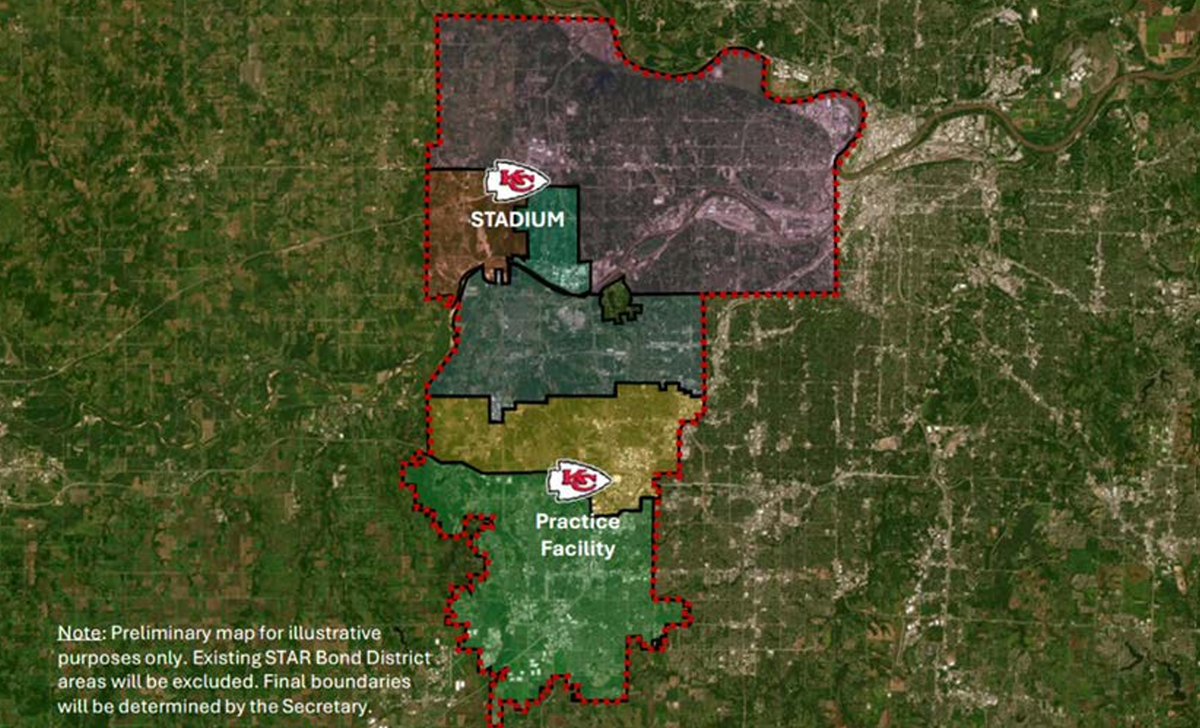
But the district that state officials proposed for the Chiefs’ bond district extends well beyond the immediate area surrounding a stadium. It stretches across nearly all of Wyandotte County and most of western Johnson County.
That means new state sales tax money — and possibly local too — throughout that entire area would be put toward paying back stadium debt instead of other government priorities for 30 years.
A state-level decision
For a regular STAR bond project, the local government is the entity that issues the bonds, which means that local officials first need to vote on and approve the bond district and other terms before those bonds are issued.
The supercharged stadium STAR bonds are different.
Rather than requiring approval at the local level, the special stadium law authorized the Kansas secretary of commerce, currently Lt. Gov. David Toland, to negotiate the deal with the teams directly. Any deal would only need to be approved by a state body called the Legislative Coordinating Council.
That’s why most of the negotiations leading up to the Chiefs’ and Kansas’ announcement were able to happen at the state level and behind closed doors. Olathe leaders said they’d been talking with the Chiefs about a deal for two years, but Wyandotte County officials said they didn’t even know about the plan until the last minute.
To be clear, the state can act on its own just to approve a stadium STAR bond deal, including drawing the size of the district and issuing the bonds for upfront costs. Local governments would still need to vote on and approve things like development plans for the project to move forward.
Local money
Part of the tradeoff for using regular STAR bonds to help cover the upfront costs of building a new attraction is that local governments then agree to divert the local sales tax money generated in the district to pay back the bonds.
That foregone local tax money is one reason why STAR bonds have been controversial, with some people criticizing how local governments don’t get to reap the benefits of new attractions in their communities until that debt is paid back.
That’s also different for these special stadium STAR bonds.
Since the state gets to set the terms of and approve the deal without local signoff, the law only authorizes it to pledge state — not local — sales tax money to pay back the bonds.
However, the law says that local governments can choose to divert their local sales tax revenue to the stadium bonds too.
Local approval
The preliminary Chiefs deal asks both Wyandotte County and Olathe to contribute their local sales tax revenue to the stadium debt in addition to the state tax money. Both local governments would need to vote to approve diverting that local money.
So far, both have confirmed that they will each have a public hearing to decide whether they want to pledge local sales tax revenue to the project.
Olathe Mayor John Bacon called the agreement a “once-in-a-generation” opportunity for the Johnson County city, but Wyandotte County officials shared more skepticism.
KCK Mayor/CEO Christal Watson said in a video-recorded statement that she still has questions about the long-term impacts a stadium could have in Wyandotte County, making it clear that negotiations are ongoing and the local government hasn’t yet locked down a deal with the team.
The municipalities have until Feb. 20 to make their decision. As of Jan. 14, no dates have been set for a discussion at the local level.
What about Missouri?
Jackson County’s rejection of a sales tax for a Royals stadium brought lawmakers on both sides of the state line back to the drawing board.
After Kansas lawmakers passed the special stadium STAR bond package, Missouri passed its own — drafting a separate incentive package in 2025 to cover up to 50% of construction costs.
Missouri’s incentive package required local funding in addition to state money, which in many cases would prompt a public vote.
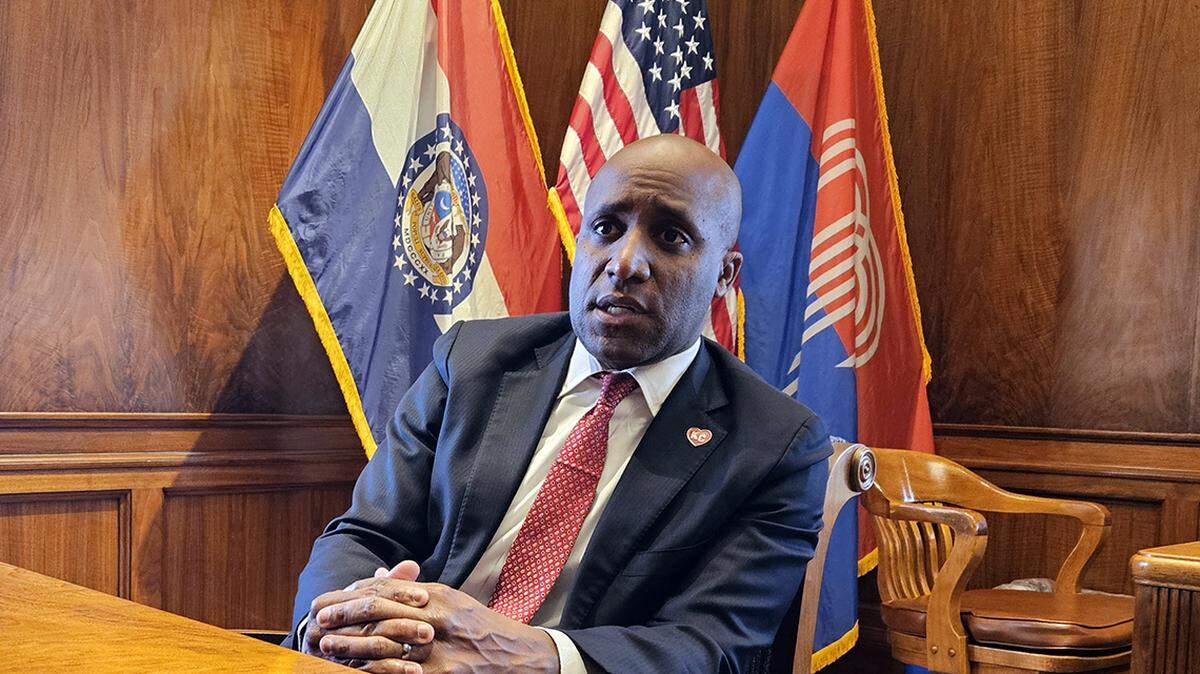
Now, as Missouri works to keep the Kansas City Royals, two top officials — including Kansas City Mayor Quinton Lucas — told The Star that Kansas City could offer the baseball team a new stadium commitment without a public vote.
“As the largest city in our region, the City of Kansas City has access to tools to support transformational development, like sports and entertainment venues, that can be approved by our elected and appointed bodies,” Kansas City Mayor Quinton Lucas said. “We will develop any facilities in a fiscally responsible manner supporting the success of our teams, our taxpayers, and our community.”
The Star’s Matthew Kelly contributed reporting.
This story was originally published January 16, 2026 at 9:55 AM.