Starting over: Dreams derailed by COVID, Kansas and Missouri undergrads return to campus
READ MORE
Mending Broken Dreams
As Kansas and Missouri undergrads return to campus, they’re readjusting their college dreams derailed by the COVID-19 pandemic.
Expand All
Starting over: Dreams derailed by COVID, Kansas and Missouri undergrads return to campus
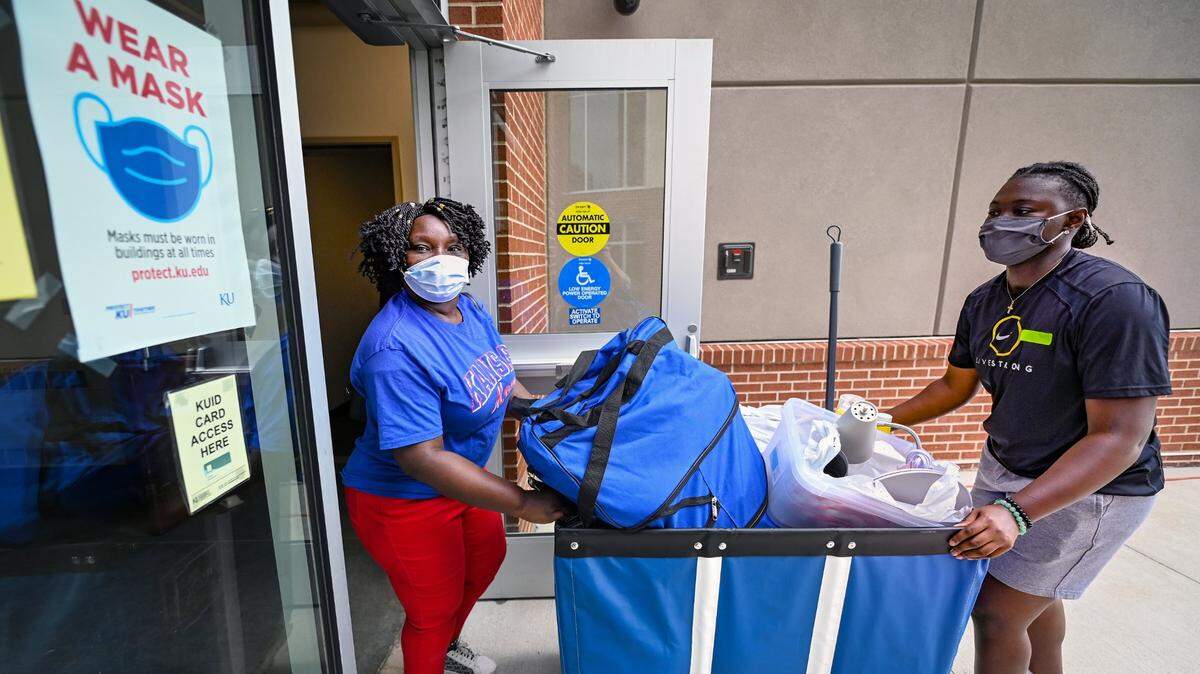
Students and staff push KU for more COVID-19 protection. What’s being done?
What if you’re exposed to COVID at college? Here are rules for Kansas, Missouri schools
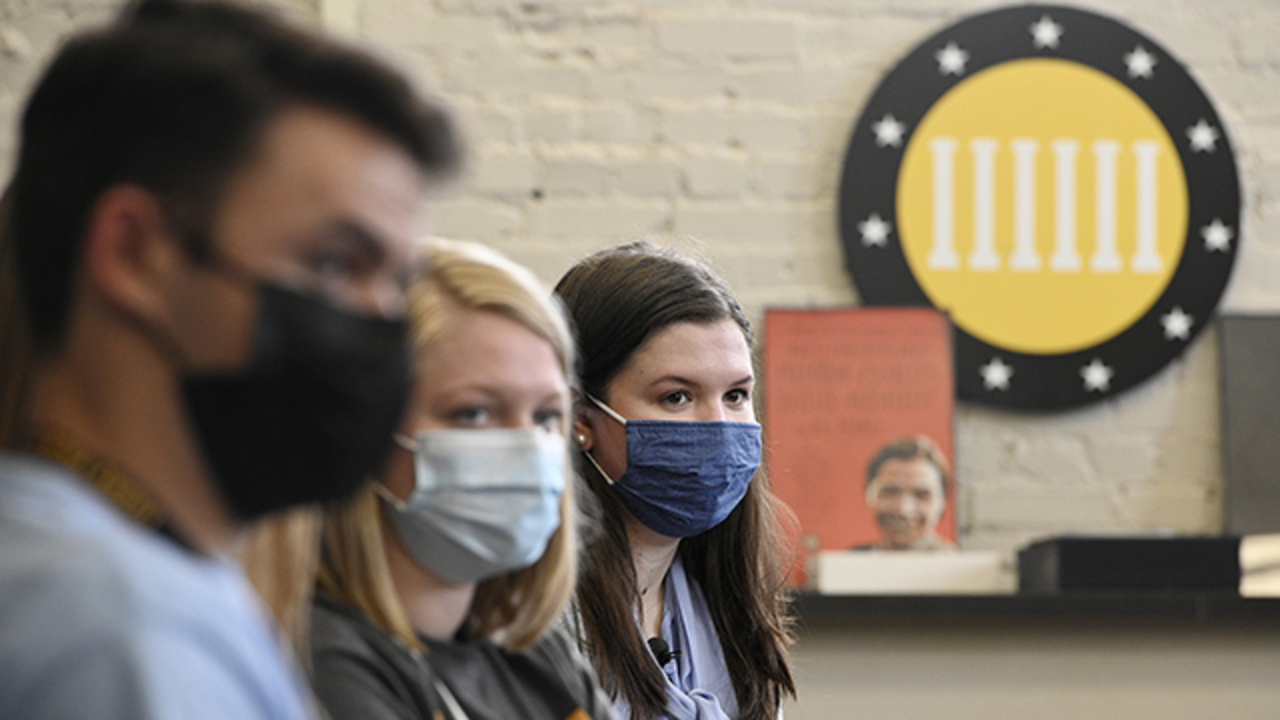
MU senior shares thoughts on her ‘roller coaster’ college experience due to pandemic
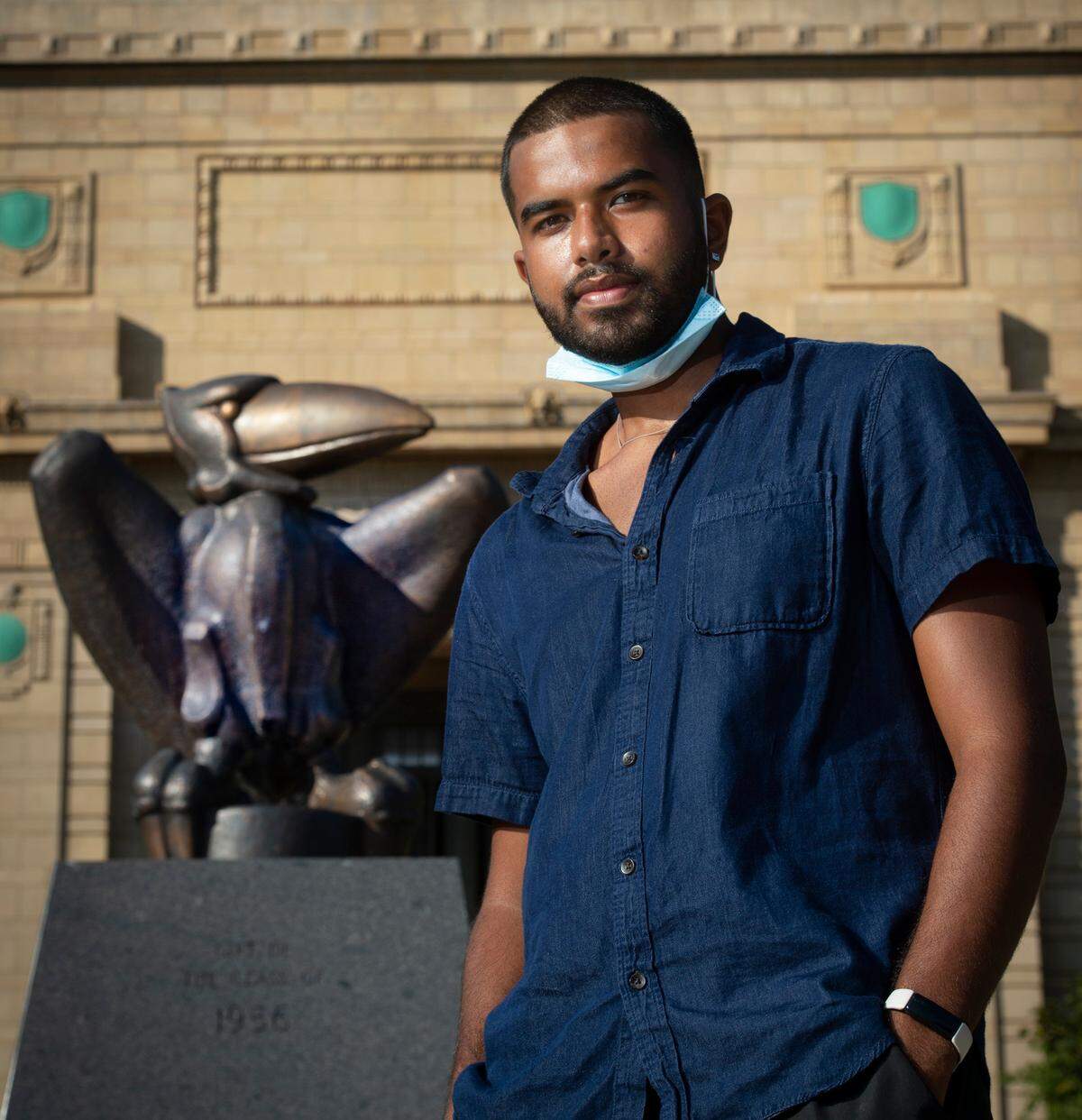
For KU student activist Sayan Grover the pandemic turned a normal college experience on its ear.
Allison Smith took a turn around the fourth floor of the University of Missouri’s Jesse Hall before heading for her destination — the Kinder Institute on Constitutional Democracy.
It all felt new for a reason: Smith has scarcely spoken to any of her professors in person, despite her plans to graduate in December with a degree in political science. Masked and dressed in a business-casual blouse and cardigan on a late August afternoon, she was a mix of nervous and excited. She thumbed through brochures as she hovered by a conference room door until someone came out to greet her.
“You’re Thomas!” Smith said after introductions were made, realizing the person who emerged from the room was the program adviser she had been emailing for months. “See, that’s the problem with COVID, I’ve never really met anyone before. Is there anyone I should start with?”
“It’s almost like this is my first day of college again,” she said in an interview.
In Lawrence a day earlier, Sayan Grover arrived at his new apartment. The junior at the University of Kansas, a son of immigrants who live in Overland Park, was moving back to town for the first time since COVID-19 forced him out of his dorm in the middle of freshman year.
He was not the same person who left in March 2020.
The pandemic forced him to look at many of his peers in a new, harsher light as he witnessed their indifference to the suffering around them, especially in marginalized communities. He worried for his family in New Delhi and, over Zoom, mourned the death of his uncle. He flung himself into community organizing and sought to educate his peers on racism after a Minneapolis police officer murdered George Floyd in May 2020.
“I lived in a microcosm of the issues that affected everyone around me,” Grover said.
Thousands of Missouri and Kansas undergrads are returning to school this fall, wary but hopeful, in COVID’S shadow. The past 18 months left their mark in missed opportunities, lost relationships and personal trials.
Some lost internships that were critical to building their resumes. Others said online classes simply didn’t offer the academic rigor they sought and that it was easy to drift away from their laptops. Most reported months of loneliness and isolation when they thought they’d be cultivating lifelong friendships.
The first surge of COVID-19 swept them from campus in March 2020, forcing completion of the spring semester online. They returned last fall for a school year marred by the winter peak in cases but ending hopefully as vaccines became widely available.
Colleges are now prepped for a nearly normal year, with classes to be held largely in-person. At KU, emergency management coordinator Andrew Foster said the university will roll out a huge vaccination push but won’t require COVID-19 testing. Before classes started, some students and faculty were already pushing for more robust precautions.
They realize that the delta variant could again scramble everything, leaving in its wake more false starts and trashed plans. Even if all goes well, many are reconciled to the fact that their undergraduate years will never be what they’d expected.
“There’s a kind of sadness ... and an honest sense of loss,” said Mary Klayder, a KU English professor and one of many faculty who have tried to mentor and counsel students from a virtual distance. “It’s been hardest on people who just don’t have that security that college is a given and also people who just don’t learn online very well.”
Bill Stackman, MU’s vice chancellor of student affairs, acknowledged the pandemic’s irreversible impact on that “one-time experience” that can change the arc of a young life.
“College is about relationships and socializing with your peers and with your professors and with staff members,” he said. “All of that was tremendously impacted. … I think we’re all mourning the loss of what we enjoy about college and the college experience.”
‘College is me ... with my laptop’
Smith grew up in Grain Valley, where her high school class was small and white, and where few of her family members had a chance at the classic, university-brochure experience: football games, friends from all over the country, professors who would challenge and inspire. She wanted to join clubs, study with a small group on the campus quad and try new restaurants in Columbia.
Afterward, she envisioned moving to Washington, D.C., to “work for whichever Democratic senator would hire me.”
Not wanting her dream to come at the cost of crippling debt, Smith completed a two-year associate’s degree through a state scholarship program at the Metropolitan Community College’s Blue River campus. She arrived at Mizzou as a college junior in August 2019. Columbia is the biggest city she’s ever lived in.
“I thought, ‘Wow, I can meet all different kinds of new people, people from other countries, people from California, people from everywhere,’ ” she said.
The first semester was an adjustment living on her own for the first time. She started as a journalism major but decided it wasn’t the right fit and switched to political science over winter break.
Spring 2020 was another adjustment — after adjustment after adjustment.
The move home and transition to online classes was “chaotic,” she said. Classroom discussions and office hours over Zoom were awkward.
By the end of that semester, which was devoted to completing social science credits, Smith still hadn’t had any in-person discussions with political science professors — the ones she saw as potential mentors.
Things were looking up as she enrolled in classes last fall. Four out of her five classes were to be held in-person.
But by the time the semester started, all but one had moved online. The lone in-person lecture was at a downtown Columbia theater to allow for social distancing.
Reluctant to buy a parking pass for one lecture, she ended up streaming it from her apartment.
This past spring was more of the same, with one lecture in-person. She attended, alongside a handful of other students, hoping for some social interaction.
“We all had to sit in masks and far apart, and it’s really hard to say, ‘Hey, how are you? How’d you do on the homework assignment?’” she said. “It’s just not the same.”
The whole experience was defined, she said, by a crushing loneliness.
She filled some of the gap with a remote summer job at a Kansas City political consulting firm, where she worked on campaigns for the Missouri House of Representatives. She enjoyed the gig, which extended through the November 2020 elections.
But after Mizzou told all students not to come back for classes after Thanksgiving break, Smith had what she called “almost an identity crisis.”
Locked down in her apartment, she watched her randomly assigned roommate make plans with friends she had made on campus prior to the pandemic. She considered meeting with a club or student group on Zoom, but with dozens of strangers on a video call, there was no opportunity to meet anyone one-on-one.
She withdrew to her room, acknowledging she was “slacking” on socializing. She kicked herself for spending her first two years in community college, though there was no way to predict a pandemic.
“College is me, in this room, with my laptop,” she said. “It’s nothing like I expected it to be.”
‘Lots of stuff coming from all directions’
Like many students routed from campus in the spring of 2020, Grover saw his social circles shrink as he moved home to Overland Park and interacted with others in small groups while making new friends online.
More than isolation, he felt frustration mounting as he watched others act as though COVID-19 were not a serious concern.
In August 2020, videos went viral of KU students hosting raucous parties, maskless and seemingly indifferent to the ongoing crisis. To Grover, it was an insight into who they were and a foreboding sign that the U.S. might never emerge from the pandemic
“If they were apathetic towards marginalized people or immunocompromised or people with disabilities during a pandemic, I don’t think they’re going to have any empathy for marginalized people even outside a pandemic,” he said.
As Grover struggled with the inequities of the pandemic world, he faced another, more interior challenge.
He’d long suspected that he had ADHD, but through high school and early college, he simply coped.
When learning went online in March 2020, his symptoms worsened. Focusing became harder in the new format, and deadlines were missed.
When classes started again in fall 2020, Grover made an appointment with the KU Counseling and Psychology Services. After months of therapy and discussion to determine whether his symptoms were truly ADHD or a response to the pandemic, he was tested and formally diagnosed.
“Even my therapist was, like, ‘Yeah, the symptoms were very obvious,’” he said.
As his junior year begins, he feels renewed pressure over the future. It seems to him like he’s barely been an undergrad but is already preparing to take the Medical College Admission Test and apply to medical school.
Having formed most of his ties with professors on Zoom, Grover is worried he doesn’t have the relationships he’ll need for good letters of recommendation.
He is hoping to finish majors in American Studies and Global and International Studies and a minor in Spanish along with his pre-med classes and get accepted to medical school by the time he graduates in the spring of 2023.
He had hoped to study abroad before graduating but is doubtful there’s time.
“It’s going to be pretty stressful,” Grover said. “Lots of stuff coming from all directions.”
‘Our experiment just stopped’
For Madison May, the pandemic meant a separation from the animals she loved and wanted to make her life’s work.
The Mizzou senior from St. Charles wasn’t sure at first what to study in college but learned about the university’s hands-on animal sciences program during a high school visit to campus. When she discovered she could minor in captive wild animal management, which prepares students to work in zoology and conservation, that sealed the deal.
The program requires a field internship, and May landed one in the spring of her sophomore year at the St. Louis Zoo — just as COVID began to spread. By the time the internship was canceled, it was too late to apply for another.
“We didn’t know that much about (the virus) and how it affected animals,” she said. “I was obviously disappointed but I completely understood, and I would be devastated if I had somehow given COVID to an animal.”
Her junior year would bring more missed opportunities.
In an animal reproduction class last fall, she spent all semester in a lab injecting mice with hormones to observe mating behavior and prepare them for dissection. The experiment was cut short when in-person classes ended after Thanksgiving break.
“Our experiment just stopped,” she said. “I definitely feel like I missed out on hands-on learning. … We were just given the data in a spreadsheet, and it was kind of disappointing not being able to see it for yourself.”
The delta variant wiped out a second chance at the St. Louis Zoo internship this summer. Same with an August trip to a Thailand elephant sanctuary. She is looking at the possibility of delaying her May 2022 graduation.
“I definitely wish I had more experience,” she said. “I want to make the most out of (this year). I want to try to get as many experiences in the little amount of time I have.”
COVID has taken a particular toll on students in the sciences. Amy Burgin, a KU biology professor, said in-person lab work is often where most mentoring takes place. She is used to spending hours with students talking about life and providing advice for school and careers.
“So much of the unstructured mentoring that we do just in conversation in the lab when people are standing around or processing samples or doing dishes — that’s where the really important work is happening with informal conversations about how grad school works,” Burgin said.
Without that, she said, she’s had to rely more on scheduled meeting times and places.
“The problem with Zoom is everything feels like it has to have a meeting time and a link and an agenda,” Burgin said.
‘I’ve still aged’
Gabriella Bain, a Mizzou senior, said that while there were “a few tears shed” when she lost her dream internship set for summer 2020 — working on social media for the Ultimate Fighting Championship in Las Vegas — strong ties to her family and a community of sorority sisters softened the blow.
But as her roommates left Columbia before Thanksgiving last fall, she found herself in total isolation, literally, facing the positive results of a COVID test.
She considered herself more concerned about the virus than the average college student, hearing near-daily updates from her father, a dentist in Prairie Grove, Arkansas.
“And then that paranoia sets in,” she said. “And I’m like, ‘Oh, my gosh, people are dying, what am I gonna do, who am I gonna call?’”
Alone in her apartment and far from family, Bain had a panic attack. In the emergency room, she said hospital workers “calmed all my fears and gave me tools to work through it mentally.”
For those new to campus, navigating college life in a pandemic became even more overwhelming.
Miles Luce packed his freshman schedule, joining the KU policy debate team, working as an editor for a student-run academic journal and achieving a long-held goal of getting his own work published. Yet he struggled to find meaning in anything he was doing.
“We underestimate how (the pandemic) changed our individual lives drastically and how we relate to the world and how we are as people and what we value, what we don’t,” said Luce, who grew up in the Kansas City area.
“I think that COVID had that kind of effect on me. It’s been a lot harder to derive meaning from things that used to fulfill me entirely.”
With life consisting of time spent almost entirely in his dorm room and the dining hall, the already intimidating task of finding friends in a large public university became more daunting.
Striking up a conversation in an elevator no longer felt like a natural task. Getting to know someone while walking to class wasn’t an option.
Now, heading into his sophomore year, Luce feels like he’s starting over.
MU vice chancellor Bill Stackman said the school expected the rise in calls for counseling services during the 2020-21 school year, though he did not provide exact figures. Improving mental health services had been a priority for his term as vice chancellor, and he said during the pandemic the university was able to reduce the wait time for an initial counseling appointment to two days.
His office took weekly surveys of students’ experiences last year, and he said the top two concerns were a dislike of online courses and a feeling of social isolation.
Carter Wade can relate.
A psychology major at Mizzou, Wade struggled with anxiety prior to college, describing the environment at his Hallsville, Mo., high school as “aggressive.”
But his first semester of freshman year, in the fall of 2019, was like an alternate universe.
“I had a really great time,” Wade said. “I felt really accepted by the community for the first time. … The thing that like really stuck out to me in the first couple of weeks was just everyone was nice to me and I was nice to them.”
He was at a small gathering of friends, celebrating his birthday in spring 2020, when he first read news of the shutdown.
Back home, attending school online and fearful of the pandemic, Wade said, his anxiety “spiraled.” He failed his classes that semester and took a leave from what would have been the first half of his sophomore year. Those six months, the summer and fall of 2020, are “all a blur in my memory,” he said.
Wade took online classes this past spring and found his way back to therapy, where he’d spent time in high school. He came to campus on occasion to see friends. He has similar plans this fall, wary that the delta variant may alter everything again.
Wade is now two semesters behind as he begins his third year of college. He is questioning all the plans he made, however tentative they were, to continue pursuing his major and go to graduate school. He feels rushed to “just get into the world” instead.
“I still feel like I’m in March of 2020,” he said. “It really feels like everything has stopped, but I’ve still aged.”
Among those most cut off by the pandemic have been international students. Both KU and Mizzou recruit students from around the world.
There were “desperate pleas” for in-person events when COVID-19 closed the campus, said Tiffany Learned, programming coordinator for international student services.
“Particularly throughout those early stages in 2020, my answer just had to be no.”
Some students were able to return home. But the international student services office advised most against doing that because it was unclear whether they’d be able to return to the United States to finish their degrees.
“They felt really lost and I also felt really lost about how best to serve them and how best to quell that sense of loneliness,” Learned said.
‘It’s now or never’
In May, as America reopened and mask-wearing recommendations were eased, Grover was coping with the loss of his uncle in India from COVID-19 and the knowledge that an aunt, pregnant with twins, had caught the virus. She became severely ill but is now recovering.
It galled him that while Americans were celebrating a return to normalcy and many were refusing to get the vaccine, his relatives were in danger and many across India lacked access to immunization.
“It’s impossible to separate racism and the pandemic,” Grover said. “With how easily people were moving on here in the U.S. while my entire family had COVID, I think people were even mad at me for being mad that the mask mandates were being taken away.”
Still, Grover found ways to extract something positive from a trying time. He came to KU with a deep interest in activism and delved into that work in ways he never imagined — focusing on direct mutual aid and advocacy.
As campus shut down his freshman year, he worked with a student group that had initially come together around Sen. Bernie Sanders and pushed the university to expand its pass/fail policy.
As a sophomore, he formed a new group, the Jayhawk Liberation Front, and organized a strike in an effort to push the university to go back online to prevent the spread of the virus. Students skipped classes on Labor Day, urging the closure of campus. Despite the demands, KU did not move to an entirely online format.
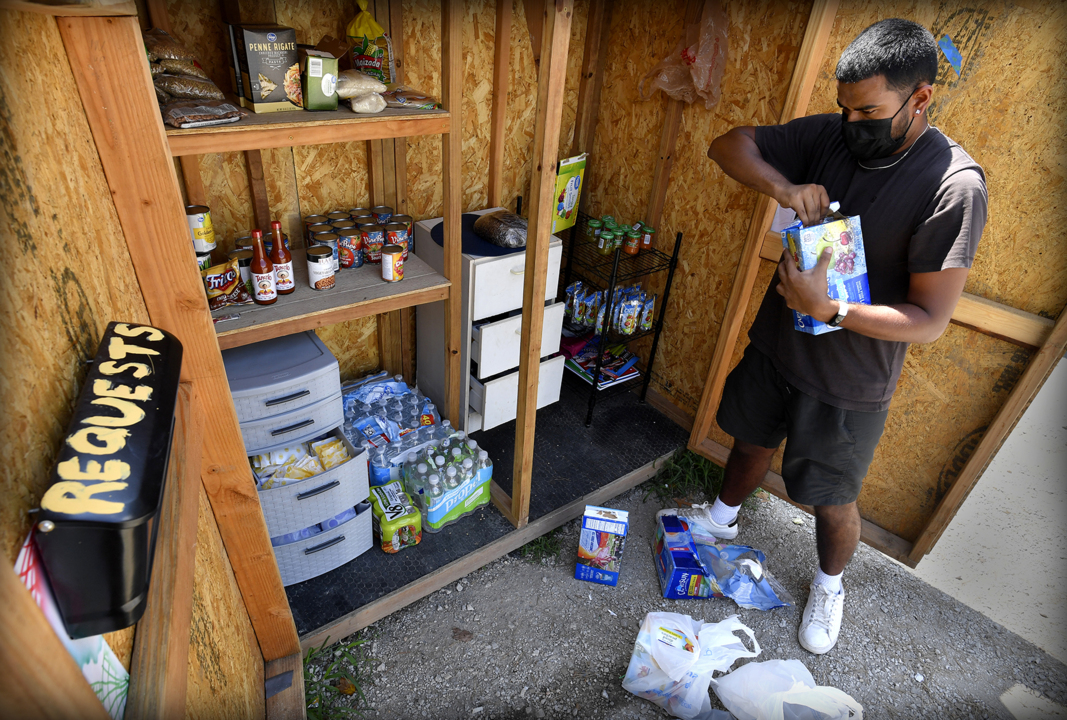
In the spring, he worked with a coalition of students to create a community pantry in an alleyway behind Massachusetts Street, downtown Lawrence’s main corridor.
The pandemic, Grover said, made clear the damage students could do to the community. He and others wanted to help heal it.
The pantry sits behind Latchkey Deli and is unlocked at all times. Grover and his peers have raised thousands of dollars to keep it stocked and to encourage community members to take what they need and give what they can.
“I never saw myself doing this pantry stuff even though I had an interest in social justice,” he said. “With everything being exacerbated and highlighted these last few months, I saw myself getting more involved and less with institutional or nonprofit organizations and more with community work.”
Heading into the back half of his college career, Grover plans to continue this work and hopes to expand it. He’s looking forward to living off campus with roommates and cooking for himself.
Everything else? Who knows?
“I was really, really hoping for a normal junior year. I wanted to go back out and enjoy my social life,” Grover said. “With the way the delta variant is spiking, I think that we’ll have to make some sacrifices.”
Smith, the senior Mizzou transfer student, said she was going into her last semester with lowered expectations. She just wants to do well in her classes and graduate.
“I’ve accepted the fact that (college is) probably not going to look like … everything I dreamed about,” she said.
Her plans have changed. She’s pursuing a master’s degree instead of moving straight to Washington after graduation. She’s not sure she’s ready for such a big city. The possibility of staying for graduate school makes it even more important to find academic mentors.
“I definitely feel like it’s now or never” for relationships with faculty and students, she said.
Her visit to the open house at the Kinder Institute gave her some hope, she said afterward. It was refreshing to chat with students with similar interests.
“It sounds like they’re really going to try to make everything as normal as possible, as normal as it can be.”
This story was originally published September 5, 2021 at 5:00 AM.