Here’s why KU, MU officials — and students — push to keep campus open despite COVID-19
When COVID-19 closed the University of Missouri campus this spring, Caitlin Danborn knew she would return this fall, even if the virus was still spreading.
The desire to be back with friends, doing things on her own and taking classes in person outweighed any worry about contracting the new coronavirus on campus.
“Being at home with my parents and taking classes online this spring just felt like an extension of high school,” said Danborn, a sophomore from Colorado and the editor-in-chief of the Maneater student newspaper. “Freedom and independence are a big part of what drove me back to campus.”
Even as coronavirus cases continued to rise this month, thousands of students flocked to Missouri and Kansas universities.
Like many of the students, university officials yearn to keep campus open.
They’ve spent the last five months developing new safety rules to protect students and faculty from COVID-19. They mandated masks, rearranged lecture halls and classrooms for social distancing, put limits on the size of gatherings and switched about half of classes to online.
Elsewhere in the country, colleges have been going to even greater lengths, including testing for the virus twice a week and holding classes in arenas and large auditoriums so students can sit far enough apart. At Syracuse University in New York, officials are testing the sewage leaving each dorm to spot signs of the virus before it spreads.
Local health departments are doing their part as well, closing bars and quarantining Greek houses. Kansas Gov. Laura Kelly on Friday said she was glad to see it. “These same kids who are in these fraternities and sororities, or mass gathering in dorms, who will be going back out to other communities … we just can’t have them become super-spreaders.”
Douglas Girod, chancellor of the University of Kansas in Lawrence, said students want to be on campus to experience “the complete environment.” That includes opportunities for learning and socializing.
At MU in Columbia, spokesman Christian Basi said students, faculty and staff want to be in person.
“Online is very much a different experience,” Basi said. “We have had to make adjustments but we felt that we could do in-person safely.”
That, and the university, like others, was concerned that if it did not offer in-person classes, many students would not enroll, and the university would lose millions in tuition, housing and other revenue.
And in college towns, like Lawrence and Columbia, the economic impact goes far beyond campus. The restaurants, bars and other businesses depend on student spending to stay afloat.
But hundreds of cases have already been found at both MU and KU, where classes just started last Monday.
Andrew Lee, a senior at KU studying political science, tested positive that day.
“I feel fine. I just can’t taste or smell anything,” he said, adding that he will remain quarantined at his Lawrence apartment for several more days.
Officials and students are warily eyeing other universities that have already had to close campuses.
One week after classes started at the University of North Carolina at Chapel Hill, outbreaks were reported and the school changed all classes to online. Some other schools that had planned to bring students back canceled the idea before classes even started.
Some student groups at KU and MU have called for online-only classes, as the schools did in the spring.
But a lot of planning was done and a lot of money spent by colleges on supplies, technology, training and more, preparing to bring students back. That kind of commitment makes it hard for college officials to throw in the towel on their plans, said John Pryor, a California researcher who studies the college experience.
“People can convince themselves of a lot of things, that it’s going to be safe, that it is going to be OK,” Pryor said. “It becomes hard to find that cutoff point when you finally say we spent millions and planned for months but we can’t do this. I think the schools that decided at the beginning they were not going to have face-to-face classes for the fall made the right decision.”
Students have to follow the new safety rules and resist risky behavior off campus, like attending large gatherings, congregating with friends and packing local establishments, where people may not be wearing masks.
On campus “we have had good compliance from students,” Basi said.
But the rules keep changing. On Wednesday, MU officials told students they could no longer just wear a face shield, “they have to wear a mask that covers their nose and their mouth,” Basi said.
“We have had an explosion of research about this disease. It is coming from the universities because that is what we do. But some of the very institutions doing this research are the very institutions struggling to stay open.”
Campus appeal
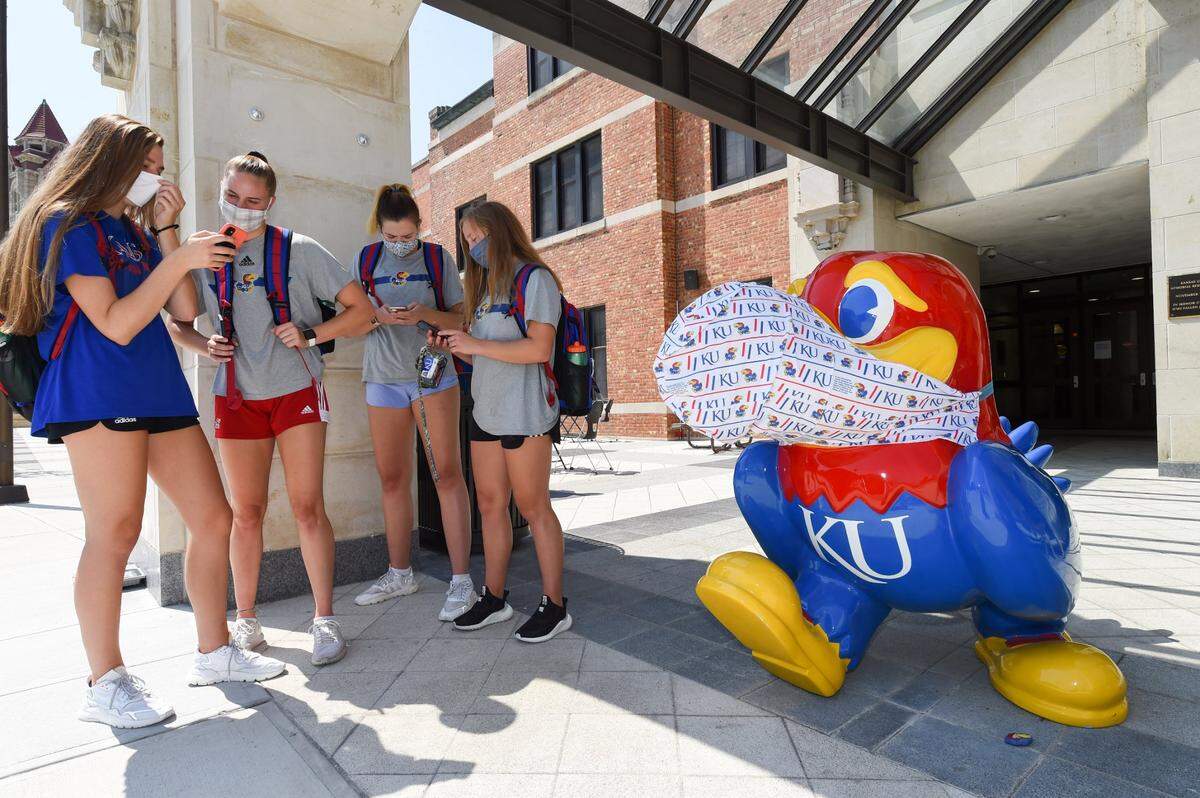
Even with the traditional college experience diminished, some students say being on campus is better than not.
“I feel more in a college mindset when I’m here,” Danborn said.
That’s a big part of why Eli Hoff, 19, is glad to be back on the Mizzou campus. Even though all his classes were moved online, “I do better academically when I am close to campus,” he said. But it does “feel weird being back on campus and not being able to sit in a big lecture hall taking notes.”
Some professors just give out assignments and students work at their own pace, he said. “I know I won’t get as much out of those classes,” Hoff said. “It takes a lot of self motivation to get everything done so I can get through the semester.”
Jack Sobel, a sophomore from suburban Chicago, lives off-campus and of his five classes, only one is in person.
“I know the risks of coming back to campus,” Sobel said. ”But I’m taking every precaution. I’m not going to bars or anything. And it has been really hard being here and not being able to hang out with friends,” because they are cautious too.
Maximillian Chibuike, who is a doctoral student studying chemistry at KU, said some of his work has to be on campus.
“I don’t have a lab at my house,” he said.
For Suzy Kramer, an 18-year-old KU freshman from New Jersey, coming to campus seemed like the right move, given the number of cases in her home state this summer.
To date, more than 190,900 people there have tested positive for the coronavirus and more than 14,100 have died, according to New Jersey’s Department of Health.
Kansas has reported about 41,000 cases in total, including 443 deaths.
Kramer lives in a campus dorm. About 4,000 people are in student housing at KU this semester.
“It’s nice to still have that in-person experience,” she said, “as opposed to just like sitting in your room at home online, where you’re not really at college.”
And even though the opportunities to meet people are more limited, Kramer said she has been able to spend time with her roommate and participate in activities like playing tennis.
“The need for connection is high among young people,” said Amelia Rance, senior director of data and analytics at Fullscreen, a research and social content group that focuses on what makes GenZers and millennials tick. “Unfortunately some of them jeopardize some of their safety for that connection.”
Positive cases
Kramer was one of about 20,000 people who was part of KU’s mass testing program.
So far 474, or 2.18%, have tested positive. But within KU’s Greek community, the positive rate was 10%. Last week, the Lawrence-Douglas County Health Department issued a quarantine order for nine chapter houses.
University officials said they never expected to be COVID-19 free, but they hope to keep the numbers low.
“The virus is out there, it’s everywhere,” Girod said. “So when you bring in 20,000 people, you know that some are going to bring some virus with us from the communities in which they lived, and so trying to identify those folks on the front end so we can get them isolated and prevent that initial wave of spread is really what we’re after.”
On Friday, MU had 306 active student cases. Seventy others who were infected had recovered. That amounts to about 1% of the nearly 30,000 in the student body. However, school officials aren’t releasing the number of tests that have been conducted, so the university’s positive test rate is unknown.
Numbers from health officials in Boone County, where MU is located, paint a more troubling picture. The county’s positive test rate for the week ending last Thursday was 44.6%, up from 10.6% the previous week. That prompted officials to order bars and restaurants to stop serving alcohol at 9 p.m., and entertainment venues to close at 10 p.m.
MU officials couldn’t say how many positive cases were among Greek organizations there. But on Thursday Mizzou fraternities announced they were suspending all in-person activities to avoid setting off a coronavirus outbreak.
University officials and health experts have stressed the importance of individual responsibility.
Lee, the KU student who has COVID-19, said sacrifices have to be made for a future payoff.
“I’m trying to make these decisions so I can walk (during the graduation ceremony) in the spring with the rest of my friends,” he said. “That’s what I’m looking forward to. If that gets canceled, I’m going to be really pissed.”
At many universities, students who refuse to cooperate with safety rules, like wearing a mask indoors at all times, could face penalties.
Students who fail to observe safety guidelines at the University of Missouri-Kansas City will face sanctions described by the school’s Student Code of Conduct, said John Martellaro, university spokesman.
“If a student continues to resist, they will be referred to the director of student conduct and civility for disciplinary review,” he said.
Refunds and reimbursements
Students interviewed by The Star said they would expect refunds for campus housing and dining plans if another shutdown happens, as they did in the spring.
But the schools did not reimburse tuition since classes continued, albeit online. Now some students say they would want a partial reimbursement if courses switched to virtual.
KU sophomore Joe Zheng, of Baldwin City, said he doesn’t get as much out of some online classes — like his foreign language course — as he would with in-person teaching.
And he doubts the campus can stay open the entire semester.
“I was already thinking if KU goes online within a few weeks, before the refund date, then I would just drop like half my classes and take them at Johnson County (Community College), because there’s no point in paying $1,000 a class when you can pay like $300,” Zheng said.
KU students have until Sept. 4 to drop a class and get a refund, according to the registrar’s office. The date was extended from Aug. 28. MU approved an extension for a full refund for dropped classes until Sept. 8, from the original date of Aug. 31.
Girod said the university’s Pandemic Medical Advisory Team will make recommendations as the semester progresses and they monitor the metrics.
“The reality is that the students are here, and whether we’re online or not, they’re here and so we need to really remember that as we think about what our metrics are going forward,” he said.
KU says 48% of courses have gone virtual.
“We’ve really de-densified the campus,” Girod said.
At MU, 51% of the classes are face-to-face, 32.5% are online only and 16.5% are blended.
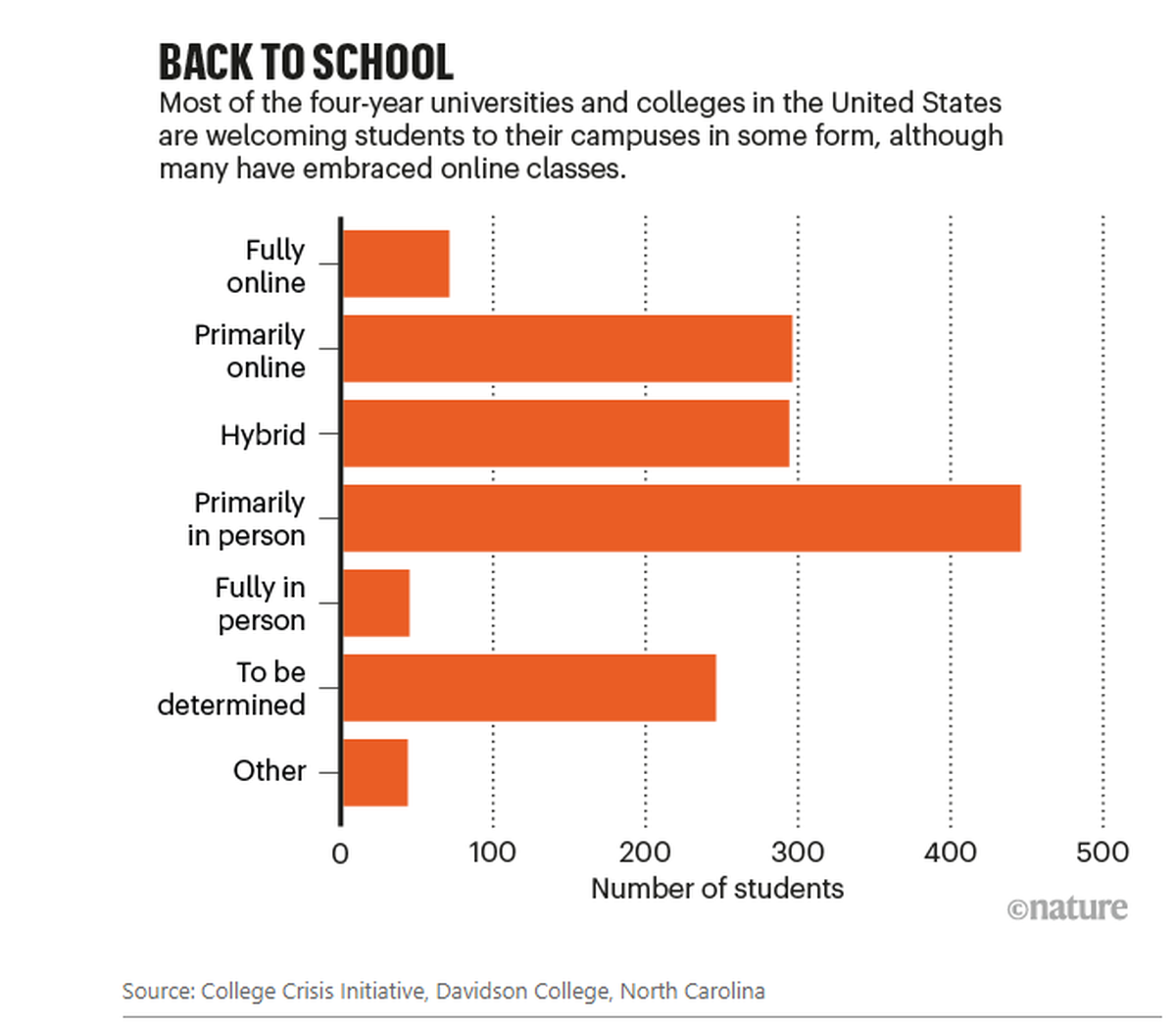
According to the College Crisis Initiative, a research project at Davidson College in North Carolina, more than 1,000 four-year colleges and universities in the United States are bringing students back to campus in some form, with 45 operating “fully in person,” another 446 as “primarily in person” and nearly 600 offering various combinations of online and in-person classes. The College Crisis Initiative was developed to examine how higher education institutions innovate in times of crisis.
Cultural anthropologists at Fullscreen surveyed 500 college students this summer to learn how they are coping with the “new normal” of COVID-19 and going back to school, and 43% said they are open to taking classes online but expect a discount in tuition.
Hundreds of lawsuits have been filed against colleges by students seeking refunds on tuition after classes they started in person were moved online in the spring. Two Kansas State University graduates last month filed a class action lawsuit against the school, claiming they did not get the education they paid for.
University officials figured that if they couldn’t offer students in-person classes and an on-campus experience, enrollment would suffer.
MU saw a 4% increase in its overall enrollment this fall. But unexpectedly, freshman enrollment was slightly down.
“We do know that a lot of students did say, I don’t feel safe going out of my state so I’m going to stay close to home,” Basi said. “I bet our 4% increase could have been higher if not for the pandemic. I believe that if we had said we were going to do online only we would have seen a steep decline.
“I think students were looking for an in-person experience and we really want to make this work so we are doing everything we can.”
While Basi could not quantify just how much MU might lose if it had to send students home and put all classes online, he said not having students on campus could put a lot of jobs in jeopardy. The spring shutdown was so costly for MU that the university ended up laying off 200 workers, and several thousand employees were furloughed.
“What has been the saving grace is we all know it is temporary,” he said, “but the question is for how long?”
This story was originally published August 31, 2020 at 5:00 AM.