Why the Kansas City Chiefs’ advantages extend well beyond their unicorn quarterback
READ MORE
Through the fire
Chiefs reemerge after seven months of challenges and stinging criticism, on and off the field.
Expand All
These words are going to lean optimistic, which will of course play well in Kansas City, but before we do that can we take a couple paragraphs to acknowledge that the Chiefs’ best days with Patrick Mahomes might already be in the past?
Maybe that sounds harsh, but it shouldn’t. The possibility is undeniable.
If the Chiefs had beaten the Tampa Bay Buccaneers in Super Bowl LV, this newspaper’s headline might have read DYNASTY. Maybe we’d have even added an exclamation mark or two. But NFL history is full of dynasties-in-the-making that turned into question marks.
The Rams won the Super Bowl after the 1999 season and were 14-point favorites for another championship two years later. They lost, missed the playoffs the next year, then steadily faded into obscurity — Stan Kroenke made sure of that — before moving to Los Angeles.
During the week of the Super Bowl after the 2010 season, ace beat writer Bob McGinn wrote how the Green Bay Packers’ age and cap space made their future even brighter than their present. The Packers won that Super Bowl, then started the next season 13-0 … and have spent much of the last decade finger-pointing about why they haven’t been back to the Super Bowl.
The Seattle Seahawks blew out the Denver Broncos in the Super Bowl after the 2013 season, and they did it with a 25-year-old quarterback. They made it back to the Super Bowl the next year … then didn’t give the ball to Marshawn Lynch at the goal line. And now they appear to have turned into a petri dish of infighting.
Patrick Mahomes can buy ownership stakes in the Royals, Sporting Kansas City and every barbecue joint in town, but no amount of raspy-voiced awesomeness can guarantee even one more Super Bowl for this franchise.
OK. Consider this sports journalism version of whataboutism over.
The rest of these words will be about why the Chiefs will win more Super Bowls with Mahomes, and we’re saying plural. They will be closer to the New England Patriots than the Packers (though mostly with sleeves, especially now that fullback Anthony Sherman has retired).
This is all based on relationships. On personalities. On the right balance of ego and humility. Because if you shorthand the conflicts in Seattle and Green Bay, they come down to a break in trust.
In each situation a hyper-competitive and successful quarterback stopped trusting — in one form or another — the people making decisions for his respective organization.
In Kansas City, we don’t have that. Not even close. At least not yet.
Chris Cabott, Mahomes’ agent, has said that the only person who believed in Mahomes as early and thoroughly as he did was Brett Veach — who pushed coach Andy Reid and then-GM John Dorsey on board to trade up for Mahomes.
Veach took over as general manager four summers ago, and every move the team has made since has been run through a simple test: If it’s good for Mahomes, they do it.
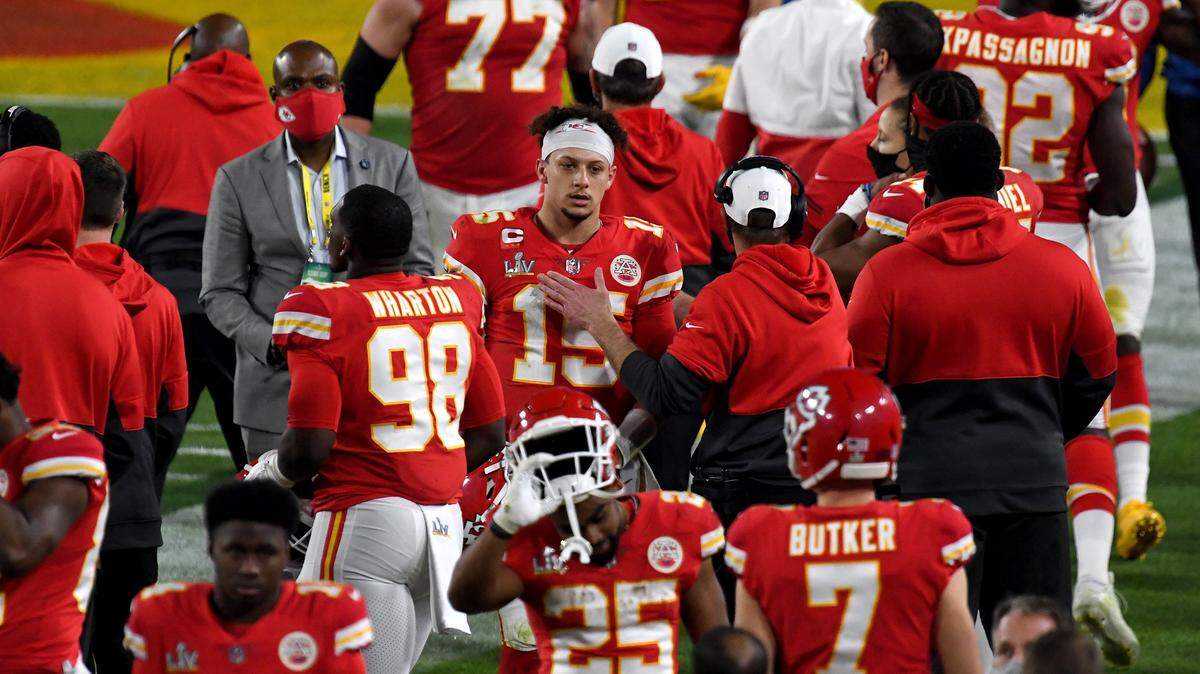
That means the quarterback, front office and coaching staff are all tied together. One’s success depends on the others’. That’s how bonds are built. Two Februaries ago they partied together. Last February they seethed together.
“I think we’re always focused,” Mahomes said. “You can definitely feel the intensity of practice, offensive and defensive side of the ball are competing every single rep. We understand we didn’t end the season how we wanted to last year, so we find a way to get better so that we can find a way to end it how we would like this year.”
The most notable part of that this offseason was a total overhaul of the offensive line — literal protection of Mahomes, the league’s most valuable asset.
Veach has joked that he began planning those changes at halftime of the Super Bowl, but he wasn’t joking when he told Mahomes minutes after the game that they would get the line right.
We’re still too early into the reconstruction to say whether that’s happened, by the way. Offensive lines rely on connectivity more than any other position group. These are talented pieces that we still need to see perform together.
But they’re generally being given the benefit of the doubt, for at least two reasons. The first is they’re talented, but more to the point there’s a culture here now that expects the best.
This is far from the first time the Chiefs have overhauled a position group. Remember the skepticism when someone else’s backup would come in to be the Chiefs’ next starting quarterback?
Even moves that have turned out well have been welcomed with skepticism. The best recent example might be the overhaul of the Chiefs’ defense after the 2017 season. Chiefs fans, justifiably, needed to see some results before they started believing.
Now, the default has flipped.
This is a beautiful if precarious place to be. Beautiful because this is where teams steal advantages over opponents, with Mahomes as the league’s ultimate force multiplier. Precarious because nothing lasts forever in this league except for Tom Brady.
Which brings us to another relevant human element at play here: ambition.
We talk a lot about the NFL’s natural parity and the salary cap and free agency, but another important factor working against teams winning multiple championships is that it requires men who are making more money than ever and constantly being told how great they are to somehow find the sort of focus more commonly seen in someone who’s just trying to make the team.
It requires guys in commercials to work like guys on the practice squad, and for guys with Super Bowl rings to be nonplussed about AFC championships.
That’s a different skill set than what’s measured at the combine, and it’s not exactly the same as what football people mean when they talk about “guys who love football.” This is not what separates good from great, but what separates great from legendary — and it’s not necessarily healthy, either.
The 2020 Chiefs won 16 of 18 games with their starters playing, and won on the road against each of the teams they lost to.
And they still must consider last season a failure. That’s not normal.
“The great ones make money,” Reid said. “(But) they want you to give them something, a little nugget, to make them greater than they are right now. I’ve told that story to our guys before, and I’ve seen it with our guys. Everybody asks about Patrick — Patrick always wants something more to make him better than he is, and he’s making more than anyone.”
These aren’t forever answers. Things change. The examples at the top are proof. But forever answers don’t exist in sports. Long-term success requires the ability to solve problems that don’t yet exist, and then solve the problems created by that solution. This stuff is hard.
But the point here is that the Chiefs are as well-positioned as any franchise in the modern NFL, up to and including the Brady-Belichick Patriots, to enjoy sustained success.
They are loaded with talent, and that’s a good place to start. But that talent is also backed up by mutual trust and the right balance of ego and humility.
We’ve seen that in the months since the Super Bowl. We’ll continue to see it this season.