New Jackson County jail will be over capacity the day it opens | Opinion
Kansas City, we have a problem — an overcrowded county jail problem.
So what’s the fix?
Apparently portable beds, expanded pods and bond reviews for dangerous criminal suspects will address this pressing issue now and in the near future, according to Jackson County Prosecutor Melesa Johnson and Sheriff Darryl Forte. But is that enough?
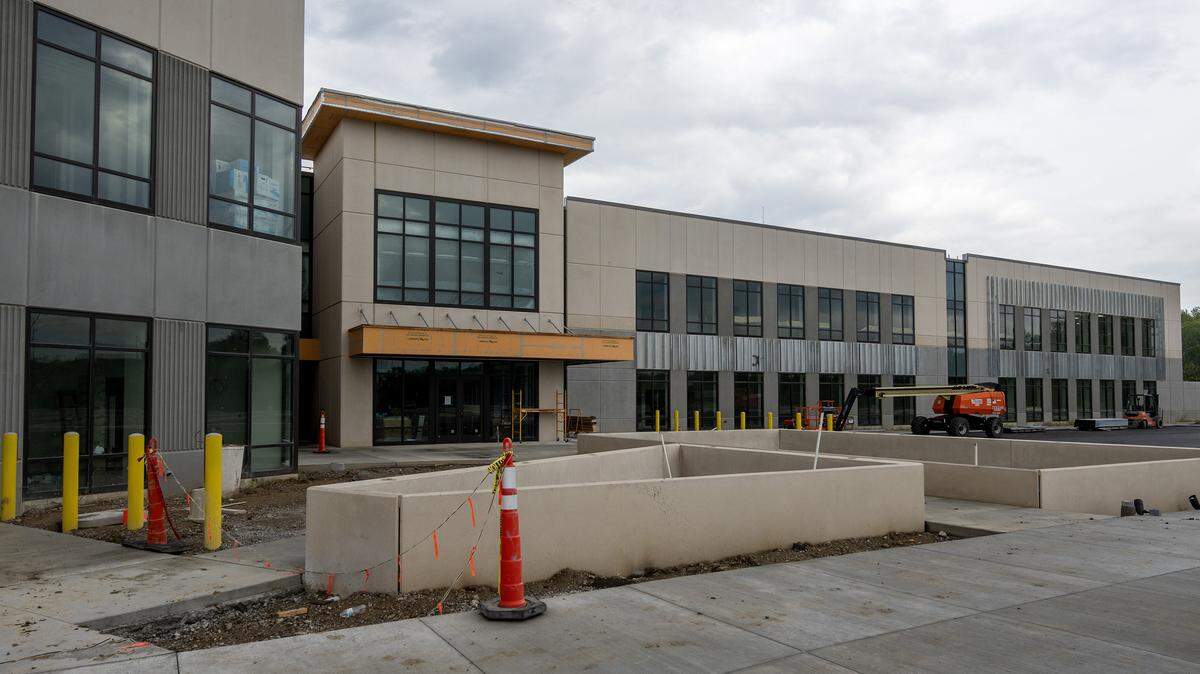
Not only is the current Jackson County Detention Center over capacity — even if the new detention center now nearing completion at 7000 East U.S. 40 was open, the $317 million facility still wouldn’t solve the overcrowding issues, Johnson said during the recent monthly Kansas City Board of Police Commissioners meeting.
“It will be over capacity the moment that the new facility is open and available to our community’s use,” she said.
Take a few moments to let that sink in. My ears certainly perked up when Johnson updated the police board about the matter.
Unless local leaders and elected officials come together rather quickly to resolve this pressing issue, I can’t see how the situation will get better anytime soon.
We’ve long known in this city the issues with Kansas City’s municipal jail — there isn’t one and local inmates accused or convicted of mostly low-level offenses are shipped off to Vernon or Johnson counties while in municipal custody. My former colleague Melinda Henneberger reported extensively on this topic, and her findings that Black male Kansas City inmates were subjected to harsh and unfair treatment in Vernon County led our board to conclude a new city-owned municipal detention center, approved by voters in April, was solely needed here.
But to learn the county detention center is overcrowded is much more unnerving. Some really bad actors are housed there on state charges that include murder, sexual assault and other serious allegations. In a city with a relatively high violent crime rate the last few years, I’m not against aggressive policing and prosecution in the name of public safety.
But these tactics must be implemented fairly and legally — nothing I’m reporting on here suggests otherwise.
I freely admit that I am torn on the issue of overpolicing and law and order. In essence, Kansas City needs adequate jail space at the city and county levels, yet I stand firmly against locking up people en masse to the point where the Jackson County jail is over capacity.
And anyone concerned with the mass incarceration of criminal suspects in this county should be too.
Higher charging rate
How did we get here and what is the solution?
Johnson did not discount that an aggressive approach by her office in charging people for their alleged criminal acts contributes to increasing numbers. As of last week, Johnson’s case filing rate was 61%, which was substantially higher than the 41% rate in January when she took office.
Johnson campaigned on law and order and in nine months in office, she seems to be following through on her pledge to be tougher on crime than predecessor, Jean Peters Baker.
“With higher charging rates and not having more jail capacity, that is certainly going to be a difficulty but one we are prepared to streamline and to work through and will leave no stone unturned to try to make sure we find the appropriate balance,” Johnson said.
And what did Johnson say about how this could be fixed? She told the police board that some inmates could be released on bond pending trial, which means people that could pose a threat to public safety would likely return to the community before they have been found guilty in a court of law.
“It puts our judges in a position where they have to make some difficult decisions as it pertains to bond because when you have a full jail you have to consider a totality of circumstances to see if somebody can be supervised in the community,” Johnson said.
In a follow-up statement sent to me via email, Johnson said she is incredibly grateful for the new facility.
“Given the number of individuals we are seeing coming in and out of the justice system each day, this facility will likely be at capacity from the moment it opens,” she said. “We need facilities that provide room to grow and adapt to changing community needs and that’s why I’m proud the Legislature was able to ensure the design for the detention center allowed for it to be expanded upon if needed with additional pods.”
County jail at capacity
As of last week, the county detention center was filled by nearly more than 1.5 times its recommended capacity, according to Sheriff Forte.
By Friday’s count, 1,033 people were incarcerated at the Jackson County Detention Center, Forte wrote in an email.
The problem with that is the current jail has 800 beds, but is operationally full at 640 inmates, according to recommendations by the National Institute of Corrections, an advocacy group.
The NIC recommends that a facility maintain a 20% vacancy rate to enable repairs and routine maintenance, Forte wrote.
“And to ensure that inmates who cannot be housed together are appropriately separated by classification,” he wrote.
The jail’s average daily population in July was 991 inmates, according to Forte. By the last week of September, the daily count was more than 1,000 per day, he said. Additional beds were added to the facility to help manage the overflow, Forte said. Former inmate indoor recreation spaces and portable bunks were added to current housing units in common day spaces, he said.
“The jail’s daily population has been on a steady increase since the first of the year and is running approximately 100 more inmates in the facility than we averaged in our highest month in 2024,” Forte wrote.
According to Forte, the inmate population is directly determined by the outcomes of the judicial process, including decisions made by prosecuting attorneys, juries and judges. He added that the sheriff’s office remains in ongoing communication with Johnson, the county prosecutor, and Jackson County 16th Circuit Court Presiding Judge Kevin Harrell, to explore strategies for resolving cases involving inmates who have been in custody for extended periods.
I would encourage all involved not only to continue those conversations, but remain transparent about what those plans are.
I reached out to Harrell to get information on how the court plans to proceed but was told in an email that the court would have no comment.
“We appreciate your interest in the subject,” Jackson County Circuit Court public information officer Scott Lauck wrote. “However, the court is declining to comment at this time.”
The new detention center is scheduled to open in spring 2026 and was originally designed with 1,257 beds, Forte said. Due to increasing construction costs, the bed count was reduced to 1,001, according to Forte.
But enough land exists to add housing units to the new facility “without having to expand the core support services areas, such as the kitchen and laundry,” Forte wrote.
Decarcerate KC leader speaks out
Amaia Cook is executive director of Decarcerate KC, a Kansas City nonprofit that wants to end mass incarceration here. In an email, Cook said data presented by Johnson clearly shows that a bigger, newer jail isn’t the answer to cure society’s ills. Investment in housing and health care could be though, Cook wrote.
“The reported overcapacity at the Jackson County Detention Center and the new facility shows that simply adding more beds isn’t the solution,” she wrote.
Cook added that this tough on crime approach is neither fiscally responsible nor effective — I found it difficult to disagree with Cook on that point.
Instead of focusing on incarceration, county leaders must address the root causes of violence, Cook said.
“Violence is often rooted in systemic issues,” Cook wrote. “Many people are struggling with rising costs for housing and food, limited access to mental healthcare, and economic instability.”
Any solution must provide accessible and affordable housing, comprehensive healthcare and financial support, Cook said. Adding more jail space or temporary beds isn’t the answer, she said
“By investing in these areas, we can prevent harm and reduce the number of people in detention,” Cook wrote.
Sounds like a practical solution to me.