Missouri set to use gerrymandered map in August primary despite legal chaos
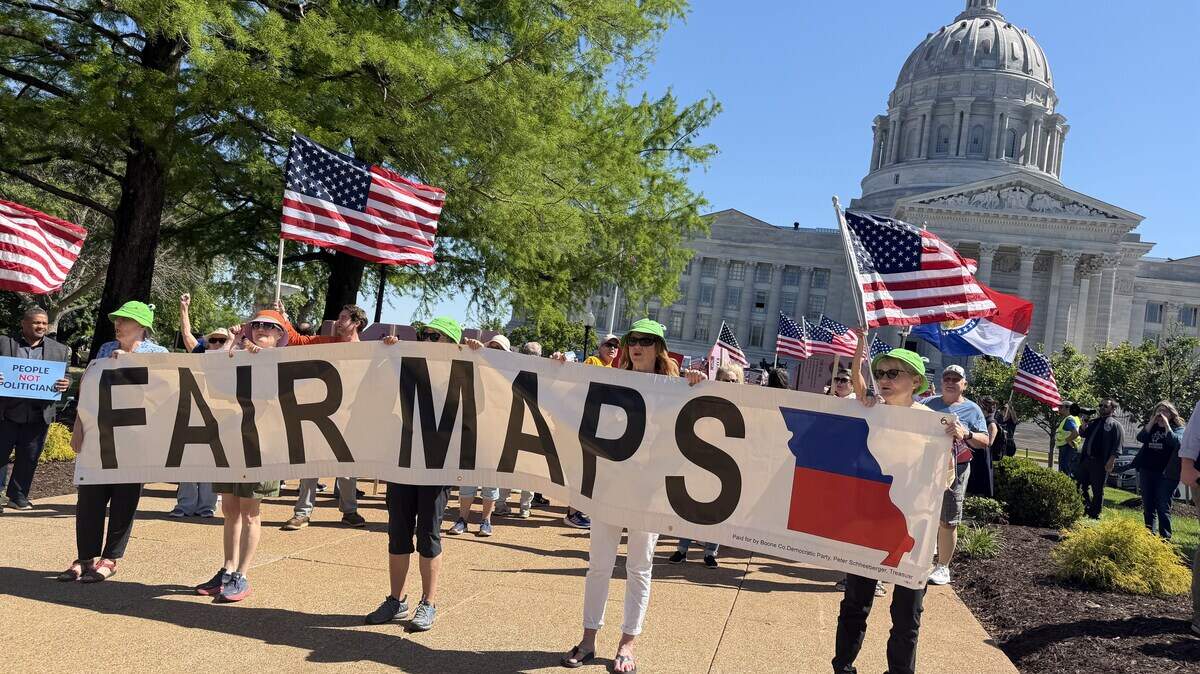.jpg "A crowd gathers outside of the Missouri Supreme Court after legal arguments in a trio of cases that could decide whether Missouri’s gerrymandered congressional map, which slices through Kansas City, can be used in the 2026 midterm election.")
AI-generated summary reviewed by our newsroom.
- Missouri appears set to use the new map in the Aug. 4 primary.
- The Missouri Supreme Court left it unclear if the map was in effect until Hoskins decides.
- Local election officials prepared to run the August primary while legal challenges loom.
Missouri appears set to use a new, gerrymandered congressional map in the upcoming August primaries despite serious questions over the map’s legal status and the possibility that the election might be overturned.
A month-long delay this week in a key court case cleared a path for Republicans to use the new map in the Aug. 4 primary. Now, local election officials are gearing up for a primary election that is virtually certain to spark a raft of lawsuits challenging its legality.
In the wake of the delay, both opponents of the map and local election officials have started to accept the likelihood of the map being used in the primary. That stark acknowledgement sets the stage for a chaotic election season as Republicans seek to force out of office Kansas City’s longtime Democratic congressman in November.
“The state is conducting an election that may not be valid,” said Richard Von Glahn, the executive director of a referendum campaign to strike down the map at the ballot box.
Republican supporters of the map, which they dub the “Missouri First Map,” have long claimed that it is in effect and would be used in both August and November. Republican Secretary of State Denny Hoskins, a former state senator, on Friday called it “the most compact and contiguous” map he’s been involved with.
“I am pleased to see it prevail,” Hoskins said in a statement.
The chaos comes amid a tangled web of court cases and rulings over the map and the referendum campaign, called People Not Politicians. Republicans approved the map last year under pressure from the Trump administration, carving up Democratic-leaning Kansas City into three GOP-friendly districts in their quest to unseat 11-term U.S. Rep. Emanuel Cleaver.
The map’s use in August would have no immediate impact on Cleaver, who is running unopposed in the Democratic primary for Missouri’s 5th Congressional District. However, it opens the door for Republicans to argue that the new map should also be used in November.
On its face, the delay this week was procedural. Cole County Circuit Court Judge Daniel Green on Wednesday moved to July a hearing in a case that could have forced Hoskins to decide whether to certify the referendum for the ballot — a decision that could also block the new map.
But Green’s timeline made it virtually impossible for ballots to be changed before Aug. 4 — all but ensuring the new map will be used in the primaries. Election officials have to finalize ballots for military and overseas voters by June 19, according to the attorneys for at least one election board.
Ruling upends August elections
At the center of the controversy is an ambiguous ruling from the Missouri Supreme Court last month that left local election officials scrambling. The state’s highest court upheld the map as legal, but also left unclear whether it was in effect or not.
That ruling focused on the referendum campaign, which raced to collect signatures across Missouri last year to hold a statewide vote on the map in November. The goal of the effort was to strike down the map.
The court found that when the campaign turned in more than 305,000 signatures to force a statewide vote on the map, that decision alone did not suspend it from taking effect. Instead, the court ruled that it was “impossible to say” if the map was in effect until Hoskins decides whether to certify the referendum for the November ballot.
If Hoskins certifies the referendum, the court said, the map would be retroactively suspended. In other words, it never would have gone into effect. However, the court gave Hoskins until Aug. 4 — the same day as the primary — to make his decision.
Hoskins, a staunch supporter of the map, has suggested that he would wait until that final day to decide, building on a series of delay tactics deployed by Republicans to ensure the map would withstand the onslaught of court challenges.
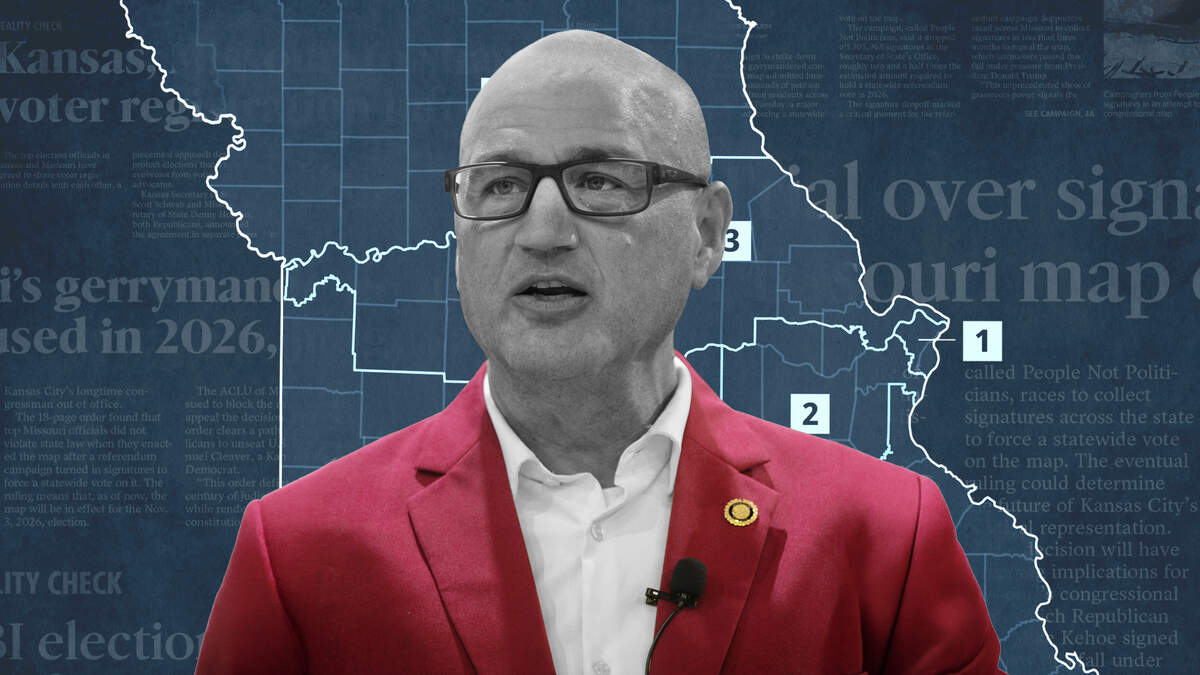
Hoskins initially rejected the referendum petition and later tossed out nearly 90,000 of the campaign’s signatures. State officials sued to block the campaign in court. Republican Attorney General Catherine Hanaway launched an investigation into the campaign. And a political action committee backed by national Republicans has intervened in the series of court cases.
Hanaway appeared to acknowledge the Republican strategy on a conservative talk radio show earlier this year.
“As long as the status quo is the new maps, delay works in our favor,” Hanaway said in the interview, referring to her office’s maneuvers over the map.
Election officials prepare for new map
Amid the delays, local election officials are now preparing to use the new map in the primary.
Only two Missouri counties — Osage and Reynolds — have not yet implemented the new map in the state’s voter registration system, according to a spokesperson for Hoskins’ office. Those two counties recently held special elections and could not update the data until their elections closed.
“Otherwise, all other counties have completed this process as far as we are aware,” said Hoskins’ spokesperson, Anne Marie Moy.
One of those election officials is Brianna Lennon, the clerk for Boone County, the home of Columbia and the University of Missouri. Lennon, who previously vowed not to use the map until Hoskins made a decision on the referendum, acknowledged that she and other local officials were now preparing to use it in August.
“We’re all trying to do our best with the understanding that we might still have to redo the August election,” Lennon said. “That’s kind of where we’re at, is trying to make the best out of a bad situation. My own priority is making sure that, at the local level, we’re as consistent as possible.”
Illegal election?
The map’s use in August sets the stage for a post-election lawsuit that could determine whether Hoskins held an illegal primary election on a map that should have been blocked. Chuck Hatfield, an attorney for the referendum campaign, said Hoskins was “taking a big chance” by not certifying the referendum before the primary.
“If we use the wrong maps, I think the most likely result is we have an invalid primary,” said Hatfield, “and (the courts) void it and order it done again.”
While exceptionally rare, there is recent precedent for Missouri courts overturning elections. The state Supreme Court in 2024 tossed the results of a 2022 vote that forced Kansas City to spend more on its police. That seismic decision came after Mayor Quinton Lucas sued to void the election results, arguing that the measure misled voters.
Despite the serious legal questions, Republicans have remained steadfast in their belief that the map is in effect and will be used. Six candidates are currently jockeying in the August Republican primary for the 5th District to challenge Cleaver.
One of those candidates, state Sen. Rick Brattin from Harrisonville, echoed that confidence on Friday and reiterated an argument from conservatives that only state lawmakers had the power to decide the state’s congressional districts.
Brattin, who has repeatedly attacked the state Supreme Court as too liberal, claimed that a court ruling against the map in the future would be political.
“If the court does what they’re supposed to do, and interprets the Constitution for what it says, not what they hope it says, I have zero issue, I have zero worry that they’re going to rule against (the map),” he said. “And if they do, in my opinion, that’s about as activist as you can possibly get.”
As Missouri prepares for the upcoming primary, the series of questions surrounding the map has thrown the state’s election cycle into disarray. Even those closely connected to the issue acknowledge that Missouri’s unprecedented mid-decade redistricting fight — and the looming referendum campaign — have thrust the state into uncharted waters.
“We are engaged in something that has never been done before in the history of our state,” said Hatfield, a longtime Jefferson City attorney. “We’re discovering what the law is in real time.”