How Denny Hoskins and his red jacket reshaped Missouri’s top elections office
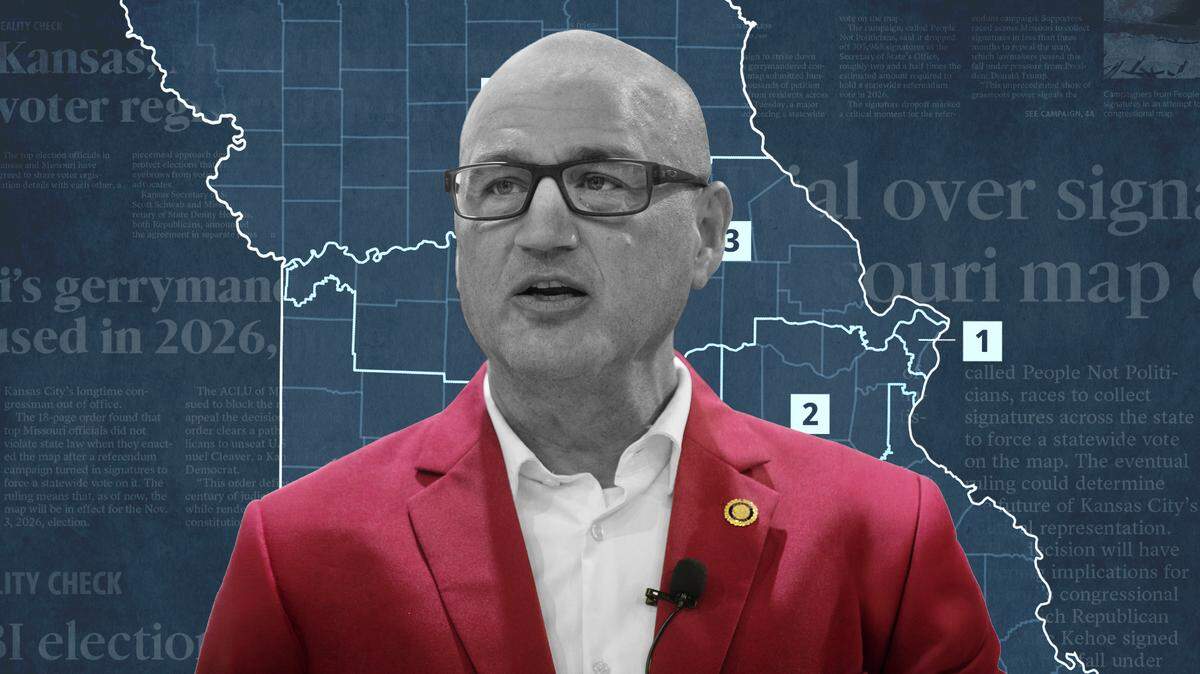
Minutes into a rally in an industrial stretch of northern Kansas City this week, Vice President JD Vance stopped his speech for a moment to search for Missouri’s top election official.
“Where is Denny at?” the vice president asked the crowd of supporters and Republican officials gathered inside Milbank Manufacturing. Secretary of State Denny Hoskins was standing in the front row, donning the bright red suit jacket that has become a signature part of his political brand.
“Denny, that is a nice blazer, man,” Vance said. “If you wear that blazer in the Oval Office, the President of the United States would take special note of you.”
The brief acknowledgement from the Trump administration marked an unofficial coronation of sorts for Hoskins, the 51-year-old former state lawmaker turned hard-charging election official who has quickly built a reputation in Missouri as a conservative firebrand.
Since becoming secretary of state last year, Hoskins has dramatically reshaped the office, historically a ministerial position designed to handle elections.
Through his efforts to thwart citizen-led campaigns and recent tussles with local election officials, critics say Hoskins has wielded the powers of his office to champion conservative ideals at a level with few parallels in modern Missouri politics. Those actions have sparked praise and scorn from both sides of the political aisle.
Hoskins’ role in Missouri’s mid-decade redistricting efforts has grabbed the most headlines. The Republican faces intense criticism for holding up a referendum campaign that seeks to strike down the state’s new congressional map, which lawmakers approved last year under pressure from President Donald Trump.
But Hoskins’ handling of elections and statewide ballot measures has also drawn scrutiny from experts who question his ability to lead the office in a nonpartisan manner. Since his election in 2024, Hoskins has faced a series of lawsuits alleging he crafted ballot questions intended to mislead voters.
As Missouri prepares for what could be a chaotic Aug. 4 primary election, The Star spoke with lawmakers, election experts, consultants, political scientists and Hoskins himself about the way in which he has handled the office. Those interviews painted a portrait of an election official willing to push the boundaries of his office and state law in pursuit of partisan politics.
“I don’t think anyone can expect a statewide official elected with a party label next to their name to be completely neutral,” said Peverill Squire, a political scientist at the University of Missouri, “but he appears to only make decisions that are in the Republican Party’s interests and, possibly, in his own future electoral interests.”
‘Missouri Red’
Hoskins’ rise within Trump world politics was on full display Monday afternoon during Vance’s trip to Kansas City. The vice president’s recognition of Missouri’s secretary of state, among the state’s least public-facing positions, was noteworthy.
Hoskins took notice — particularly after Vance’s tribute to his trademark red suit jacket. He owns three from a brand called Braveman and has worn them in virtually every public appearance over the past two years. He purchases two-piece suits and wears the jacket. He donates the pants to charity, he told The Star.
“I’m not cool enough to wear red pants,” Hoskins said.
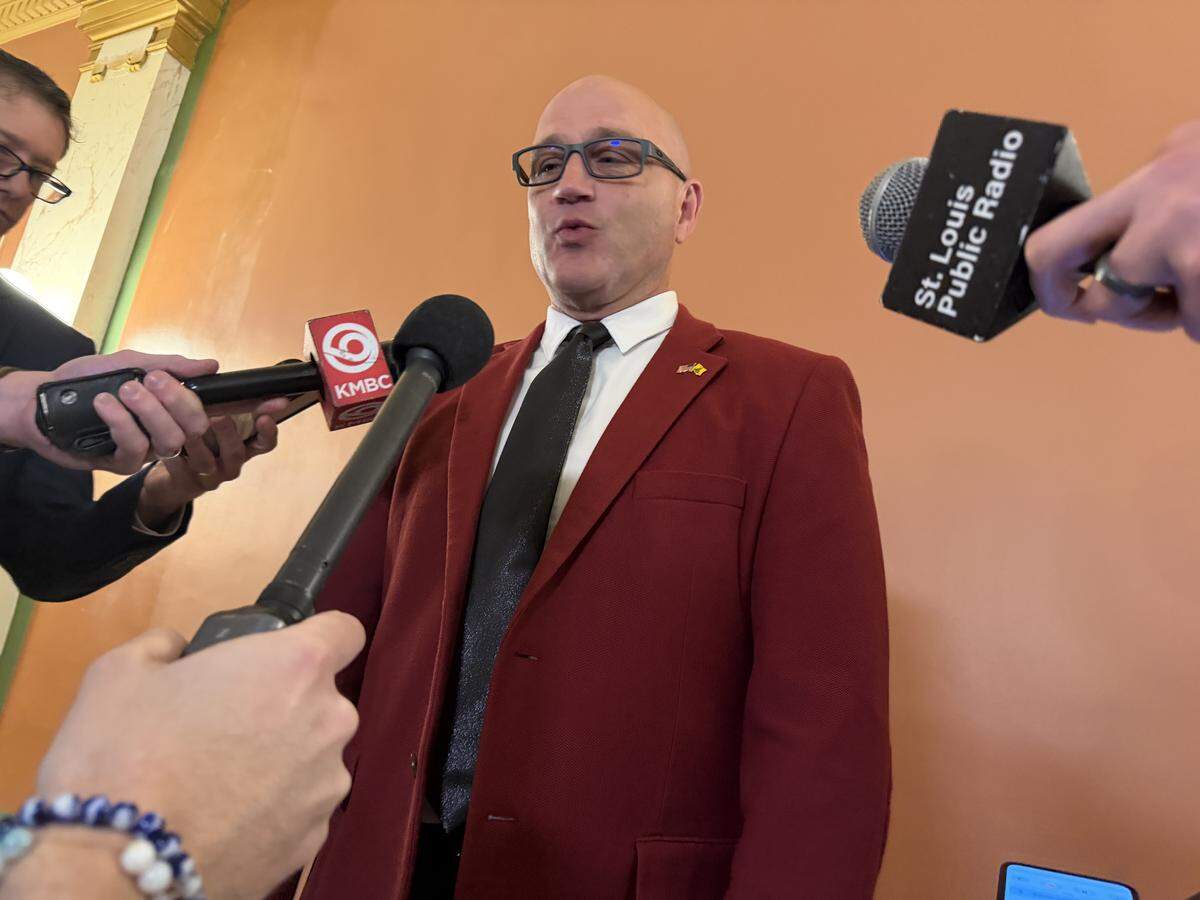
Hoskins rejects the idea that his red jacket, a color often associated with the Republican Party, is partisan. He views it as a way to honor his hometown of Warrensburg and the colors of his alma mater, the University of Central Missouri. He said he lifted the idea from another former state senator from Warrensburg who also wore a red jacket.
“The red jacket definitely has a unique, iconic personality of its own,” Hoskins said.
Perhaps more noteworthy, Hoskins’ affinity for red has also seeped into state documents released by his office. Since taking office, Hoskins has changed the covers of publicly available copies of the Missouri Constitution and the official state manual, both historically blue, to a shade of red he calls “Missouri Red.”
“We have a lot of great things in the state of Missouri that relate to red, St. Louis Cardinals, the Kansas City Chiefs,” he said. “Red represents a lot of different great things in Missouri and most definitely does not have to be partisan.”
But, for political experts and critics, Hoskins’ signature jacket and the red Constitution serve as symbols for his willingness to blur the lines between partisan politics and the administrative duties of his office. For some, it signals an extraordinary push by Hoskins — who campaigned on a promise to stand “against the woke agenda” — to insert conservative politics into how Missouri handles elections.
“On the one hand, these little things aren’t maybe that important,” Matt Harris, a political scientist at Park University in Parkville. “But in another sense, they are, I think, indicative of somebody who sees a partisan fight in everything.”
That fight is most visible in Missouri’s protracted redistricting push, in which Hoskins’ actions have scrambled local election officials of both parties and raised serious concerns about the upcoming Aug. 4 primaries.
Carving up Kansas City
Republican lawmakers last year redrew the state’s congressional map to push out U.S. Rep. Emanuel Cleaver, Kansas City’s longtime Democratic congressman, a move that forced Missouri into a national redistricting frenzy. Hoskins has since been a staunch supporter of the new map, which Republicans call the “Missouri First Map.”
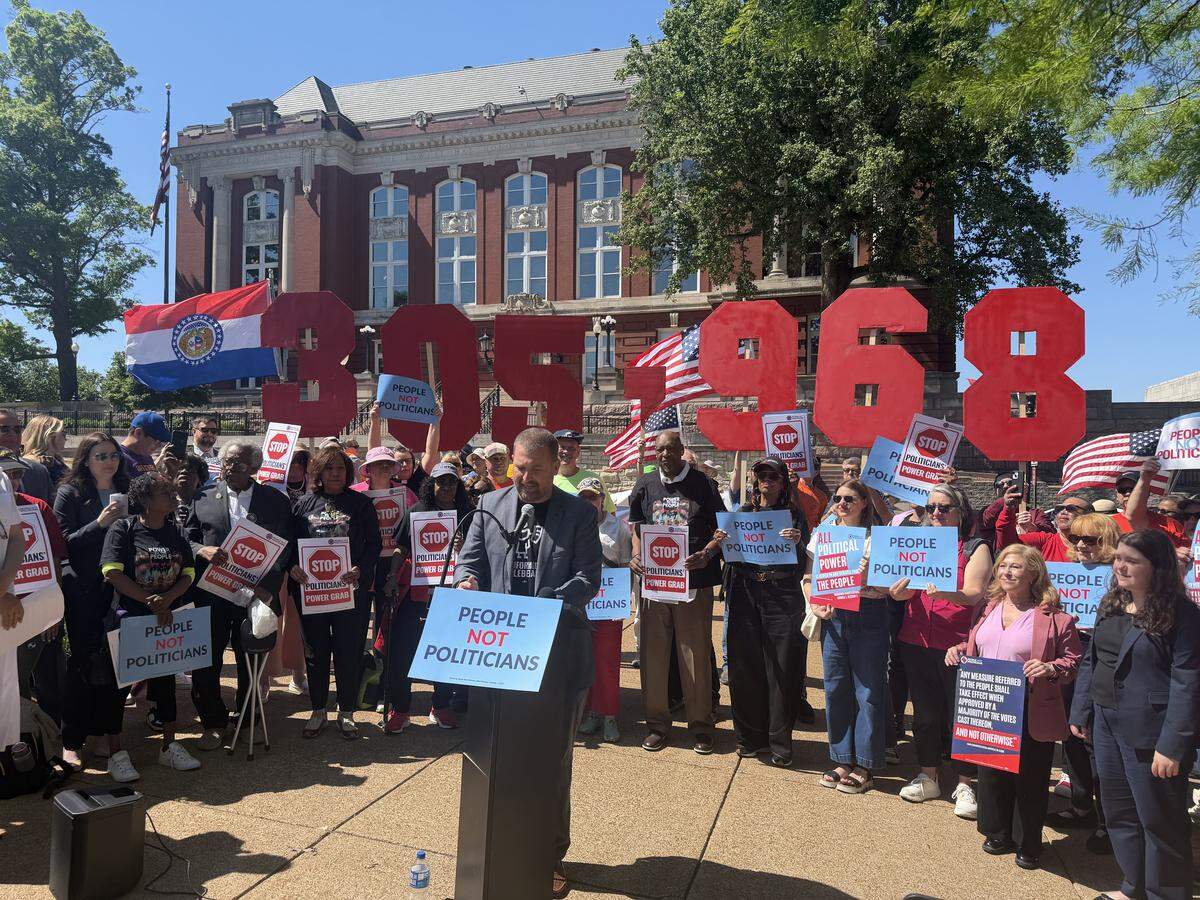
In the wake of that vote, a campaign called People Not Politicians raced across the state to collect more than 305,000 signatures to force a statewide vote on the map through Missouri’s referendum process. The goal of the effort is to strike down the new map at the ballot box.
In the months since, critics have accused Hoskins of using the powers of his office to block the referendum and ensure the map will be used in the 2026 midterms, a key election cycle for Trump.
He tossed out nearly 90,000 of the campaign’s signatures. He vowed to wait until “around” the day of the Aug. 4 primaries to certify the referendum for the ballot despite records that show the campaign turned in more than enough signatures. He pressed forward with the new map despite legal questions about whether it is in effect or not. And, he’s accused at least one local election clerk of violating the law for raising those questions.
Hoskins, in an interview with The Star, also questioned whether the referendum itself was legal, a remarkable suggestion that he might unilaterally reject the ballot measure outright.
“Obviously, that could be a reason,” Hoskins said. “I’ve not made any decisions yet, but that’s something that my legal counsel is researching.”
Hoskins’ stance on the referendum and the new map has left local election clerks scrambling to decide whether to use the map in the upcoming primaries.
Chuck Hatfield, a prominent attorney who’s been involved in the slew of redistricting fights against Hoskins, said the secretary of state has followed a trend of violating or breaking political norms, similar to Trump.
“Denny Hoskins is a disruptive force in politics and he has used the Secretary of State’s Office in a way that’s been more aggressive than any other office,” he said.
Hoskins now faces a lawsuit over his failure to certify the referendum. People Not Politicians on Monday sued Hoskins and Hanaway, accusing the pair of “attempting to bully and intimidate local election officials” into using the new map.
The suit asks a judge to force Hoskins to make a decision.
“Defendants are not acting in good faith and are instead intentionally delaying issuance of a certification decision in the hopes of conducting elections under maps they know are not, and cannot be, in legal effect,” the lawsuit said.
Missouri v. election clerks
The Missouri Supreme Court recently ruled that it was “impossible to say” whether the new map was in effect until Hoskins decides on the referendum, but Republican Attorney General Catherine Hanaway has said that failure to use the new map in the Aug. 4 primaries “is a clear violation of the law.”
Adrienne Lee, the Republican clerk of Vernon County, located about an hour and a half drive south of Kansas City, said that her office has received mixed messages from Hoskins’ office.
“The Secretary of State has communicated poorly with the county clerks,” Lee said. “The information we have received is minimal and contradictory. It is obvious that Secretary Hoskins has not actually run an election, yet he serves as the state’s Election Authority.”
The high-profile fights between Hoskins and local election clerks are largely unheard of in elections across the country — even in states that redrew their congressional maps more recently, such as Louisiana, said David Becker, the founder of the nonpartisan Center for Election Innovation & Research.
“I don’t know that there’s a state where there are more challenges between the state and local election officials than Missouri,” Becker said. “There’s, to my knowledge, no other state where local election officials have been threatened with lawsuits.”
Hoskins rejects partisan accusations
Hoskins, for his part, refutes the characterization of his actions and tenure as partisan. His decision to certify the referendum by Aug. 4 is squarely within what the law allows, he said.
“I don’t view my role as Secretary of State as a partisan position,” he said. “My job as secretary of state is to administer the law, not make law, and so I’m operating under state laws that our legislature has passed since Missouri became a state.”
Hoskins also listed off a series of his accomplishments. He said he removed more than 200,000 ineligible voters from the state’s voter rolls. He entered into an agreement with Kansas to share voter registration details between the two states. He’s attempting to streamline ways to start businesses in the state. And his office has pursued investigations into election complaints.
Other Republicans who spoke with The Star were supportive of Hoskins’ actions during his time in office.
“I think he’s done a decent job,” said state Sen. Mike Cierpiot, a Lee’s Summit Republican who served with Hoskins in the Missouri House and Senate.
John Hancock, a former chair of the Missouri Republican Party, downplayed the significance of Hoskins’ clashes with local election clerks and framed the situation as a byproduct of the position.
“The GOP base is very supportive of the steps he’s taking,” said Hancock. “It is rare that the secretary of state does not have these issues with county election officials.”
But Hoskins’ actions related to the referendum are part of a longer list of positions he’s taken that have raised alarm for critics. Most of those actions center around his role in crafting the language ballot measures that appear in front of voters.
Over the past several months, Hoskins has faced lawsuits alleging that his office drafted misleading ballot questions for certain hot-button policy measures. In December, for example, an appeals court struck down Hoskins’ language for a measure that would ban nearly all abortions in the state.
The ruling found that the questions Hoskins wrote failed to accurately inform voters that the measure would strike down last November’s historic vote that legalized access to the procedure.
Hoskins’ decisions to rewrite ballot measures in incendiary language have appeared to follow a playbook by Missouri statewide officials who have been accused of using their administrative tools to tip the scales on policy measures they support or oppose.
In 2023, for example, an appeals court ruled that ballot summaries for a separate abortion rights ballot measure crafted by Hoskins’ immediate predecessor, Jay Ashcroft, were “replete with politically partisan language.”
JD Vance shout-out
For political experts, like Harris, the brief exchange between the vice president and Hoskins in Kansas City illustrated the broader desire of Republican officials to receive approval from the Trump administration.
That desire is “uniquely concerning” for an office historically designed to administer elections and write impartial ballot measures, Harris said.
“We have very partisan people holding these offices and I think there’s sort of an inherent tension there,” he said.
But the exchange was noteworthy to Hoskins for a different reason.
“I think JD Vance is doing one heck of a job,” he said. “It was neat that he expressed gratitude for my efforts on election integrity and then gave me a shout out for the red jacket.”
The state’s top election official went on to emphasize the name he’s branded for the new color for copies of the state Constitution, state manual and, of course, his red jacket.
“I don’t call it Republican Red,” he said. “I call it Missouri Red to represent all of Missouri.”
The Star’s Matthew Kelly, Jack Harvel and Ben Wheeler contributed reporting.
This story was originally published May 21, 2026 at 5:00 AM.