KC banned mini liquor bottles in certain neighborhoods. Why some say it’s not fair

AI-generated summary reviewed by our newsroom.
- Kansas City ordinance bans mini liquor bottles and single cans in select areas.
- Grand Slam Convenience and the convenience store trade association filed the suit.
- Lawsuit claims the ordinance conflicts with Missouri liquor statutes and Equal Protection.
A Kansas City liquor store on Friday sued to strike down a city ordinance that bans certain shops from selling mini liquor bottles and single cans of beer, claiming the law discriminates against businesses and violates state liquor laws.
The lawsuit, filed in Jackson County Circuit Court, aims an April 9 ordinance creating “retail alcohol impact areas” where convenience stores aren’t allowed to sell single-serve “shooters” of hard alcohol or individual containers of malt liquor of 40 ounces or less.
The City Council passed the measure to help deter public drunkenness and crime downstream from easy access to shooters and single-serving malt beverages. It garnered support from neighborhood organizations and some civic groups in the impacted areas.
“This ordinance is about protecting communities that have been disproportionately impacted by chronic nuisance activity, violent crime, public intoxication, and disorder tied to the overconcentration of high-alcohol, single-serve liquor products,” Gwen Grant, president and CEO of the Urban League of Greater Kansas City, said.

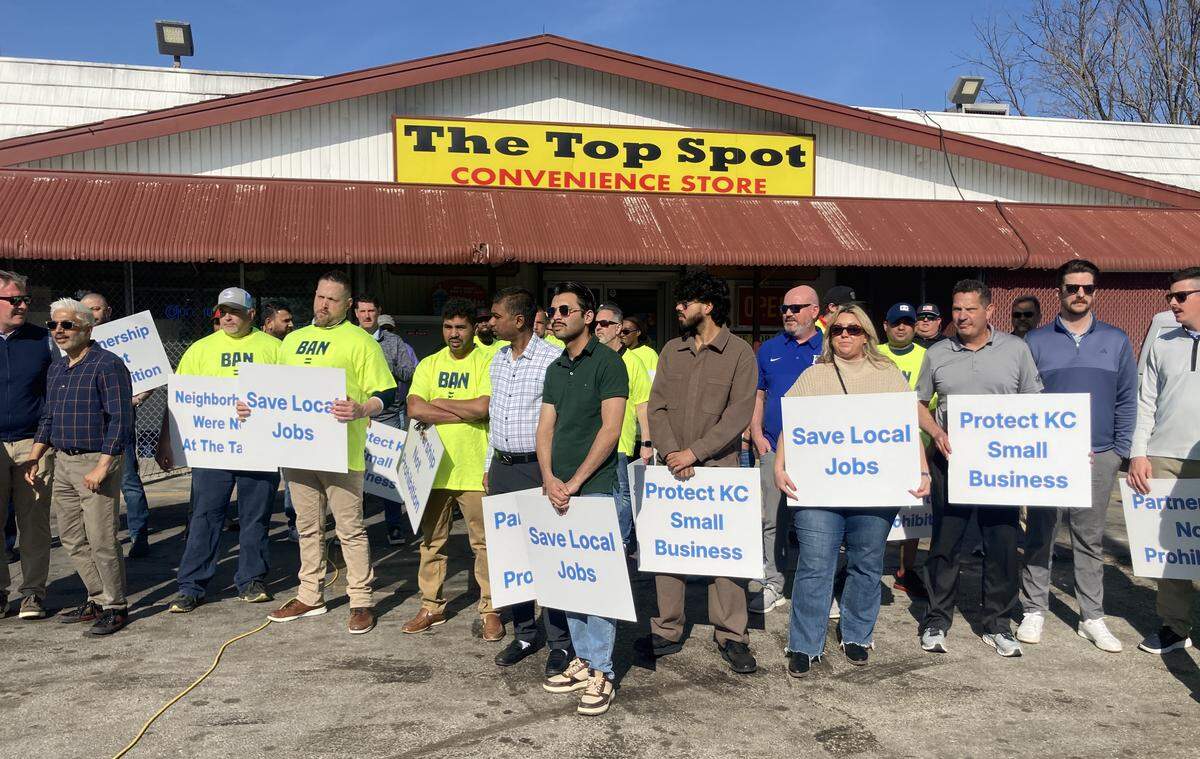
But the ordinance also garnered strong opposition from the convenience industry that would lose the ability to sell a profitable and popular item.
The liquor store that filed the suit, Grand Slam Convenience and Liquor, and the Missouri Petroleum and Convenience Association are asking a judge to declare the ordinance void and unenforceable. The store’s owner Joe Sacco declined to comment, but previously said that he was against the ordinance.
“This is not going to solve crime,” Sacco said in March. “There’s more things to it: There’s drugs. There’s violence. There’s homelessness.”
The districts where convenience stores would be restricted include: downtown, the Independence Avenue corridor, Prospect Avenue corridor and the Blue Ridge corridor.

Kay White, the owner of WW Crown Liquor Grocery & Grill at 27th Street and Benton Boulevard, which is not a party in the lawsuit, championed the lawsuit’s claims on Monday. Mini-liquor bottles and other single-serve containers, she said, comprised about 30% of her revenue.
Banning their sale, she said, will likely lead to layoffs.
White said she sees the ordinance, overall, as discriminatory in that it placed the ban on the sale of small liquor bottles in only certain areas of the city. The ordinance also allows for the continued sale of the items in grocery stores.
“I feel like it was slightly redlined,” White said, using the term that describes historical discrimination against minorities based on neighborhoods.
Lawsuit claims of discrimination
The availability of single-serve alcohol in grocery stores is central to the lawsuit, which claims it violates the Equal Protection clauses in the Missouri Constitution.
“That’s not fair. It doesn’t do anything to accomplish the goals the city says they’re trying to accomplish,” said Chuck Hatfield, an attorney representing Grand Slam.
Hatfield said the main concern of his clients is uniformity of regulation. Shawn Coudry, who owns 25 liquor and convenience stores in the Kansas City area, echoed that criticism on Monday.
“I would really understand it if the whole of Kansas City was shut down,” Coudry said. “But if you can go and buy across the street, but you can’t buy here, that’s a big problem. Midtown can sell, but downtown cannot. Consentino’s Market can sell, but Grand Slam and Downtown Market cannot. That is just nuts.”
The lawsuit argues that the ordinance is overridden by Missouri’s liquor laws. A state statute specifies that local liquor regulations “shall not be interpreted to prohibit the sale of intoxicating liquor in its original packaging, provided it is not opened or consumed on the premises where it is sold.”
“Missouri law says, as long as the retailers are selling liquor in its original packaging, they have the ability to do that,” Hatfield said. “It’s packaged for individual sale.”
A spokesperson for Mayor Quinton Lucas, who sponsored the legislation, said she doubted that Missouri’s liquor laws prevent the city from enforcing the ordinance.
“Had the liquor ordinance been preempted, then the industry likely would not have spent hundreds of hours and tens of thousands of dollars in lobbyists unsuccessfully pursuing legislation in the most recent Missouri General Assembly to overturn the Kansas City ordinance,” Megan Stickland, a spokesperson for Quinton Lucas, said.
Missouri lawmakers briefly considered legislation that would have superseded the ordinance, but it failed to become law when the legislative session ended on Friday.
Ordinance passed narrowly
When the Kansas City Council passed the mini liquor bottle ban last month, it did so by a narrow 7-6 vote. The ordinance was designed to affect five major parts of the city designated as retail “alcohol impact areas” where overindulgence was seen as a problem.
Parts of Midtown were originally included in the ordinance as an alcohol impact area, but were removed by an amendment a week after the ordinance passed.
“It shows that you could pick what areas you wanted to pick. And it’s awfully funny that it’s the 3rd and the 5th districts that are predominantly Black (that were chosen),” White, the owner of WW Crown Liquor Grocery & Grill, said.
The ordinance, introduced in February, was originally sponsored by Lucas and Councilwoman Melissa Robinson. Support for the bill was split among council members who live outside of the urban core.
On March 20, dozens of community leaders rallied for the ordinance, saying it will help address blight, crime and poverty that have held back urban development.
Grant, of the Urban League, said the ordinance is the result of months of organizing, studying the issue and consulting with city officials and health advocates.
“The community demanded action because the status quo was a plague on our neighborhoods,” she said. “People are calling this a liquor ordinance. But for residents living with violence, loitering, litter, and chronic disorder, this has always been a community stabilization ordinance.”
Grant said the ordinance is the latest step in a long-term plan to revitalize areas that have lacked investment. Strickland, Lucas’s spokesperson, said she agreed that the ordinance will help communities grow.
“Kansas City supports public order and public safety and welcomes collaborative efforts from the liquor industry to help our communities become safer, cleaner, and more vibrant—rather than exploiting communities that can least afford the negative effects of clustered liquor sales,” Strickland said.
This story was originally published May 22, 2026 at 12:03 PM.