What splitting the bill on Chiefs stadium could mean for KCK’s budget, services
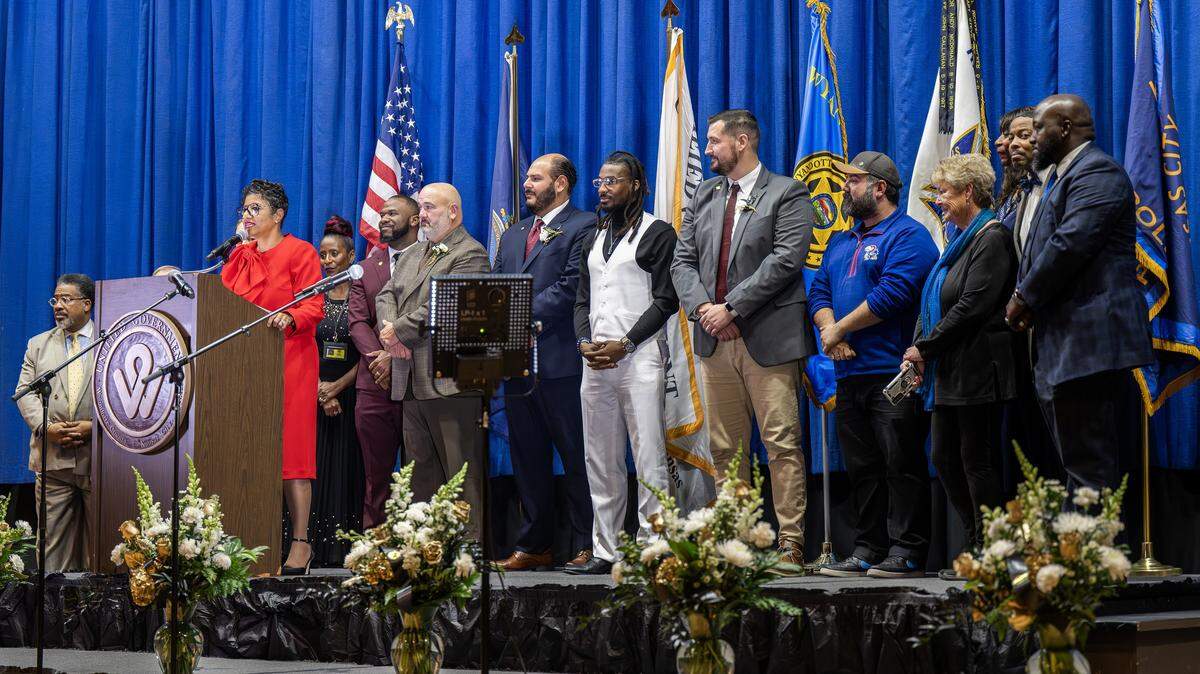
Wyandotte County leadership has less than a month to decide whether it splits the bill on the Kansas City Chiefs’ proposed $3 billion stadium in west Kansas City, Kansas.
And it’s not clear how much money the local government’s willing to put on the table.
Officials’ decisions will determine how new sales tax revenues generated in businesses across the entire county will be used for the next few decades — whether that money will be used to pay for local public services as anticipated, or if it will instead be used to pay back the debt used to build a new stadium.
The high-stakes call comes at a time when county leaders have publicly admitted that the local government is having serious financial problems, and when residents have repeatedly told their leaders that it’s hard to afford county property taxes.
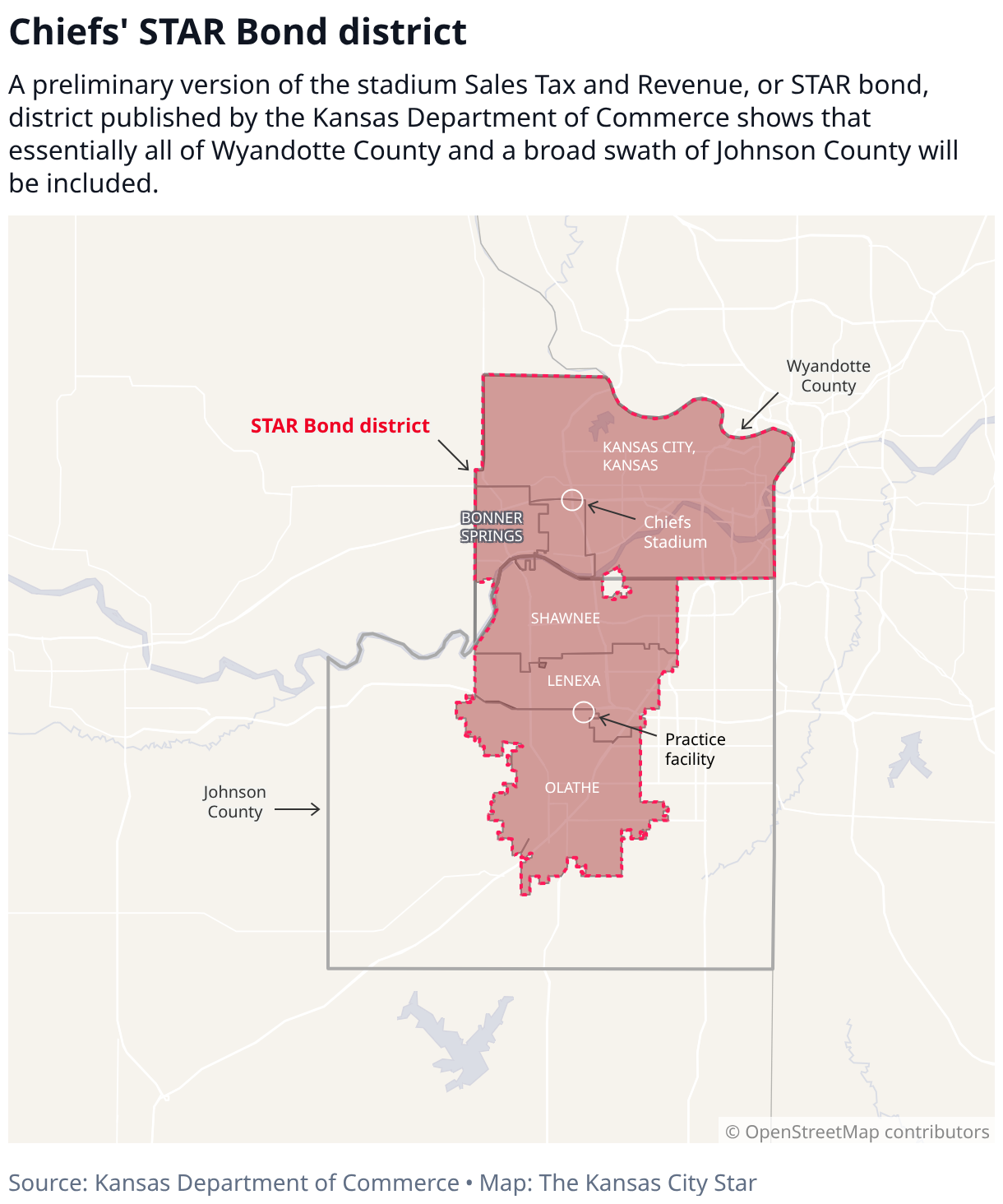
In December, state officials greenlit a multibillion-dollar sales tax and revenue bond, or STAR bond, agreement that, should all go according to plan, would make way for a new, domed Chiefs stadium in western KCK. The plan also includes a team headquarters and training facility in Olathe and surrounding entertainment districts.
And although the state has said it would chip in $2.7 billion for the project through those bonds, Wyandotte County hasn’t formally decided whether it’ll play ball and help cover that bill like the Chiefs and state officials have asked it to.
Before the stadium project can move along, the Unified Government Board of Commissioners must vote on whether to divert new local sales tax revenues generated countywide to help pay off those bonds, in addition to the state sales tax funding already pledged. It’s also up to local officials to finalize a legally binding development agreement that will lay out the ground rules for construction.
Typically, STAR bond districts encompass a new development aimed at attracting tourists and its immediate surrounding area, redirecting the sales taxes generated by that development to pay off the debt used to build it.
But the district that state officials proposed to pay back the stadium bonds covers nearly all of Wyandotte County and most of western Johnson County. That means new state sales tax money — and possibly local too — throughout that entire area would be put toward paying back stadium debt instead of other government priorities for several decades.
The vote on local sales tax revenues has a Feb. 20 deadline, County Administrator David Johnston told The Star earlier this month.
Given state law says negotiations on the Chiefs’ project can remain confidential until parties reach an agreement, the Unified Government hasn’t said how much of local sales tax revenues generated across the county could be used to help pay for the stadium.
But Shelley Kneuvean, the Unified Government’s chief financial officer, said staff will perform an independent financial analysis to understand the impact of the project and to make sure decisions are made in a way that doesn’t adversely affect public services.
Limiting future revenue
Choosing to use incremental sales tax generated across the county could present a financial risk for the Unified Government, said Zachary Mohr, an associate professor for the University of Kansas’ School of Public Affairs and Administration.
Mohr, who teaches and conducts research on public budgeting, accounting and financial management, worked in city administrative roles before joining the university’s staff.
He said his concern with the bond district spanning the whole county is that local sales tax money from both new and already existing Wyandotte businesses would go toward the Chiefs stadium instead of local services.
While the Unified Government would still be able to collect a base amount of local sales tax revenues from existing businesses and developments, that amount flowing into the UG would be limited going forward by the stadium bond district, Mohr said.
Any local sales tax money that exceeds the base amount that state officials set for the county is referred to as the increment. Those revenues would go toward paying off stadium debt instead of to the Unified Government’s budget.
In other words, the Unified Government wouldn’t get all the potential sales tax dollars it otherwise would without the stadium bond district.
“You’re going to be risking a lot of money that would’ve naturally occurred anyway,” Mohr said.
Mohr said that cap could prevent Wyandotte County from collecting additional dollars that would be naturally generated by inflation at those businesses across the county. So, sales tax rates in the county would likely need to increase in the future to at least meet the rate of inflation in order to keep up with increasing prices observed across the nation.
And, the stadium will come with its own infrastructure expenses, like roads and public safety staffing, that the local government may need to finance.
“Local leaders will have to decide what are the benefits of doing that with the clear understanding that there will be additional financial risk if they choose to use local proceeds,” Mohr said.
Sales taxes in Wyandotte
Sales tax revenues account for about 12%, or $59 million, of the Unified Government’s revenue, according to its 2026 budget.
Residents and businesses pay sales taxes when they shop at area businesses in the county and city limits, and items they purchase online are subject to a use tax that goes into the same funds as the regular sales tax. Compensating use tax makes up 5%, or $25 million, of the Unified Government’s revenue, according to the budget.
Both local sales taxes and local compensating use taxes go toward financing the city and county general funds, a dedicated sales tax fund and an EMS fund. They pay for things like public safety, emergency services, government personnel and infrastructure costs.
Sales tax revenues are projected to increase year over year in the city and county, Kneuvean said. The 2026 budget projected that the city and county will both see 2% sales tax revenue growth through 2028, then a 4% increase in the 2029-2030 year.
If commissioners vote to put local revenues toward the stadium, that increasing sales tax money above the base amount would go to the stadium’s STAR bond debt.
What about property taxes?
Property taxes, meanwhile, account for 30%, or more than $150 million, of the Unified Government’s combined revenues, and 70% of the county’s general fund revenues. County funds pay for mandated state services, like the district attorney’s office, the court system and county law enforcement.
When the Unified Government froze increasing property tax revenues in the 2025 budget year, it had to implement a hiring freeze and cut from numerous public services, including overtime for first responders and public transportation routes.
Property taxes are collected based on the value of someone’s residential or commercial property. Wyandotte County residents in recent years have struggled with increasing property tax bills prompted by rising home values and local decisions.
Sales taxes don’t directly affect property taxes, Kneuvean said. They come from completely different revenue streams.
That said, Unified Government officials, and the government’s own budget document said that diversifying its revenue streams, and lessening its dependence on property tax revenues could be one way to provide property tax relief for residents. That would be harder to do if sales tax revenue is limited.
“It is possible that the UG could attempt to diversify revenues for the County General fund in the future so that property tax relief would be more realistic for the county side of the budget,” it read.
The budget’s projections indicate the county will see increased property tax revenue growth in coming years as personnel and other expenses are likely to increase.