Experts say their son needs more special ed. Shawnee Mission fights family in court

READ MORE
Experts say boy needs more special ed. District goes to court
A Kansas City area family is entangled in litigation with Shawnee Mission schools over special education law and services their son needs.
Expand All
Experts say their son needs more special ed. Shawnee Mission fights family in court
Resources for parents trying to navigate their school system’s special ed program
Shawnee Mission violated special ed law, independent officer says. Read the ruling
Read the federal appeal Shawnee Mission filed to fight special education rulings
He’s a bright and passionate 9-year-old boy, whose idea of fun is messing around with computer software and creating his own video games.
But since preschool, he has struggled to keep up in classes and socialize in school. His parents, Natalie and Christopher Beer, pushed to get a medical diagnosis for their son, which eventually confirmed their suspicion that he has autism spectrum disorder.
Despite warning signs that their son required more support in school, the Beers argue that the Shawnee Mission school district has continually failed to appropriately evaluate him for special education and provide enough services, both before and after the diagnosis.
As a result, the family entered a years-long battle with the district. And the parents say that their son has regressed in several areas, and grown increasingly frustrated and depressed, as they have fought for the district to provide more support.
“It continues to be a struggle,” Natalie Beer said. “Where (our son) is at is not a good place. Nothing has changed for him. … The question at this point is how do you get somebody back on track that’s already lost so much?”
Two independent hearing officers have agreed with the Beers on many of their claims, and yet the Shawnee Mission district has not acquiesced. The district has denied the family’s allegations and has now appealed the rulings in federal court. That is despite records showing that district staff members privately expressed concerns in emails that the child needs the very services the Beers have asked for and the district denied.
In 2020, the Westwood couple filed a due process complaint against the district, alleging that Shawnee Mission violated the Individuals With Disabilities Education Act, denying their son his right to a free, appropriate public education.
A hearing officer — a third party attorney who is trained to conduct special education hearings and is usually assigned by the school district — largely sided with the Beers. The officer determined that the district did not satisfy the law’s requirements, by failing to evaluate the student to determine his eligibility for special education in a timely manner and failing to appropriately implement services, denying him educational benefits. The officer also ruled that the parents’ opportunity to participate in the decision-making process was significantly impaired.
Last year, a review officer agreed with the majority of the ruling.
The review officer ruled that the district must take several steps to remedy the situation, including hire someone to conduct an independent evaluation of the student, develop a new Individualized Educational Program, or IEP, contract with an independent specialist to ensure the IEP meets the student’s needs, and hire a tutor to provide in-home teaching.
The district has denied the Beers’ claims. And now, Shawnee Mission is fighting the decision in federal court, asking for it to be reversed. The district has argued that it was “harmed by the unsupported findings and conclusions issued” by the two officers.
Meanwhile, the Beers’ son has spent this school year with a special education plan that the family alleges is based in faulty data, and without the resources they say he requires.
The family alleges that the district has failed to properly evaluate their son to avoid providing him more services.
But the district counters that it ”employed extraordinary efforts” to develop an appropriate special education program for the child and meet the various demands of the family. The district says in court records that it did follow the law, and that the officers’ decisions were based on irrelevant testimonies from expert witnesses who were not present during district meetings about the child.
Shawnee Mission also argues that the student has continued to progress in school, which demonstrates that he does not need the remedies called for under the previous ruling. In court documents, the district argues that the remedies are “unlawful and arbitrary,” and “unsupported by competent and substantial evidence.”
In an email, district spokesman David Smith said that Shawnee Mission “is committed to serving all students, and regrets when parents choose to initiate litigation,” and that, “it would not be appropriate for the district to comment on a legal matter concerning the education of a specific student.”
The Star is not naming the student, who is only referred to by his initials in court documents.
As the litigation nears a conclusion, with a ruling expected this summer, the Beers say their son continues to suffer through classes without the services he needs.
The review officer wrote last year that the boy is “currently operating under an IEP that was developed utilizing an evaluation that was conducted during his kindergarten year. (The student) is currently in third grade.
“There have been no changes or modifications made to the IEP despite the fact that District staff acknowledged in January of 2020 that the ‘current plan is no longer effective.’”
The district has yet to hire an independent party to evaluate the boy, despite the review officer’s ruling, the family said. The Beers’ attorney Matthew Rogers said they hope a ruling will be made in the case more quickly if they do not fight to have those remedies immediately implemented.
Natalie Beer said the district is currently reevaluating her son’s IEP, but she feels they have already lost crucial years for their son’s development.
“Especially in early education, those are the most important years that build the scaffolding for your education and the way you see the world the rest of your life,” she said. “And so to wait three years and say, ‘oh, we’re going to do it right this time,’ you’ve already pulled the Jenga brick out. It’s already falling apart.”
Troubles in special education
School was difficult for the Beers’ son from the beginning.
While attending pre-K at Briarwood Elementary in the 2017-2018 school year, the boy’s teacher reported that he had several social problems, such as having one-sided conversations and not interacting with his peers, according to court documents.
The teacher observed that he had “difficulty building peer relationships, was destructive of materials, and would flee group learning time.” Court documents say that soon after, the teacher requested that the district evaluate the student to determine whether he needed special education services.
This took place during a turbulent time for Shawnee Mission’s special education department. The Star reported in 2018 that more than 150 special education employees had resigned or retired since the 2014-15 school year from a department that included 310 certified employees.
Critics claimed the department was mismanaged, pointing blame at former superintendent Jim Hinson and then-special education director Jackie Chatman, arguing that some protocols flirted with violating the law, a concern that was substantiated in a small number of cases in a 2017 state probe.
Employees and parents at the time alleged that teachers endured verbal abuse and unrealistic workloads, as the department struggled with staff resignations and unanticipated enrollment of more special needs children. They said they were encouraged to cut corners by Chatman and other leaders. Chatman stepped down from the role in 2018 and soon retired.
In general, special education remains a difficult field, one that educators say is made more challenging due to inadequate funding in Kansas. Educators across the state have pleaded with lawmakers to increase special education funding to the level required by law, a move that Shawnee Mission estimates would result in $8 million more for the district.
In 2017, the district agreed to evaluate the Beers’ son, to see if he was eligible for special education services, according to court documents. The evaluation included interviews with a teacher and the parents, observation and a play-based assessment.
The staff member doing the evaluation reported that within six weeks, the student had seen “huge growth” socially, almost doubling previous assessment scores.
Patricia Weigand, a behavior analyst who specializes in working with children with autism, later testified that given the deficits the student displayed, it was not realistic that skills would have developed that quickly. She testified that the school’s evaluation was inadequate and should have been expanded to be more comprehensive, according to court documents.
Weigand argued that the evaluation also contradicted the teacher’s interview, where she said she had great concern about the student’s ability to interact with others, although did note some progress.
But the district contended that the student was making significant progress, growing socially and emotionally, and staff did not notice any lag in his development compared to his peers. The district also has argued against Weigand’s testimony being used, saying she was not present during staff meetings and formed her opinion on data that wasn’t used by district staff in evaluating the student, and that she focused on best practices in the field rather than the law’s requirements.
Special education staff determined at the time that the student did not qualify for services, and Natalie Beer agreed with the evaluation. She testified that she felt relieved that the team did not find anything wrong with her son, and thought that she maybe “just needed to work harder as a parent,” court records say.
“I spent, like, probably a little over a year questioning myself,” Natalie Beer said. “Not getting feedback from the school district, like concrete feedback, that there was anything wrong with my son. And I was just being like, is this me? Is this my parenting? Am I missing something?”
That spring, her son started showing more aggressive behavior at school, raising concerns. And Weigand testified that during the school year, the district was witness to what she believes to be several red flags that the student might have had autism.
‘Might have to provide more services’
After the school year ended, the Beers met with their pediatrician, who recommended genetic testing.
In the summer of 2018, their son’s test results identified that he had a chromosome micro-deletion, which the family’s attorney Matthew Rogers said “was a signal that autism was a possibility but not a definitive diagnosis.”
The family immediately got on the wait list at Children’s Mercy for an evaluation — a roughly nine-month wait, Natalie Beer said.
“I had no idea what autism was. I was like slowly trying to educate myself and feeling really confused,” she said. “Every parent thinks their kid is amazing and they love them no matter what. Love is blind. And I just didn’t really see stuff (the signs) like a teacher would in that way.”
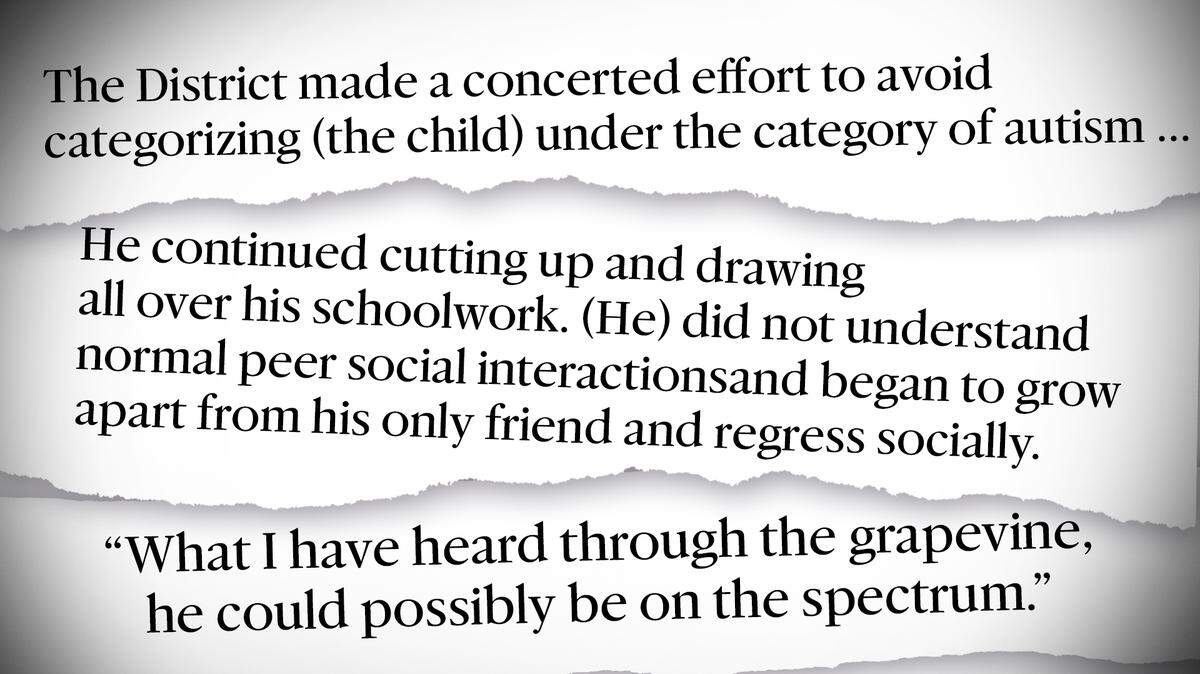
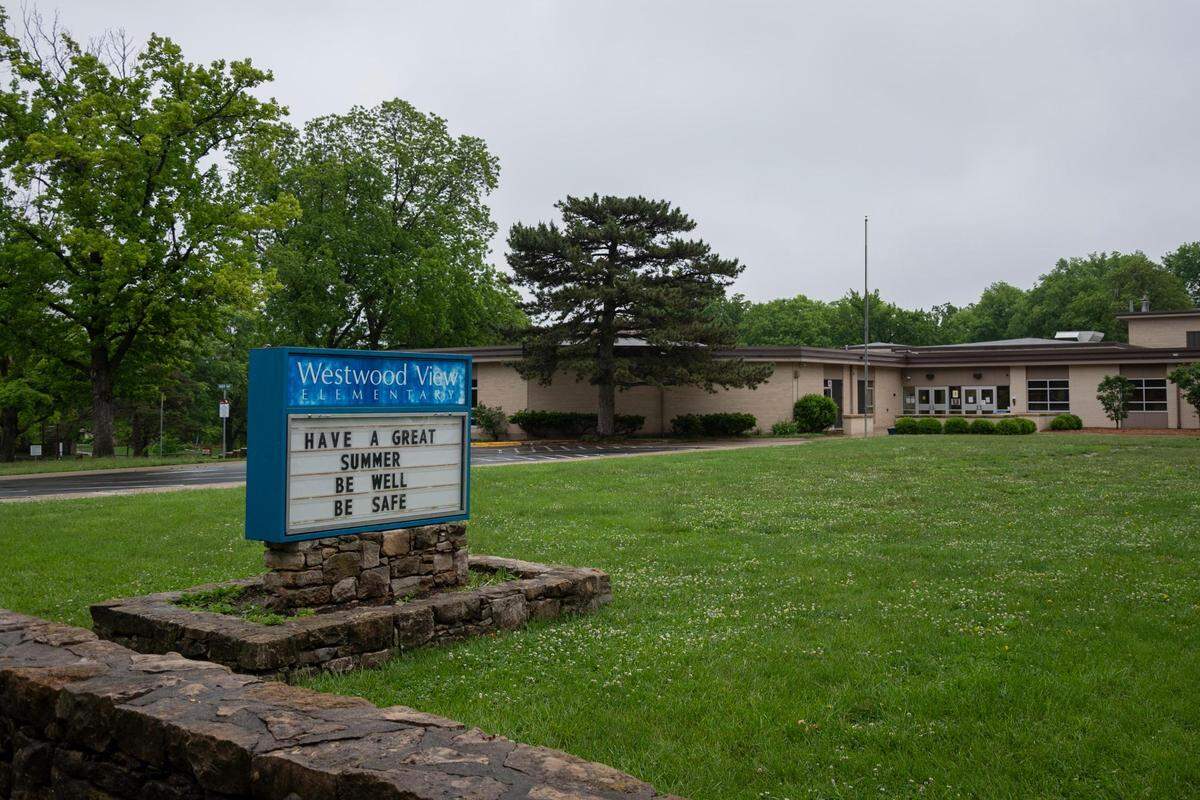
In the 2018-19 school year, their son attended kindergarten at Westwood View. And he immediately struggled, reportedly biting his shirt as a nervous tick, not participating or following directions in class, and ripping up papers at his desk at the back of the room. According to court documents, his teacher reported he was not playing with classmates and was struggling to understand jokes or games.
The school also identified him as at “significant risk of not meeting grade level expectations” on a reading assessment. Natalie Beer requested that the district evaluate her son to determine whether he qualified for special education services. The district agreed to collect new data in several categories, including health, social-emotional status, behavioral status, academic performance and communication skills.
The district regularly monitored and recorded the student’s progress, and implemented interventions, such as activity breaks and alternate assignments in class.
But the family claims that “inaccuracies and insufficiencies” in the district’s process required staff to extend the evaluation, according to court documents.
“There was confusion with the data and different things that were going on. … Things weren’t lining up for certain tests that were done,” Natalie Beer said.
The Beers say in court records that the evaluation documents were confusing, with some documents lacking dates or missing data, making some of them unreliable for making conclusions. Such data is crucial for determining what interventions a student might need.
The Beers found problems with much of the data, including documents that stated they were tracking “daily behavior” but actually aggregated data in weeks, court records say. They also allegedly measured behavior in terms of percentages, but were not grounded in an understandable measure.
And a behavior summary in the evaluation reportedly contradicted the student’s daily behavior reports, as well as observations by his teacher and mother.
A district school psychologist testified that the the special education department could have concluded its evaluation of the boy in December 2018, “however, the team delayed an eligibility determination to address Mrs. Beer’s concerns and get her input into the evaluation.”
In January 2019, Children’s Mercy evaluated the Beers’ son, who was 6 years old at the time, and determined that he had autism spectrum disorder and ADHD.
Meanwhile, the district continued collecting data, and it agreed that the student was eligible for special education services.
After the diagnosis, Natalie Beer said she fought with special education staff over how to categorize her son for his IEP. Court documents show that staff were going to categorize him under “other health impairment,” or OHI, but the Beers argued for him to be under the category of autism. The category can determine what services the student receives.
The Beers maintained that the district “made a concerted effort to avoid categorizing (their son) under the category of autism, pursuant to direction from Jackie Chatman, Assistant Special Education Director for the District, with the purpose of denying (their son) services,” court records say.
In February, according to court documents, the school psychologist said in an internal email that: “We agreed to change exceptionality from Other Health to Autism … Jackie said by changing it — we might have to provide more services??? But she didn’t speak in the meeting when I tried to keep it OHI.”
The Beers argued that by not identifying their son as a child with autism, the district unnecessarily prolonged the evaluation and IEP process, depriving their son of access to an appropriate education.
Mitchell Yell, an expert in special education law and IEP development, testified that it is not acceptable for schools to avoid identifying a child with a disability with the aim to avoid providing services to that child.
Natalie Beer disagreed with the district’s proposed special education plan for her son, and requested an independent evaluation.
But the district counters in court documents that “Mrs. Beer was the primary cause of any delay” in completing the boy’s evaluation and development of his IEP.
“Mrs. Beer refused to attend the February 25, 2019, meeting before the team could develop an IEP for (the student) and refused to accept the results of the evaluation report and the eligibility determination,” the district says in court documents. “Further, Mrs. Beer also refused to develop an IEP for (him) because in her view, (he) needed an independent education evaluation to be completed first.”
The district said that the student continued to make progress that school year.
But the Beers claimed that by the end of the year, their son was significantly behind his peers and showing signs of regression. Over the summer, they enrolled their son in the Riley ABA and Autism Center in Kansas City, hoping to help him catch up.
Court documents show that during the summer, a Shawnee Mission special education employee sent an email to a new leader about the Beers:
“I wanted to bring this student to your attention as mom is a hard parent for Westwood View. We did not complete his evaluation last year and we need to make sure we get on this first thing. She already has an advocate and is very difficult to please.”

Outward denials, internal worries
Natalie Beer continued to question the data the district had compiled, arguing that it did not paint an accurate picture of her son.
She did not consent to the proposed IEP for her son during the fall of his first grade year, arguing that it remained mostly unchanged despite her concerns. She agreed to her son receiving specialized instruction for a certain period of time each week, while she negotiated with the district on all of the resources that would be provided under the IEP.
But she argued that the district still did not have baseline data to properly evaluate her son, and the district continued collecting data into the semester.
At a meeting in November, Natalie Beer requested the addition of a reading goal, as well as paraprofessional support in the afternoon during math, both of which were denied. The district argued that the student was making adequate progress.
She provided consent for the district to implement the IEP.
While the district did not agree to provide the additional services the Beers requested, some internal emails showed that staff members had expressed concern that school year that the student did need those resources.
Although the district did not agree to offer afternoon para support, a special education teacher said in an email that, “As challenging as this will be, I think (he) needs more support.”
District staff also developed concerns about the student being unable to read. According to court documents, staff said internally that, “He needs a lot of help however, because he cannot read anything on the page. I feel that this is at least part of the reason he’s not completing work in the classroom. After working with him for 2 days, he may, in fact, need a reading goal.”
And a special education teacher said in another email in January that she thought the IEP team should meet because “[t]he current plan is no longer effective.”
Natalie Beer said that she didn’t find out about those emails until after she filed a complaint with the state education department in the summer of 2020.
“It’s like an iceberg. You’re up here. And there’s this whole other conversation with all these people about your child that you don’t know about. And then it comes out. And that’s why it’s even more hurtful,” she said.
The Beers filed a due process complaint listing several concerns and possible special education violations.
After reviewing the case and hearing testimonies from experts, a hearing officer last summer largely ruled in the Beers’ favor. He determined that the district failed to complete the student’s evaluation during the time frame required under law, unnecessarily prolonging the process to “correct evaluative errors.” He wrote that the district also failed to communicate critical information to the Beers, including data that showed their child likely had autism spectrum disorder.
The hearing officer also ruled that the district did not reasonably calculate the IEP, as it was based on unmeasurable goals and contradictory data, and failed to revise it. He wrote the district failed to implement the IEP and track goal progression, violating federal law by providing progress reports to the Beers that were “inconsistent with goal progression data collected” by the district.
The officer did agree with the district on a few points, such as deciding that there was insufficient evidence to determine that the district failed to appropriately evaluate the student in pre-K.
The district appealed the ruling, arguing that most of the hearing officer’s determinations were “merely copied from the proposed findings of fact proposed by the Beers” and were not based on independent findings.
When a hearing officer’s ruling is appealed in Kansas, the state education department must conduct an impartial review of the proceedings and render an independent decision.
And in December, a review officer affirmed much of that ruling, deciding that the district did fail to evaluate the student’s eligibility for services in a timely manner, failed to determine the student’s placement through development of an IEP and failed to implement the IEP.
“These failures deprived (the student) of an IEP reasonably calculated to enable him to make appropriate progress in light of his circumstances and resulted in lost educational benefit,” the review officer wrote.
The review officer ruled that the district must hire someone to conduct an independent review of the student’s educational needs, develop a new IEP and get it independently reviewed, hire a board-certified behavior analyst to create a report, and contract with a tutor to provide the student 25 hours of in-home training for two school years each.
Falling further behind
But now the district is fighting the decisions in federal court, asking for a reversal of the rulings.
The district argues that the decisions were based on information on “best practices” from experts who testified and lacked first-hand knowledge of the situation. The district claims the officers erred in ruling that the district did not properly develop or implement an IEP, arguing that it was Natalie Beer’s fault the process was delayed because she did not accept the evaluation results.
“The District employed extraordinary efforts to develop a special education program for (the student) that satisfied the frequent and varied requests and demands made by his mother, Ms. Natalie Beer, concerning his evaluation and subsequent regular and special education services,” the district says in its appeal.
The district said that “despite the strain placed on the District’s professional staff by such demands and the delays they inevitably caused in drafting and implementing an IEP … the District nevertheless complied with the law at each step of the process.”
And the district is opposing the remedies listed by the hearing officers, arguing that the student’s “continued progress demonstrates that no compensatory education was appropriate.”
Rogers said that a ruling should be made in the case this summer, to determine whether to uphold the previous decision and grant the Beers any remedies to help their son.
Meanwhile, Natalie Beer said that despite teachers’ best efforts, her son continues to struggle in school and has regressed socially while he does not receive the support he needs. She worries about his depression and mood, as he gets frustrated when he’s unable to meet the demands in his classes.
“He says he gets pushed too hard. And I’ve taught him how to advocate for himself. If somebody is pushing you too hard, and you feel like you can’t do something, you need to ask for a break. You need to say, ‘I have autism and this is not working for me right now …’” his mother said. “He says he’s expected to do all these things that the (other) kids in the class are doing but that he can’t keep up and do.”
She said that the district is now reevaluating her son’s special education program. But as more time passes without an effective plan in place, she worries her son will only fall further behind.
“We’re in a stay-put situation and functioning off of something (the IEP) that didn’t work in the first place. I feel like where we’re at is completely unheard of. I just can’t even believe where we’re at.”
This story was originally published June 12, 2022 at 5:00 AM.