19-year-old debuts KC exhibit with art on trans visibility: ‘Express the joy’
Junie Brown is using her first solo exhibition to place Black trans joy inside a space dedicated to preserving Black history.
Brown, a Kansas City Art Institute student and Black transgender artist, is the featured artist for July at the Black Archives of Mid-America. The exhibition does not have a formal title, but it is part of a yearlong series highlighting Black artists in Kansas City. Brown’s show will run throughout the month.
“They actually approached me,” Brown said. “I’ve worked with an organization called No Divide before, and they recommended that the Black Archives reach out to me about this opportunity, this endeavor. I answered a few emails from them, they liked my stuff, and from there, it was history.”
The exhibition comes about two years after Brown began fully embracing her identity as a trans woman. Since then, she has used art to explore femininity, transition, self-discovery and the visibility of people whose stories are often left out of galleries and museums.
Brown describes the show as a visual record of her journey. The work begins with her transition and moves through the motifs, people and community figures who have helped shape her understanding of herself. Rather than centering pain or hardship, Brown said the exhibition focuses on joy and the process of becoming.
“It’s honestly a huge opportunity to really convey the message that I’ve always been trying to convey,” Brown said. “I feel like my identity is such a huge part of my life and is a huge topic of discussion politically right now. I think it’s really refreshing to be able to express the joy that I have and the process of becoming who I am.”
Having her first solo exhibition at the Black Archives in the 18th and Vine Historic District gives the moment added weight. Brown said the institution’s mission of preserving Black history makes the space meaningful for work that centers Black queer and trans identity.
For Brown, the show is also a statement about belonging. She said queer people are not always placed at the forefront of Black community struggles, even though their stories are part of Black history. Through the exhibition, she hopes to show that Black trans stories deserve to be preserved and seen.
“It was honestly such an honor,” Brown said. “I feel like a lot of times in the Black community, queer people in general are not at the forefront of the fights that we’re fighting. Being able to be a voice for such a large community and show that we belong in the Black community, and that our history is just as important as any other Black person’s history, is an honor. It’s surreal.”
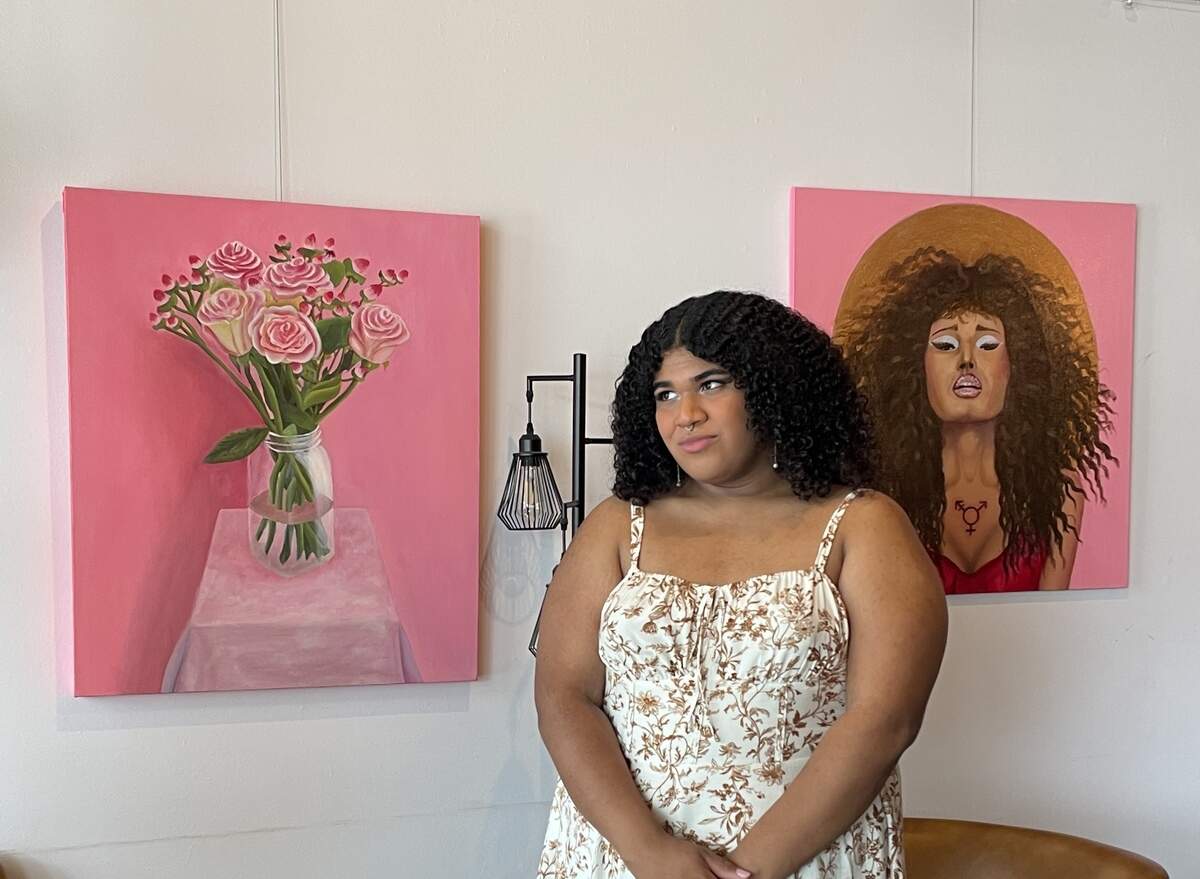
Brown began preparing for the show in December gathering past pieces she created for the exhibition. The process required her to balance her responsibilities as a student, worker and emerging gallery artist. She described it as having three jobs at once, with sleepless nights and missed time with friends.
Still, the work has confirmed her commitment to art. Brown said there have been times when she questioned whether pursuing art was the most practical career path. But continuing to create work rooted in her identity has helped reaffirm that this is the path she is supposed to follow.
“Honestly, I think it’s just the amount of self-growth that I’ve gone through,” Brown said. “There have been many times where I felt like art might not be the most productive route to go when it comes to having a career. But the longer I stick with it and the longer I keep expressing these opinions and experiences that I’ve been through, I think it really reaffirms that this is the thing that I’m supposed to be doing.”
Brown said her relationship with her identity has also changed. Earlier in her transition, she was more focused on how others viewed her. Now, she is more focused on how she views herself, how she treats herself and how she experiences the world.
Art has been central to that growth. Brown said she has gone through her transition while making art, using the process to sit with her feelings and understand her experiences before sharing them with others. She hopes that honesty helps others feel less alone.
“It’s the main reason I can, honestly,” Brown said. “I’ve gone through my entire transition making art, and I think it’s a really good spot for me to sit down and contemplate the feelings that I’m having and the experiences I’ve been through. It gives me a chance to really process those in my own time and then express them with others so that others don’t feel like they’re the only ones going through what they’re going through.”
The exhibition also challenges the way trans people, especially Black trans people and trans people of color, are often represented. Brown said many depictions focus on struggle, while her work focuses on existence, dignity and joy.
She wants the larger Kansas City community to think about the impact trans people have had throughout history, both locally and globally. She credits local figures in the Kansas City transgender community like Nyla Foster, Korea Kelly, Merrique Jenson and Lana Luxx as role models that she draws inspiration from.
She said some of the most important lessons she has learned have come from other trans people.
“I think it’s just reaffirming that trans bodies exist, and we’re not going anywhere,” Brown said. “I think it’s also an important depiction of transness because a lot of times we’re depicted in these moments of struggle. But I feel like my work focuses a lot more on the joy and the process behind the transition rather than just the struggles that we face.”
Brown also wants the show to push Kansas City’s art world to reconsider how it measures value. She said art centered on Black, trans, plus-sized or otherwise underrepresented bodies may not always be treated as the most commercially marketable, but that does not make it less important.
For Brown, the value of the work is in its impact. She said the most fulfilling response comes when people who share parts of her identity see the art and feel recognized. She hopes the exhibition encourages other galleries to make space for work like hers.
“I want it to say that I’m here,” Brown said. “My people have been here since the beginning of time, and I think our stories are just as important as anyone else’s. We deserve to share these stories.”