If measles reaches the KC metro, Wyandotte County could be particularly vulnerable
Questions about whether the Kansas City metro area is prepared for a measles outbreak are hypothetical for now. No cases have been reported in either Wyandotte or Johnson counties.
But health experts warn the coming summer travel months will present ample opportunity for the highly contagious respiratory virus to spread from the southwestern corner of Kansas and beyond to larger population centers.
“Should we be thinking about it? Yes. Should we be preparing for it? Yes,” said Brandan Kennedy, a licensed pediatrician who has practiced medicine in the Kansas City area for 30 years and chairs the Immunize Kansas Coalition, a group dedicated to educating about vaccines.
One dose of the MMR vaccine is 93% effective at preventing measles. The second dose stops 97% of infections. But in communities with immunization rates well below the threshold for herd immunity, like in Wyandotte County, the rapid spread of the virus can wreak havoc.
Lower vaccination rates put a community at higher risk for widespread infections and “a significant number of hospitalizations and deaths,” Kennedy said.
In Texas, the site of the largest measles outbreak in the U.S. currently, two unvaccinated children have already died.
So far, Kansas health authorities have confirmed 37 cases across eight rural counties. Thirty-one of those infections involve unvaccinated patients.
In Johnson County, where the vaccination rate hovers around the 92-94% threshold for herd immunity, people are better protected. But low immunization rates in Wyandotte County could contribute to an accelerated spread if the virus makes it to the metro, Kennedy said.
“As of now, we don’t have any measles cases in Wyandotte County, but it’s important to be prepared in case it reaches our area,” said Terrie Garrison, interim director of the county’s health department. “Now is a good time to make sure you and your family are up to date on routine vaccinations, including MMR vaccines to protect against measles, mumps and rubella.”
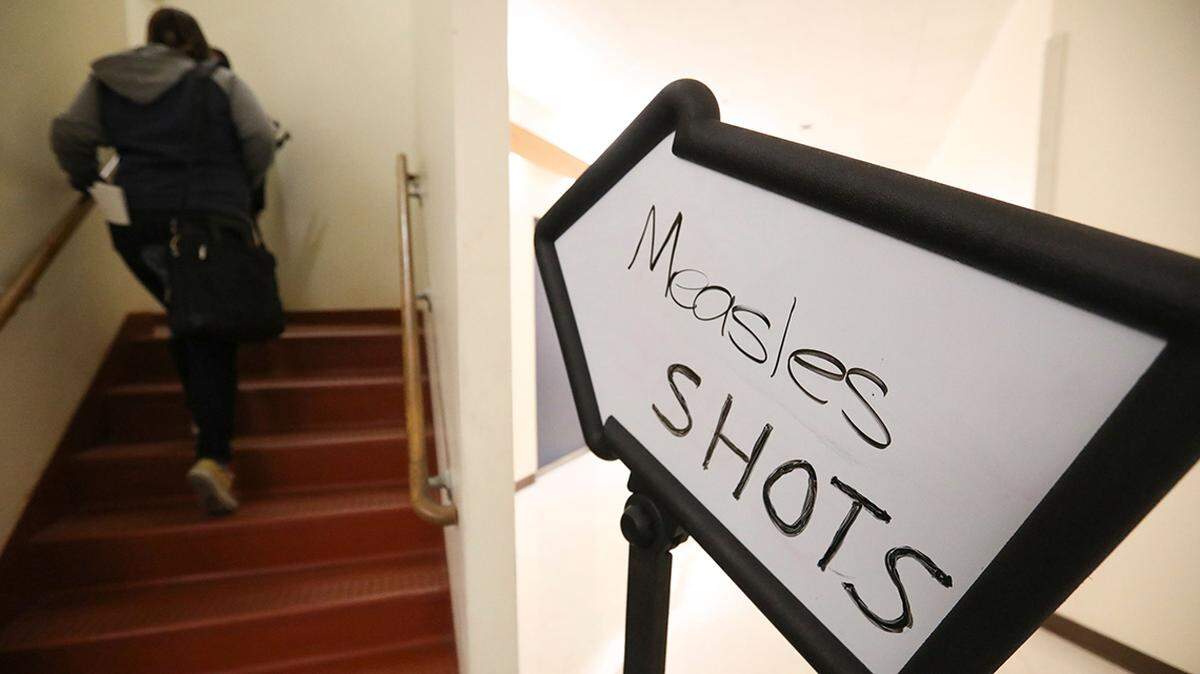
Vaccine appointments for adults and children can be scheduled by calling 913-573-8855, and the health department accepts walk-ins from 1-3:30 p.m. Wednesdays and 8:30 a.m. to 3:30 p.m. Fridays.
KCK schools vaccination rate
Health experts recommend children receive their first dose of the MMR vaccine when they’re 12-15 months old and the second dose between the ages of 4 and 6 years.
Kindergarten vaccination rates in Kansas City, Kansas Public Schools are among the lowest in the state, according to data from the Kansas Department of Health and Environment.
KDHE spokesperson Jill Bronaugh said the agency considers kindergarten immunization data to be the best assessment of vaccine coverage in communities.
With one exception, public school districts in Johnson and Wyandotte counties reported immunization rates between 88% and 94% for the 2023-24 school year, the most recent year with available data.
USD 500 reported that only 55.8% of all incoming kindergarteners had received all of their required immunizations.
Edwin Birch, a spokesperson for KCK schools, said the district is actively sending out letters to parents to tell them their students who don’t have all their shots could eventually be excluded from school activities.
“The district has always been committed to safeguarding the health and well-being of our students and staff,” Birch said.
“We’ve sent out communications. We’ll be sending out more communications notifying those parents of children who are not in compliance.”
Molly Gotobed, executive director of the nonprofit Community Health Council of Wyandotte County, said no one factor can explain low immunization rates in and around KCK.
“Among our Black communities, there’s a lot of distrust from historic racism around vaccination from being experimented on,” Gotobed said.
Wyandotte County’s large immigrant population also means some residents are more familiar than others with public school immunization requirements, she said.
USD 500 is among the most diverse school systems in Kansas. According to district data, 55% of students are Hispanic, 24% are Black and 9% are white.
For many immigrant families, proving children’s immunization status can be difficult, said Justin Gust, vice president of community engagement at El Centro, a nonprofit that serves Hispanic families in the Kansas City area.
“They need to get their immunization records from their home country. If they were vaccinated at a point of entry in the country, they need to get those vaccine records,” Gust said.
That process can be cumbersome and slow. Other children aren’t vaccinated because of the financial burden it poses, he said.
“It can be an issue around cost or money, especially if a child is uninsured,” Gust said. “There are ways that our clinic partners are able to find funds through the state of Kansas to pay for the vaccine. But even the administrative fees sometimes, $20 at the health department or a $25 appointment for their child at the clinic can still be a barrier.”
Measles prevention
Speaking at a press conference in Garden City last week, Gov. Laura Kelly pleaded with residents not to fall for COVID-era misinformation about the safety and efficacy of vaccines.
“Wanting to be cautious, wanting to do right by your children — those are normal instincts. But you do not have to do this alone,” said Kelly, who encouraged people to reach out to their health care providers with any questions or concerns they have about vaccines.
“When I was growing up a very long time ago, measles wasn’t something you read about. It was a disease that you actually got and your friends got, and it was a disease that made kids incredibly sick,” said Kelly, 75. “Some were hospitalized. Some were left with permanent complications. And some didn’t make it.”
The governor also blamed lawmakers for weakening the state’s public health infrastructure. Earlier this month, the Legislature overrode Kelly’s veto to adopt a new law stripping local officials of the authority to issue binding health orders and mandating that they prove “probable cause” before requiring people to quarantine.
Rep. Laura Williams, a Lenexa Republican who introduced an expansion of the religious freedom exemption to vaccine requirements for children in day care facilities, said she’s not overly worried about the risk of measles right now.
“I have confidence in how our state is responding and trying to inform the community. But as a parent, I know that I am doing my own due diligence,” Williams said.
Kennedy, the pediatrician, said guarding against exposure can be exceedingly difficult because someone who has been infected with measles can appear asymptomatic for up to four days before developing a rash.
An unvaccinated person can spread measles to as many as 20 other people in a room at a time, and the virus can hang in the air for up to two hours once the carrier has left, he said.
Children under 5 face an elevated risk of adverse measles complications, as do adults over the age of 20, pregnant women and people with weakened immune systems.
One in 20 children infected with measles will develop pneumonia. The virus can also cause swelling of the lungs and brain.
“These kids get really, really ill. And the risk of getting a vaccine is far less than the risk of these diseases,” Kennedy said. “And in that respect, you don’t want to see what I’ve seen firsthand.”
This story was originally published April 28, 2025 at 6:00 AM.