Home of the Kansas City Dandy-Lions? Here’s how the Chiefs got their name
Kansas City had done it.
After helping to sell 25,000 season tickets, Mayor H. Roe Bartle successfully lured the American Football League’s Dallas Texans to Kansas City.
But you can’t call a Kansas City team the Texans. In May, Lamar Hunt announced he had settled on a new name: the reigning AFL champions would be called the Chiefs.
In the years since, the name has been both a source of pride for Kansas City, particularly amid a football dynasty under Head Coach Andy Reid and Quarterback Patrick Mahomes. But it has also drawn criticism from some Native Americans who find the name and iconography surrounding it insulting.
The Chiefs’ official website says the name was in honor of Bartle – a larger-than-life mayor who got the nickname after serving as a chief executive of the Boy Scouts – and his effort to help lure the team to Kansas City.
But newspaper archives from Hunt’s announcement in 1963 show that Bartle was one of many factors that Hunt considered when choosing the moniker.
“I felt that Chiefs best combined what we were looking for in a new name,” Hunt told reporters in May of 1963. “It has local significance. The Kansas City area was once a dwelling place for at least four different Indian tribes. It has class and it is short enough to appear in headlines anywhere. These were just a few of the factors considered.”
Both The Kansas City Call and The Star noted at the time that the name was fitting because it served as a tribute to Bartle – The Call called the connection between Bartle and the new team name a “note of interest.” A reporter from United Press International said the new name was “incidentally” the nickname of the mayor who helped lure the team.
Still, The Star’s sports editor at the time, Ernie Mehl, complimented the name, saying it was a “deserved tribute to H. Roe Bartle, who, as mayor, made the first overtures to the club and these made it possible for the eventual move.”
The new name wasn’t the winner of a “Rename the Dallas Texans” contest The Star held on Hunt’s behalf from mid-April to May 1963, which received more than 4,600 entries.
If Hunt had been choosing the team name based on the highest number of submissions, Kansas City fans would be cheering for the Mules to win their third consecutive Super Bowl.
The runner-up was the Royals, later adopted by the city’s baseball team in recognition of the American Royal livestock show, horse show and rodeo. Other contenders included the Pioneers, Steers, Stars, Mokans, Tornados, Mavericks, Bulls, Plainsmen, Wranglers, Mohawks, Hunters and Scouts.
One person even suggested the Dandy-Lions.
Name Controversy
Along with adopting the Chiefs name, the team began to adopt Native American imagery.
The team’s original logo, used until 1971, depicted a caricature of a Native American wearing a loincloth, tomahawk and headdress running on top of an outline of the region, including Missouri, Kansas, Nebraska, Iowa, Oklahoma and Arkansas.
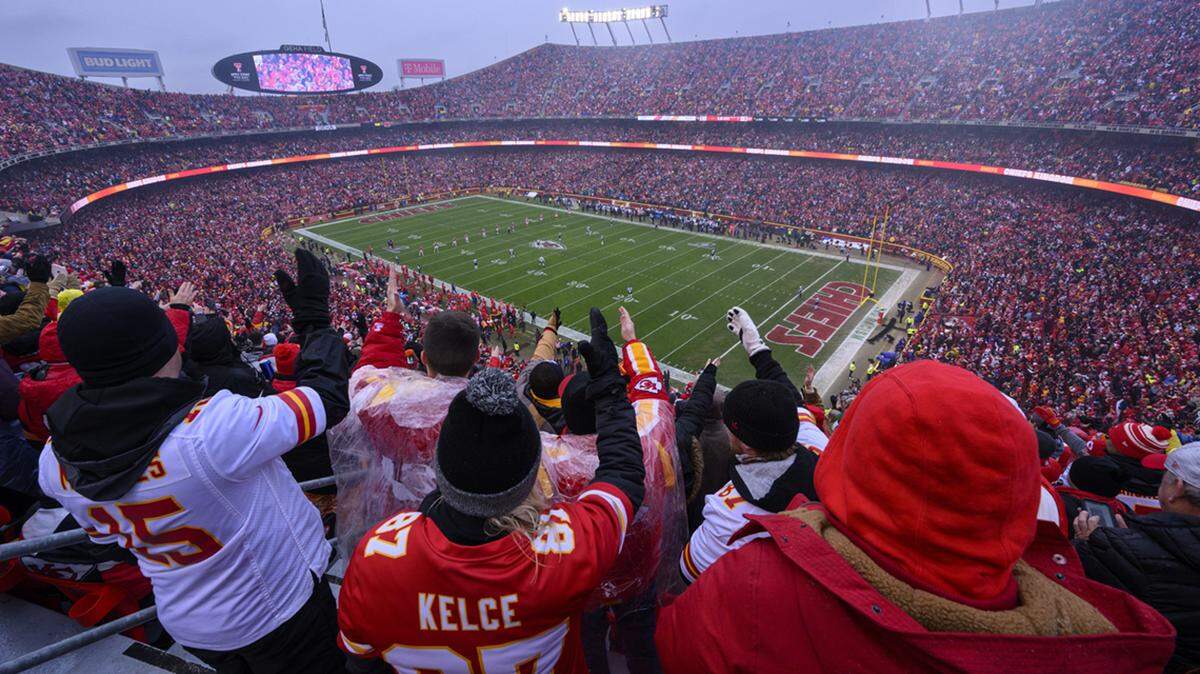
The Chiefs still play at Arrowhead Stadium. For years, the team celebrated touchdowns by having a man wearing a headdress ride a horse – named “Warpaint” – up and down the field. And there’s the “tomahawk chop,” the decades-old tradition where fans wave one arm backward and forward while chanting in unison.
Over the past few years, the Chiefs have attempted to address the criticism of their name and traditions. The team formed an American Indian Working Group several years ago, which has led to changes – like the elimination of the touchdown celebration and a ban on fans entering the stadium wearing headdresses or with their face painted in a way that suggests Native American imagery.
But the Chiefs have said they do not have any plans to change the team’s name, despite continued debate.
The Chiefs are one of two remaining major professional sports teams that still use a name associated with Native Americans, alongside the Atlanta Braves of Major League Baseball.
The Washington football team, which once had one of the most controversial names in professional sports, eliminated its use of a slur for Native Americans in 2020 and changed its name to the Commanders in 2022. Major League Baseball’s Cleveland Indians became the Cleveland Guardians in 2021.
Unlike those teams, the Chiefs name is not a slur and the logo is not the head of a Native American.
But the team also defends its name because of its origin as a tribute to the mayor who helped bring the team to the city.
“The Chief”
By all accounts, H. Roe Bartle was a large man.
He was 6 foot 3 and weighed up to 375 pounds. He smoked long cigars because, he told The Star, if he could afford a 30-cent cigar instead of a 20-cent cigar, he’d take the bigger one.
Bartle served as mayor between 1955 and 1963, after being encouraged to run by his friend, former President Harry Truman. But Bartle largely made his name running the local Boy Scouts and through speeches that he gave throughout the country, charging between $500 and as much as $2,500.
He got his nickname, “The Chief,” from his time in the Boy Scouts. After briefly practicing law in Kentucky, Bartle took on the role of chief executive of the Boy Scouts in Casper, Wyoming. From there, he went to St. John, where he founded the “Tribe of Mic-O-Say” before leading the Kansas City area Boy Scouts between 1928 and 1955.
While he served two terms as mayor of Kansas City, Bartle’s time on the speaking circuit helped him gain national prominence. A profile of Bartle in 1970 called him the most widely-known Kansas Citian, after Truman.
The scout reservation in Osceola is named after Bartle, as is Bartle Hall, at the Kansas City Convention Center.
Still, Bartle’s efforts to lure the Chiefs – which included a covert visit by Hunt and general manager Jack Steadman before the two were ready to announce they were looking at moving the Texans – has proved to be one of Bartle’s most lasting legacies.
Hunt said Bartle “almost singlehandedly persuaded him to attempt the move to Kansas City,” the Star reported in 1963.
“This is not a matter of Hunt coming to Kansas City looking for a home,” Bartle said at the time. “This is a matter of the mayor looking for a football team to come to Kansas City.”
This story was originally published January 8, 2025 at 10:28 AM.