
On The Vine: Rev and reboot

My laptop sounds like a jet engine revving for take off. I don’t know if they’re connected, but a little notification in the bottom right corner too continually pops up to tell me the computer needs to reboot. I click “not now.” There’s work to be done. Push through.
I imagine we kind of all live life like the relationship between me and this laptop. When you’re in the thick of it — 1,300 words (not all mine) into a newsletter — who has time to stop, to breath, to take a break. There’s this and so many other things we have to do.
We have to keep going; keep revving. Don’t stop.
We have to, right?
I don’t know about y’all, but my laptop and me are definitely looking forward to a break this holiday season. It’s a nice reminder — yes, the fight is important, the work is important, but the people, the moments in between, kinda feels like that’s what it’s all about, no?
Around the block

Land grab remakes Kansas City’s East Side, upending neighborhoods, Star investigation finds
Kansas City’s East Side — where Black residents were historically demarcated to, but where now they have raised homes, culture, and community — has been all but invaded by outside investors and speculators buying up properties and lots in a land grab that is remaking the face of Kansas City’s predominantly Black neighborhoods with little to no deference to the people who live there.
As part of a monthslong investigation, The Star analyzed thousands of real estate and tax records, charting and mapping out city parcels and ownership data east of Troost — Kansas City’s de facto racial dividing line for three generations.
Eric Adler and Kevin Hardy write for The Star:
Data reveals that the area — created by racist housing policies, depopulating, suffering crime and physical decline — has since the economic downturn of 2008 become an active hunting ground for investors and speculators from across the Kansas City region, all 50 states and at least a dozen countries as far off as Australia and Ukraine.
Real estate buyers call it “investment,” an influx of paint, plywood and money that will only improve blighted parts of the East Side, fix abandoned or dilapidated houses, raise property values and slowly bring diversity.
But Black residents, leaders and other East Side advocates have a different view of the change: exploitation. What they see is a massive profit-from-poverty buy-up that’s enriching mostly white investors at the expense of Black residents. And they are deeply troubled by the already apparent fallout: rising home prices and rents plus evictions. In two gentrifying census tracts just east of Troost, the median rent prices in the past decade have leaped 114% and 118%...
Problems arise, said Jordan Ayala, a doctoral degree candidate at the University of Missouri-Kansas City in housing and public policy, “when we have LLCs and others from outside our neighborhoods treat housing as something to be flipped for profit.”
This too is for you...
‘They’re trapping us in blight’: Kansas City Land Bank has failed, East Side residents say
Plans for East Side revival come and go. Will City Hall’s latest make a difference?
What kind of police chief does Kansas City need? Here’s what leaders and residents say
‘Let’s make it happen’: Tyrone Garner is sworn in as mayor of Kansas City, Kansas
Jury awards $4 million to transgender Blue Springs graduate in discrimination lawsuit
Missouri prisoner paroled after 241-year sentence for robbery committed at 16
Bobby Bostic was sentenced to 241 years in prison for a robbery he committed when he was 16 years old. In 2018, the judge who sentenced him more than 20 years ago called her decision benighted and unjust. This week, Bostic was released from prison on parole, thanks to a new law.
The Star’s Anna Spoerre reports:
Bostic, 42, was convicted of kidnapping, as well as multiple counts of robbery, armed criminal action and assault in St. Louis. He was 16 at the time and committed the crimes with an 18-year-old. At one point a gun was fired, causing a grazing injury to one of the victims.
In recent years, Bostic has become the face of a movement to end harsh sentences for juveniles convicted of non-homicide crimes in Missouri.
Bostic was initially not eligible for parole until he was 112 years old.
But a bill signed by Gov. Mike Parson earlier this year made minors convicted of non-homicide crimes eligible for parole after serving at least 15 years in prison. The law went into effect on Aug. 28.
Beyond the block
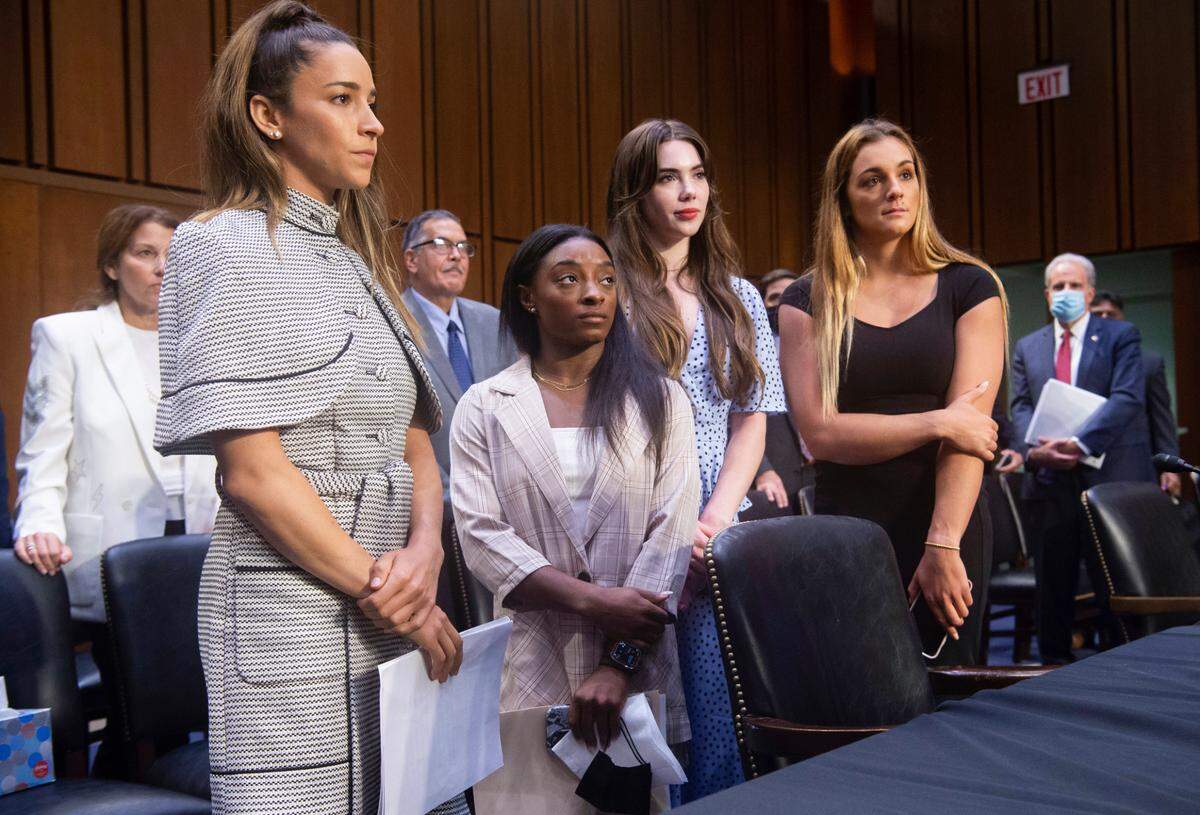
Nassar abuse survivors reach $380 million deal with USA Gymnastics, Olympic committee
USA Gymnastics and the U.S. Olympic and Paralympic Committee have agreed to pay a $380 million settlement to hundreds of survivors of sexual abuse by former team doctor Larry Nassar, reported Joe Hernandez at NPR
“We prevailed for one simple reason, the courage and tenacity of the survivors,” John C. Manly, an attorney for some of the victims, said in a statement. “These brave women relived their abuse publicly, in countless media interviews, so that not one more child will be forced to suffer physical, emotional, or sexual abuse in pursuit of their dreams.”...
USA Gymnastics will be required to have at least one abuse survivor on its board of directors and create a restorative justice process for victims, among other provisions.
Sarah Hirshland, CEO of the U.S. Olympic and Paralympic Committee, said in a statement that she was grateful to have reached a settlement with the survivors of Nassar’s abuse.
Read up on this...
For the culture
bell hooks, Pathbreaking Black Feminist, Dies at 69
Clay Risen writes for The New York Times:
Starting in 1981 with her book “Ain’t I a Woman? Black Women and Feminism,” Ms. hooks, who insisted on using all lowercase letters in her name, argued that feminism’s claim to speak for all women had pushed the unique experiences of working-class and Black women to the margins.
“A devaluation of Black womanhood occurred as a result of the sexual exploitation of Black women during slavery that has not altered in the course of hundreds of years,” she wrote.
If that seems like conventional wisdom today, that is in large part because of the enormous impact Ms. hooks had on both feminism and Black women, many of whom had resisted aligning with a movement they felt was designed to diminish their experiences...
bell hooks, whose incisive, wide-ranging writing on gender and race helped push feminism beyond its white, middle-class worldview to include the voices of Black and working-class women, died on Wednesday at her home in Berea, Ky. She was 69.

Barack Obama’s 2021 reading list
I look forward to this every year. I don’t know what it is exactly, because I can tell you for sure that I don’t run out and devour every book on the list — the list of books in my reading queue is embarrassingly long... and untouched. Maybe it’s as simple as the delight of knowing the consumption habits of intelligent and interesting people.
“Art always sustains and nourishes the soul. But for me, music and storytelling felt especially urgent during this pandemic year—a way to connect even when we were cooped up,” the former president wrote on Instagram.
Here’s Obama’s book list:
- “Matrix” by Lauren Groff
- “How the Word Is Passed” by Clint Smith
- “The Final Revival of Opal & Nev” by Dawnie Walton
- “The Lincoln Highway” by Amor Towles
- “Invisible Child: Poverty, Survival & Hope in an American City” by Andrea Elliott
- “Harlem Shuffle” by Colson Whitehead
- “Cloud Cuckoo Land” by Anthony Doerr
- “These Precious Days” by Ann Patchett
- “Crying in H Mart” by Michelle Zauner
- “Aftershocks” by Nadia Owusu
- “Crossroads” by Jonathan Franzen
- “The Love Songs of W.E.B. Du Bois” by Honorée Fanonne Jeffers
- “Beautiful Country” by Qian Julie Wang
- “At Night All Blood is Black” by David Diop
- “Land of Big Numbers” by Te-Ping Chen
- “Empire of Pain” by Patrick Radden Keefe
- “Project Hail Mary” by Andy Weir
- “When We Cease to Understand the World” by Benjamín Labatut
- “Under a White Sky: The Nature of the Future” by Elizabeth Kolbert
- “Things We Lost to the Water” by Eric Nguyen
- “Leave the World Behind” by Rumaan Alam
- “Klara and the Sun” by Kazuo Ishiguro
- “The Sweetness of Water” by Nathan Harris
- “Intimacies” by Katie Kitamura
He will also share his favorite music and movies in the coming days.
Imagine what is possible
Did someone forward this newsletter to you? You can sign-up here. If you’d prefer to unsubscribe from this newsletter, you can do so at any time using the “Unsubscribe” link at the bottom of this message.