Funeral directors see too much senseless death. Here’s how they try to save lives
READ MORE
‘Enough is enough’
As gun violence rocks their communities, funeral directors take action for peace
Expand All
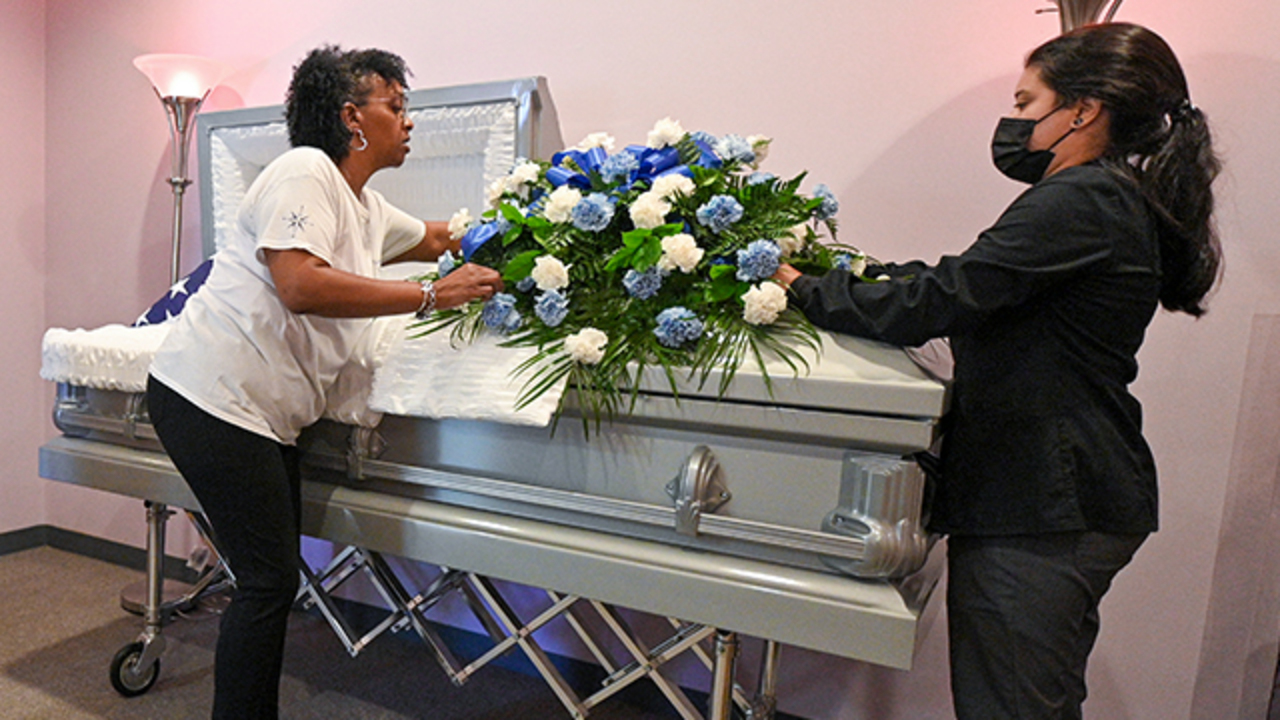
The first funeral at Northern Star Mortuary in Kansas City, Kansas, was for an older woman who died of natural causes. The second: for a teenager shot in the forehead, the son of a family in a blood feud.
Police warned the new funeral home’s owners, Gwendelrae and Scottie Hicks, that someone might shoot out their windows.
“OK,” Scottie thought, “now we’re in the game.”
At the funeral, the two family factions had to be seated apart. And though the police stood by, Scottie was nervous because amid the mourners there to grieve, “there were a lot of young men there who were prepared for war.” He could see the telltale bulges of guns tucked into their waistbands. The hard looks in their eyes and body language told him they were ready … set … go.
More homicide victims would come to their mom-and-pop operation on Leavenworth Road in Wyandotte County, and another in Wichita, and 14 years later the violence continues to trouble them.
But now, like a growing number of other Black funeral home directors across the country in recent months, they’re speaking out and taking action.
“Let’s put the guns down,” said Gwendelrae, a rare female funeral home owner in a male-dominated industry. “I have had too many people come into the funeral home that have been shot because of something senseless.”
They join a decades-long legacy of Black morticians who have used their voices for change: for civil rights, voting rights and now for stopping the violence they see claiming too many lives in their communities.
Funeral home directors bring a unique perspective to discussions about gun violence. As last-responders, they bear detailed witness to the carnage. “When the police finish gathering all the evidence from the crime scene, the crime scene is wrapped up and then (the body is) sent to us,” said Scottie, who handles the business side while Gwendelrae runs mortician duties.
“We clean you, wash you, disinfect you, and then we start the process of rolling you over to plug holes so you don’t leak in this casket or this suit.”
Funeral directors across the country are addressing the violence in YouTube videos and at peace rallies. On billboards in Ohio and Alabama, funeral directors declared: “We don’t want your business that bad.”
They have used the tools of their trade to show this generation that death is permanent and can’t be undone by pushing reset.
They’ve driven their hearses through cities rocked by gun violence to grab the public’s attention. Last summer in Tallahassee, Florida, hearses from nearly 20 funeral homes traveled across two counties after a 12-year-old got hit by a stray bullet while taking out the trash.
The “mirror casket” is back, too.
Last month, during a Stop the Violence rally outside the city hall in Worcester, Massachusetts, a funeral home set up a casket with a mirror inside so that people who walked up would see themselves lying inside.
They’re prodded in part by a rash of shootings, some deadly, at funerals and funeral-related events over the last year, including one in Kansas City this summer, that have put mourners in the line of fire.
“Funeral homes and funeral directors all over the nation, you see them in Chicago, in Detroit, in New York, we see them coming together because now the violence is spilling over into our workplace,” said Scottie. “Now it’s at our job.”
In July, five people in Indianapolis — including a 4-year-old girl — were shot outside a funeral home during a fight in the parking lot. The mother of a teenage girl shot in the chaos later begged the public: “Put the guns down, open your mouths and let’s hug and love on one another.”
“The only thing that I think at this point in time that’s going to stop the shooting is the community rising up and saying enough is enough,” said Nathaniel Moody, a city commissioner and funeral home owner in Grand Rapids, Michigan, a city that set a homicide record last year.
Gwendelrae and Scottie Hicks “walked around the table 100 times” trying to decide what they could do, Scottie said. They came up with an idea they’d like to try with young people involved in crime in Kansas City — even if it might offend some people.
“Our approach is through a dose of reality, scared straight,” he said.
They want to invite parents trying to keep, or get, their children off the streets to bring them to the mortuary, a former dry cleaning store painted Kansas State University purple because Gwendelrae grew up in Manhattan.
They want those parents and children to take a seat at the table — and plan the kids’ funerals.
“I think we need to be more proactive in this situation,” she said. “Then again, every time we say stop the violence, more violence ensues.”
‘They’re coming to kill’
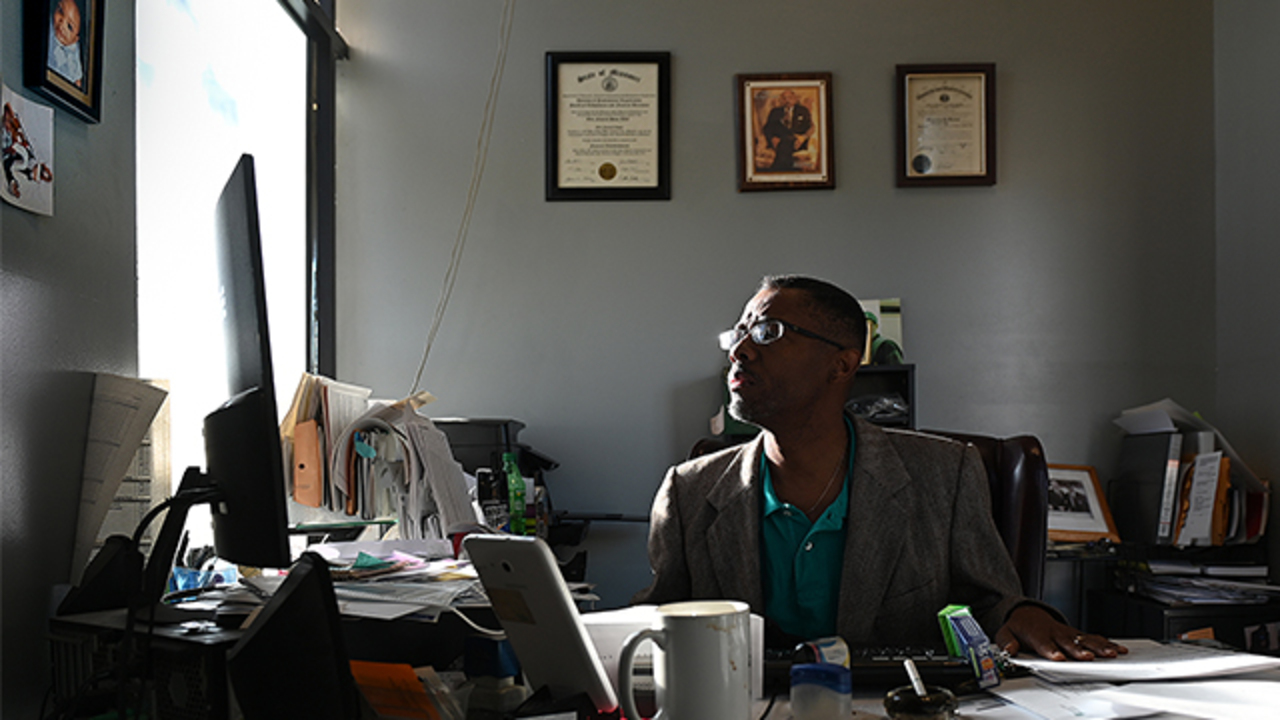
Kansas City funeral home owner Malcolm Morris has made his own statement about violence.
In more than 20 years in the funeral business he’s buried countless crime victims. But no more.
Eight years ago he made a move unheard of in his field when he stopped doing funerals for homicide victims, with rare exception.
“It takes a toll on you,” Morris said.
He owns Elite Funeral Chapel on Blue Ridge Boulevard in south Kansas City, a sprawling operation anchoring a strip mall with Diamond Cleaners and Alterations at one end, and a laundromat and convenience store in between.
The death industry wasn’t his first career choice.
He gave up a lucrative, globe-trotting sales career with cosmetics company Revlon and came home to Kansas City to help his father, Eugene R. “Gene” Morris, run his funeral home. The elder Morris had suffered the first of several heart attacks that eventually took his life.
Gene Morris was a well-known entrepreneur who owned and operated several businesses, including a beauty supply store that influenced his son’s first career choice. For more than a decade until he died he ran E.R. Morris Funeral Chapel at 41st Street and Troost Avenue.
Gene — known for wearing cowboy boots with his suits — believed everyone deserved a nice funeral, even if they didn’t have the money for it. He provided funerals for many indigent people.
He buried crime victims, too, and learned to handle the difficulties that sometimes accompanied them. Morris remembers helping his “Pops” escort caskets out of Kansas City churches, toting shotguns because someone had anonymously threatened to shoot the mourners.
It never happened. But still, his father kept guns handy under the limousine seats in case trouble broke out.
Morris has never done that. He hires off-duty Kansas City Police Department officers for security if he thinks there might be trouble at a funeral.
He didn’t realize how the violence in the city was affecting him until a dead girl shoved him off an emotional cliff.
“They killed the little baby,” said Morris.
She was a tiny body laid out on his prep table, murdered just weeks before her fourth birthday.
Morris turned from the table to grab makeup powder to give her face a soft, matte finish. When loved ones saw her she would look like a little girl sleeping, not a crime statistic.
When Morris turned back to the table, his troubled mind played a trick on him. Instead of the victim, he saw the face of his own granddaughter, then about the same age, but very much alive.
“When do you say when?” Morris said recently, describing the hallucination from eight years ago in a voice dull with surrender. “My psyche at that point was more valuable to me. And that was the scenario that made me stop.
“I said I’m done. No more.”
Morris is 58, the age his father was when he died. To this day he blames the stress of the funeral business for his father’s heart problems and death. “He died too young” — an ending he’s determined to avoid.
‘Now it’s revenge killing’
Morris’ sister, Shantell Williams, is also a mortician and helps from time to time at the funeral home. From what she has seen and heard over the years, she thinks the motive for murder has changed from when their father was burying bodies.
“It’s just a different generation. Back then it might have been a drug deal gone bad or someone was getting jacked for their dope,” said Williams. “Now, it’s revenge killing.
“The generation I came from was a fighting generation. But now these kids bring guns to a fist fight. They’re coming to kill.”
She recognizes cycles to the killings, too, a domino effect that happens when a young mourner at a crime victim’s service returns to the funeral home — in a body bag.
Black males ages 15 to 34 make up 37% of gun homicide victims but only 2% of the U.S. population, says the Centers for Disease Control and Prevention.
Across all ages, Black men are nearly 14 times more likely to die in a firearm homicide than white men, and eight times more likely to die that way than the general population, according to CDC estimates.
“That’s why I don’t watch local news, because I know tomorrow morning I’m going to be addressing that,” said Baltimore funeral home owner Hari P. Close II, president of the National Funeral Directors & Morticians Association, which represents Black morticians.
“The news comes on … someone got stabbed, someone got murdered … then tomorrow I go to my funeral home and I have one of those people on my table, I have one of those families calling me.”
And he’s had some close calls himself.
Once at a cemetery, an angry young man shoved a .357 Magnum in his side as he was closing the casket of a murdered gang member.
‘Lead poisoning’
In Minneapolis in June, the tiny pink coffin of 6-year-old Aniya Allen was carried along busy streets to the cemetery in a fancy white horse-drawn carriage followed by honking cars. She had been killed by random gunfire while eating McDonald’s in the backseat of her family’s car.
Her body was shown around the community to remind people they can do a better job of bringing people together, a bishop said at her funeral.
“You come in, you have a child that has been killed and you’re standing there working on that person and you think about that life,” said Williams. “Here you are, working on somebody that had their whole life ahead of them. And it was taken from them. Man has no right to take someone’s life.”
Close, whose group represents 2,000 funeral directors and morticians across the country, refers to gun violence as “lead poisoning.”
“Because what is a bullet made of? Lead,” he said.
When bullets do the killing, the body preparation is restorative. Wax can create facial features where none remain.
Sometimes, clay is employed for the reconstruction.
When Close works on bodies that have sustained multiple gunshots, he thinks about how someone really, really, really wanted them dead.
“Imagine being the embalmer who sees this,” he said, mentioning one young victim he spent more than three hours sewing up “trying to hide stuff.”
“Those of us who are serving families that have those types of tragedies, we take so much pride in making sure we can cover what we’ve seen so this family never ever sees it,” Close said.
The younger members of his national group, the under-40 set, have begun talking with one another about how to take better care of their own mental health and using therapists to help them handle the grief they’re trained to never show on the job.
“Being in this business as long as I’ve been in the business there are moments when it’s overwhelming to me, seeing the senseless deaths,” Close said.
When Morris of Kansas City explained in a TV interview why he stopped doing funerals for homicide victims, he took heat from people on social media who told him to “man up” because “that’s what you chose for a living.”
“I had to start thinking about certain things like, my mother’s still living. I have grandchildren. I have daughters. I have a son,” he said.
“I am not going to repeat my family history and I am not going to put myself in a position to physically or mentally harm myself to accelerate that. And if nobody understands that, I don’t care.”
Legacy of social justice
Black funeral home directors have a rich history of serving as a voice in their communities.
“We have always been the prominent persons in our community but we have been ‘the quiet’ in our community,” Close says in a video on the National Funeral Directors website.
“We do so much in our community that we don’t want to boast (about) and we do it with grace, dignity and respect. But now we need to tell our story.”
It’s no surprise to researcher Candi K. Cann that some funeral directors are calling out the violence.
“Funeral home directors have a long history, especially African American funeral home directors, of serving as witness to the violence against bodies of color,” said Cann, an associate professor of religion at Baylor University in Waco, Texas, who researches death and dying.
“That’s a huge role and these funeral homes have really operated as this bastion of these communities for years.”
During slavery in the United States, “oftentimes people of color were only allowed to gather when there were funerals or funeral rituals,” she said.
“And then white people didn’t want to treat bodies of color when they died. So African Americans ended up treating bodies of color because white people didn’t want to and weren’t qualified to.
“As a result, funeral homes became a place where you could make money, hold money, create community, create community activism.
“And they often became these wonderful resources for the Black community to be able to help with certain events and community events, like voting.
“And then out of these African American funeral homes you see a long line of civil rights activists that emerge from funeral home families.”
During the civil rights movement, Black funeral homes hosted community meetings. Funeral directors drove leaders, including the Rev. Martin Luther King Jr., from town to town in their hearses for safe passage, a la the underground railroad, Cann wrote in a 2020 scholarly article about Black funeral homes.
“The history of African American funeral homes is so inspiring,” said Cann. “And I feel like they have served as witness to white supremacist violence for years, so why not now, too?””
Last fall in Philadelphia, funeral home owners drove their limousines around the city in a show of solidarity against the violence there. They also affixed signs to the cars calling attention to COVID-19 and to opioid abuse, and reminding residents to vote on Election Day.
“We need police, politicians, academicians, community advocates, and, yes, funeral directors to help people understand how much violence affects everyone,” Darin Toliver, a co-founder of The Black Men at Penn School of Social Work, told The Philadelphia Inquirer.
“If their approach of displaying the realities of death would help save a life, then, yes, it’s worth it.”
What stops the violence?
Earlier this year Moody, the city commissioner and funeral home operator in Michigan, told a reporter that the rise in violence in Grand Rapids sometimes has him in tears and asking the Lord, “What can we do to stop this?”
As an elected official and the owner and director of Brown’s Funeral Home Ltd., Moody believes much of the violence in his city “centers around economic development.” People need jobs and help to start their own businesses, he said.
“The education system has done everything it possibly can to educate people, to get prepared for the future,” said Moody. “But I think somewhere along the line, a lot of what we’re dealing with deals with economics, deals with poverty and poor family functions that families have within homes in raising their kids.”
“As a funeral home director and owner of a funeral home, my rising up is to help families understand that they have to be the responsible people to talk with their children, talk with their young adults, and they have to be the ones to put a stop to this.
“We can put all the programs together in the world. We can get all the funds from government to curb violence and to bring jobs. But it starts at home.”
Moody wouldn’t be surprised to have more of his colleagues joining this discussion, given what some have already tried.
“You can ride a hearse through town all day, which we do for funerals every day,” he said. “Hearses riding through community — if that doesn’t scare you and tell you that death is imminent, that there’s no way to escape, then what else is going to help you?”
In Kansas City, Kansas, Gwendelrae and Scottie Hicks hope their dose of reality will scare kids straight.
They want to invite young people and their parents to come to the funeral home, sit at the table and plan the kids’ funerals.
Pick the casket.
Will that be burial or cremation?
Who’s going to pay for it?
“After we take you through the process and explain to you what goes on behind that door back there in the morgue, when you leave here it gives you a different perspective of your own activities, your own behavior,” said Scottie.
“Now, do you even want to play the game?”
.jpg)