‘Lexus lanes’? State recommends toll lanes to fund wider highway in Johnson County
Update: Here’s what happened at the June 14 meeting about toll lanes. Read the story here.
The Kansas Department of Transportation has determined that adding express toll lanes on U.S. 69 in Johnson County is the preferred option for widening the highway — concluding it would be cheaper and friendlier to the environment.
But the decision is ultimately left up to the Overland Park City Council.
KDOT officials will present the findings of a new study to the City Council on Monday night. The council is then expected to vote June 21 on whether to enter into an agreement with the state to advance the project. The highway would be widened to six lanes from 103rd to 179th streets — paid for in part by making a lane in each direction a toll lane.
Rush hour toll rates likely would be between 25 cents and 32 cents per mile, lower than the national average of 56 cents, the study said. A commuter driving through the entire stretch of the express lane five times a week could expect to pay a weekly average of $7.50 in tolls. Tolls would be less when it isn’t rush hour.
Such express lanes have been built in other metro areas, such as in Dallas and Denver. Typically, the far-left lane is tolled. The two other lanes in each direction would remain free.
“There’s been a misconception that we’re making a toll road. But this is just one lane. People can continue to use the highway like they do today without spending additional money,” said Lindsey Douglas, deputy secretary for KDOT. “These improvements to the highway are going to happen with either option. We’re not just adding a lane to build revenue. We’re trying to solve transportation problems that exist.”
The idea of adding Kansas’ first express lanes — what some have nicknamed “Lexus lanes” — on the stretch of highway in Overland Park has been met with some opposition from residents, who argue the model favors the wealthy. Some council members also have voiced skepticism.
In a survey released this month by KDOT, nearly 78% of the 1,200 respondents said the highway’s traffic flow should be improved in the next five years. Asked whether drivers would use the express lanes, 8.5% said most of the time; 24% said some of the time; 26.5% said only in emergencies; and 32% said they would never use them.
“What we want with the express toll lane is to have about one-third of people who want to use it. If someone is late to work and they want a reliable trip and decide their time is worth the toll, it is a great tool to manage traffic,” Douglas said. “People make the decision that means the most for them. It doesn’t have to burden the whole tax base of Overland Park to pay for the capacity they may not use.”
“We think it’s a good option and will help with the long-term health of this corridor as the population continues to grow.”
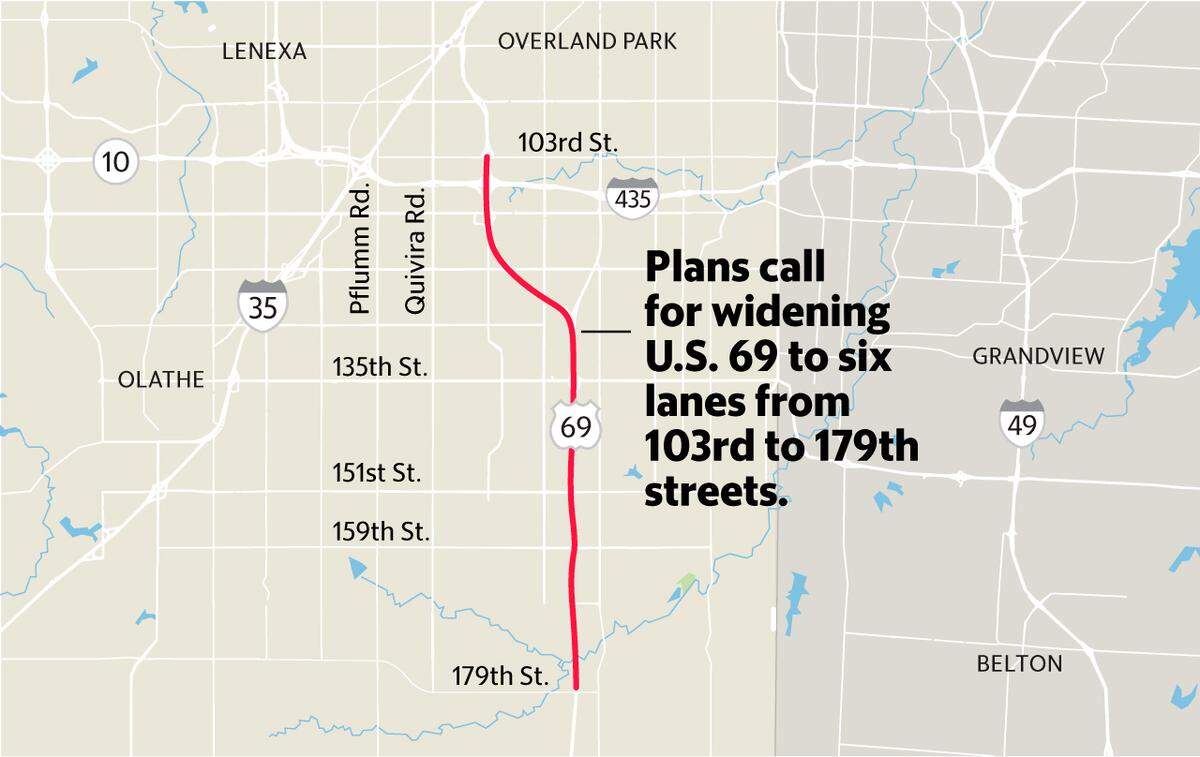
Weighing two options
KDOT’s study found that adding express lanes would be roughly $85 million cheaper than a traditional widening project, which would require more roadway to be constructed.
With the toll lane option, construction would total $655 million.
The first phase would include improvements north of 151st Street, at an estimated cost of $300 million. KDOT is requesting a $20 million contribution from the city. Overland Park could use the revenue generated from the toll lanes to pay it, with tolls collected up until 2042.
If the City Council does not agree to add toll lanes, it could pay $2.2 million a year over the next decade, or contribute the entire $20 million at the beginning of construction.
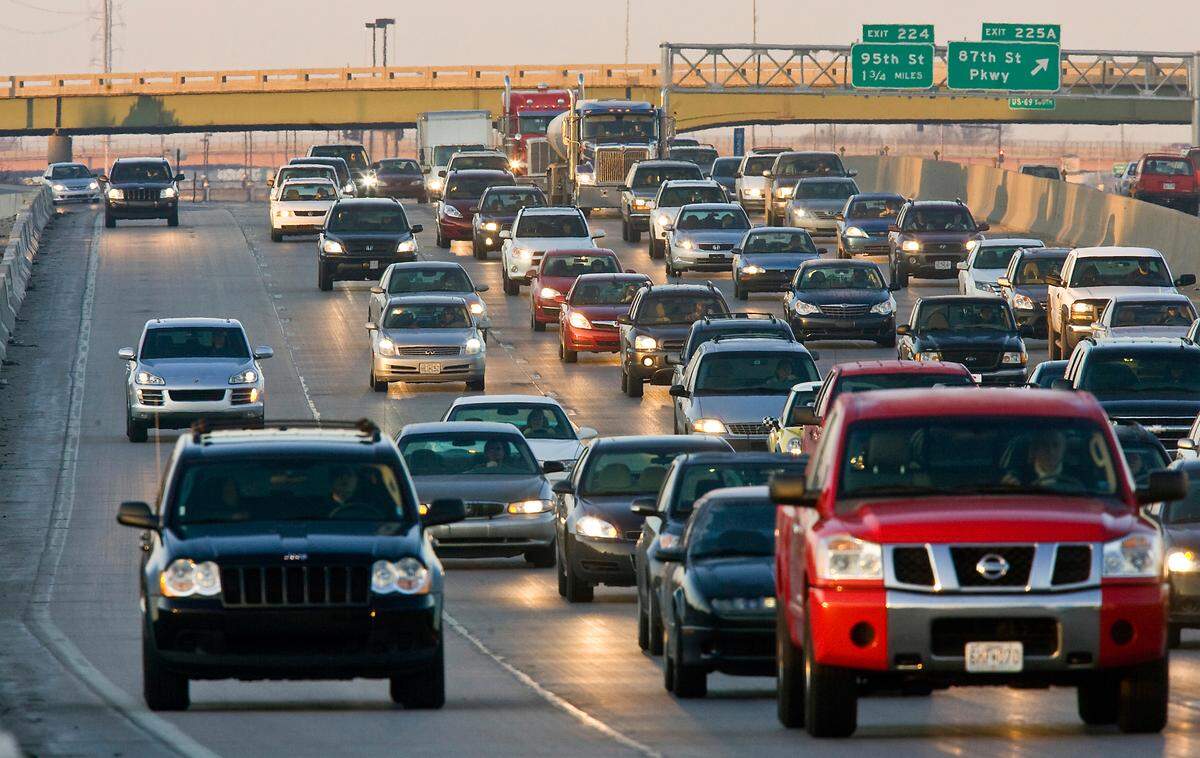
The stretch of U.S. 69 is the most congested four-lane highway in the state, according to a traffic analysis, and local leaders only expect longer backups in the coming years as more people move to southern Johnson County. Around 80,000 vehicles travel it each day. KDOT estimates traffic volume will double, and travel times will triple, by 2040.
In addition to adding the new lanes, the project includes reconfiguring the interchanges at Blue Valley Parkway and at Interstate 435. Improvements would be made to cross streets and pavement, and bridges would be reconstructed.
A previous study found that the southbound segment between Blue Valley Parkway and 135th Street sees the worst congestion during evening rush hours. Ann Melton, with KDOT, said construction would aim to relieve those issues.
Heading south, the Blue Valley Parkway entrance ramp would be moved from the left side of U.S. 69 to the right side, she said, eliminating the current weave to 135th Street. Crews would also add ramps connecting the express toll lane and Blue Valley Parkway.
“These two improvements are expected to provide dramatic improvements to both operations and safety in this section of U.S. 69,” she said.
Along with a cheaper price tag, KDOT has determined that expanding the highway with express toll lanes would be less obtrusive.
A traditional widening would still add one lane in each direction. But in addition, Douglas said, even more lanes would be added at high-traffic interchanges where some cars merge onto the highway only to exit again shortly after. Those cars would instead stay in extra lanes to the far right, as drivers can do on I-435 between Roe and Nall avenues, for example.
“We would have to acquire additional property and the overall footprint of the roadway would be so much larger because you have to build an additional system for the traffic,” she said.
But several City Council members have yet to say they are in full support of adding the express lanes. Some previously told The Star that they would like to consider other funding options, while holding out hope for federal funding under President Joe Biden’s administration.
“It seems to me like that should be something we should seriously consider as a funding source instead of doing it as a toll lane. That’s not to say I wouldn’t support the toll lane if that’s what it comes down to, but we should look at alternative funding first,” Councilman Paul Lyons previously said.
What’s next?
In the meantime, officials hope that federal funding could help pay for at least a portion of the project, at the interchange with 167th Street.
Kansas Democratic Rep. Sharice Davids announced this month that her $15 million request for earmarked spending to fund the project has been selected in the federal surface transportation reauthorization bill. Congress must pass the bill by Sept. 30 before funding for federal highways expires.
Douglas previously said the project includes raising U.S. 69 there and replacing the two bridges for a higher clearance over 167th Street below. The extra room would allow for a four-lane divided 167th Street, from just west of Metcalf Avenue to Antioch Road.
The interchange now only provides an exit ramp for southbound traffic and an entrance ramp for northbound U.S. 69 traffic. The project would convert it into a full interchange with access in both directions.
The reconstruction would better serve the new AdventHealth South Overland Park hospital, expected to be completed later this year. Douglas previously estimated the total cost of that bit of roadwork to be $30 million.
Douglas said federal funding could help that piece of the project get done earlier than originally expected.
For now, the City Council will meet at 6 p.m. Monday to discuss KDOT’s report on options for expanding the highway, but will not take action. KDOT will offer a recommendation of adding express toll lanes, according to city documents.
If the City Council on June 21 votes to move forward with adding express toll lanes, Overland Park and KDOT would propose the project to the Kansas Turnpike Authority board and State Finance Council for their approval.
If tolling is approved by those boards, construction could begin as early as next year, according to city documents.
But if the council does not agree, work would stall until a new plan is created for funding the project.
This story was originally published June 14, 2021 at 5:00 AM.