Overland Park business leaders push for new highway toll lanes. Others say not fair
Business leaders and state officials on Monday urged the Overland Park City Council to agree to add express toll lanes to U.S. 69, arguing that it’s the most cost effective and equitable way to widen the crowded highway.
“Are tolls popular? Of course they’re not. Neither are taxes. But as we all know these are a cost effective means when implemented carefully and in a cost effective manner to acquire the things a community needs,” said Tracey Osborne Oltjen, president and CEO of the Overland Park Chamber of Commerce, which has endorsed the plan.
But some residents told council members that the toll lanes would favor the wealthy.
“The (lanes) present a situation where many cannot afford to pay a toll,” said resident Mark Lanzrath. “This will only reinforce a perception of Overland Park being a city of ‘haves,’ dividing people into ‘us’ and ‘them.’”
Next Monday, the City Council will decide whether expanding the most congested four-lane highway in the state should include adding express toll lanes. It’s a controversial decision that will impact Johnson County traffic for decades.
The Kansas Department of Transportation conducted a study showing that adding toll lanes was a more cost effective and environmentally-friendly option, compared to a typical widening project. The new, far-left lanes would be tolled, with rates fluctuating depending on traffic and the time of day.
But the average cost for a driver using the full length of the toll lane five times a week during rush hour would be $7.50 a week. The two other lanes in each direction would remain free.
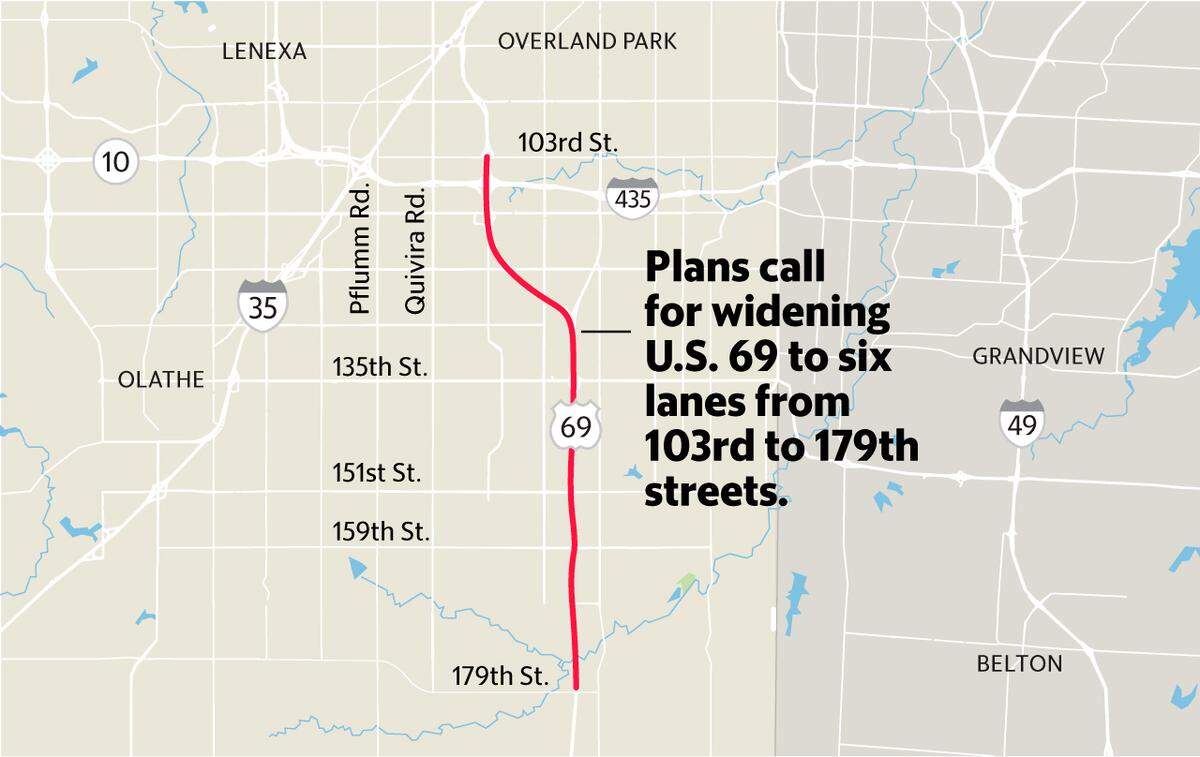
The first phase of construction would include $300 million of work to expand U.S. 69 to six lanes from 103rd to 151st streets. KDOT is asking Overland Park to contribute $20 million. Revenue from the toll lanes could pay for that local contribution.
“KDOT believes that express lanes are the best value for the state,” Lindsey Douglas, deputy secretary for KDOT, told the City Council on Monday. “With a smaller footprint, there are fewer environmental impacts, which is very attractive. The overall construction cost is lower and would not impact demand on the current city resources.”
Out of the drivers expected to use the toll lanes, about 59% would live outside of Overland Park, Douglas said, meaning the burden would not fall solely on city residents. And KDOT officials expect the free lanes to see reduced congestion as well.
If approved by the City Council, construction north of 151st Street would be expected to begin next year, with the new toll lanes opening to traffic in 2025.
The project also includes reconfiguring the interchanges at Blue Valley Parkway and at Interstate 435. Improvements would be made to cross streets and pavement, and bridges would be reconstructed.
The funding options
In 2019, state lawmakers passed new legislation allowing tolls to be collected, but only on newly constructed lanes, and only with community support. Douglas said that Overland Park would use the revenue generated from the toll lanes to reimburse KDOT for its match, with tolls collected up until 2042.
Once the match is paid off, the tolls go away. That is, unless there is a change to the law allowing tolling to continue, Douglas said. Otherwise, at that point, she said that additional roadwork might be required to deal with the growing congestion.
Next Monday, the Overland Park City Council could take a different route, though.
Officials could decide to contribute the $20 million out of the city budget up front or slowly over the next decade, to pay for a traditional widening project. City officials are unclear on where that money would come from. And that option would require more roadwork to be built over a longer period of time.
That ask would come at a time when the city is already considering increasing property taxes for residents in next year’s budget to help pay for a funding increase for public safety, mental health services and other items.
If officials choose the traditional widening project, construction would start in 2025 and likely last until 2027 for the first phase of work, which would still total $300 million. The project would take longer because it would require more lanes to be built at high-traffic interchanges, where some cars merge onto the highway only to exit again shortly after — as vehicles do, for example, along I-435 between Nall and Roe avenues. That extra roadwork, called a collector distributor system, would also require five more bridges to be built, Douglas said.
That extra roadway is part of the reason the traditional widening would cost $85 million more.
Eventually, the highway would be expanded to 179th Street. With the toll lane option, the entire construction project would total $655 million, compared to $740 million for the expansion without tolls.
Another option is that the council could decide not to contribute local funding. That would mean the state would expand the highway in smaller pieces over several more years, Douglas said. The state would only move forward with $70 million worth of work to start, expected to be completed in 2027.
Who would use toll lanes?
Funding such a project remains challenging in a state that borrowed more than $2 billion from its highway fund during the administration of Gov. Sam Brownback.
Douglas said if Overland Park contributes the local match, the U.S. 69 expansion would be the state’s top priority for funding under its 10-year program funding highways, bridges and other infrastructure.
If the City Council agrees to add toll lanes, rush hour rates likely would be between 25 cents and 32 cents per mile, lower than the national average of 56 cents, according to KDOT.
Toll rates would fluctuate, with higher prices when there is more demand. The toll would be collected digitally, with drivers charged after their K-Tag or license plate number is scanned.
It would be the first express lanes built in Kansas. Douglas said KDOT studied the rollout of such toll lanes in other metro areas, such as Denver.
In a survey of 1,200 Johnson and Miami county residents released this month by KDOT, 8.5% of drivers said they would use express lanes most of the time; 24% said some of the time; 26.5% said only in emergencies; and 32% said they would never use them.
Douglas said the goal is to have about one-third of drivers wanting to use the express lanes.
If the City Council on June 21 votes to move forward with adding express toll lanes, Overland Park and KDOT would propose the project to the Kansas Turnpike Authority board and State Finance Council for their approval.
This story was originally published June 14, 2021 at 10:37 PM.