‘Ghost town’: Weeks into COVID-19 crisis, Overland Park shops work to adapt or wither
Darby Brender’s classes at Fusion Fitness were jammed at the start of March. Business was so good, her three locations around the Kansas City area, with 40 instructors, were pulling in 500 high-energy exercising clients a week.
“Classes were packed,” the owner said. “Everyone was happy.”
So it seemed for her 300 neighboring merchants in downtown Overland Park, where many seemed to reaping the fruits of a fast-paced economy nourished by the lowest unemployment rate, 3.5%, in half a century.
In three years, more than $100 million in new luxury apartments have risen around 80th Street and Metcalf Avenue. It brought nightlife with young people pouring into local businesses. Strang Hall, a collective of six eateries, had just opened to excitement and packed tables in December.
Then COVID-19 changed everything.
“This is a ghost town. The whole area,” said Joe Cordero, operations manager at Mi Ranchito Cocina & Cantina, a Mexican restaurant located one floor below Brender’s studio, where Cordero is working to hang on.
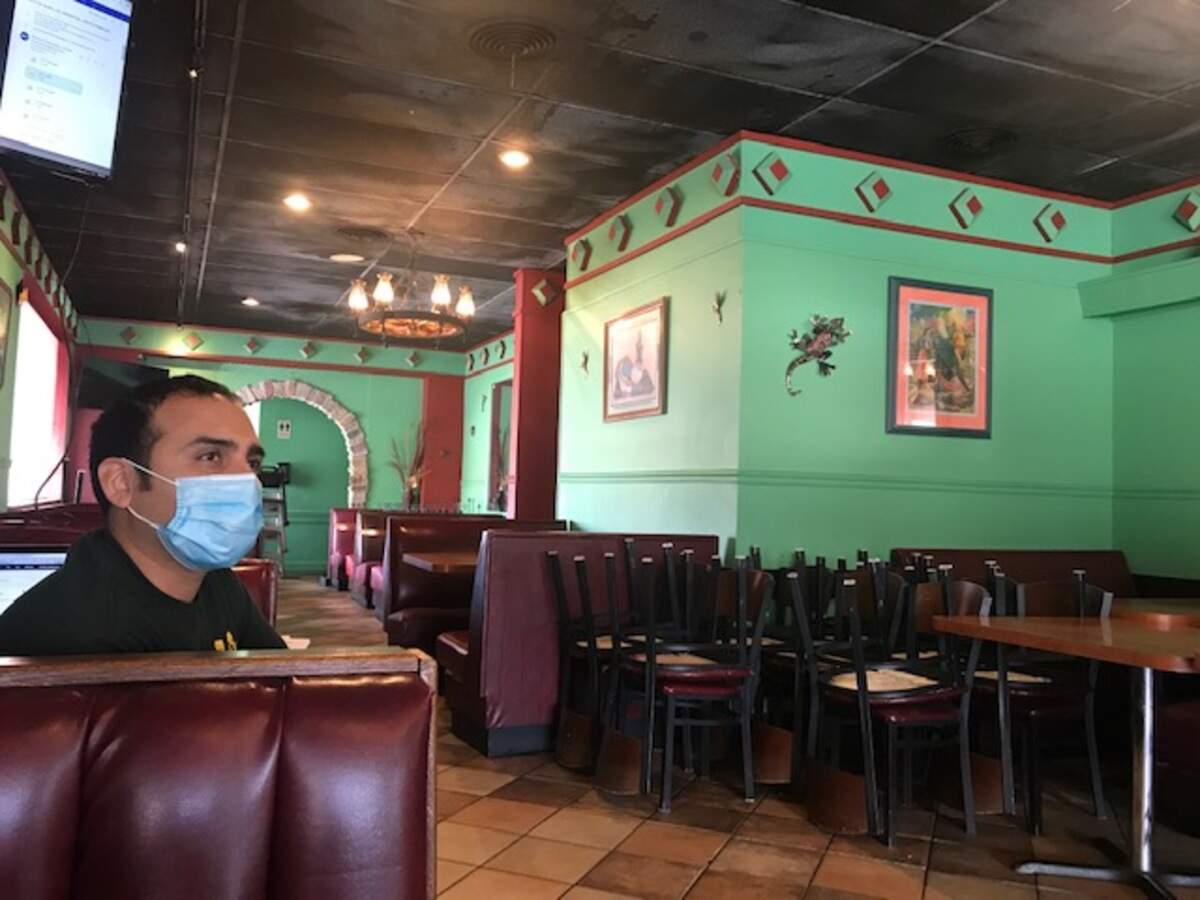
Sales are off at least 50 percent, he said, as he handed a $19 pickup order to a walk-up customer. Hours and staff have been cut. Across the street, Strang Hall has temporarily suspended curbside service. It sits dark, its workers sent home.
The result is a retail corner of downtown Overland Park that has become like millions of similar corners across America.
Small business owners — many deemed unessential and forced to close — look to the future with uncertainty. At the same time, they are working to find ways to keep going by connecting with customers: Mi Ranchito’s Cordero running to curbside; Ensemble clothing pushing online sales; Fusion Fitness exercising over social media; the Tasteful Olive serving customers through half-open doors as its owner looks for the return of some semblance of normal days.
This past week, the federal government released hobbling numbers: March’s retail sales down 8.7%, the largest drop in three decades, with April expected to be even worse. New unemployment claims topped 22 million over the last four weeks. On Thursday, Kansas City extended the end of its stay-at-home order from April 24 to at least May 15; Kansas and Missouri extended theirs to May 3, but both Johnson and Wyandotte counties say they’re ready to prolong the order if necessary. Everyone hopes for an end of the hardship on already burdened businesses.
In Overland Park, snapshots of a few offer a glimpse of not only how merchants are trying to hold on, but also of how they hope to emerge.
‘Hard decisions’
Kassie Murphy wept inside her car.
She sat next to her nearly 2-year-old daughter in the parking lot of Sam’s Club, when a friend texted her the March 21 notice about the shutdown of all nonessential area businesses in the Kansas City area. For nearly a month prior, she had been concerned about the spread of the coronavirus when wholesale vendors began telling her that shipments she had ordered for her specialty clothes shop were being delayed.
Now, in a matter of days, the doors of her shop, named Ensemble, would be shuttered.
“I remember my daughter and I sitting in the back and I just started crying,” Murphy, 31, said this past week, “because I was like, ‘What does this mean? Where will things go?’ That first week I was in a grieving process in a way.”
In May 2018, at eight months pregnant, she had opened her shop at 7941 Santa Fe Drive as a dream project. She had begun the shop as an online venture in 2016, but after 16 months she wanted a lovely destination store that would bring people together.
“I need to touch things,” she said. “I need to feel things, and when I go shopping, I love when somebody is just giving me attention, and helping me find something, and just having somebody in there to walk me through it.”
She thought others would like that, too.
Over the last two years, Murphy had done well. Her husband, who runs a small, residential remodeling company, had fixed up the space, laid the wood plank floors and hung the teardrop chandeliers. Murphy’s mother painted the mural of pink roses on the far wall.
The shop was not yet financially self-sustaining. But it was doing well enough for Murphy to quit her salaried job as a commercial real estate broker. She had five part-time employees. Monthly sales in her second year were double those of her first year. She says 99% of her customers were walk-ins.
They had begun holding 30-person or smaller bridal showers, baby showers, birthdays and tea parties for teenage girls in an event space downstairs. They held wine events upstairs. They were looking forward to the opening of the Overland Park Farmers’ Market on April 11, which often doubles weekend foot traffic.
“In January, I was sitting there looking at the numbers, and I think I looked at my husband and I was like, ‘Wow, this is working. This is exciting. And I’m so glad we did this!’” Murphy recalled.
One day after the stay-at-home order was issued, she laid off her five employees so they could apply for unemployment. Almost all the retailers here have applied for government PPP help, which — if at least 75% of money is used for payroll and is spent before the end of June — becomes a forgivable loan. Otherwise, it needs to be paid back at 1% interest over the next two years.
Yet to see a dime, Murphy is pulling from her and her husband’s bank account to meet monthly rent, utility bills and other expenses. Her vendors need to be paid. She’s confident she can last at least through April. She had already started working again in commercial real estate, although that industry has also gone into near free fall.
More and more, she continues to try to sell online through her website and through social media, like Instagram.
“I think when May 1st hits, I’ll have to sit down and make some hard decisions,” Murphy said.
On a scale of 1 to 10, she gives her chances of reopening a 6. “Maybe a 7,” she said.
“I try to remain positive,” Murphy said. But even if she does reopen, she’s doubtful it will be the same.
On her good days, she hopes that people, sick of quarantine, will want life to return to the way it used to be. But more realistically, she thinks that COVID-19, at least in the short term, will have created a new normal in which restaurants, perhaps, are seating people at every other table. Retail stores may need to continue to require social distancing limitations on capacity.
“I mean, are we really going to see what we saw before?” Murphy said. “For me, I’d like it to return to where I can go somewhere and I can walk in and I can say hi, and I can have conversations with people and shop like we used to.
“But do I know that’s going to be the case? No. I know there are more people than not who think that it might not look like that.”
Bigger issues
Kay, short for Kilver, Martinez, grew up in difficult circumstances. A young solo business owner at 25 — married with two girls, 3, and 7, “Yeah, man, I started early,” he said — the owner of K’s Barbershop, 7140 W. 80th St., said he’s ready to endure whatever comes.
“I’m a huge believer, God is, you know, he leads us,” Martinez said by phone, his voice upbeat. Martinez sees himself as an optimist. “I can sit here and think bad things are going to happen. But moments like these, I believe everything I’ve gone through is for a reason.”
He was 8 years old when he came to the U.S. from Honduras and didn’t speak a word of English. He graduated from Central High School in May 2012. His daughter came that December. That was hard, too.
“Our parents, they helped us out,” Martinez said. “They were able to talk to us. They said, ‘The world is not over. You’re young.’ Being young is not a bad thing. I think mankind is seeing that at the moment.”
Youth offers the hope that, given time, life can get better.
When he was younger, Martinez would get a haircut nearly every week. His father, a hard-working house painter, suggested to the oldest of his four boys that perhaps the young man should go to barber school to support his family.
So he did, graduating in 2013 and opening his own shop in Olathe in 2014, and then moving to downtown Overland Park about 2 1/2 years ago. Luck came his way, “a blessing,” Martinez calls it, when Roger Espinoza, a Sporting Kansas City soccer player who is also from Honduras, showed up.
Martinez said he would often travel to the Sporting Kansas City locker room before home matches to neaten up players.
“They look good. They feel good. They play good,” he said. No, times are not easy now. His shop is shut down as nonessential. “Everything was going very smooth, until this whole thing,” he said.
It was only him and his younger brother working there. Ten heads a day popped in. Decent money at $20 to $40 a cut, working six days a week. That’s an average of around $7,000 a month. Now zero money is flowing. His wife, Janice, 29, works in insurance from their Olathe home, so that helps a great deal.
His shop landlord, he said, at least right now is willing to be patient with him on rent. Meantime, Martinez has applied for a fraction of the $349 billion inthat Congress had made available under the CARES Act, signed into law on March 27.
Martinez is not sure how long his business can last without an income.
“To be honest with you, anything past August, it becomes a bigger issue,” he said.
If it gets so bad that he has to close, and then start again from scratch, he said he’ll do that, too.
“We came from a Third World country, brother,” Martinez said. “Our parents, they struggled. They showed us the light and they showed us the way.”
Whatever happens, he figures, it will be OK.
‘This is our livelihood’
At the Tasteful Olive, 7945 Santa Fe Drive, the signs on Jay and Jeanne Mackay’s storefront are all but shouting.
“Open,” says a sign to the left of the door. “Open,” says another to the right. “Yes We Are Open” says a third on the front. Four poster-size letters are tacked to the olive oil and gourmet grocer’s window: OPEN. A sandwich board sits on the sidewalk: “WE ARE OPEN!! HERE*PHONE*PICK-UP, CELEBRATING 10 YEARS!! THANK YOU!” The shop’s website address is taped to the window.
Other signs declare “SALE CONTINUED BOGO!!,” for buy one get one free.
Inside the shop, Jeanne MacKay, 72, wears yellow rubber dish gloves. Her husband outfitted a gray pushcart, jerry-rigging it with a plexiglass splash guard. When customers come to the door, Jeanne Mackay pushes the front end of the cart through the half-open door. She speaks from behind the plexiglass. Customers place their credit cards in a sanitized plastic tray.
Married for 47 years, the Mackays, as entrepreneurs and with six children, have been through hard times before. They’ve sold blinds and shutters. Jay Mackay worked in corporate real estate. Before that, they made gold- and silver-plated crosses fashioned from horseshoe nails. It was part of a 240-acre timber farm they owned on the edge of Missouri’s Mark Twain National Forest. Then fire engulfed their 10,000-square-foot manufacturing building.
The couple are resolute. Others here are similar. A pizza place is still open, a bakery, other eateries doing curbside. The Tasteful Olive so far has cut back staff and store hours, but continues to open daily, selling specialty olive oil and other products.
“This is our livelihood,” Jeanne Mackay said. “Everything we’ve done as entrepreneurs has been our survival. … For us, why would we quit? I suppose we could, but there goes our calling in life. We’ve had it for 10 years. … We’ve had a lot of struggles, but we’ve gotten through all of them. There’s no reason to shut down yet. It’s not that bad. We can handle this and go on from here.
“On the other hand, there is the chance that this is going to go on so long that maybe it will be just my husband and I working in the store.”
A customer, her fact covered by a blue bandanna, came to the door for a prepaid pickup. Mackay clasped the bag with her yellow gloves and cracked open the door, calling out to the customer, who stood near a short table outside.
“I’m going to put it on the table,” Mackay called out, snaking her arm and the bag to the table top. The customer picked it up and drove away.
80% drop
The diagonal parking spots along Santa Fe, typically full at noon, were almost empty. The streets sat quiet. A plastic bag, billowed by a gust of wind, rolled down 80th Street like a tiny tumbleweed.
Dan Phillips, the ponytailed owner of Vinyl Renaissance & Audio, the record and stereo shop at 7932 Santa Fe Drive, sometimes wonders. Once all this is over, how much effort will it take to return to normal, and does he even have the energy?
“I’m 68,” the former bankruptcy lawyer said. “I’m like, ‘Do I really want to fight through all of this?’”
Phillips began selling records and CDs online 20 years ago, and moved into his brick and mortar store in 2005. He says 55% to 60% of his sales come from the store, with big ticket items like turntables and stereo amplifiers — equipment that customers want to see and touch in person before they buy it — paying a good part of the rent.
“We are 20 years in, and along comes COVID,” Phillips said. His business was pummeled. “It could be worse. I could’ve been hit by a truck.”
Were it not for his online sales, “Oh, God, no. We’d be dead in this water,” he said.
Because Vinyl Renaissance is an official UPS drop-off point, the store is considered essential and is still open. Phillips let go his staff of eight, so they could get unemployment, and he reduced his open hours.
“Once they put the county stay-at-home order in, walk-in business dropped, my God, 80%,” he said. Business “was negligible. Honest to God, I haven’t crunched the numbers in detail. I have been paying attention to getting our stuff online and building our web presence.”
Selling something is better than nothing. Phillips estimated that prior to the pandemic, he had 10,000 items listed on his website. Now it’s at 20,000. If online sales grow, great. But right now the goal is to just keep online sales intact.
A historic 22 million workers have filed for unemployment in the past month.
“People are just gun shy on spending a lot of money right now,” Phillips said. “People just said, ‘Whoa,’ and dug in their heels.”
He has no idea whether people will be willing to thrust themselves back into stores once businesses reopen. Or whether they’ll fear a second wave. As for his shop’s survival:
“That depend on so many factors,” Phillips said. “Obviously, how long the landlord’s tolerance is, how much we can build up the online presence. Ask me if we make it to May 1st. Probably. Will we make it to June 1st? That’s a good question.”
Flat curve. Flatter revenue.
Elaine Van Buskirk and sister Jan Knobel question their decision constantly.
“Every day,” Van Buskirk said. “Should we have held on a little longer?”
Technically, the Upper Crust Pie Bakery, 7943 Santa Fe Drive, could have stayed open. Pies are food. Essential. They could have done takeout, delivery or curbside service.
But the business owners felt compelled to do something to help “flatten the curve,” the escalating rate of coronavirus infection that began in early March.
The decision was gut-wrenching. March, April, May, is when business picks up: spring break, farmers market, Mother’s Day, graduations.
Now at least six regular employees have been laid off. Knobel had just begun building a new home. “I have three kids in college,” she said.
But Van Buskirk said that on March 14 — known as “Pi Day,” for the first three digits, 3.14, in the mathematical constant pi — it become apparent that they needed to do something.
It was one week before the area-wide shutdown would be announced. But COVID-19 had already killed thousands in China and Italy. Both U.S. coasts were being walloped. The virus had arrived in Kansas and Missouri and, only days before, both the Big 12 basketball tournament and the NCAA March Madness tournaments had been canceled.
On Pi Day, with sales booming, Van Buskirk had cordoned off the tables in the shop, to prevent mingling and possible viral spread. A mother and daughter nonetheless ignored the barrier and sat down to eat.
“For me, that was like a kind of flashing, glaring light. Folks aren’t getting it,” Van Buskirk said. “They aren’t taking this seriously.”
For a week, the shop offered curbside service. The sisters worried about infection for both customers and shop workers, creating points of contact, handing pies through car windows. Plus sales dropped by 50% anyway, enough to pay some bills, but not all.
The workers would make more on unemployment.
“I probably could have limped along with one baker, and myself up front,” Van Buskirk said. “I was just concerned about the overall effect of everything. Is this the right decision to keep people out there?”
Their answer was no. The shop continues to sell merchandise online. But no baked goods. A sign on the shop windows says they closed for 30 days. After that time, the sisters had planned to reevaluate.
“We have some savings,” Van Buskirk said. “But it is astonishing how quickly that disappears.”
New appreciation
Down the block, Karen Greenwood, the executive director of Ten Thousand Villages, knows exactly how serious the coronavirus is.
Her shop, staffed often by volunteers, is part of a national nonprofit that helps poor artisans in Africa, Asia, South and Central America and the Middle East by selling their goods at fair market prices.
Four of Greenwood’s Johnson County volunteers, two older couples, have already been hospitalized in intensive care units with COVID-19. One died.
The shop is shut down, as nonessential. Greenwood understands.
“I know some retailers look at it differently, that you can be open and have been encouraging curbside business,” she said. “We are encouraging folks to stay home.”
The organization continues to take financial donations. It’s planning a 20-year anniversary festival in June at the Johnson County Heritage Center that organizers still hope to pull off. The current closure, nonetheless, has a cost.
“We are at virtually no revenue right now,” Greenwood said. The shop has only three paid employees: Greenwood and two who work part time.
The plan, come May, was for all to work half-time and then, in June, perhaps layoffs. On Tuesday, Greenwood opened her shop briefly for visitors. She wore a face mask and stood near a stack of rugs from Pakistan.
“Can you see the smile under my mask?” she asked. That morning, they had received word that their federal PPP money had been approved, saving the three jobs at least until the end of June.
But Greenwood’s larger concern is the domino effect that the global shutdown is having on their artisans and poor communities around the world. A few good stories exist, she said, such as artisan communities being asked to sew protective masks.
But the global economic shutdown has affected supply chains and shipping. Materials needed by artisans aren’t being imported; their wares aren’t being exported.
“They are not able to get their products to us,” Greenwood said. “In Peru, they are living on less than a dollar or two a day. If they are not able to sell their products, they have no money coming in and they have no safety net.”
Greenwood’s hope is that once the pandemic wanes, people will come away with a greater understanding of how interconnected everyone on the planet is.
“I am a glass-full kind of person. The kind of work we do here is trying to always be hopeful. I hope we come out of this with a greater appreciation for each other and looking outside while we’re all stuck inside.
“I’m really hoping that people are understanding that we are all in this together, because it is affecting everyone on the planet.”
‘Tight ass Tuesday’
Darby Brender isn’t going to let 12 years of work just atrophy.
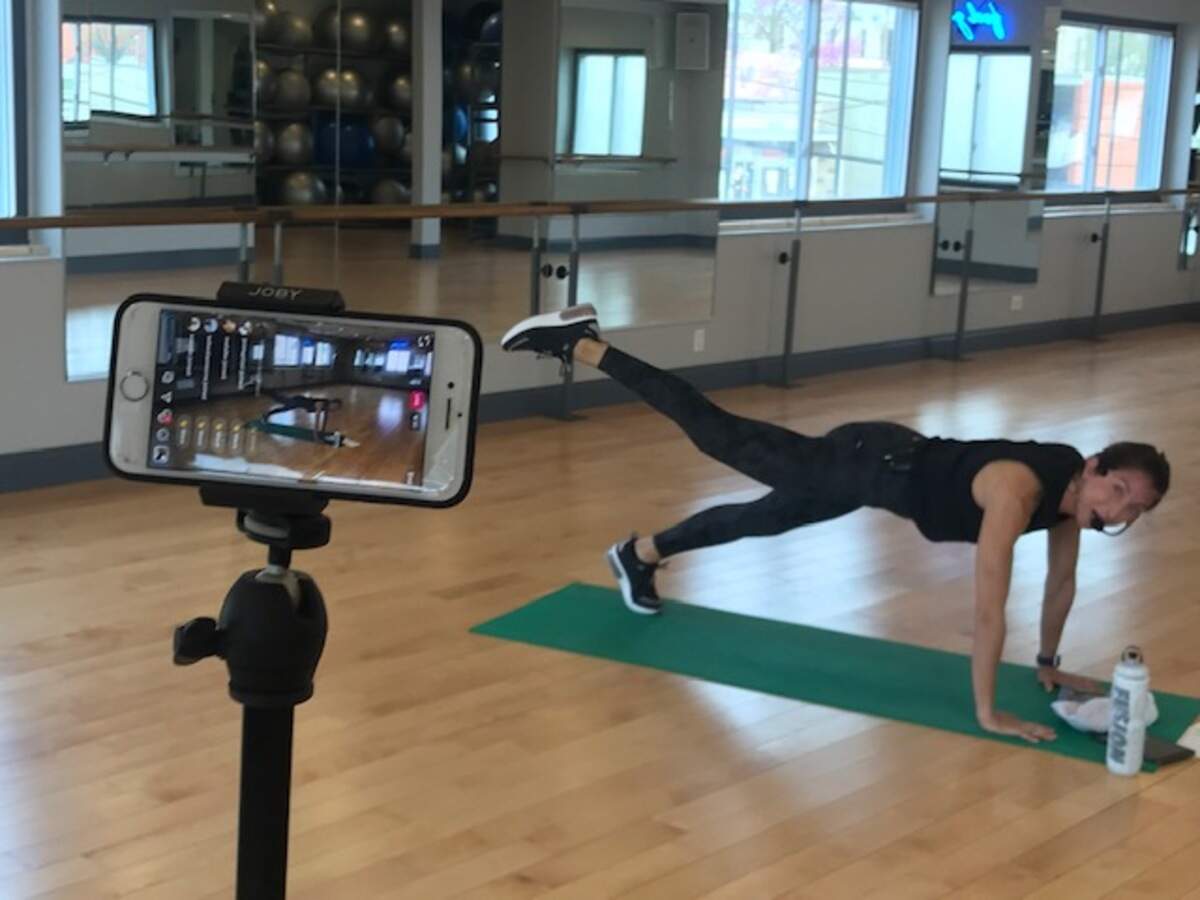
At 9 a.m. Tuesday, the owner of Fusion Fitness, 4,000 square feet of second-floor workout and office space, with mats and weights and stretchy bands at 7134 W. 80th St., stood behind a cellphone camera trained on fitness instructor, Erica Creger.
The high-energy morning class — kicks, lunges, squats, leg lifts — would typically have 50 to 60 women inside the blond-wood studio, mats lined in rows. On this morning, Cregar led the workout alone for a free, live Instagram class. There would be another at 11 a.m.
Names popped up on the cellphone of people joining from remote locales: Tara, Mari, Amy …. By class’s end, 75 people joined in for “tight ass Tuesday.”
“The most productive day of the week. You guys ready?” Creger said, music thumping in the background. “So, we’re going to just work that glute in lots of different ways. Here we go, guys, let’s get warm.”
She punched the air. “Jab, jab, hook, hook, elbows up high. Jab, jab, hook hook …”
Before the pandemic hit, a steady stream of clients flowed into Brender’s three Fusion Fitness studios, one near Crown Center, another in Leawood. The original opened a dozen years ago in Overland Park.
On March 16, a week before gyms and other businesses were ordered closed as nonessential, Brender and her studio managers decided to act. They shut down early. Social distancing was vital.
“We are in close quarters. We are sweating. We felt like we needed to be ahead of the game as far as taking good care of our clients and our instructors,” said Brender, who, like many of her clients, is a mother. She has children ages 11 and 13.
The outcome: “I mean, it has completely obliterated our sales,” Brender said.
Some 30% of clients have long-term paid membership. But the majority by far are shorter-term or walk-ins.
March sales, with the studios opened half the month, were down 28%. April’s so far are down 80%. The staff of 40 instructors has been reduced to eight. Because they are independent contractors, they can apply for federal money though the Payment Protection Plan to make up their salaries.
For Brender, “bills are piling up that we can’t pay right now.”
From the very start of her business, Brender had embraced video. Her goal during the shutdown is to keep her clients happy, giving paying members two unique classes online every day. They also offer two additional free classes that anyone can take, as a way to add value and perhaps build a following. She keeps in touch daily through social media, two emails a week, throwing contests like workout bingo and sending sweaty selfies.
“I feel like the hard work will pay off in the end,” Brender said. “We are doing everything we can right now to stay engaged with our clients. We will keep on going, as long as our clients will keep on going with us.”
Back in the studio, Creger pushed on. “Big arms. High, high, low, low, squat, two times, up …”
Currently Brender is trying to pay whatever bills are necessary. She’s talking to her landlord about adding months on to the lease to offset costs now. “We do have big spaces, so we have high rents,” she said.
Long term she is not worried. She started her business in 2008 at the start of what was then considered the most severe economic crisis since the Great Depression. She saw that through, confident enough that they are small enough to adjust. She’s already working on plans on how to maintain greater distance between people as they exercise once the pandemic ebbs.
Business is about adaptation.
“We started out with one little studio, and I’m not afraid to go back to one little studio, if that’s what it takes,” Brender said.
As for the immediate future: Brender has her own prediction. The stay-at-home order, she thinks, will last until mid-May. Businesses will gradually open over the following six weeks.
“I know that we can sustain throughout the summer, if we had to,’ Brender said. “We just don’t want to have to.”