Combo platters are popular at Johnson County Mexican place. My favorite is even better
READ MORE
Let’s Dish, Kansas City
Dig in: Our series showcases some of our favorite restaurant meals.
Expand All
Editor’s note: Welcome back to our series Let’s Dish, Kansas City, showcasing some of our favorite restaurant meals. Click here to sign up for our new newsletter. And scroll down to learn how you can participate.
Every now and then when I got a hankerin’, as they say, I would tell my husband, Michael: “I want carnitas!”
And off we’d go on a short drive to Dos Reales Authentic Mexican Restaurant, off Antioch Road at 8841 W. 75th St. in Overland Park.
My mouth would water for those chunks of seasoned pork slowly cooked according to a “secret recipe,” as the menu teases.
In Spanish, carnitas means “little meats.” But that’s a misnomer here because the hunks of braised meat served on colorful platters with beans, rice and warm, hand-sized tortillas are hefty.
The Carnitas Dinner ($16) is a specialty of the house, and the owner, Alvaro Quezada, blew my mind when he revealed some of his secret ingredients. And he blew my mind again when he showed how to eat those carnitas. It was way better than how I’ve been eating them all these years.
Quezada has been in the restaurant business more than 40 years. He worked his way up from washing dishes in a Mexican restaurant in Atlanta to owning several of his own. He opened two Dos Reales locations in Johnson County in 2001 — the other is at 6453 Quivira Road in Shawnee — and has since stepped away from the daily work.
He named the restaurants after “reales,” Spanish coins used in Mexico before the peso. “Dos” means two.
Sometimes the din of the dinner crowd is louder than the Mexican music playing. The menu is loaded with combination platters because experience taught Quezada that’s what customers want. The most popular menu item is the Acapulco Bay ($18), grilled chicken, shrimp and steak cooked with onions and tomatoes, then covered with cheese dip.
In my family, both my Mexican grandmothers would usually disappear into the kitchen when people dropped by, tie on their aprons and start cooking. It would have been a mortal sin for anyone to leave hungry.
My late Grandma Palacio made carnitas, but they were nothing like any other place I’ve seen them served. Hers were tiny cubes of chewy pork chop — or was it pork steak? — cooked in a tomato-y sauce she made pepper-hot for the adults. The kids’ version was carnitas with training wheels — no heat.
(Before I forget, let me share my favorite Dos Reales hack for others who can’t handle anything spicy. When I order the Queso Fundido, $11, cheese dip made with chorizo, I ask them to substitute ground beef for the spicy sausage. It’s one of those I-could-plant-my-face-in-this treats.)
Quezada, born and raised in Mexico City, said carnitas recipes in Mexico vary by region. His are based on Michoacan in western Mexico, which claims to be the “World Capital of Carnitas.”
“To my knowledge,” he said, “I made an improvement to the dishes.”
In some parts of Mexico, carnitas are a special-occasion dish served on Sundays. Here in the States they can be upstaged on restaurant menus by fancier combination plates.
But there’s nothing lowly about carnitas. Preparation requires patience. At Dos Reales the process begins the night before when the pork and other ingredients are cut up and refrigerated overnight.
The best carnitas are crispy on the outside and tender on the inside. Many recipes call for boneless pork butt or shoulder. But Dos Reales uses the pork leg, a lean part of the hog where ham also comes from. The leg is tender with almost no fat, producing less greasy carnitas, Quezada said.
First, the meat is browned in lard. Then it cooks for 2 1/2 hours in a liquid concoction of his own creation.
“I’m going to give you a few ingredients, they will shock you,” he said. “We put Mexican beer, Coca-Cola and the milk that comes in a can, very sweet, sweet milk … and fresh oranges.”
He meant sweetened condensed milk, which I’ve only ever used in baked goods. The beer is Casa Blanca, a Mexican lager, added at “room temperature, never cold. It just gives a thoroughly different flavor,” he said.
“It has to be Mexican Coca-Cola,” he said, which is sweetened with cane sugar instead of high fructose corn syrup used in American Coke.
Quezada was careful not to reveal all his ingredients, specifically the dry seasonings. “There are other (ingredients). But these are the ones that shock people,” he said.
Five hours of prep and cooking time goes into the carnitas before they arrive at the table on steaming hot platters. Their sweet, smoky fragrance arrives before the waiter does.
Quezada loves to demonstrate the best way to enjoy these carnitas: First, he unrolled one of the three warm tortillas wrapped in foil. (You can ask for corn tortillas, too.)
He laid it flat on the plate and spread some of the refried beans, topped with melted white Mexican cheese, over it.
Then he took one chunk of meat and shredded it with a fork, pulling it apart easily. He plopped a sizable mound on top of the tortilla and already I could see that I could have used a bib.
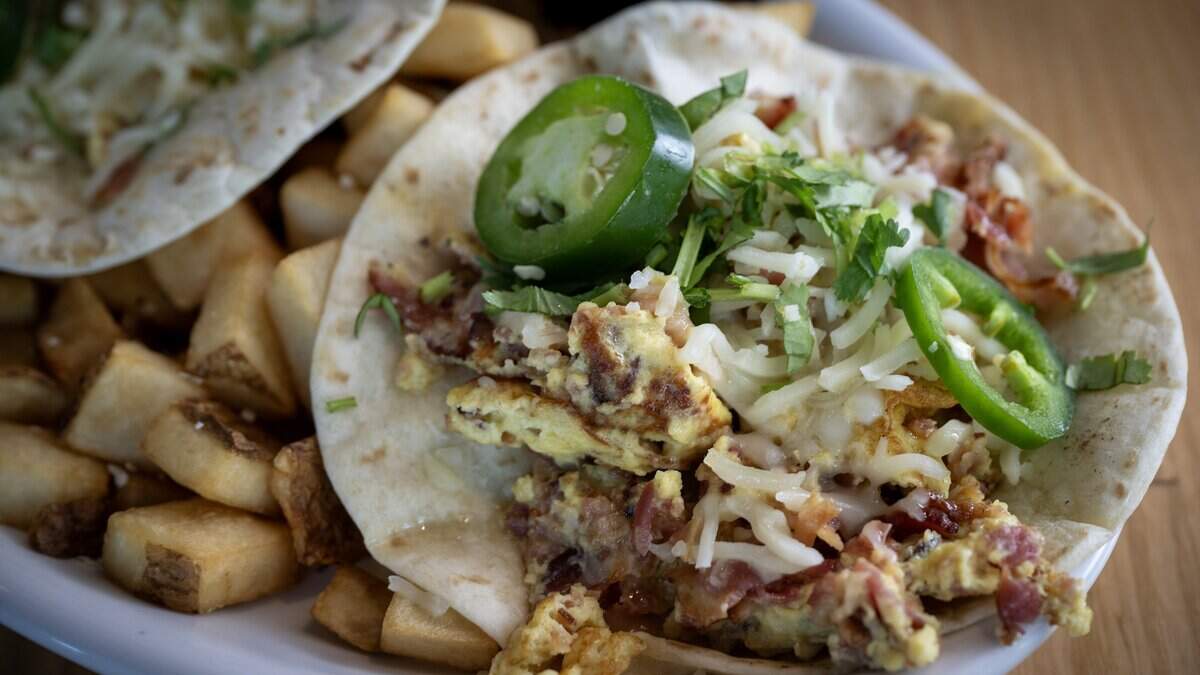
Next, he turned to a little edible “bowl” on the platter, fluted and crispy, made from a fried tortilla. It was stuffed with guacamole, pico de gallo (fresh salsa) and sour cream. He mixed all three together with the fork, then scooped that mushy Mexican melange on top of the meat.
In all those times I’ve eaten carnitas at Dos Reales, and there have been many over the years, I had never shredded the meat.
I had never made tacos from it.
Carnitas can be used to fill tacos and burritos and other things, but I’ve always eaten them on their own, as the main dish — with a fork, people, with a fork!
Shame. I feel shame.
This story was originally published July 25, 2023 at 5:30 AM.
.jpg)