Series 7 prep can humble you fast.
Options finally start making sense, then suitability shows up, and you are back to square one.
Some Series 7 courses give you a real study plan. Others basically hand you a giant book and say good luck. The hard part is figuring out which course has the tools you actually need, not just the longest feature list.
That is where I come in. I tested five exam prep courses from the inside to see which study styles they actually fit and where each one fell short. Here is what you should know.
Best Series 7 Exam Prep Courses
These five courses took completely different approaches to the same exam.
- Best for Customizable Practice: Securities Institute of America – Its 5,200-question bank gave me the most control over what and how I practiced.
- Best for Live Instructor Support: STC – Premier Plus added live classes, weekly Q&A sessions, and an instructor hotline.
- Best for Adaptive Review: Achievable – Older material kept returning based on what I missed instead of disappearing after one chapter.
- Best for Staying on Track: Kaplan – Its Study Plan, unit videos, and exam checkpoints gave each study week an order.
- Best for Video-First Studying: ExamFX – Lessons, quick checks, and focused webinars made it easy to learn a topic and practice it right after.
| Best Series 7 Course Comparison Chart | ||
 |
| GET STARTED |
 |
| GET STARTED |
 |
| GET STARTED |
 |
| GET STARTED |
 |
| GET STARTED |
Top Series 7 Study Materials
1. Securities Institute of America: Best for Building Your Own Series 7 Exams

SIA threw a lot at me the second I opened it. The dashboard was full of exams, reports, videos, calendar tools, and question filters. It took me a minute to figure out where everything was, but once I did, I could control almost every part of my practice session. The question bank let me get extremely specific about what I wanted to work on. I could drill one topic, reopen missed questions, or build a timed final. The Series 7 Test Bank, Greenlight Exam, and Exam Plan Personal Study Calendar were the biggest parts of my testing.
TotalGenius AI Tutor
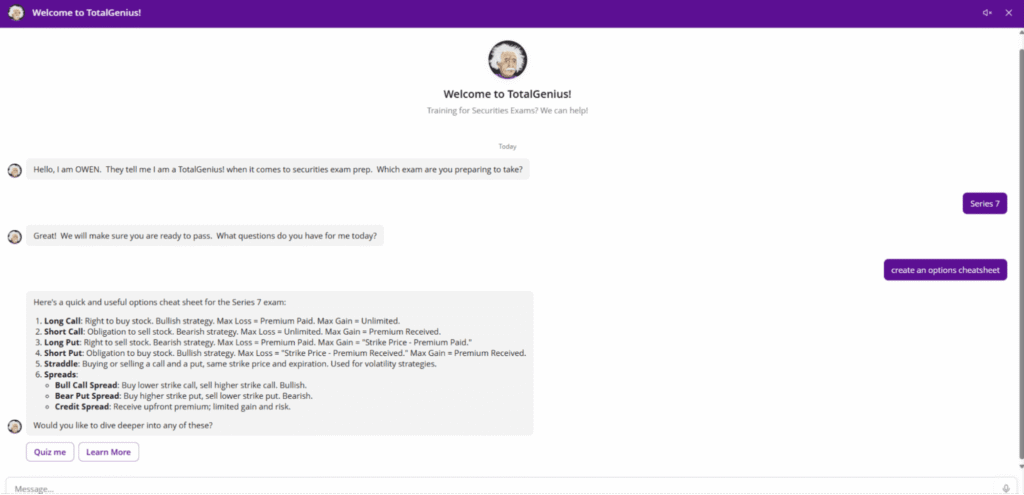
TotalGenius worked like an AI tutor built specifically around Series 7 material. I used it to ask questions when an explanation still was not clicking, but it could do more than give me one quick answer. I asked it to break down harder rules, compare similar concepts, and create cheat sheets for topics I wanted to review later.
The cheat sheets were one of the better uses because I could tell it exactly what I needed instead of sorting through the full textbook again. I could also ask follow-up questions when the first explanation was too broad. It saved time, but I still double-checked important details against the course material instead of treating every AI response as automatically correct.
Greenlight Exam
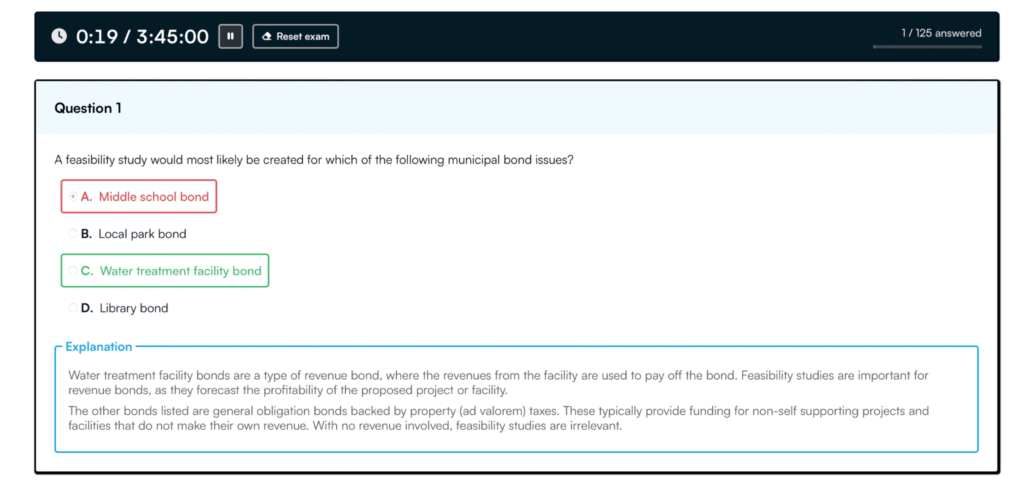
I saved the Greenlight Exam until I had already taken several simulated finals. It was not something I had to burn through early just to see another score. The regular final exams were unlimited, timed, and randomized, so I used those to work on pacing first. Then I opened the Greenlight Exam when I needed a more serious check before exam day. My report showed the total score, category scores, every answer I selected, and the explanation for each question. That gave me more than a simple pass or fail screen. The guarantee rules were a separate issue, though, and I would read those carefully before relying on them.
Exam Plan Personal Study Calendar
The Exam Plan Personal Study Calendar stopped me from bouncing between random tools with no order. SIA had a 624-page book, 20 hours of video, 25 section tests, 5,200 questions, Checkpoint Exams, and final exams sitting inside the same course. I entered my expected exam date and used the calendar to see what I was supposed to finish next. It gave the dashboard some direction without locking me into a live schedule. I still had control over when I studied. My main complaint was that SIA only included the calendar in the Complete package, even though the cheaper packages still had a huge amount of practice to organize.
I tested more than the question bank. The videos, textbook, TotalGenius tutor, support, and daily dashboard experience are all covered in my SIA review.
Securities Institute of America Packages
| Package | What’s Included | Best For | Price |
|---|---|---|---|
| Complete Exam Prep Course | 624-page textbook and ebook, 20-hour Video Training Class, 25 section tests, 5,200 questions, TotalGenius, personal calendar, Greenlight Exam, Checkpoint Exams, reports, cheat sheets, and support | Every SIA tool in one course | See Pricing |
| Textbook & Exam Prep Test Bank | Printed textbook, 5,200 questions, 15 customization options, unlimited practice and final exams, Checkpoint Exams, Greenlight Exam, reports, and support | Studying through reading and questions | See Pricing |
| Video Course & Practice Exam Package | 20-hour Video Training Class, 25 section tests, 5,200 questions, unlimited exams, Greenlight Exam, reports, Test Tips Video, and cheat sheets | Videos and practice without a textbook | See Pricing |
The Complete Exam Prep Course gives most people the easiest path through SIA because the calendar connects the book, videos, and exams. The Video Course package is cheaper and still includes the full test bank, but it removes the textbook and planning tool.
SIA Course Ratings
| Aspect | Rating |
|---|---|
| Content Quality | 9.5 / 10 |
| Practice Question Bank | 9.9 / 10 |
| Adaptive Learning Technology | 9.0 / 10 |
| Instructor Quality | 8.8 / 10 |
| Pricing and Value | 9.5 / 10 |
| Support and Guarantees | 9.5 / 10 |
| Overall Average | 9.4 / 10 |
Pros
✅ I could reopen only the questions I missed.
✅ The test bank included 5,200 explained questions.
✅ Randomized answers stopped me from memorizing positions.
✅ The reports showed exactly which categories hurt my score.
Cons
❌ I had to learn my way around the dashboard.
❌ There were no regular instructor-led classes.
❌ The calendar and AI tutor required the top package.
Fit Your Study Style?
SIA is better for someone who wants to control every practice session and spend a lot of time answering questions. It may feel like too much clicking and setup for someone who wants the course to hand them one simple daily assignment.
2. STC: Best for Live Series 7 Classes and Instructor Access
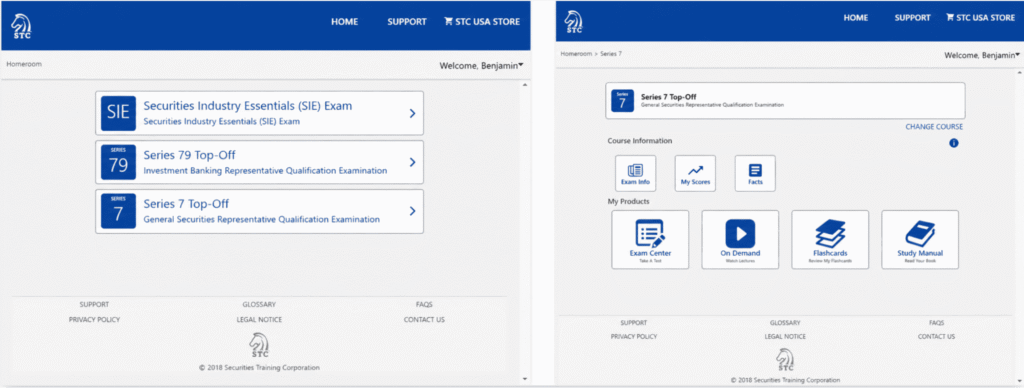
STC felt much more like a textbook course when I first opened it. I had the manual, chapter quizzes, final exams, and an instructor hotline before getting into the extra tools. The package level changed the experience a lot. Standard was mostly reading and testing. Premier added videos, flashcards, and stronger readiness exams. Premier Plus added the actual live teaching. I placed STC here because it gave me more ways to reach a real instructor than SIA did. The On-Demand Lectures, Green Light Exams, and Instructor-led Virtual Class showed the biggest differences between the three packages.
On-Demand Lectures
STC’s On-Demand Lectures gave me around 23 hours of recorded instruction. I used them alongside the study manual when a chapter started getting too dense, or I needed to hear someone explain the rule another way.
The videos were easier to follow when I watched the matching topic instead of trying to binge the entire course. They stayed available for six months from first use, so I could replay sections closer to the exam. My issue was that Standard did not include them at all. Anyone who struggles to learn from a book would either need Premier, Premier Plus, or the separate lecture product.
Green Light Exams
The Green Light Exams came later in the course, after the Chapter Quizzes, Progress Exams, and regular Final Exams. I used them as the last serious score check instead of opening them as soon as I logged in. That exam order gave me a better idea of where I was in the study process.
Chapter Quizzes checked one section, Progress Exams combined more material, and Green Light Exams came closer to the final review. I did not have to treat every test like the same thing. My problem was that Standard removed both the Progress Exams and Green Light Exams, so its testing path ended much earlier than the other packages.
Instructor-led Virtual Class
The Instructor-led Virtual Class was the feature that separated Premier Plus from the regular self-study packages. It came with scheduled teaching, weekly Series 7 Q&A sessions, and recorded Live Virtual Classes. I could bring up a topic during Q&A instead of hoping a written explanation answered the exact thing confusing me. The recordings also gave me a backup when I missed something or wanted to hear it again. This was the part of STC I would pay extra for, but only if I planned to attend. Premier Plus was expensive, and buying it just to ignore the classes would waste the main reason the package costs more.
For live classes, exams, and study tools, I saved the rest of my notes in my STC review.
STC Packages
| Package | What’s Included | Best For | Price |
|---|---|---|---|
| Series 7 Top-Off Standard | Online and printed Study Manuals, Chapter Quizzes, Final Exams, Instructor Hotline, Crunch Time Facts, course updates, and 24/7 technical support | Studying mainly from the manual | See Pricing |
| Series 7 Top-Off Premier | Everything in Standard plus Progress Exams, Green Light Exams, On-Demand Lectures, Flashcards, and the STC Pass Guarantee | Videos and more exam checkpoints | See Pricing |
| Series 7 Top-Off Premier Plus | Everything in Premier plus the Instructor-led Virtual Class, weekly Series 7 Q&A sessions, and recorded Live Virtual Classes | Direct instructor teaching | See Pricing |
Premier gives most people the main STC experience without paying for scheduled classes. Premier Plus is only worth the jump when the live class and weekly Q&A are tools you know you will actually use.
STC Ratings
| Aspect | Rating |
|---|---|
| Content Quality | 9.5 / 10 |
| Practice Question Bank | 9.2 / 10 |
| Adaptive Learning Technology | 8.7 / 10 |
| Instructor Quality | 9.7 / 10 |
| Pricing and Value | 8.9 / 10 |
| Support and Guarantees | 9.6 / 10 |
| Overall Average | 9.3 / 10 |
Pros
✅ Every package came with an Instructor Hotline.
✅ Premier Plus included weekly instructor-led Q&A sessions.
✅ I could move from chapter quizzes into harder exam stages.
✅ The course included both printed and online manuals.
Cons
❌ Standard cut out most of the better study tools.
❌ The price jumped sharply between packages.
❌ Less customizable than SIA.
Who Will Get the Most From STC?
STC is best for someone who wants a real manual, access to instructors, and the option to attend scheduled classes. Someone who cares more about building custom quizzes and drilling thousands of questions will probably get more use from SIA.
3. Achievable: Best for Adaptive Series 7 Review

Achievable felt much lighter to use than I expected. I could open the textbook, finish a section, and move straight into practice without turning each study session into a whole project. It was reading-first and drill-heavy, but the explanations stayed human. This one fit short, steady study days more than someone looking for live classes or a dashboard packed with controls.
Adaptive Study Planner
The Adaptive Study Planner watched how I answered questions and changed what appeared later. A topic I missed would return sooner, while material I kept getting right showed up less often. I noticed this most when rules from older chapters suddenly appeared in a new quiz. It stopped me from reading a chapter once, passing its quiz, and then forgetting half of it two weeks later. I did not have to sort through every weak category myself. That was convenient, although SIA let me control far more of the process. With Achievable, I usually followed what the system placed in front of me.
35+ Practice Exams
I waited until I had finished a decent part of the textbook before touching the full exams. Taking 125 questions too early would have been more discouraging than useful. Achievable included more than 35 attempts, so I had enough to test my pacing without protecting a tiny supply of finals. The wording and number variables changed, which caught me when I only remembered how an earlier version was written. I still had to understand the calculation or rule. The exams covered what I needed, but I could not rebuild them with the same detailed topic and question filters available inside SIA.
Narrated Textbook Audio
The Narrated Textbook Audio was what I opened when my eyes were done with the screen, but I still wanted to get through a section. I listened while following the page, then paused for formulas, charts, or anything that needed notes. The writing was already conversational compared with some securities manuals, so hearing it aloud did not sound painfully formal. I also had more than 44 short videos when audio alone was not enough. Those videos were more like quick explanations than a complete lecture library. Achievable still expected me to read, answer questions, and work through the chapters instead of watching my way through everything.
Achievable Packages
| Package | What’s Included | Best For | Price |
|---|---|---|---|
| Series 7 Exam Prep | Online textbook, narrated audio, 2,000+ chapter quizzes, 35+ practice exams, 44+ bonus videos, Ask Achievable AI tutor chat, Adaptive Study Planner, customer support, and one year of access | Candidates who want to review adjusted around their answers | See Pricing |
Achievable puts its main tools into one package instead of removing the audio, planner, or exams unless I upgrade.
Achievable Ratings
| Aspect | Rating |
|---|---|
| Content Quality | 9.3 / 10 |
| Practice Question Bank | 9.2 / 10 |
| Adaptive Learning Technology | 9.6 / 10 |
| Instructor Quality | 8.8 / 10 |
| Pricing and Value | 9.3 / 10 |
| Support and Guarantees | 9.0 / 10 |
| Overall Average | 9.2 / 10 |
Pros
✅ Old topics returned before I completely lost them.
✅ I had 2,000+ quizzes and over 35 full exams.
✅ The narrated book saved me from nonstop screen reading.
✅ One year of access left room for real-life delays.
Cons
❌ Custom exam controls were limited compared with SIA.
❌ A large part of prep still involved reading.
❌ Live Series 7 classes were not included.
Is Achievable Worth Your Time?
Achievable is strongest for daily independent studying without manually deciding what to review next. People wanting live instruction or full control over every exam setting will get more from another setup.
4. Kaplan: Best for Staying on Track Through Series 7

Kaplan was good when I wanted to study in a very specific way. I could follow the Study Plan on busy days, build my own quiz when one topic kept getting me, or send a question to an instructor when the rationales were not enough. The dashboard was packed and not the most modern-looking, but the tools were useful once I knew where everything was. The SecuritiesPro QBank, InstructorLink, and Unit Intro and Wrap-Up Videos were the three parts I got the most out of.
SecuritiesPro QBank
The SecuritiesPro QBank let me choose the topics, question count, and type of exam I wanted to take. I used short quizzes when I kept missing one rule, then switched to longer mixed sets once I was doing better. The attempts were unlimited and randomized, so I was not stuck retaking the exact same quiz. Each question had a detailed rationale and pointed me back to the material when I needed more review. The QBank was one of Kaplan’s better tools, but setting up every quiz took extra clicks. Sometimes I just wanted the course to hand me a set and let me start.
InstructorLink
InstructorLink let me send questions directly to a Kaplan Securities instructor. I used it for topics where I understood the correct answer but still could not explain why the other choices were wrong. Getting an answer from an actual instructor was better than searching random forums and hoping someone knew what they were talking about. Kaplan says replies can take up to two business days, so this was not instant help. I would not use it for every tiny question, but it was good for rules or calculations that kept confusing me after I had already reread the explanation.
Unit Intro and Wrap-Up Videos
The Unit Intro and Wrap-Up Videos were short and straight to the point. I watched the intro before starting a unit so I knew which topics were coming, then used the wrap-up before taking the Checkpoint Exam.
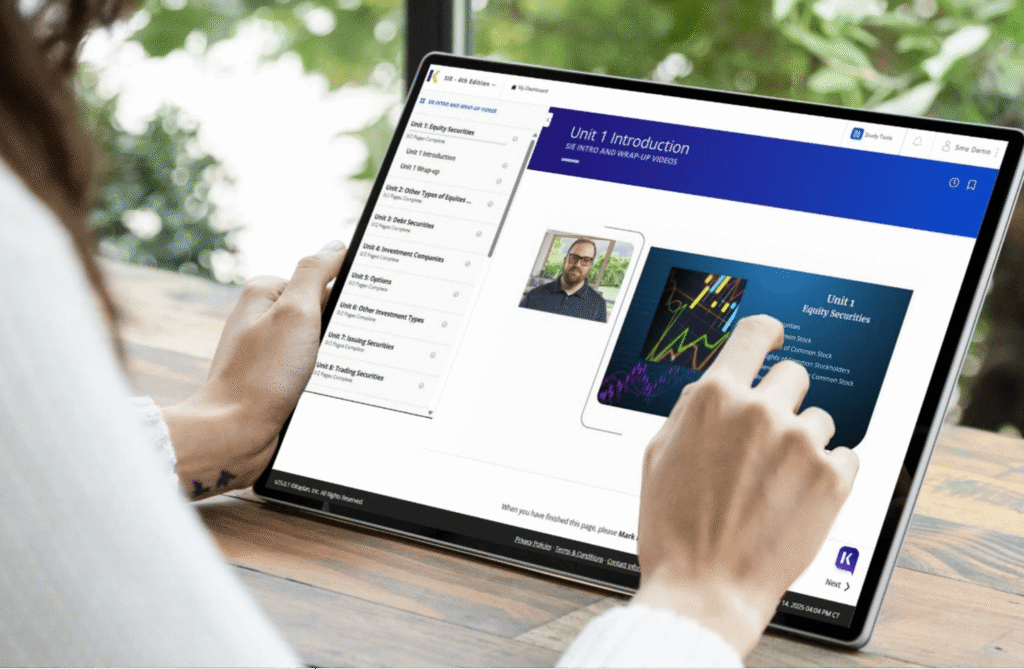
They helped when the License Exam Manual started getting dense because I could hear the main ideas without sitting through a full lecture. These were not deep video lessons, though. They worked more like quick previews and recaps. Anyone wanting full video teaching would need the Premium Package with OnDemand or Live Online classes.
The QBank, Study Plan, and package options get a closer look in my Kaplan vs ExamFX comparison.
Kaplan Packages
| Package | What’s Included | Best For | Price |
|---|---|---|---|
| Premium Package | Live Online or OnDemand instruction, Mastery Exam, Practice Exam, Checkpoint Exams, Midterm Exam, SecuritiesPro QBank, Performance Tracker, Class Notes, Study Plan, InstructorLink, Unit Intro and Wrap-Up Videos, License Exam Manual, and Student Community | Candidates who want full classes and instructor support | See Pricing |
| Essential Self-Study Package | Practice Exam, Checkpoint Exams, Midterm Exam, SecuritiesPro QBank, Performance Tracker, Study Plan, Unit Intro and Wrap-Up Videos, License Exam Manual, and Student Community | Candidates who want structure without paying for classes | See Pricing |
| Basic Self-Study Package | Practice Exam, SecuritiesPro QBank, Performance Tracker, Study Plan, License Exam Manual, Exam Tips and Content Updates, and Student Community | Candidates who mainly want reading and practice | See Pricing |
Essential Self-Study gives most people the main Kaplan tools without paying for classes. Basic is pretty stripped down, while Premium is only worth the jump if you will actually use the videos or live instruction. Kaplan includes five months of online access. That is enough for a normal study plan, but it is shorter than Achievable’s full year.
Kaplan Ratings
| Aspect | Rating |
|---|---|
| Content Quality | 9.4 / 10 |
| Practice Question Bank | 9.5 / 10 |
| Adaptive Learning Technology | 8.8 / 10 |
| Instructor Quality | 9.4 / 10 |
| Pricing and Value | 8.7 / 10 |
| Support and Guarantees | 9.3 / 10 |
| Overall Average | 9.2 / 10 |
Pros
✅ I could build quizzes around exact topics and lengths.
✅ InstructorLink gave me access to a real securities instructor.
✅ The Study Plan kept my weekly work organized.
✅ Premium included both Live Online and OnDemand options.
Cons
❌ The dashboard looked busy and took time to learn.
❌ Basic removed several tools I actually cared about.
❌ Five months of access felt short for the price.
Will Kaplan Actually Work?
If you like having a plan but still want to take over when one topic starts beating you, Kaplan handles both. The QBank and instructor access stood out, but five months could feel too short.
5. ExamFX: Best for Video-First Series 7 Prep
ExamFX was more direct than the huge courses I tested before it. I could watch a lesson, check whether I actually understood it, and move on without opening five different tools first. The course had a very video-and-practice rhythm, which worked well for shorter study sessions. It was not as deep or customizable as SIA, and the textbook package was honestly too cut back for the price. The online packages were where ExamFX became worth looking at, especially with the SpotCheck Quizzes, Live Focused Webinars, and Phone Instructor Support.
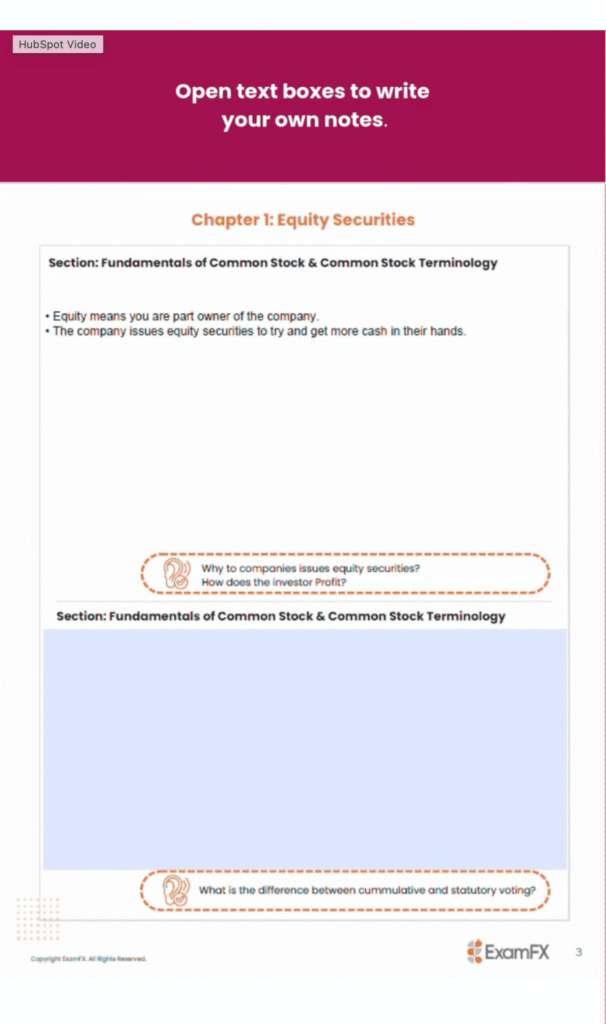
Note-Taking Notebook
The Note-Taking Notebook gave me a structured place to follow along during the live webinars. I used it to write down key rules, examples, and smaller details I wanted to review later. I also marked anything I did not fully understand so I could return to it after the session instead of stopping every few minutes. The layout kept my notes in the same order as the lesson, which made them easier to study than pages of random writing. However, the structure could feel limiting when I wanted to explain something in my own way or add a longer example. It was also much less valuable without attending the matching webinar.
SpotCheck Quizzes
SpotCheck Quizzes were probably the most natural part of the course for me. I could finish a lesson and take a quick check without turning it into a full practice exam. They caught the topics I thought I understood until the wording changed and suddenly I did not. That gave me faster feedback than waiting until the end of a unit to find out I had missed the point. I also liked that they broke up the longer videos with something active. They were not included in the Textbook Package, which was one reason that option looked weak next to the two online packages.
Live Focused Webinars
The Live Focused Webinars did not waste time reteaching every basic Series 7 topic. They were three-hour sessions built around harder areas like options, bonds, equity, and suitability. I would rather save live instructor time for those sections than sit through a full class covering material I already understood. The fillable Webinar Notebook was also smart because I could follow the lesson without scrambling to write everything down. The schedule was the catch. I had to work around the available dates, and there may not be a session for the exact topic I needed when I needed it.
More on the video-first flow and practice tools is in my ExamFX review.
ExamFX Packages
| Package | What’s Included | Best For | Price |
|---|---|---|---|
| Live Online Package | Live Focused Webinars, On-Demand Video Lectures, Webinar Notebook, Personalized Study Plan, SpotCheck Quizzes, Competency Exams, custom exams, instructor support, flashcards, ebook, and printed textbook | Video learners who also want live help with harder topics | See Pricing |
| Online Course Package | On-Demand Video Lectures, Personalized Study Plan, SpotCheck Quizzes, Competency Exams, custom exams, phone and online instructor support, flashcards, ebook, and printed textbook | Someone who wants the full video course without scheduled webinars | See Pricing |
| Textbook Package | Printed textbook, Personalized Study Plan, practice sets, Checkpoint Exams, Benchmark Final Exam, Standard Final Exams, custom exams, and progress tracking | Someone who only wants reading and exam practice | See Pricing |
The Online Course Package is the one I would look at first. It keeps the videos, quick quizzes, instructor help, and full practice setup without making me plan around webinar dates. The Textbook Package costs too much for how many of ExamFX’s better tools it removes.
ExamFX Ratings
| Aspect | Rating |
|---|---|
| Content Quality | 9.2 / 10 |
| Practice Question Bank | 9.2 / 10 |
| Adaptive Learning Technology | 8.8 / 10 |
| Instructor Quality | 9.4 / 10 |
| Pricing and Value | 8.5 / 10 |
| Support and Guarantees | 9.3 / 10 |
| Overall Average | 9.1 / 10 |
Pros
✅ The personalized Study Plan gave each week a clear order.
✅ All packages included progress tracking and final exams.
✅ Real-time content updates kept rule changes inside the course.
✅ The online packages included both digital and printed materials.
Cons
❌ The Textbook Package was too stripped down for its cost.
❌ Webinar dates may not match your study week.
❌ The platform had less depth than the courses above it.
Is ExamFX for You?
The videos and SpotChecks fit someone who likes learning a topic and testing it right away. I would skip the Textbook Package unless you truly only want a book and practice exams.
More Series 7 Resources to Consider
- Study.com: Choose this for light review and extra practice problems. The simple setup is easy to follow, although you will not find many advanced tools or instructor support.
- Mometrix: I would pair these materials with a more complete prep program. They add another way to review difficult topics but do not cover enough to replace your main course.
- PassMasters: The real draw is its collection of roughly seven practice tests. They give you a decent batch of fresh questions once your original exam bank starts feeling familiar.
- Brainscape: Flashcard users may get a quick review from this one. Its collection leaves a few gaps, but it still helps with shorter facts and terms you need to memorize.
How I Scored Every Series 7 Course
I went inside each course, used the dashboard, opened the lessons, answered practice questions, and compared what happened after I missed something. I scored all five using the same six areas instead of letting one flashy feature carry the entire review.
| Criterion | Weight | What I Evaluated |
|---|---|---|
| Content Quality | 25% | Accuracy, depth, readability, and coverage of current Series 7 topics |
| Practice Question Bank | 20% | Question volume, explanations, realism, and quiz-building options |
| Adaptive Learning Technology | 15% | Weak-area tracking, personalized review, reports, and study planning |
| Instructor Quality | 15% | Teaching style, Series 7 knowledge, live help, and video quality |
| Pricing and Value | 15% | What each package included compared with its cost |
| Support and Guarantees | 10% | Instructor access, customer support, pass guarantees, and access length |
Series 7 prep needs more than a long textbook and a pile of random questions. I looked for courses that explained harder areas like options and suitability without dragging them out, and then gave me enough realistic practice to prove I understood them. Study planning also counts because a strong course should show you what needs work before you waste another week reviewing topics you already know.
Which Series 7 Course Fits the Way You Actually Study?
Still stuck? Go with the line that sounds most like your normal study day.
- Want to build every quiz around exactly what you missed? → Securities Institute of America
SIA gives you the most control over topics, question counts, and repeat practice. - Need a real person to explain the harder stuff? → STC
The live classes and weekly Q&A are worth paying for when teaching support is what gets you through. - Keep forgetting older rules after moving on? → Achievable
Its adaptive review pulls weak topics back in before they completely disappear. - Do you prefer knowing exactly what to study each week? → Kaplan
The Study Plan and exam checkpoints give the course a clear order without making you plan everything yourself. - Learn better by watching first and practicing right after? → ExamFX
Its video-heavy setup works well when reading a full chapter is not how your brain learns best. - Trying to avoid the highest-priced package without ending up with something bare? → SIA or Achievable
Choose SIA for deeper practice controls or Achievable for a simpler reading-and-drilling routine.
What to Check Before Choosing a Series 7 Course
The “best” course can still be the wrong purchase when its main study format fights how you naturally learn.
- Choose your main format first. Reading-first courses can feel endless when you need someone to explain the topic out loud.
- Look past the total question count. A smaller bank with realistic wording and strong explanations can beat thousands of weak questions.
- Check what the cheapest package removes. Some entry tiers cut videos, readiness exams, instructor access, and planning tools.
- Compare the access window with your real schedule. Five months may be plenty, but it leaves less room when work or life pushes the exam back.
- Read every pass-guarantee rule. A guarantee may require certain scores, course completion, or a specific exam timeline.
My Final Pick After Testing All 5
SIA was my main pick because it gave me the most freedom without making the course hard to use. STC came second because the live help was strong, but the higher price only makes sense if you will actually use the classes. Achievable was the best lower-cost choice and still felt like a full course.
Before buying, be honest about how you study. Pick SIA if you want to control your practice, STC if you learn better with an instructor, or Achievable if you want a simple reading-and-practice routine. The wrong course is the one packed with tools you never open.
If you are ready to enroll, compare pricing at SIA, STC, Achievable, Kaplan, and ExamFX.
FAQs
You need a score of 72% to pass. That equals at least 90 correct answers out of the 125 scored questions.
Most people need several weeks of consistent studying. Your timeline depends on your securities background, daily schedule, and practice scores. Leave enough time for full exams and weak-area review instead of rushing through the book.
SIA had the largest confirmed bank I tested with 5,200 questions. Achievable included more than 2,000 chapter quizzes and over 35 full practice exams.
SIA, STC, and Achievable advertise guarantees, but the rules differ. You may need to complete specific course steps, earn a qualifying practice score, or take the real exam within a set period.
The Series 7 can be challenging, especially when suitability, regulations, and product details appear together in longer questions. A course with realistic exams and clear explanations can make these areas easier to manage.
There is no required number. Take enough full exams to prove that your scores remain steady across different question sets. Review every missed answer instead of repeatedly testing without studying the results.