
Mellinger Minutes: Chiefs’ (first) big splash, Bobby Witt Jr.’s future, Royals pitching
The Chiefs are now the proud new owners of the most expensive guard in NFL history, and maybe this is obvious, but the most important thing to remember is that this is not the end. The Chiefs are not done.
Brett Veach, the general manager with a flair, promised to prioritize the offensive line.
On the first day that teams were allowed to negotiate with players, the Chiefs agreed to terms with Joe Thuney — five years and $80 million, with $32.5 million fully guaranteed. The deal’s structure, first reported by Albert Breer, is essentially three years and $48 million. The 2021 cap number is just $4.5 million.
The Chiefs are far from done.
Thuney is the consensus best interior lineman on the market. The Patriots used the franchise tag on him last year. He’s played at least 97 percent of the snaps every year he’s been in the league. In 1,833 pass block snaps over the last three seasons, he’s allowed three sacks and 11 hits, according to Pro Football Focus.
This is an elite player, who instantly improves the Chiefs inside and might even change their calculus a little in short yardage.
The question is whether he’s the right player.
The Chiefs need tackles. Well, let’s be real. They needed interior linemen, too, but they NEED tackles.
At the moment, the Chiefs would be playing Lucas Niang — a promising talent, but also a third-round pick last year who opted out — at right tackle and a shoulder shrug at left.
The Chiefs are probably set in the middle now. They have Thuney, Laurent Duvernay-Tardif, Andrew Wylie, and Nick Allegretti through the middle. They released Austin Reiter, which could be an indication that they like Daniel Kilgore at center.
Now, even if we assume that Niang can play right tackle, the Chiefs had a bigger need at left tackle than left guard.
Eric Fisher could still return on a smaller deal, but if the Chiefs had certainty about his availability they would not have cut him for $12 million in cap savings.
Trent Williams will probably be too expensive, but I am not Brandt Tilis, so don’t take that as gospel. Maybe the Chiefs have a way to get creative at the line’s most high-profile position. But their best path forward could be to sign someone else.
Alejandro Villanueva is a literal giant — 6-foot-9 and 320 pounds — with a six-year track record with the Steelers of being consistently solid. Riley Reiff is a former first-round pick (which means he’ll cost a little extra) generally regarded as an equal player to Villanueva.
Each man has some red flags, but either would provide stability. Also, with Thuney in the middle the Chiefs figure to be in better shape there than in years past. The help and blocking schemes can branch out to the edges a little more.
In other words, the Chiefs are an unquestionably better football team than they were a day earlier. Joe Thuney will solve some problems along the line, and improve the protection for Patrick Mahomes.
But it’s also true that the biggest hole remains.
Which is why we started this the way we did: the most important thing to remember is that the Chiefs are not done.
This week’s eating recommendation is the bacon wrapped cherry peppers at the Savoy, and the reading recommendation is Alec MacGillis on what the pandemic cost teenagers*.
* Semi-regular reminder that teachers and everyone else who dedicates their professional lives to helping our children are heroes.
Thanks to everyone who’s listened to our Mellinger Minutes For Your Ears podcast, and here is a big warm invitation to start if you haven’t already. We’re out from behind the paywall and free on Apple or Spotify or Stitcher or wherever you get your shows.
Reminder: If you’d like to participate in the show — and I’d love for you to do that — please call 816-234-4365 and leave your first name, where you’re calling from, and almost literally any question.
Please give me a follow on Twitter and Facebook and, as always, thanks for your help and thanks for reading.
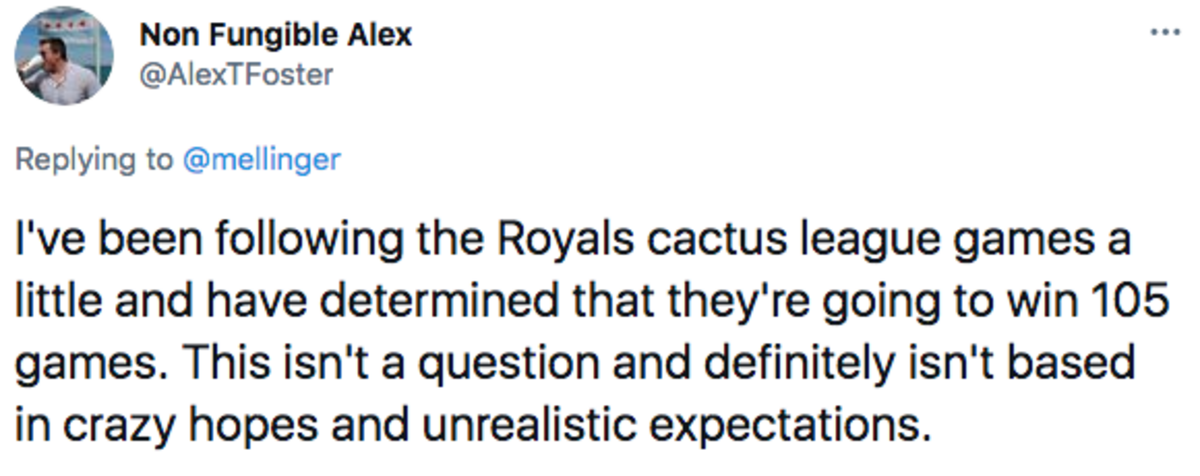
There will be man, many words in this space and in columns and podcasts about the Royals between now and opening day* so we’ll try to keep the answer to this first question under 3,000 words.
* THAT IS IN SIXTEEN (16!) DAYS!
There are many reasons to be optimistic about the Royals. The lineup should be deeper, the defense should be better, and the pitching has some depth.
The Royals have a lot of pieces that fit well together, and a lot of players who are either trending up or not yet at the age where you’d expect a fall. The vibes are genuinely positive, which is a change from the last few years when the vibes were trying very hard to be genuinely positive.
Think about it like this. The Royals have one of the game’s fastest players in Adalberto Mondesi. They have one of the most powerful hitters in Jorge Soler. They have one of the hardest throwers in Josh Staumont. They have one of the most consistent performers in Whit Merrifield.
There is high-end talent here, and we haven’t mentioned Sal Perez’s energy or Brad Keller’s effectiveness or the versatile talents of Hunter Dozier and Andrew Benintendi.
There’s a lot to like about this.
But I also think that one of the biggest traps in sports is making too much of spring training statistics, good or bad. What we see this time of year is simply not reality. Guys are facing a lot of minor league pitchers, or big league pitchers who are focused more on (for instance) repeating their curveball delivery than competing in a specific at bat.
The ball carries, outfielders lose popups in the desert sun, guys are walking to the clubhouse in the fourth inning for tee times ... it’s just reality.
When reality hits, the Royals are going to have some real challenges. Good vibes matter, and it’s notable that Carlos Santana and Benintendi and others have played on good teams but Perez and Duffy are the only guys who’ve been around long enough to have played on even one Royals team with a winning record.
The Twins and White Sox are among the best teams in the American League. Cleveland might fall, but how far? The Tigers have some high-ceiling prospects to dream on.
Baseball is the most fun sport for irrational belief, and I’m not even telling you that believing in this Royals team is irrational.
I’m just telling you that if you’re believing because of spring training results, you’re going to have strong feelings if they fall behind 4-0 in the season opener, too.
But maybe I’ve buried the lede because ...
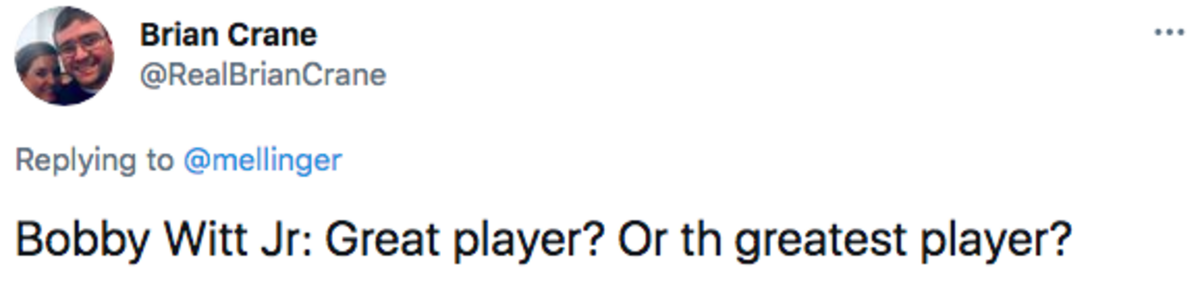
... there was a lot of this kind of thing ...
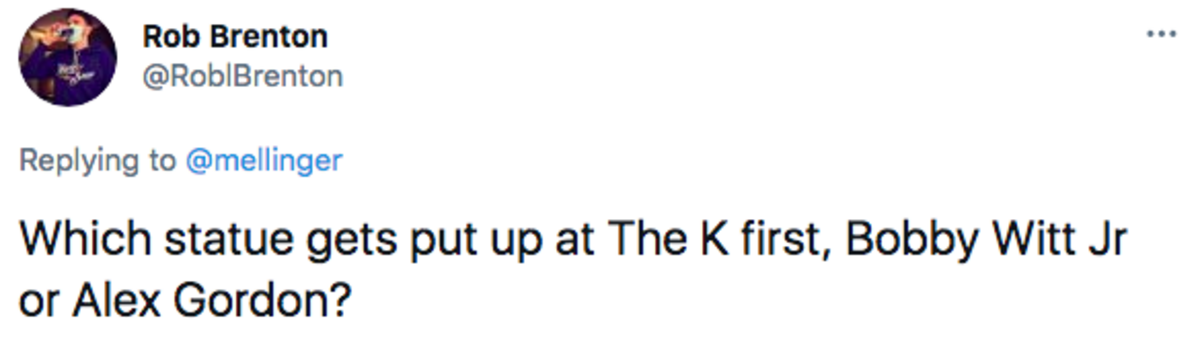
... and when I say “a lot of this kind of thing” what I’m telling you is that I’m including less than half of the Bobby Witt Jr. stuff so let’s just get to the very talented elephant in the room ...
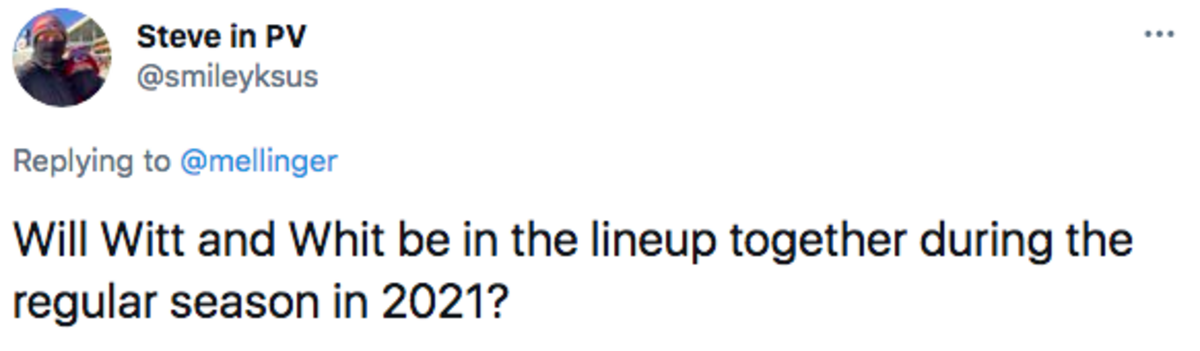
I believe so, yes.
Bobby Witt Jr. is the Royals’ most valuable asset, and if things go perfectly well he’ll be their most valuable asset even after they build that downtown ballpark.
He is forcing his way to the top of conversation about the Royals. We see him hit home runs off successful big-league pitchers. We see him draw 12-pitch walks. We see him score from second base on an infield error.
Most of all, we see how his teammates are talking about him, and that might seem like a strange thing to focus on but for me it might be the most encouraging development of all.
Because Bobby Witt Jr. checks all the boxes of a potential clubhouse punk: he’s talented and has to know it, he’s coming for someone’s job, and he made more from his signing bonus than many Royals big-leaguers have made in their careers.
Clubhouse punks can wreck a vibe, and be a real block to a team’s success.
If he was a punk we’d know it, and not because anyone would be publicly rude about it, but because they wouldn’t be gushing about him like this. Those older and more established players are greasing the skids for his inevitable big-league career. They wouldn’t be doing that if they didn’t respect the way he’s working and behaving outside the batter’s box.
That stuff matters.
Now, it’s important to remember that Witt Jr. remains far from the big leagues. He’s not yet 21 years old, and the extent of his professional experience consists of glorified scrimmages at T-Bones park, 37 plate appearances* and now two weeks in spring training.
* Where he hit .262/.317/.354 by the way.
Baseball-Reference includes a helpful OppQual stat, which rates each player’s hitter-pitcher opposition 1-10. Witt Jr.’s is 6.4, which is the equivalent of somewhere between Class AA and High-A ball. Just for comparison’s sake, Whit Merrifield’s OppQual is 8.2.
OK, so with all that noted, it’s also true that there is not a single thing Witt Jr. could do to impress club officials that he’s not currently doing. From performance to focus to attitude to everything else. His swing was said to be a little long coming out of the draft. It’s now short, compact, and powerful.
He can play anywhere on the field other than catcher and pitcher, too, so his promotion is not reliant on a particular big-leaguer opening a spot.
The Royals’ decision on him comes without precedent, because there will be no minor-league baseball in April. It’s one thing to start a talented prospect at, say, Class AA. But the Royals’ decision would be to either break camp with the guy everyone’s talking about, or put him at the alternate site for more glorified scrimmaging.
A baseball truism is that hitters cannot develop beyond the competition they’re facing. The Royals figure to have some talented pitchers at the alternate site, which helps, but it’s not as productive as facing other teams’ pitchers in a truly competitive environment.
The club’s plan has been to start Witt Jr. in Northwest Arkansas, and then go from there. That’s still the plan, and not because the Royals are playing the service time game — they aren’t, and never have.
Guys just don’t play their first big league game before they play their first minor league game. That’s not how this typically works.
The Rays just optioned baseball’s consensus No. 1 prospect to the minor leagues. Witt Jr. might be a superstar, and if so he wouldn’t be the first future superstar to begin a season in the minor leagues. He’s not so accomplished that there’s nothing for him to gain from facing the best minor league pitching.
So, my expectation remains for him to start at Northwest Arkansas and from there he’s on the big league radar.
If he’s making a mockery of the place the way Eric Hosmer did in Omaha in 2011 ... then we’ll see Witt Jr. in Kansas City.
And, yes, I do think Witt Jr. is talented enough that he’ll play in the big leagues at some point this season.
Probably at second base.
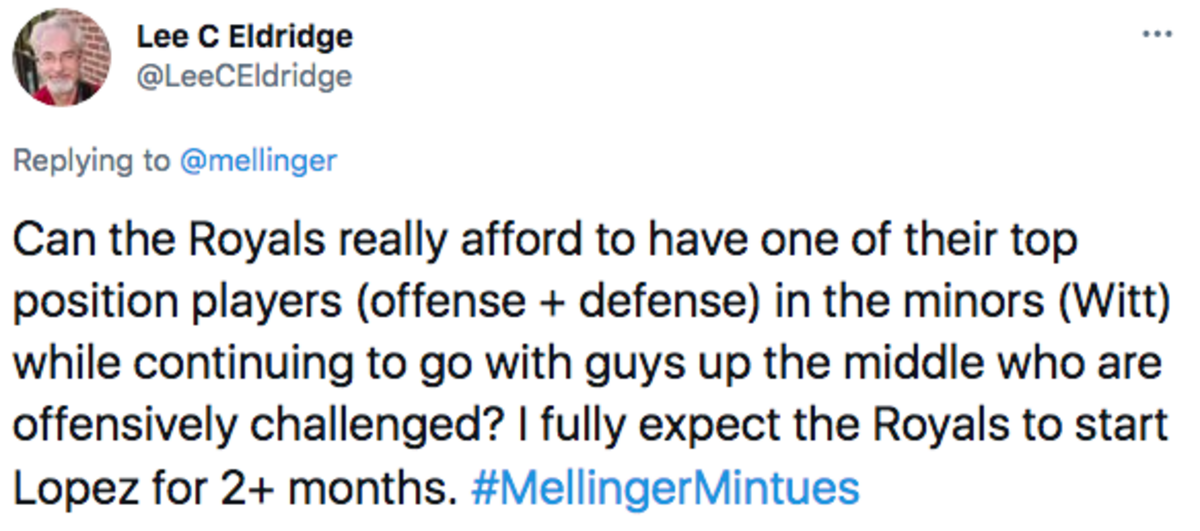
I get being excited, and I don’t want to squash anyone’s personal parade here, but are we at the point where 29 plate appearances mostly against lower level minor-leaguers means there’s nothing left for Witt Jr. to prove below the big leagues?
Is that where we’re at?
I know we just mentioned it, but it’s worth repeating. When we talk about the timeline of Royals prospects we can do it honestly. We don’t have to play these side games where we keep in mind that three weeks or so is enough for an extra year on the back end, and another few weeks after that is usually enough to avoid Super-2.
We can just talk about when the prospect will be ready.
I’m not trying to be the grumpy old man here, but these two weeks of spring training are being taken by a lot of fans as the equivalent of two years of minor league development and I’m not seeing it.
The other simplifier is that Witt Jr. can play anywhere. The most obvious potential fit would be second base. Nicky Lopez might just not be a major league hitter, and the Royals could have one of the most athletic middle infields in baseball.
So I guess your question could be answered with another question:
Can the Royals really afford to rush their best prospect in years to potentially fill a potential hole, while risking him being overwhelmed and his development being stunted?
The Royals need to forget everything else and concentrate solely on what’s best for Witt Jr.’s long-term career.
Speaking of what’s best for Witt Jr.’s long-term career...
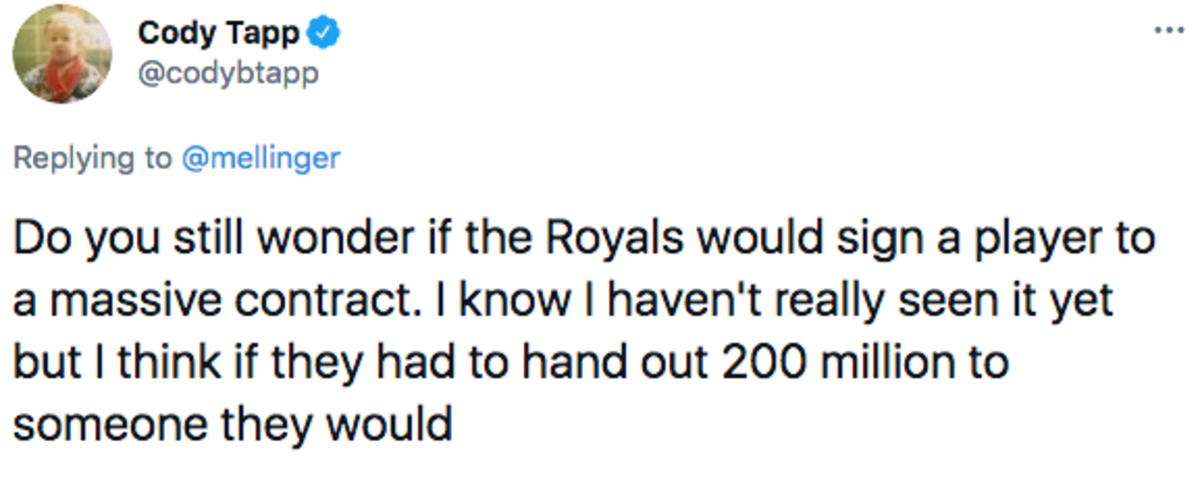
That’s based more on faith than evidence, right?
The biggest free agent contract in Royals history was $72 million to Alex Gordon, which was pushed forward by the winds of the 2015 World Series championship. Also, notably: it did not age well.
The Royals did make what Will Wade might call a strong ass offer to Eric Hosmer, but it was a tangibly inferior deal to the one they knew the Padres made. If the Royals offered anyone other than J.E. Dunn $200 million or more* it would be a major departure from history.
* How many downtown ballpark references can a fella fit in a timesuck?
The wildcard here is John Sherman, obviously. We just don’t know. The stuff we know about him is all good. But we just don’t know a lot. The only teacher here will be time.
But a few things are worth noting.
The first is that Sherman and his investors group had a unique excuse to go garage sale last summer, and they did not take it. In fact, they went the opposite, adding staff and even bumping the big league payroll (still modest, by still) beyond original forecasts.
The second is that Sherman’s investors group is nearly two dozen names long. They are all impressive, all locally connected, but still. The general rule is that if you have enough cash to go it alone, you go it alone. The Royals, like many teams, have taken out loans to cover some of the shortfalls. This group does not burn cash.
The third is that Sherman’s experience as a minority investor in Cleveland is often cited as part of his qualifications in Kansas City, and if you know a baseball fan in Cleveland he or she will probably tell you that Larry Dolan doesn’t spend enough. Cleveland just traded Francisco Lindor because he got too expensive.
So, that’s a bit of a mixed bag, right?
Some of the stuff we know about Sherman would indicate he’ll spend significantly more than the Glass family. And here it’s worth noting that Sherman is operating under a new TV deal that is believed to have spiked the previous (and atrocious) contract by double or triple.
Some of the stuff we know about Sherman would indicate he’ll continue to operate as the Glass family did — like a model small money ownership, occasionally spending above their revenue weight but mostly succeeding or failing based on baseball operations’ ability to find value.
So I’d want to see the $200 million offer before I expect it, but I’ll just say two more things about this.
I cannot imagine this front office making a $200 million offer to another team’s free agent, so if in a few years we’re talking about a $200 million offer from the Royals we’re talking about a homegrown player being worth a $200 million offer which — gawd I love this line — sounds like one of them good problems.
I’m not sure that Dayton’s front office shouldn’t get at least partial credit for Zack Greinke, who was literally out of baseball when Moore took the job.
You could make the case that the handling of Greinke — welcoming him back on his time, letting him get competitive again in Wichita, transitioning him as a reliever, all the way up to the Cy Young year and then (being forced into) the trade that brought back Lorenzo Cain, Alcides Escobar and Jake Odorizzi — is the single greatest success story of Moore’s front office.
But, either way, let’s do a game. I’m going to pick a random team — the Twins are good, right? — and look at their draft classes since 2010.
They took Jose Berrios with the 32nd pick of the 2012 draft, and you’d certainly call him a successful starting pitcher — 115 starts with a 105 ERA+ over 659 2/3 innings and 7.8 bWAR.
They took Kyle Gibson with the 22nd pick in 2009. He’s made 200 starts with a 93 ERA+ over 1,154 1/3 innings and 9.4 bWAR.
Here is the complete list of other starting pitchers the Twins drafted since 2007 (Dayton’s first “official” draft) with at least 1.0 bWAR:
*the above space intentionally left blank*
Cleveland is incapable of finishing breakfast before developing another starting pitcher, right?
But, same time period, here is the list of starting pitches drafted and signed by Cleveland with at least 1.0 bWAR: Shane Bieber, Zach Plesac, Aaron Civale, Drew Pomeranz (140 of his 262 appearances are starts) and Cody Anderson.
OK, a couple disclaimers. The first is that this is an imperfect way of judging an organization’s ability to develop starting pitchers. Most obviously, we’re only looking at the draft here, but Baseball-Reference doesn’t have a quick-and-dirty way to filter international signings so it’s what we’re going with here.
Also, I did not come up with this game. An old scout who at the time worked for a rival club had me do this when I made a similar point to him about the Royals’ bad record with starting pitchers.
“All of us have crummy records with starters,” he told me.
But, either way, the Royals’ relative success or failure with other starting pitchers is at best a negligible predictor for the current crop of prospects.
I have to be totally honest here. When the Royals went so completely in on college pitchers in the 2018 draft, I suspected they would end up regretting it. Most of that is the numbers game, and how often pitching prospects break your heart.
But there isn’t even one of those guys who’ve underperformed even ambitious expectations. Not one.
I’m not here to tell you the Royals will go Keller-Lynch-Singer-Lacy in every World Series between 2022 and 2026, but I am here to tell you each of these guys has a chance to be good.
Honestly, between the majors and minors they’re doing all the stuff I think can help the game be a better watch: limiting pitching changes, limiting shifts, deadening the ball, even robot umpires.
I think we all want more action. That’s more balls in play, more chances for great defensive plays, more guys sprinting around the bases, and fewer walks on a 3-1 count.
The only thing that hasn’t been addressed here is the increasing velocity and movement from pitchers, and I know some — including Rany Jazayerli and Ben Lindbergh — have advocated for the mound to be moved back. I don’t know if I’m there quite yet, but I’m closer than I was a few years ago.
I also hope that baseball continues to push for less time between pitches. If you watch old games from the 1990s or earlier, the thing that most consistently sticks out is how many hitters stayed in the box, and how many pitchers kept a rhythm. You could shave 10 minutes off the time of a game with that, easy. Maybe more.
But, honestly, more than anything the rule I’d like to see changed is the one where MLB limits the number of people who can watch and enjoy the product with steaming blackouts and lack of full distribution.
But maybe I’m not smart enough to understand the benefit of a business in desperate need of younger customers actively making it harder specifically for younger customers to patronize said business.
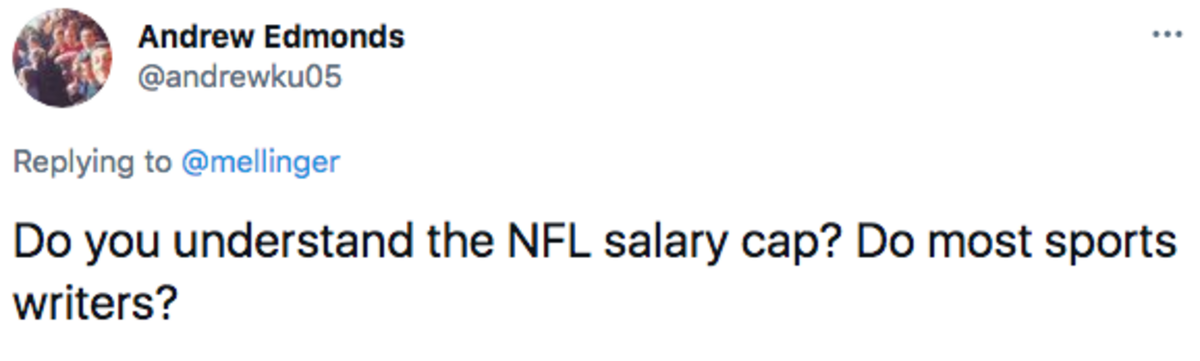
Sort of? Mostly? Sometimes? Enough to be dangerous?
I understand enough that the cap is not fake like some say, but it is also not what most would think could be described as a cap. It is, in the parlance of the day, fungible.
The cap can be confusing, and NFL teams pay executives many dollars to understand it fully. There is even a cottage industry of public cap experts — shouts to Joel Corry, who I think is the best — to explain some technicalities to fans.
Well managed teams will always have ways they can create some immediate space, and we’re seeing that with restructures and roster bonuses converted to signing bonuses.
In the most basic terms, those paperwork maneuvers spread a specific player’s cap hit over some number of years. In the last week or so, the Cardinals (J.J. Watt) and Saints (Taysom Hill) signed deals with dummy years that each side knows will be voided.
Doing that allows teams to spread the cap hits to future years, which is particularly important right now with a cap some $30 million lower than teams expected a year ago.
The cap is real, but saying it’s fake is more fun than noticing all the middle- and lower-class players who are being cut or forced to take less money. You can say the cap is fake now, and completely forgot you said it by the time we’re all mocking the Saints for carrying dead money on Taysom Hill in 2023.
Here’s a more local example: if the cap wasn’t real, the Chiefs would cut or restructure Frank Clark’s deal. He’s on a $25.8 million cap hit this fall, but with $37.9 million of dead money a cut would be counterproductive.
After this season, though, the Chiefs would gain $13.4 million of cap space by cutting Clark.
But, look. I don’t pretend to know everything about the cap. I have people I can call who can explain it to me, but I’m also aware that none of us fell in love with football because we just couldn’t get enough cap talk.
As a sports columnist in a city with an NFL team, I need to have a working knowledge about the cap, but I’m never going to pretend to be something I’m not.
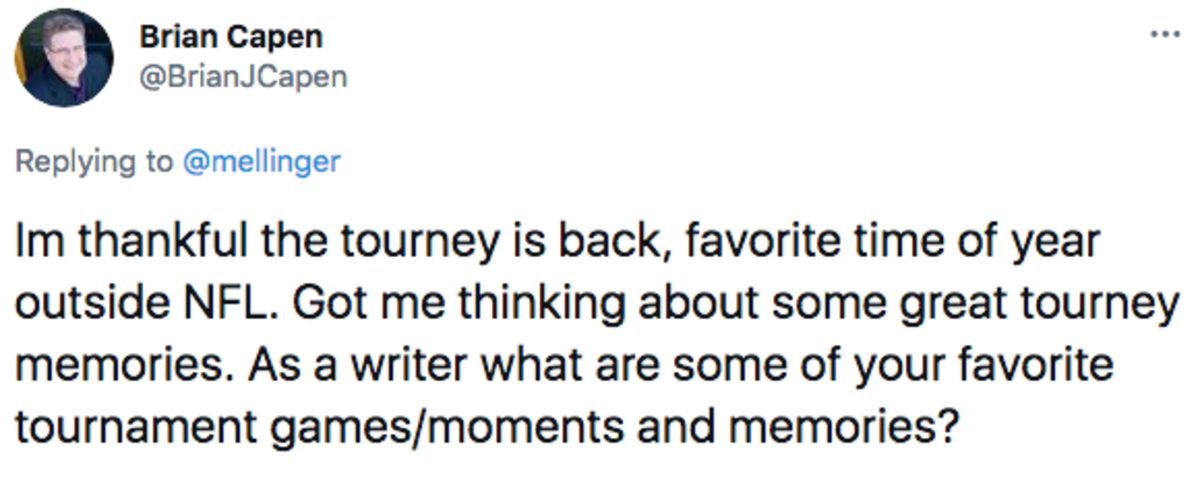
My favorite game I’ve covered in this job is one of the first: 2010 Sweet 16, K-State beats Xavier 101-96 in double overtime.
I remember so much about that game. I remember it was on a Thursday, and I booked a flight to land on Tuesday to make sure I’d be there in time for the media availability on Wednesday.
I remember that the flight got completely f’d, and instead of Salt Lake City I spent Tuesday and Wednesday in — wait for it — Amarillo. I remember there was a place in Amarillo with one of those Eat This Absurdly Enormous Steak That Honestly Would Probably Be A Meal And A Snack For A Hippo And Win A T-Shirt things and I thought long and hard about it because honestly what the hell else did I have to do.
I remember that I ordered tacos instead, because tacos are always a good idea.
I remember that game having an elevated energy right from the start, and my goodness that was a fun K-State team. Denis Clemente was one of the fastest players in the country, and Jacob Pullen one of the toughest. All they needed was one teammate to join them in scoring and they were all set, and against Xavier they got it from Curtis Kelly with 21 points*.
* I did not remember the point total. Had to look that one up.
I remember the call on Terrell Holloway, Denis Clemente’s missed 3 at the end of regulation, Jordan Crawford’s bomb that sent it to double overtime, Jacob Pullen bossing the second overtime, and all the while Gus Johnson calling the last 15 minutes or so without ever sitting down courtside.
I do not remember what I wrote, but I do remember calling my boss to apologize, telling her the column didn’t come close to matching the game and that I’d do better the next day. I remember her thinking that was weird, and then I remember getting a drink to wind down before going to sleep.
Also: I remember believing in my soul that K-State would have beaten Butler and made the Final Four, but that the game against Xavier just took too much out of them.
My goodness that was fun.
Oh, one more. At some point after that game, maybe in the offseason or maybe during the next season, when Pullen finished a career that would put his jersey in the rafters, I wrote something about Frank Martin.
In my mind, the gist was supposed to be that Martin wasn’t going to be at K-State for long and who knew when there’d be another Jake Pullen so let’s try to enjoy this as much as possible.
K-State fans did not appreciate the tone. One threatened me. Another wanted to bet $100 that Martin would be there at least five more years. I didn’t hear back from that fella when Martin left for South Carolina in 2012.
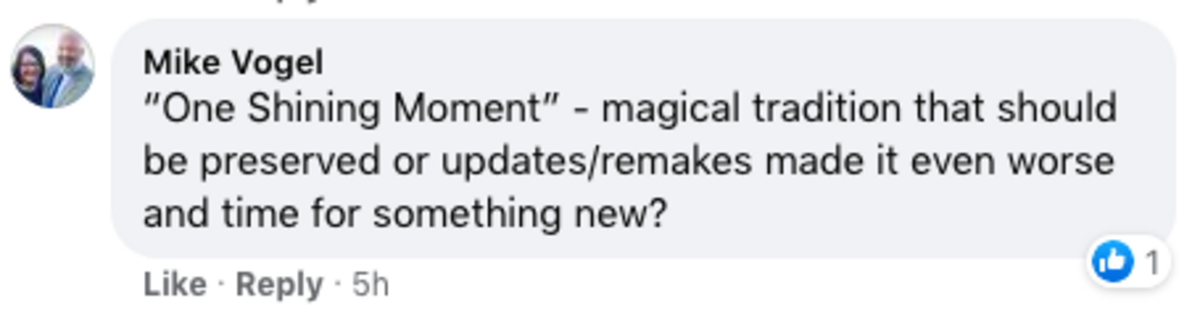
I am a One Shining Moment fanboy, and I will apologize to no man for this, but if you’re a good interrogator you’ll eventually find out that I hated the years they went away from Luther Vandross.
But then I would also point out that they had the right guy in the most recent One Shining Moment.
Let’s be real here. Despite everything I say and do, I am not stupid. I understand why One Shining Moment is a tired act for some. It’s super corny, and depending on how you look at it the production can be a bit cookie cutter — same cuts to the band, a coach in the locker room, a player diving on the floor and smiling/sticking his tongue out, lots of jump shots, tears, cheerleaders, etc.
But I’ll tell you this. If you can’t enjoy something that you know is a little corny, then you and I are just very different sports fans.
Because I like the 3-goggles, I like the bow-and-arrow thing, I like standing up and singing Take Me Out To The Ballgame, I like cornerbacks giving the exaggerated incomplete motion even if they were beat by three steps and the ball was off, I like over-the-top punchouts by umpires, and I particularly like a defense slapping the floor and then getting scored on.
This says more about me than anyone or anything else, but assuming I’m not working the NCAA Tournament final I am going to stay up on my couch the 20 minutes or so after the game and if they don’t play One Shining Moment I’m going to riot, and if they don’t use the Luther Vandross version I’m going to write a sternly worded letter.
If you don’t like it, go to bed, turn the channel, whatever. But kindly get gone.
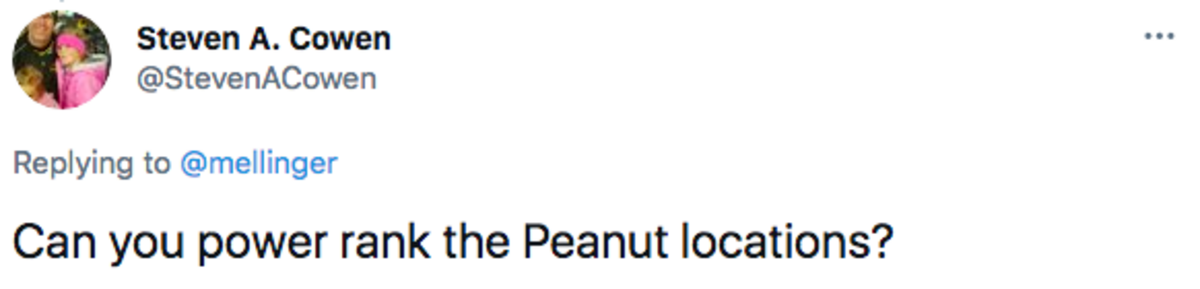
Sir, it would be my honor. Now, according to Google we here in Kansas City are blessed with seven Peanut locations. I have been to six, so with apologies to the Northland store I will rank them here.
6. Olathe. Look, I’m not going to be mad at any Peanuts. All Peanuts are good Peanuts. It’s just that some are better than others.
5. Mission. Has some of the dinginess I want from a Peanut.
4. South Overland Park. Has more of the dinginess I want from a Peanut.
3. Downtown Overland Park. Good beer list, enough space that you don’t usually have to wait, it’s a good option.
(BIG GAP)
2. Downtown. So, I didn’t know this for years, but the Johnson County and Northland Peanuts are only vaguely affiliated with the older ones. Same was true with Lee’s Summit when it was still open. If you go to www.peanutkc.com and go to locations, only downtown and Main Street are listed. Different ownership, and I think if you’ve been and compared you’d agree it’s a much different feel.
I’ve been told — I HAVE PEANUT SOURCES AND A HOODIE — that Downtown and Main source their chicken from different places. And I can tell you from extensive research that the wings and blue cheese are superior to the Johnson County stores.
The Downtown Peanut is everything you want: completely unpretentious, friendly service even when you don’t see anyone for 20 minutes because they’re on a (wink-wink) smoking break, great food, playlists procured by the bartender’s whims, it’s just a great spot.
True story: I once met Scott Pioli there. He wanted to know the best place in town for wings, so that’s where we went. At one point, I don’t know what happened, I guess he misjudged a bite and he started coughing with intensity. There was a tense moment, I may have even tried patting him on the back or something.
Finally, he’d tamed it, and smiled.
“You almost had a great story: Chiefs GM wiped out by wing,” he said.
1. Main Street. If anyone has been to this Peanut and says it’s not their favorite Peanut, what they are actually telling you is that they are never to be trusted. Ever. Never. People say never say never? Not these people, not when they tell you they like some other Peanut better.
The staff is great, especially considering that they NEVER have enough staff. They have enough of a beer selection, but not so much that it’s out of place in a dive bar. The chairs are torn and sometimes wobbly, the walls and ceiling are covered with random old stuff, they could definitely use more space, and there’s not a single person in the place in a bad mood.
It’s the perfect bar.
They even started answering the phone for takeout orders after Covid hit.
This week, I’m particularly grateful for these new running shoes. Not that I’m particularly fast, or even go running as much as I should, but the new shoe boost is real and it’s spectacular.