
Mellinger Minutes: Inside John Sherman’s ownership group, fixing college hoops & more
John Sherman’s leadership is, in some ways, the story of the Royals’ next decade. We can and have and will talk about Adalberto Mondesi and Bobby Witt and Brady Singer and Jackson Kowar and Daniel Lynch and everyone else who matters on the field. The players are the ones who do it, or don’t. That should always be the focus.
But ownership, particularly in baseball, is what allows those players to do it, or not.
Kansas City has seen both sides of this. Ewing Kauffman built what was then the most successful expansion franchise in baseball history. He was a visionary, one of America’s great entrepreneurs, and he adored his hometown.
David Glass’ ownership was awful, in the early years. The Royals were lost. Leaderless. Often without support.
Then, in 2006, Glass made a dramatic turn, even if it took many fans years to see it. He hired the best people he could and supported their vision. Payrolls routinely outranked revenues. The Royals had another parade.
Now is Sherman’s turn. He sat with me for his first extended interview since taking the job, and I hope you read the column. He struck me as direct about who he wants to be, humble about what he doesn’t know, and ambitious about where he thinks the team can go.
One thing we didn’t get into in the column that I want to mention here is that Sherman’s ownership — regardless of what we observe on the field, good or bad — will be unlike anything Kansas City has seen.
Whether you like the owners of our teams or not, the teams have always been run, basically, by one person. The Chiefs by Lamar or Clark Hunt, the Royals by Kauffman or Glass, Sporting Kansas City by a partnership so tight between Cliff Illig and Neal Patterson that even when it was both of them at the top of the power structure, they might as well have been one person.
Sherman is the leading investor of a group 17 deep. MLB’s preference has always been for one person to serve as the face and voice. That’ll be Sherman, but he won’t be the only man with influence.
Sherman is the one that will beheld publicly accountable, but he explained the mechanism to me like this: within the 17 investors are “12 to 14” lead investors, some of whom have people behind them.
“Then within that 12 to 14 we have a core group, a kind of the executive committee slash advisory committee,” he said. “Certainly on key things I’ll want their counsel.”
Sherman wouldn’t give names, but said the executive committee is “six to eight” people and the largest investors.
“If we’re talking about a big deal to extend a player I want those guys to hear the rationale,” Sherman said. “What I’ll be looking for is perspective and kind of a sanity check as well.”
The entire group is meeting in the Phoenix area in a few weeks. My understanding is that it’s part of a regular series of meetings throughout the year with financial reports and other information, and that the setting will allow them to see how baseball operations does its thing.
The size of Sherman’s group has raised some eyebrows around baseball. MLB likes to keep ownership groups small, and the assumption is that Sherman’s group expanded out of necessity to meet not just the $1 billion purchase price but the yearly operating expenses of running a major league baseball team.
Sherman’s group will have one major advantage: a new television deal that’s expected to be formalized and announced soon will boost annual revenues by $20 million or more.
Glass consistently said — and Forbes’ estimates generally agreed — that he ran the team on a break-even basis. In a sort of exit interview with me last fall he said that in overall yearly operating costs he lost some money — “but not a lot.”
Even with the ownership’s strong local ties — another preference in MLB — it would be hard to imagine the league approving the sale to a group that can’t at least run the team to generally break even and occasionally take yearly losses.
That’s generally how Sherman has indicated his group will do it. The mechanics of how it operates will be different, but the spending should be the same, or more.
That’s the hope and expectation, anyway.
This week’s reading recommendation is Greg Miller on The Intelligence Coup of the Century and the eating recommendation is (can you tell I haven’t been home much the last few weeks?) the BLT and wings at the Peanut.
Please give me a follow on Twitter and Facebook and as always thanks for your help and thanks for reading.
There seems to be a little more focus.
More urgency.
More seriousness?
More work.
Please don’t get the wrong idea. I don’t think the Royals were goofing off the last few springs. They worked. They cared. All that stuff. But it wasn’t like this.
I wrote some about this the last few years but a feeling had emerged in parts of the organization that the big league team had become too loose. That it was happy with 2015, and not working with the same hunger and desperation that existed before.
This is probably obvious but some of that is inevitable, because no big-league team can have its default level of intensity equal to a core of homegrown friends trying to erase a 29-year playoff drought, and it should also be noted that not everyone in the organization saw this as a problem.
But the point I’m making is that it’s different now. A lot of it is, I assume, because there’s a new manager to impress and that manager is pounding details and putting his energy into all corners of the big-league team’s operation. Some of it, too, I assume is because there’s a new owner.
There are other products of timing. Sal Perez — more on this in a column this week — is back from an elbow injury as a changed man. He’s still the most energetic guy in the room (though Nick Heath isn’t far behind), but there’s a different edge to him now, too.
Adalberto Mondesi, Hunter Dozier and Brad Keller are among those entering their first year of arbitration. A core of high-ceiling pitching prospects are working for their careers. Alex Gordon is back and (again, more on this soon) not just for a victory lap.
As much as anything else, this is a group that’s lost 207 games the last two years. Do that and you’re probably headed one of two ways — you’re going to give in, or you’re going to fight back.
It’s still February, for goodness’ sake, but the sense is this group is fighting back.
So, look. This is the 14th spring training that I’ve been to, and while I’d tell you this is among the biggest one-year changes in feel*, I’d also point out that there are more factors than just the change in manager.
* Just off the top of my head, and recognizing how subjective and silly this is, I’d say the only one with more of a change was in 2015 when the team was the defending pennant winner.
If at least two don’t debut this summer something went wrong.
Jackson Kowar and Daniel Lynch have passed Brady Singer in several prospect rankings, and usually that’s an awful sign for the guy selected first. In this case it means the guy selected first is performing well but the lower-floor, higher-ceiling guys selected just behind him are showing out.
This is early. This is also basically the opposite problem the Royals and many other organizations have had with pitching prospects who, it must be said, are baseball’s most notorious heartbreakers.
Anyway.
The timing, details, and execution of the transitions of these guys to the major leagues could be the most important thing the organization does this summer.
There are dozens of complications, most of which aren’t talked about much publicly. The Royals, even more than most clubs, consider factors beyond pure performance in considering when to call guys up.
That means work rate. That means how they respond to coaching. That means how they are with teammates, because touted prospects can sometimes make or break based on who is on their side.
It can be lonely, and high-end prospects are targets of the opposition and sometimes even the umpires. If they don’t have advocates on their own side a difficult game becomes even harder.
That’s part of why I think Brady Singer will be the First Man Up. Not that those other guys don’t have what I’m talking about, but this focus and work is an outsized portion of Singer’s profile. Aside from that, his stuff is big-league ready, his delivery is repeatable and he’s just best positioned to make the move right now.
I’d also bet on Jackson Kowar being in the big leagues this summer. His stuff has progressed nicely — though he can overthrow at times, when he’s amped — and the Royals have been encouraged by his professionalism.
The other two are guesses. If you’re forcing me to say I might tag Bubic as a September guy, though the timeline could accelerate or decelerate based on what happens between now and then.
Lynch is really interesting. The Royals (like a lot of clubs) see value in transitioning rotation prospects to the bullpen first. The advantage is a manager can better cherry pick spots for success, and it’s “easier” to get outs as a one- or two-inning reliever than a starter who needs to go at least five. That’s a good way for pitchers to gain confidence, and see what works.
Lynch might be the exception. He’s long, and his warmup routine takes more time than the other guys. He’s a tall left hander drafted to be a starter, and at least at the moment the Royals feel like his best path might be without the temporary transition to the bullpen.
Most likely, that means his debut would be delayed when compared to what it might be if he could be a reliever.
But the Royals’ rotation is thin — seriously, they need lots of health and these prospects to be real — so you could also imagine a scenario when the Royals need a starter sooner than later.
It’s a good question, and there’s a case to be made both ways. The real answer is “both” but that’s avoiding the question so here we go:
The next wave. I say that for two main reasons:
First, the Royals should know what they have in Whit Merrifield, Sal Perez, and Jorge Soler. They hope they know what they have in Adalberto Mondesi, but almost no matter what he’s going to be a major part of the future going forward. Guys like Ryan O’Hearn, Nicky Lopez and even Hunter Dozier could have some volatility, but for the most part this is what the Royals have.
Second, the next wave is disproportionately made up of high-end starting pitching and there is nothing the Royals need more (and it’s not particularly close) than high-end starting pitching.
Put another way: if at least two of those college picks don’t turn into productive starters it’s hard to imagine this push working. If at least one doesn’t click it’s really hard. If none click we might all be wasting our time.
As a bonus, choosing the next wave means I also get Bobby Witt (the highest-ceiling prospect of them all) and Nick Heath (the Royals are low-key desperate for someone to play 40 or so games in center this season and more in next few years).
Here’s one that’s been kicked around inside the organization:
Adalberto Mondesi, SS
Hunter Dozier, RF
Whit Merrifield, CF
Jorge Soler, DH
Sal Perez, C
Ryan O’Hearn, 1B
Alex Gordon, LF
Maikel Franco, 3B
Nicky Lopez, 2B
Have to admit, my first reaction was muscle memory — why not break up all the right-handed bats from Dozier through Perez, and the consecutive lefties with Gordon and O’Hearn?
But, then, I remembered baseball’s new rule about a relief pitcher needing to finish an inning or pitch to at least three batters.
I’m assuming that rule will be abused — hoping for some comedy with LOOGYs coming up with sore elbows that heal within 24 hours — but it should be considered when constructing lineups.
I like the lineup. Merrifield could be a leadoff hitter, but I like Mondesi’s switch hitting and speed at the top. I love using the No. 2 spot with a guy who can drive the ball, and not just a get-the-leadoff-runner-over guy, and I love it so much that if Dozier is injured or struggles I’d advocate moving Merrifield up or inserting whoever else might be the team’s next best hitter.
I’d also listen to an argument for flipping O’Hearn and Perez, but I think Perez is the kind of guy for whom lineup glamour matters and O’Hearn should probably prove it first anyway.
Depending on how long you stare at that lineup you can come up with scenarios where the Royals score a lot of runs and also scenarios where they’re near the bottom in offense again.
They just have so many guys with a lot of range — Mondesi could be a star, Dozier could be a legit top-of-the-order guy, O’Hearn could breakout, Franco could provide depth at the bottom, on and on.
But other than Merrifield, Perez and probably Soler there are a lot of guys in there who could bottom out, too.
One thing that might drag the lineup a bit is they don’t have a lot of depth. That potential opening lineup could be deep, but an injury or two and they’re giving a lot of plate appearances to a lot of guys who simply might not be big-league hitters.
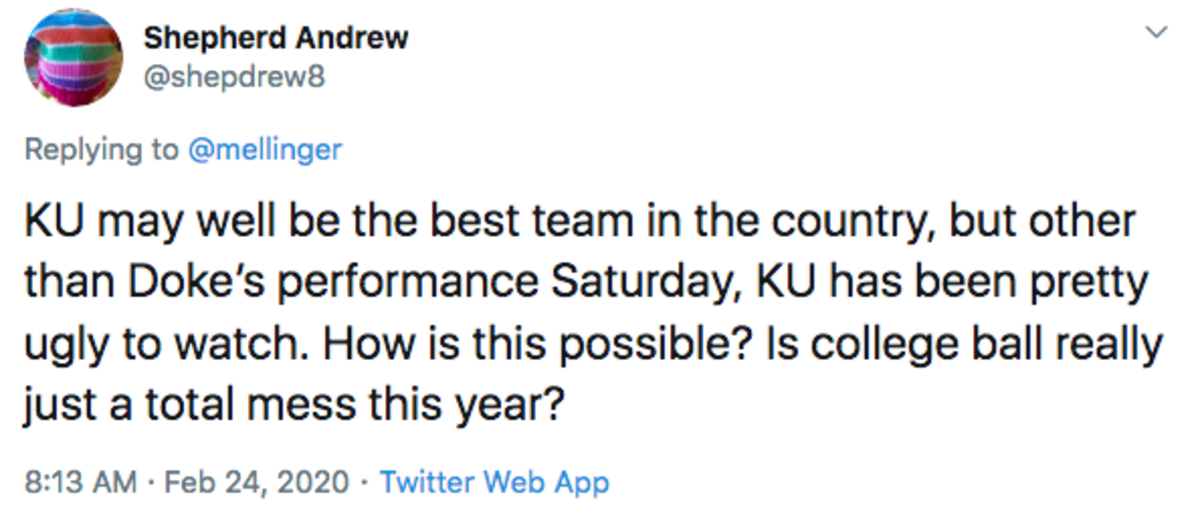
Well, at least two factors come immediately to mind.
The first is that, yes, this is a down year in college basketball. In most years, it seems as if there is a blueblood stocked with lottery picks and an upperclassman or two that by this time of year has emerged as a power.
That’s just not true right now.
I’m probably biased a little because I’ve watched them more than the other teams toward the top of the polls, but for me Kansas and Baylor are the two best teams I’ve seen. Both have clear paths to victory against virtually anyone, both are well-coached, both are athletic and play hard.
But, also, both are the kind of teams that might be on the fault line between a No. 1 and No. 2 seed in other seasons.
But the other factor that comes to mind is that Kansas defends like dang savages. Marcus Garrett might be the best defender in the country, and if he didn’t exist you could make a case that Udoka Azubuike is the country’s best defender.
Beyond those two studs, Ochai Agbaji can be a problem defensively and Devon Dotson’s speed and athleticism help on defense.
And, lets face it, defense isn’t usually as fun to watch as offense, and as proof of the rule I present one notable exception:
This might also be part of what you’re talking about. Or, at least, it’s part of what I think about in terms of college basketball being a little down.
Here is one mock draft, and it’s just one, and mock drafts are sort of silly, but still. There’s only one guy in the top 10 who plays for a KenPom top 10 team. Just five guys in the top 20 are on top 20 teams.
In theory that kind of thing doesn’t matter, and maybe it shouldn’t, but it does. College basketball is a more enjoyable product when the best teams also have the best individual talent.
But, in that vacuum, Kansas is wonderfully poised to defend and Doke and Dotson its way to the Final Four.
Maybe there are ways that Kansas will be exposed. Maybe they’ll run into a coach with a way to neutralize Doke, or maybe a gameplan that will exploit KU’s passing inefficiencies, but they’re going to be a mother of an out.
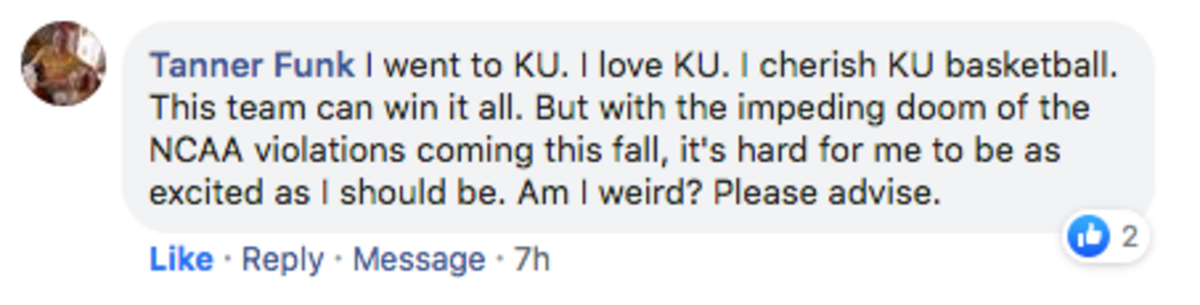
Well, you know my initial answer, and it’s really the truest answer I can give:
Nobody can tell you how to be a fan.
If you’re squeamish because of the violations that many are expecting, that makes sense. A title followed by probation is a title that’s not as easily enjoyed.
If you’re feeling even more bonded with your team because the NCAA’s rules are stupid and Zion Williamson went to Duke then, well, that makes sense, too.
Here’s where I land: the whole thing is bad for the sport.
The investigations are inherently flawed, the rules lack credibility, and the heavy-handed presentation of student-athletes is comical.
The sport has needed a massive update for years. I don’t know what the best solution is, and I know this is outside the box and would never be implemented but I think something like it would be great for all sides:
- full image and likeness.
- a more attractive situation in the G League coupled with college scholarships requiring at least two seasons.
- financial incentives for college players to stay in school longer, perhaps paid out in the form of interest-free loans or bonus payments for academic progress that would be proportionate to potential draft status.
This plan would help update rules to modern times, correct some of the gap between his important athletes are to the enterprise and how much power they have, improve continuity in college, and give athletes better options both professionally and in college.
We’re way off track here. You asked about KU and I came back with a bunch of “feel how you want to feel but this is how the sport could be improved.”
But, that’s how I feel.
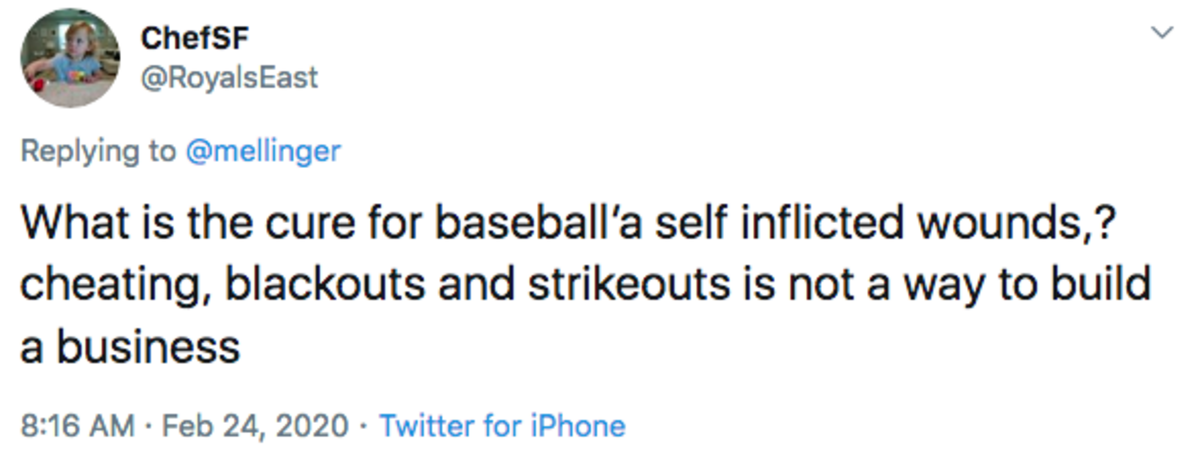
We’re hitting a lot of stuff that I might write more about as the days go on. I do believe baseball has some major problems, and is need of some major fixes.
I’m just spitballing here but some thoughts:
- Those within the game need to honor and take seriously the responsibility of growing the game. That means everything from broadcasters stopping the seemingly constant trash-talking of the game to players being more accessible to fans and media. Baseball is as great a game as it’s ever been, but it needs to tell its story better.
- Prioritize long-term grown over short-term profit. Baseball is a business, and I recognize that, but there are too many examples of the sport chipping away some of its future for a fraction more revenue right now. The most obvious example is the social media policies and blackout restrictions on MLB.tv. The sport needs to look at these things as marketing tools, not just profit generators*.
- * This is getting into the weeds a bit, but it’s worth pointing out that opening MLB’s terrific streaming service completely could produce at least one unintended consequence. Revenue generated by MLB Advanced Media (which is awesomely shorthanded to BAM within the sport) is split evenly among 30 clubs. Reducing revenue would mean reducing revenue sharing.
- Continue to search for ways to improve college baseball. Maybe this sounds counterproductive but the more and better opportunities in college, the more and better athletes who will play baseball. The NCAA needs to play ball on this (sorry, truly didn’t mean the pun, but it’s there) and allow a Title IX exception if MLB is willing to fund an extra scholarship or three at Division I programs.
- Continue to search for ways to be not just accessible to but aggressively reaching out to kids, particularly kids from lower and middle class families. Kansas City’s Urban Youth Academy is a terrific example of what’s possible, and should serve as a model for more programs around the country, and not just in big-league markets. Done right this will broaden the talent pool, sure, but just as importantly it’ll mean more kids today grow up to be baseball fans tomorrow.
- Every team, even those who regularly sell out games, should offer something like 5 percent of their ticket inventory at deep discounts to families. Offer kids tickets for $10 or less with the purchase of an adult ticket. Teams can track everything so make sure both tickets are non-transferrable and can’t be resold. All professional sports (and a lot of college sports, too, if we’re honest) are pricing out for lower and middle class families. Baseball teams have so much more inventory that this should be the exception.
None of these proposals would make a difference tomorrow. These are all long-term plans, and I’m not sure we’d see whether they work for years.
But I do think there’s logic behind all of them, and I’m 100 percent certain that more and better ideas exist.
Baseball is a great game. It needs to present itself that way.
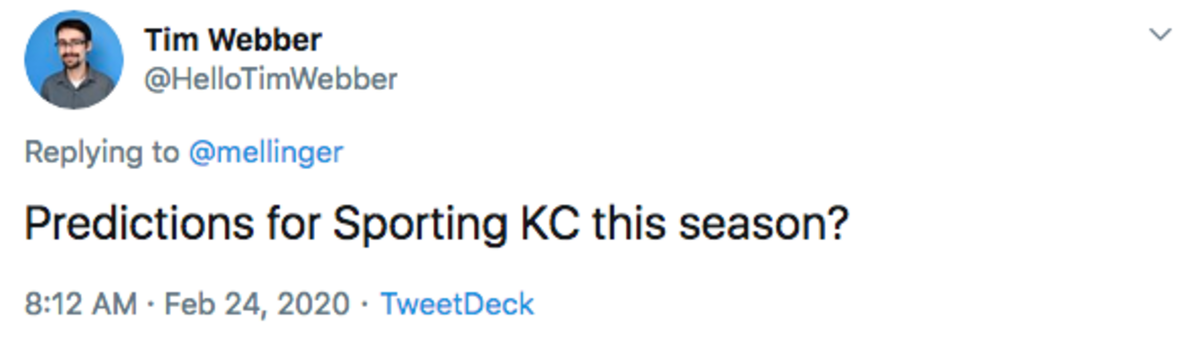
I’m sure it is possible to overstate the importance of signing star Mexican striker Alan Pulido, but I’m willing to do that here.
I believe it’s among the most important signings and roster moves in club history, in terms of on-field production, basic symbolism, and timing.
Sporting Kansas City needed goals. Sporting Kansas City needed to show a willingness to play ball in MLS 2.0, and it needs to show that 2019 is the aberration and not the beginning of a downward slide or (worse) the new normal as other clubs around the league use newer ideas and bigger stacks of cash to build winners.
Pulido led Liga MX in goals last year, and is an important signing not just for Sporting but for MLS. Crucially, he’s not the only addition. Sporting added depth everywhere, and signed Israeli midfielder Gadi Kinda on a multimillion dollar deal.
The apparent goal, then, is ambitious: a reset and transition toward a new future done without the (often) requisite teardown of walking away from veterans like Matt Besler and Roger Espinoza.
I’m as interested in following this season as any in recent memory, which is a different thing than saying I believe this will be a better team than any in recent memory.
I’m expecting them to make the postseason, but beyond that am not sure of any tangible predictions other than a freshened interest in how Peter Vermes and Sporting navigate this new future.
Well, they can’t implement anything the players don’t agree to and depending how far down this thought path you go you’ll get to a certain truth:
There is no greater mismatch in sports than the negotiating will, chops and leverage of NFL owners compared to players.
It’s brutally unfair, and those words are chosen deliberately because much of the owners’ advantage rests in the inherent danger of the sport. Careers are short, bodies break down and windows close so a chunk of the union will always be incentivized to negotiate as much as possible but ultimately sign whatever deal they can.
The owners know this, and they negotiate accordingly.
That’s why they don’t have long-term health insurance and that’s why even with more than twice the labor force and a sport that often leaves bodies mangled NFL players take a smaller percentage of the revenue than is typically paid out in baseball (with 10 times as many games, which means 10 times as many dates that owners have to keep a stadium operating).
I’d be more aghast at all of this if I ever believed that NFL owners cared about player safety above the minimum requirement of making it appear as if they care about player safety.
You know what owners really care about?
Maximizing profits, keeping the machine rolling, and buying a bigger yacht than the guy who finished above them in the division.
Players tried striking once before. It ended disastrously for them. Owners have more money invested now than ever before, but on average are far more equipped to handle a work stoppage than players.
It’s not a fair fight, which is why the owners always win.
This is the biggest change Patrick Mahomes has brought.
It’s why Kansas City threw a dang parade*.
* Drink.
I actually can’t remember if they put tangible rankings on the games but just going by the order of presentation this would be NFL Network’s rankings of Mahomes’ best games:
1. Super Bowl LIV, when he won the game’s MVP for the 3rd and 15 wasp, threw two touchdowns and ran for another while leading a 10-point fourth quarter comeback.
2. 2019 AFC Championship win over the Titans. Another comeback, and that 27-yard touchdown run might be (considering stakes and everything else) the best play of his career after wasp.
3. 2019 AFC Divisional win over the Texans. I mean, the guy trailed by 21 points after the first quarter and had the lead back by halftime.
4. 2019 Week 3 win over the Ravens. Vastly outplayed the eventual league MVP and ripped apart Baltimore’s defense for 374 yards, three touchdowns and no interceptions.
5. 2018 Week 11 loss at the Rams. There’s a case for this as the best regular season game of all-time.
6. 2018 Week 3 win over the 49ers. Highlighted by the 9 seconds of chaos touchdown.
7. 2018 Week 2 win at the Steelers. This one left Steelers linebacker Bud Dupree openly admitting the team underestimated Mahomes’ intelligence.
8. 2018 Week 1 win at the Chargers. His debut as QB1, when he won AFC player of the week and threw that absolutely perfect touchdown pass to Anthony Sherman.
Honestly, it’s a pretty dang good list. I wouldn’t argue too passionately against any, but here’s my list (list? List!):
1. Super Bowl LIV. Really, it was one of his worst games before the fourth quarter. But Super Bowls are different, and I’m not sure if any other quarterback in the league could have completed the wasp play against that defense, let alone be the one to make the call.
2. 2019 AFC Divisional win over the Texans. I’m putting a lot of weight into the stakes here, but his play was dang near flawless and that team — and that stadium — needed his superhuman talent to believe in when Houston went up three touchdowns.
3. 2019 AFC Championship win over the Titans.
4. 2018 AFC Championship loss to the Patriots. This is the highest I’ll rank any of the games NFL Network left out. Mahomes wasn’t good, at all, in the first half. But to respond after halftime that way against the best defensive coach of all-time (against a defense that would squash the Rams two weeks later) was special. If Dee Ford is onside, or the coin flip goes the other way, then there’s an argument for this one to be No. 2. NFL Network certainly would’ve had it on its list.
5. 2018 Week 13 win over the Ravens. This was Baltimore’s first loss after going to Lamar Jackson, and Mahomes’ numbers weren’t spectacular by his standards (377 yards, two touchdowns, one interception) but he stood strong in the face of a brutal beating from the Ravens’ defense and delivered the unforgettable 4th and 9 pass to Tyreek Hill.
6. 2018 Week 1 win at the Chargers. Again, context matters on my list. That was his debut, not only rising to but exceeding expectations. He was basically perfect.
7. 2018 Week 5 win at the Broncos. Did I mention that context matters? This was the left-handed pass, and the fourth quarter comeback on Monday night on the road against the team which did that to the Chiefs so many times before. The Broncos locker room was a heck of a scene.
8. 2018 Week 2 win at the Steelers. The thing he proved in this game was how quickly and effectively his mind could operate. The Steelers did everything they could, blitzing from different angles, switching coverages, all of it, and Mahomes chopped them up.
Well, I think that’s probably how this is going to go and it’s probably how it should go but it’s DEFINITELY not how it will or should go based on what happened with Eric Berry’s contract.
The Chiefs are better with Chris Jones. Much better. The point of drafting well and hiring good coaches and operating an NFL team is to find players like Jones and keep them as long as you can.
/Stephen A. Smith voice/: However ...
The Chiefs are against it.
This is a good problem to have, and it’s something I wrote extensively on a few weeks ago, but the Chiefs are going to run out of cap space.
They will give Patrick Mahomes an extension, and depending on the structure, giving Chris Jones the contract he’s earned (and is demanding) would mean using somewhere north of 40 percent of the cap on a quarterback and two defensive linemen.
After that, if you anticipate Travis Kelce wanting a raise after George Kittle and/or Zach Ertz are paid, and you think about the cap hits already on the books with Tyreek Hill, Tyrann Mathieu and others, then one of the league’s most top heavy payroll is just pushing further to the extreme.
I’ve wondered if the Chiefs might approach Frank Clark about a renegotiation. Clark is in line for a $22.7 million cap hit. Who knows, maybe you get lucky and Clark plays ball with you to help keep his friend.
But, realistically, the likeliest scenario is that the Chiefs will have to decide between two suboptimal options:
1. Build around a cap hit of around $15.5 million for Jones in 2020 knowing that his trade value will go down and franchise tag number will go up in 2021.
2. Trade him now for draft picks, knowing that you don’t have anything resembling a one-for-one replacement to backfill the loss as you try to win another Super Bowl.
Teams like the Chiefs have an equal chance of winning because of the salary cap and revenue sharing, but this is the other side of that.
I know we all want villains, or someone to blame, but I don’t have a problem with how either side has handled this. Jones wanted to be paid last summer, sort of skipping a step in the typical progression, and the Chiefs wanted to wait.
Their eventual Super Bowl winning roster was stronger with Jones on a $1.9 million cap hit, but they knew the current reality was a strong possibility.
Jones could’ve been more flexible in an extension’s structure last year, but he has every right to seek his full worth under a CBA that already makes it harder than it should for young stars to be paid.
The Chiefs got their championship, and now Jones shouldn’t be expected to do anything less than want the most money possible. This is the system working as intended.
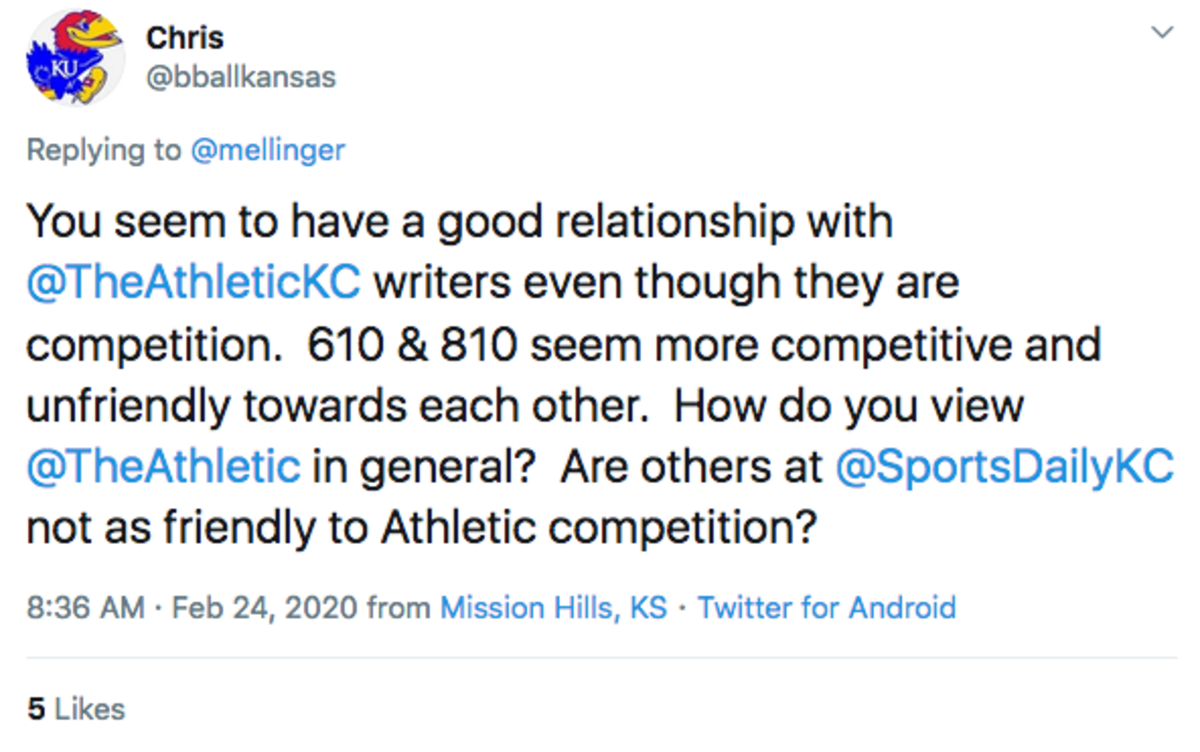
Well, look. Please don’t misunderstand. I want to metaphorically beat The Athletic’s brains in. And they should want to do the same to me. That’s part of competition, and part of wanting to be as good as possible at what you do.
But that doesn’t mean I can’t be friendly or even friends with the people who work there.
It doesn’t mean I can’t thoroughly enjoy their work and respect what they do. I enjoy and respect the work of a lot of people, at a lot of places, from the St. Louis Post-Dispatch to Yahoo to the Washington Post to ESPN to the Rivals network and so many others.
I’m not going to speak for anyone at either radio station, or anyone else at The Star. People are different, and I know of good friendships that exist between competitors and terrible relationships that exist between teammates.
I can’t say I love everyone in Kansas City media, but whether I’m friendly with someone or respect someone has nothing to do with where they work and everything to do with how they treat me and others and how they go about the work they do.
You asked how I feel about the Athletic, and maybe this isn’t the answer I’m supposed to give, but I love it. I think they’ve hit on something, both in terms of the content and way they deliver it.
Their goals are a little different than a typical newspaper’s. That’s not good or bad. Just different. The Star will have five or six people at every Chiefs game; the Athletic will have one or two. The Star won’t write a word about LeBron or the Astros; the Athletic has talented people on those beats.
I know there’s a tendency to look at these things as zero sum games and, who knows, maybe that’s where this ends up. But I love journalism, and more specifically I love sports journalism. I root for everyone to succeed.
I enjoy reading good stuff no matter where it is, even the stuff that’s so good it makes me jealous — especially the stuff that’s so good it makes me jealous.
Hopefully there’s room for all of us, but no matter where any of us work it’s our responsibility to be good enough that readers make that room for us.
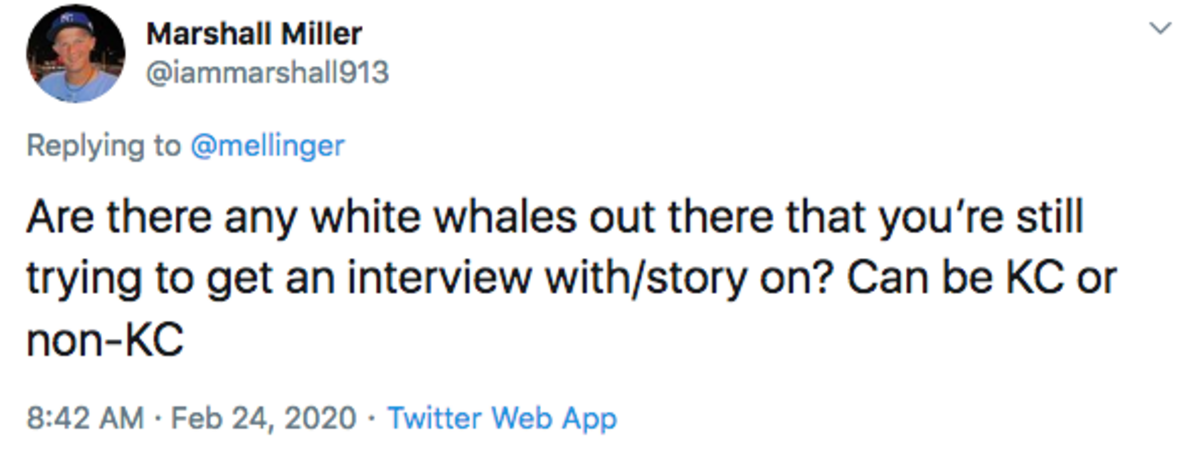
There’s a file on my notes app three screens long with column ideas I’d like to get to. Some of them probably aren’t realistic, some are probably bad ideas, and some are probably outdated.
But the answer to your question isn’t so much people I haven’t talked to. I usually have pretty good luck reaching people. The problem is getting them to open up.
- I’d love to hear Clark Hunt spill his soul about what went wrong in 2012 and what lessons he took from it.
- For that matter, I’d love to hear Scott Pioli do the same.
- I’d love to know everything that happened inside and around Mizzou’s football program in the fall of 2015.
- I’d love to know everything that Bill Snyder thought and felt his last few years coaching.
- I’d love to know everything that happened with not just Billy Preston and Silvio De Sousa but all the recruits Kansas didn’t get, and what those recruits got somewhere else.
- I’m always looking for great high school stories, because I find there’s a sincerity and realness there that doesn’t always exist at higher levels.
- I’d love to know every last detail of what happened with John Dorsey.
- As much as anything else, I’d love to know every last detail of what happened with Yordano Ventura.
Look, there is every possibility that I could sit here for another hour and come up with a hundred more. That’s one of the best things about this job, and one of the most frustrating. You can learn a lot but it’s never all you want to know. You can hear a lot but always want more.
This week, I’m particularly grateful for a moment last week when I had to take the kids’ sunglasses and dump some sand from my work backpack so that I could put my notebook and computer and everything else back in.
It was the transition from using the bag on a family vacation to the beach that was awesome, and using it to come down for spring training, one of my favorite trips on a job I’ve done for a decade and still sincerely enjoy. I’m lucky, and I know it.
This story was originally published February 25, 2020 at 5:00 AM.