Here’s the secret to KU Jayhawks’ defensive success against the Iowa State Cyclones
Kansas coach Bill Self smiled wide — and with good reason — following his team’s 64-50 road victory over Iowa State on Saturday.
His Jayhawks, for most of the game, shot it miserably, mustering just eight points in the game’s first 11 minutes.
The result could have been decided by then ... but wasn’t. KU still only trailed 15-8 at that point, thanks to a heroic defensive effort that continued the rest of the afternoon.
And the biggest reason for that?
“I don’t think we screwed up one ball-screen coverage the whole night,” Self said with a grin afterward.
OK, let’s be honest: That sentence isn’t going to mean much to casual readers. Most of us aren’t coaches or former players, meaning comments like this from Self are most likely going to be accepted without further examination.
I think it’s important, here, to dive into what Self’s talking about. Because it is significant — and also was one of the biggest reasons KU won on Saturday.
Self says the Jayhawks’ ball-screen coverage was good.
Another way to explain this: Each of KU’s players executed their roles to near-perfection while working as a team.
The plan
Self said Saturday he decided to change up his team’s ball-screen defense about a month ago, choosing a more passive option while electing to keep center David McCormack closer to the basket.
It’s important to note I’m not in KU’s practices. But if we rewatch — and take our eyes off the ball — it seems fairly likely the Jayhawks’ new defense hinges on three players performing their roles simultaneously:
1. KU’s big man is asked to help contain drives;
2. KU’s lowest defender is asked to bump the opposing big man rolling to the rim;
3. KU’s defender on the side with two perimeter shooters is asked to stand between them and guard both until his teammates can recover.
We see how the Jayhawks execute this on Iowa State’s very first possession.
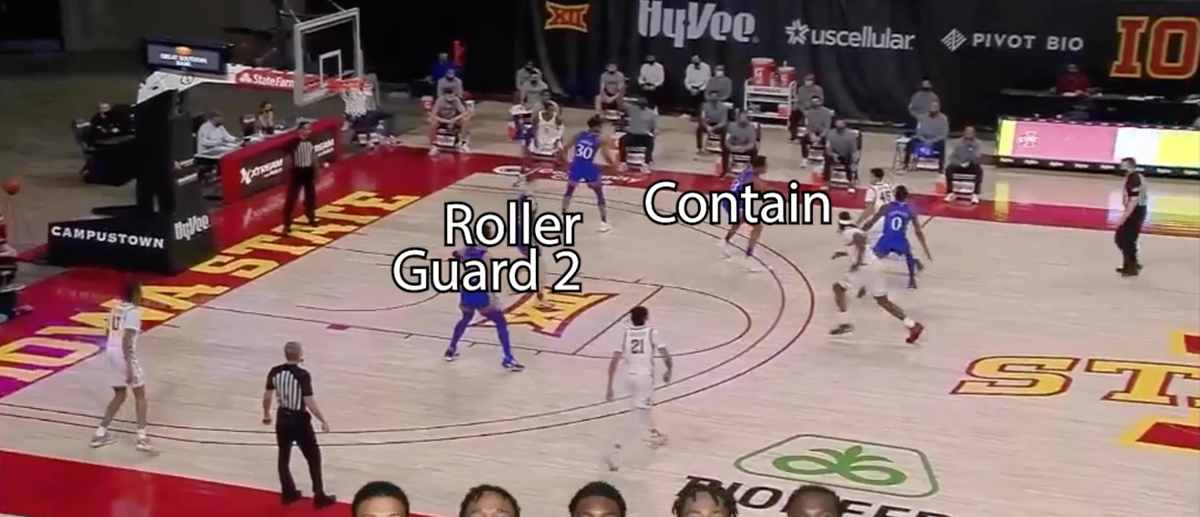
McCormack helps on the ball screen without getting too aggressive. Christian Braun leaves his defender in the corner to step to the middle of the lane to get ready for Iowa State’s big man. Meanwhile, Marcus Garrett splits the difference between the two Cyclones’ shooters so he can recover to either of them if it’s passed their way.
Altogether, it looks like this.
The way Iowa State runs offense, KU had to perform these actions over and over and over.
And there are two specific examples from the first half that show just how focused the Jayhawks were Saturday.
Instinctual play
Self often talks about Garrett’s excellent defensive instincts, and we see that on this possession from late in the first half.
It appears to be a lot like the ball screen above, though Iowa State throws in a wrinkle: Instead of having two shooters around the three-point line, the Cyclones have one player cut late from the middle of the lane.
This would be difficult to guard for many teams. Notice, though, that Garrett still goes through his help motions while sensing there should be a second player he’s responsible for.
When Jalen Coleman-Lands sprints to the top of the key, Garrett closes in a flash. He’s there on the catch to contest the Coleman-Lands three-point attempt, making it a tougher try that ends up wide of the mark.
Rotating responsibilities
KU’s defensive style makes it so players can have different responsibilities on a play-to-play basis. It also will challenge each of the guards to perform their duties properly.
We see this on Iowa State’s next possession.
On the Cyclones’ first ball screen, Garrett and Ochai Agbaji are tested, though after a few seconds, their attention to detail has KU back at full strength defensively.
That leads to a later ball screen where Braun and Jalen Wilson must copy their teammates’ actions, which they do effectively as well.
All of that — along with McCormack limiting two drives — leads to Iowa State desperation. A last-second shot is blocked by Agbaji, which results in a Cyclones shot-clock violation.
This all was part of a 6-0 KU run to close the half.
“The guys are starting to understand it,” Self said of his team’s new defensive scheme. “Sometimes when you put in something new, that you’re not used to doing, it takes a while to become instinctive instead of thinking, and I think we’re becoming more instinctive on that.”
It potentially means even better defensive days ahead for KU. Iowa State posted a season-low 0.75 points per possession Saturday, stymied by a defense that rarely made missteps.
Self had a fancy way of saying it: KU had great ball-screen coverage.
Another way, though, is this:
The Jayhawks defense moved as one.