KU football’s run game stalled during crunch time against Indiana State. Here’s why
On third and 7 late in the fourth quarter, Indiana State forced a sack fumble and recovered it in the end zone. The ensuing extra point gave the Sycamores a 17-16 lead over Kansas with 4:26 left.
Fox Sports analyst Jordan Palmer, at that moment, delivered what I thought was a good point.
“This thing was started (for KU) on the inability to run the ball on first and second down,” Palmer said on the broadcast. “You can’t put yourself in a position up six against a team — you’re Big 12, they’re FCS — you can’t put yourself in a third and (7) situation where you’re backed up like this.”
As we know, KU ended up rallying for a 24-17 victory, but this still obviously wasn’t a good look for a team and coach that put great offseason emphasis on playing physical football.
With the game on the line, KU rushed for one yard on first down and two on second down, putting the team in position for a costly mistake.
So what happened on those two previous snaps? A closer look shows offensive line execution was only a minor part of the Jayhawks’ issues.
(For help with this story, I consulted a Division I assistant coach to get his thoughts.)
1-yard run, 5:45 left in fourth quarter
KU is showing a run look here with two backs and two tight ends, and because of that, Indiana State’s defense sells out to stop a potential rush.
The Sycamores have eight in the box, with a ninth defender coming quickly when a safety breaks on a blitz. A few Indiana State players also are “slanting” at the bottom of the screen to try to get out of the direct path of KU’s offensive linemen.
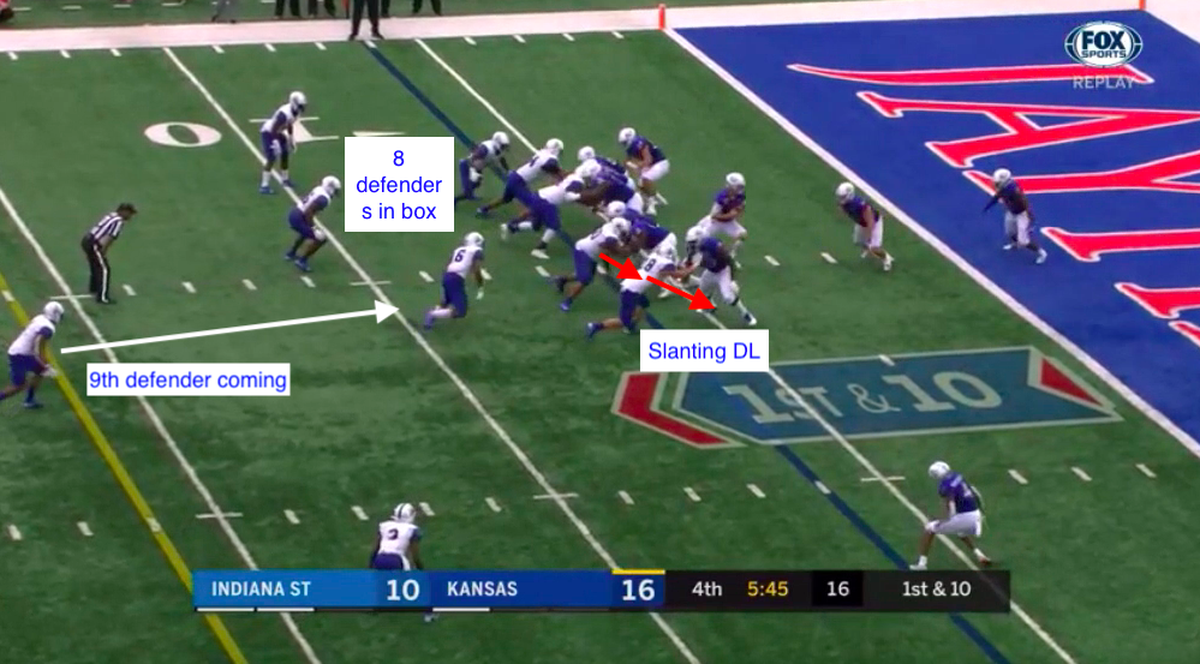
KU goes with a lead zone play, and Indiana State’s run blitz makes it more difficult to execute. The Jayhawks’ technique also isn’t perfect, as left guard Malik Clark fires upfield too quickly and misses his tag-team block with center Andru Tovi.
That starts a domino effect. Tovi can’t move ahead to get to Indiana State’s free linebacker. That results in defensive penetration, so KU fullback Ben Miles has to shuffle his feet in the hole instead of charging ahead.
Running back Khalil Herbert actually does well to get a yard here from a play doomed from the start.
Perhaps the best option? Not running it at all.
Receiver Andrew Parchment runs a stop route at the bottom of the screen, and quarterback Carter Stanley could have thrown the ball.
I showed Stanley the replay to see what he thought.
“Shoot, looking back on it, I feel like I maybe should have (thrown the screen),” Stanley said. “ ... I can throw that fast screen, but (coaches) say if you’re ever in doubt, hand it off. Especially being that close, I just wanted to see what we could do up front.”
KU still had a chance for success that way, but running into poor numbers without proper execution eventually resulted in a non-productive down.
2-yard run, 5:08 left in fourth quarter
This play might be more concerning when it comes to the long-term prospects of KU’s offense.
KU has a run-heavy look here with two tight ends, a fullback and running back. In addition, both tight ends have their hands on the ground before the snap.
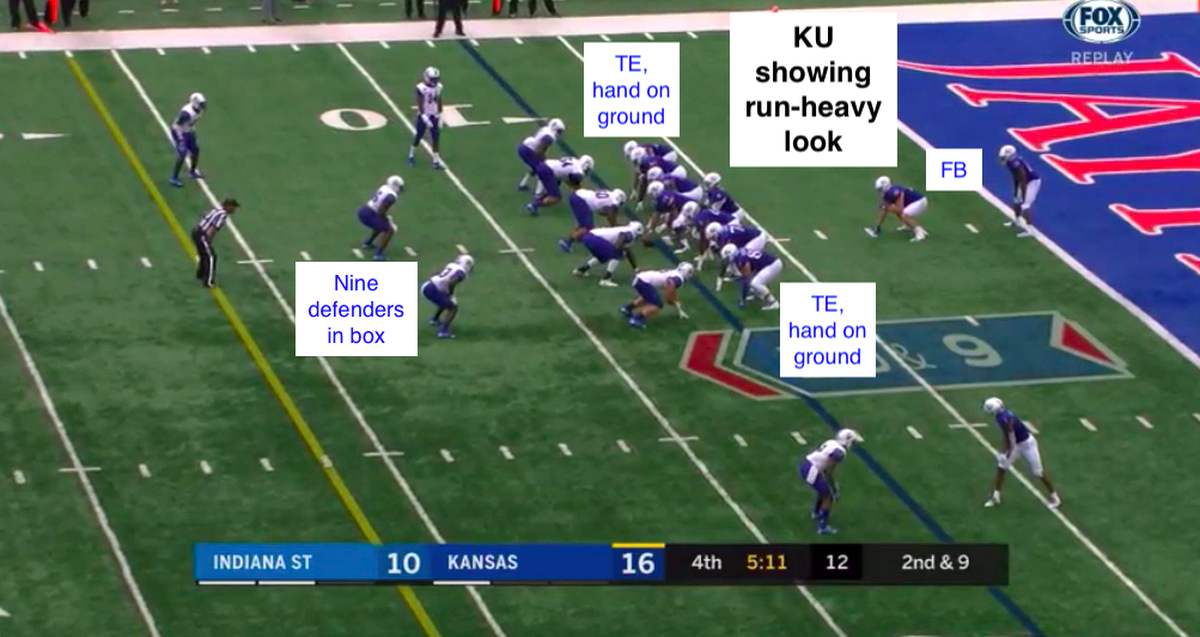
Indiana State counters this as one might expect. Not only does the defense have nine players in the box to stop the run, but it also sends a run blitzer from the top of the screen; this may have been called by the coaching staff, or it could have also been a defensive check triggered by this particular formation from KU.
In any case ... this well-timed blitz by Indiana State gives KU little chance at success. The Jayhawks get some good blocks — right tackle Clyde McCauley in particular clears some space — but it’s all for naught because Indiana State brings one more defender than KU can block. The only possible hope is fullback Ben Miles seeing the blitzer at the last second, but truthfully, that’s a lot to ask him to diagnose in real time.
KU’s receiver at the bottom — Parchment — also is blocking, so there doesn’t appear to be a post-snap pass option.
“Corner blitz off the edge. For the linemen, that’s really hard to account for,” Stanley said. “You can see our end man on the line of scrimmage is (Jack Luavasa), and he’s doing his best. He blocked his man, but that’s just an extra man than we can account for.
“I’m looking to see how we can get out of situations like that moving forward.”
Like the first play, the easiest way out was likely a pass. This defensive setup left Indiana State vulnerable on the outside, and if KU had the option of another playcall — a one-step throw by Stanley to Parchment for a slant, for example — it could have been in a better situation.
For the first week, though, KU was stuck to go against a schematic disadvantage — a bad place to be during one of the game’s most crucial moments.
Sack fumble, 4:32 left in fourth quarter
There’s not a way to sugarcoat here: This play is a mess from the start.
Because KU is facing third and long, Indiana State can get exotic with a blitz. Behind it, the defense is playing Cover 1, meaning there is man coverage with a single high safety.
This appears to be a tight end screen for James Sosinski, but even that wouldn’t be a great call against this particular defense. For running back and tight end screens, coaches usually want to go against zone coverage, as it’s easier to get defenders lost in space.
With one defender assigned to cover Sosinski, it appears that if Stanley throws this pass accurately, it could result in a pick-six with a man defender breaking on the ball.
“That play was just kind of unfortunate from start to finish and was, for whatever reason, we kind of had a lack of communication and it just turned into the play not being ran how we practice it,” Stanley said. “And so it just completely changed the look that we had, and it obviously didn’t help that they brought a blitz that heavy.
“At the end of the day, I was really just trying to throw it away and just get the ball out and you’ve got to be pretty quick, and it was unfortunate.”
The final result of the three plays: KU gave up the lead and needed a late comeback for the win.
I asked coach Les Miles on Monday about what he saw from film on the first two running plays above and about the desire to potentially seal the game at that point with physical football.
“That was certainly something we would have loved to have had happen, but the opponent made a good play,” Miles said. “We’re going to let that kind of stand. But that was the plan, and our guys certainly — they wanted that opportunity.”
Perhaps the biggest concerns for KU should be moving forward.
Indiana State will be the least talented team KU faces this season, and even then, it was able to stop the Jayhawks’ late runs with perfectly timed blitzes.
Maybe in the future Stanley will be more confident to throw the screen on first down. And perhaps, with more time, KU will give the quarterback an opportunity to check out of that run call on second down while facing a loaded box.
For this contest, though, KU’s offense stalled mostly because it lost a numbers game and couldn’t get itself out of a losing situation.
That’ll have to change quickly if KU wants to compete against better competition ahead.
This story was originally published September 3, 2019 at 4:11 PM.