Bishop Miege HS president Baniewicz fired: ‘In the best interest to move forward’ | Opinion
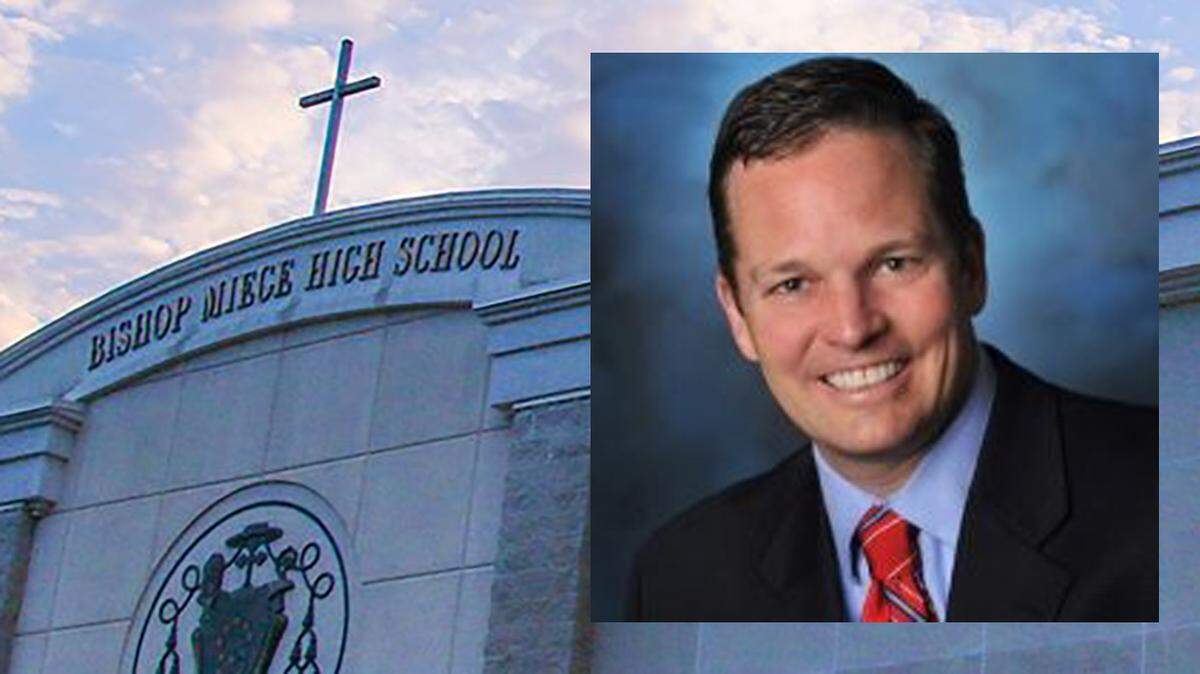
On Wednesday night, Bishop Miege High School announced that Wednesday had been Phil Baniewicz’s last day as president of the Catholic school in Roeland Park.
That this only happened a week before school starts again implies that the board did not want to do this, and that Baniewicz was fighting it; otherwise, of course, he would have resigned.
Baniewicz had been suspended since June 5, when the archdiocese announced that it was investigating “his ability to oversee a safe environment.” On June 16th, he was barred from ministry anywhere in the archdiocese, based on a new report of “inappropriate behavior with a minor.”
This was a different kind of report, a spokeswoman said, than those of the two women who have said that when they were students at Maur Hill-Mount Academy in Atchison, Kansas and Baniewicz was president there, he pulled them into highly traumatic and inappropriate closed-door one-on-one meetings to talk about their sexuality and question their purity.
Both civil authorities and an independent firm hired to investigate for the archdiocese continue their investigations. Baniewicz never responded to earlier requests for comment, and whenever he wants to change that, he can.
Katie Kincaid-Longhauser, a Miege graduate whose twin sister Kelly was abused by her Miege track coach, has been asking since Baniewicz was hired two years ago why the school and the diocese would take such a chance in hiring someone who had been accused of abusing a minor, even in the distant past.
Allegations of sexual talk with minors
He has always said he was wrongly accused, and may have been in the case of the young man who said Baniewicz sexually assaulted him, since that never went to court. But there is a lot more to the story, as I have written multiple times, including serious allegations of bringing young people into a highly sexualized environment — one where young people were grilled about their sexuality as a precursor to abuse.
In 1985, Baniewicz was accused of sexually assaulting a boy in the rectory of St. Timothy Catholic Church in Mesa, Arizona. No criminal charges were ever filed against him. The Diocese of Phoenix settled a 2005 civil suit against him and two priests for $100,000. Both priests accused in the suit pleaded guilty to different crimes involving minors.
On Thursday, Kincaid-Longhauser said that the most “thrilling” thing about Baniewicz’s ouster is that when someone from the archdiocese called to tell her about it on Wednesday night, that person said that how Baniewicz ever got hired in the first place is “one of the archbishop’s greatest concerns” and something that’s being investigated, too. Archbishop Shawn McKnight was installed on May 27.
“Finally, they’re prioritizing the safety of children,” Kincaid-Longhauser said, and are “actually going to evaluate the gatekeepers” instead of continuing to “put all of Miege students in front of a perpetrator and normalizer.” Up until now, she said, the school and archdiocese “not only said ‘this isn’t true’ but you normalized it.”
So now, with school starting, the Bishop Miege board has decided to “move forward” and will have no more to say about it, their announcement said. Kind of like how they had nothing to say about Baniewicz’s history when they hired him two years ago, until reporters asked about it.
Should anyone ask you about this, according to the announcement saying practically nothing, refer them right back to this announcement:
‘Confidential personnel matter, no further information’
“After careful consideration of the present circumstances, the board determined it is in the best interest of the BMHS community to move forward toward new leadership. Because this is a confidential personnel matter, no further information will be provided. The process of selecting a new president will begin soon, and the board expresses its gratitude to interim president Joseph Schramp for his leadership as the new school year begins.”
“As we move forward, we’re committed to strengthening Bishop Miege High School by reviewing our practices and continuing to ensure a safe environment for our students, the announcement said. “At the request of Archbishop McKnight, we’ll work with the archdiocesan Catholic Schools Office and the Office for Protection and Care to create opportunities for the school community to be heard and supported.”
That last part may sound like pro forma language, but it is not. I can’t say enough about how McKnight moved into this archdiocese and made clear on his literal Day 1 — that’s when the report that led to Baniewicz’s suspension came in — that such reports would from now on be taken seriously.
When Baniewicz was suspended from all ministry in June, McKnight said that was done “in the interest of promoting the common good, protecting the vulnerable, and pursuing the truth of the matters being investigated. The precautionary restrictions are no indication of guilt or wrongdoing” but would remain in place until all investigations were over. Those closest to those probes say that probably won’t happen soon.
There is no record of a similar report about Baniewicz sent by post more than a year ago ever having been received by McKnight’s long-serving predecessor, Archbishop Joseph Naumann, to whom it was addressed. Maybe it did get lost in the mail; such things have happened. But those reporting feel their messages are much less likely to go awry now.
Parker Valdez, who sent that letter a year ago, said in a statement that “The removal of Phil Baniewicz as president of Bishop Miege is a necessary and long-overdue step in the right direction. But this is only the beginning. The harm he has caused is lasting, and there are still many survivors, including myself, who are actively working to heal from what we experienced.”
She also said that Baniewicz’s name should be removed from the baseball field at her alma mater, Maur Hill-Mount Academy, since “honoring him in any way is a disservice to those he harmed. Survivors deserve justice, not reminders of what they endured every time they walk past a monument to their abuser. This is about more than one man — it’s about an entire system that needs to change. There’s still a long way to go, but I believe change is coming.”
So do I.
Called accuser
Taylor Kelsey, another of those former Maur Hill students who reported Baniewicz, said that Thursday is her birthday, “and this is my present.”
It bothers her, though, that Baniewicz had to be made to step down instead of resigning. After she let many diocesan and school officials, Baniewicz included, know that she was going to be filing a complaint, he called her, she said, and tried to convince her first that nothing had occurred and then that it hadn’t happened as she said.
Neither Kelsey nor Valdez accused Baniewicz of touching them, but physical boundaries aren’t the only ones that matter.
On Thursday, she said that “He was aware of the risk he posed because when he called me, he said, ‘I’ve been so careful here at Bishop Miege.’ My hope is that he doesn’t have to be careful anywhere else.”
This story was originally published August 7, 2025 at 9:02 AM.