KCK archdiocese bars Miege president from all ministry, based on new complaint | Opinion
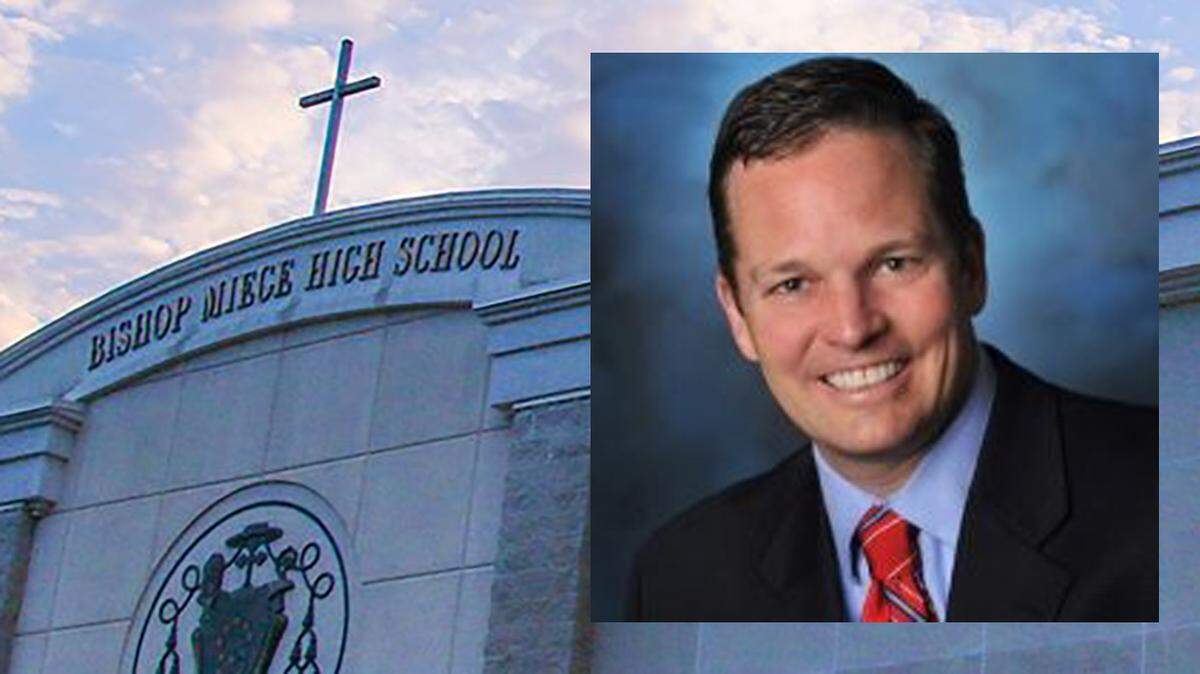
Phil Baniewicz, the already suspended president of Bishop Miege High School in Roeland Park, Kansas has as of Tuesday been barred from ministry anywhere in the archdiocese, based on a new report of “inappropriate behavior with a minor.”
This is a different kind of report, a spokeswoman said, than those of the two women who have said that when they were students at Maur Hill and he was president there, he pulled them into highly traumatic and inappropriate closed-door one-on-one meetings to talk about their sexuality and question their purity.
Neither of these women has accused Baniewicz of touching her. He was suspended on June 5 while the archdiocese investigates “his ability to oversee a safe environment.” The spokeswoman for the archdiocese said she couldn’t be any more specific about what the new report does or does not involve.
Archdiocese statement
This is the announcement released by the archdiocese on Tuesday:
“On June 17, 2025, the Archdiocese of Kansas City in Kansas announced that Phil Baniewicz is restricted from all active ministry in the Archdiocese of Kansas City in Kansas due to an allegation of inappropriate behavior with a minor. These restrictions are based on previously unknown information, which has not been released in public media, provided to the archdiocese after the June 6 announcement that he was placed on administrative leave at Bishop Miege High School. This information has been reported to civil authorities.
Mr. Baniewicz is prohibited from engaging in youth ministry and volunteer work in any Catholic parish, school, institution or event in the Archdiocese of Kansas City in Kansas. He is to refrain from representing the Church in any official, volunteer, ministerial, or leadership role. This includes participation in Life Teen, a Catholic youth ministry. In addition, Mr. Baniewicz has signed an archdiocesan safety plan which states he agrees not to contact anyone known to have made an accusation of abuse or misconduct against him, or who may be a witness known to him.
This action has been taken “in the interest of promoting the common good, protecting the vulnerable, and pursuing the truth of the matters being investigated,” Archbishop McKnight stated.
The restrictions are imposed for the duration of the ongoing preliminary investigation and through any subsequent process conducted in the Church’s judicial system.
These precautionary measures are no indication of guilt or wrongdoing.
The archdiocese will provide no further information regarding the investigation until it is concluded.”
‘Hopefully he won’t call me again’
Taylor Kelsey, the woman whose complaint about Baniewicz’s behavior at Maur Hill is part of what led to his suspension, said that a day after she emailed many officials in the diocese, Baniewicz included, to let them know that she would be doing so, Baniewicz called her. She said he initially told her that no such meeting ever occurred, and then that it did, but that he had never come around to sit on the same side of his desk, as she had said he did.
On Tuesday, Kelsey said that the fact he’s now been banned from all ministry in the archdiocese “is a great step in the right direction, and I hope they release more information. He can still use his free choice, and hopefully he won’t call me again.”
Parker Valdez, who told her similar story more than a year ago, and sent a letter to Archbishop Joseph Naumann about what had happened to her, told me on Tuesday that she sees this new step as “an indication of their dedication to hearing the voices of survivors. It definitely shows they’re taking allegations seriously, and I hope this would empower” other victims to come forward. The archdiocese said they have no record that Naumann ever received the letter from Valdez, but church officials in any case knew of its contents, which were outlined in my story in April of 2024.
A victims’ advocate for the archdiocese told Valdez on Tuesday that there would now be an independent investigation, and that gave her hope, too: “I think it’s good they’re looking outside the archdiocese. It displays their commitment to truth and impartiality and really getting down to reform. For a long time, the church has displayed more covering up, and Archbishop McKnight seems to really want to change it around.”
Katie Kincaid-Longhauser, a Miege graduate whose twin sister Kelly was abused by her Miege track coach, said when Baniewicz was hired two years ago that he “would never get hired in a public school.” She has been asking all this time why the school and the diocese would take such a chance in hiring someone with his history. On Tuesday, she that after waiting so long for some action to be taken, what’s happened over the last couple of weeks is almost “surreal.”
“I am relieved and grateful,” she said. “Praise God that concerns about youth safety are being taken seriously. The new leadership and tone is refreshing, and gives me great hope. Archbishop McKnight and his leadership is an answered prayer.”
Baniewicz history
In 1985, Baniewicz was accused of sexually assaulting a boy in the rectory of St. Timothy Catholic Church in Mesa, Arizona. No criminal charges were ever filed against him. The Diocese of Phoenix settled a 2005 civil suit against him and two priests for $100,000.
Both priests accused in the suit pleaded guilty to different crimes involving minors.
One of them, former Father Mark Lehman, is a convicted pedophile who served 10 years in prison for the sexual abuse of a girl at St. Thomas the Apostle Roman Catholic School in Phoenix. He was also sentenced to lifetime parole for the sexual abuse of three other girls and one boy.
The other man accused in that civil suit, former Monsignor Dale Fushek, describes Baniewicz as “like a son to me” in his memoir, and together, the two men founded a popular charismatic program called Life Teen, in which Baniewicz still participates. It’s having a conference at Benedictine College in Atchison later this month.
Fushek was accused of fondling seven boys and young men and was initially charged with three counts of assault, five counts of contributing to the delinquency of a minor and two counts of indecent exposure. After one of Fushek’s alleged victims died, he took the plea deal offered by prosecutors and avoided five separate trials by pleading guilty to a single count of misdemeanor assault. The Maricopa County Attorney, Andrew Thomas, said at the time that he couldn’t believe that the crimes in question weren’t felonies.
Fushek’s indictment said that between 1984 and 1994, he fondled boys, walked around naked in front of them, invited one into his bed and asked another to join him naked in a hot tub. Prosecutors also said Fushek conducted “sham confessions” in which he asked question after question about the sex lives of boys for his own gratification.
My main question a year ago, to officials and in print, was whether, in focusing solely on whether Baniewicz had sexually abused a 14-year-old boy in 1985, they had ignored other concerns. Like, for instance, the potential failure to protect others from the highly sexualized environment that, according to a criminal indictment and news accounts, he’d been bringing kids into in Arizona all those years ago. Was he keeping kids safe in all ways?
That question is in the process of being answered now. And like the women who reported Baniewicz for asking question after question about their sex lives, I see that as a positive step for them personally, as well as for student safety and for the church.
This story was originally published June 17, 2025 at 9:05 AM.