Will redistricting end Cleaver’s 47 years in office? Don’t count him out | Opinion
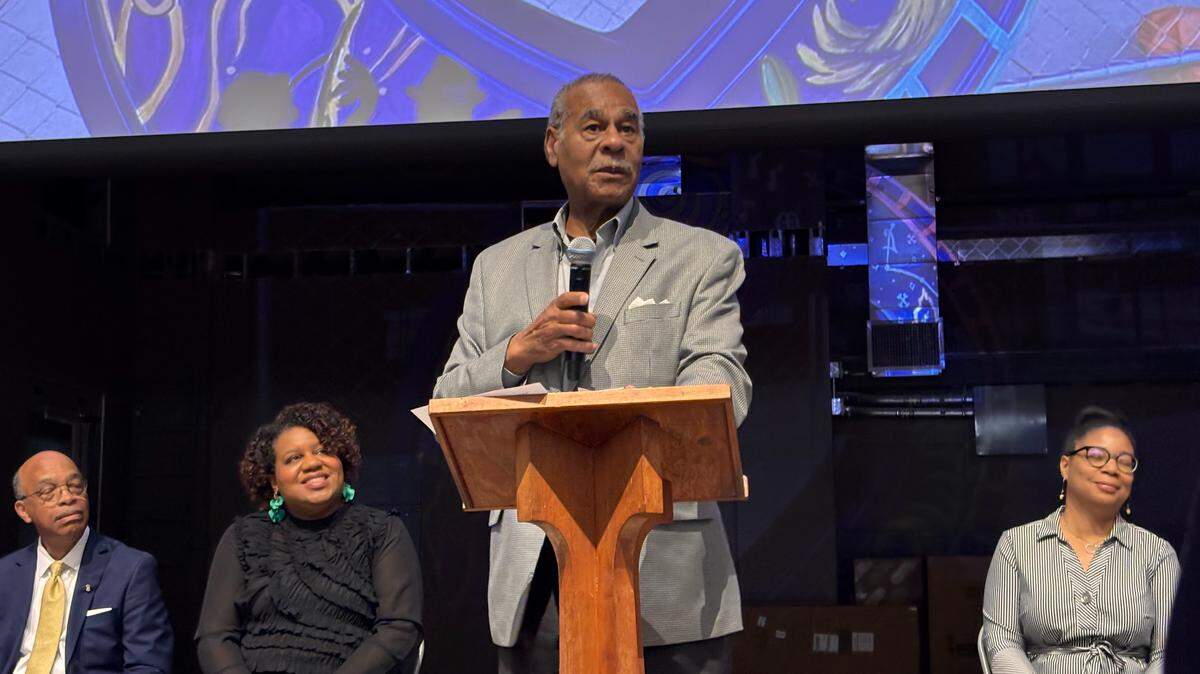
At a recent event celebrating the reopening of the historic Boone Theater in Kansas City’s redeveloped historic 18th & Vine Jazz District, U.S. Rep. Emanuel Cleaver II stepped to the podium to congratulate the civic leaders, city officials, philanthropists and developers who had come together over the years to make the moment a reality.
What he didn’t do was praise himself for initiating and driving the vision that this district could become the Kansas City gem and point of pride it is today — not only for the city’s Black community, but for the city as a whole.
But of course, gratitude was indeed extended to the 5th District congressman from others who spoke that afternoon, reminding the audience that it was Cleaver who in 1989, as Kansas City mayor, first presented a vision for a redeveloped jazz district. He championed that project — 40 years in the making — because he believed not only that it was a way to preserve Kansas City’s rich cultural history and launch economic development on the predominantly Black East Side — but also he saw it as a unifying catalyst for the whole city.
“If people understand our history, they will want to come partake of it and keep it alive,” Cleaver said at the time. And he was right about that. The Boone Theater opening was proof.
After a local and national political career spanning nearly 50 years, Cleaver’s future in the political arena might be in jeopardy for the first time. His position is under attack by a Republican-pushed ploy to claim his seat in the U.S. House of Representatives through a controversial gerrymandered congressional map that chops up and stretches Missouri’s 5th Congressional District, which Cleaver has represented for over two decades.
On Tuesday, the Missouri Supreme Court upheld the state’s new district map, setting up a path to split Kansas City’s longtime Democratic-heavy district into three separate districts, diluting the Democratic vote ahead of the 2026 elections.
Newly redistricted congressional map
We don’t know yet whether Cleaver, who is running unopposed in the August primary, will face a Republican challenger in November under the old district map or the newly redistricted map. There’s still a lot of wrangling at play.
We do know that chopping up the district was clearly aimed at pushing Cleaver out of his seat. Still, some say not to count out the possibility that the longtime trusted, steady and diplomatic preacher turned Democratic lawmaker can pull off a victory regardless of the political — but clearly legal — Jefferson City shenanigans intended to stop him.
Pulling people together has always been one of Cleaver’s superpowers, and it’s why, in part, the iconic late Joseph Lowery tapped Cleaver in 1968 to start a chapter of the Southern Christian Leadership Conference in Kansas City.
“He was the man,” said the Rev. Vernon P. Howard Jr., who is president of SCLC of Greater Kansas City today.
But, Howard said, Cleaver’s ability to unify is not what has been his greatest attribute for political success. What has led people across Kansas City and the surrounding area to vote the congressman into public office over and over again for nearly 50 years is that “he embodies what it means to be a public servant,” Howard said. “The people know this. And his message has always been the same: ‘Let justice roll down like water and righteousness like a mighty stream.’”
.JPG "ROLL CALL(3).JPG")
First Black Kansas City mayor
Cleaver officially entered Kansas City politics in 1979 when he was first elected to the City Council. After 12 years on the council, in 1991, he was elected the city’s first Black mayor. He won two terms, serving until 1999. Cleaver was elected to the U.S. House of Representatives for the first time in 2005 and reelected to the post 11 consecutive times.
As a city councilman and mayor, Cleaver had big success.
He kept the city calm during Kansas City’s landmark school desegregation litigation that stretched from 1977 to 2003. He became known for the Cleaver Plan, a $114 million urban revitalization and redevelopment initiative that included the 18th & Vine Jazz District, flood control and beautification along Brush Creek, a new American Royal arena, and repairs to the Broadway Bridge, later renamed the Buck O’Neil Bridge.
Mickey Dean, a longtime resident of Kansas City and an independent voter, said he believes people have returned Cleaver to office time after time because he brings home money to the district. “He has delivered for his district and that’s what people care about,” Dean said. “You have got to take care of your district. He does that and nobody can criticize him for that.”
In 2024, Cleaver announced nearly $19 million for the 5th District to fund public safety, economic development, and infrastructure initiatives.
And as recently as February, he secured more than $15 million for projects in cities and towns all across the district, including in Grandview, Lee’s Summit and North Kansas City.
Poorest member of Congress
His popularity may also have something to do with the amount of time Cleaver spends in his district. He’s in town from Washington, D.C., a lot. I’ve seen him at public meetings, community discussions, local rallies and marches.
A couple years ago, I ran into the congressman strolling the aisle of an Independence thrift store, which I learned is a favorite pastime of his. After he and I chatted briefly, I watched other shoppers approach him for a handshake and conversation, which he obliged.
Lest you think that Cleaver went to Congress to fill his bank account, know that The Star in 2015 described Cleaver as “one of the poorest members” of all 435 in the U.S. House of Representatives. At that time, his estimated net worth was a negative $2.5 million, because of a debt incurred from a failed car wash he’d bought for one of his children. His 2024 personal finance disclosures (the most recent on file) show he still carried a debt of between $1 million and $5 million connected to the car wash loss.
Cleaver chuckled when I asked about the debt. “I don’t get joy out of being broke,” he said. “But I also don’t think you are supposed to become wealthier by being a pastor or by going into public office. I have a bill right now prohibiting members of Congress from delving into the stock market.” He added that he’s pretty sure most of his colleagues won’t support the measure.
“But even before the car wash, Cleaver was never independently wealthy, never,” said Dave Helling, a longtime political writer and retired Kansas City Star columnist who covered Cleaver closely during his time as the city’s mayor.
Helling, who still writes about the congressman at Kansas City Stack, said Cleaver’s financial woes worked more in his favor than against him. “It did give him some greater appreciation for the financial struggles of everyday Missourians,” Helling said.
‘Tear in the fabric of our democracy’
The 81-year-old congressman was born in Waxahachie, Texas, but raised in public housing in Wichita Falls, Texas. So yeah, he knows something about struggle.
Cleaver came to Kansas City after graduating from Prairie View A&M University and received a master’s degree in divinity from St. Paul School of Theology.
He was pastor at Kansas City’s St. James United Methodist Church from 1972 to 2009 and became one of city’s most popular preachers, known for his clever turn of phrase and his civil rights and social justice activism — and he earned citywide admiration.
There is something to say for his having spent so many years in the political arena without personal scandal — especially at a time when nastiness, name-calling, disgrace and plain incivility are highly prominent features of today’s political climate.
Cleaver said he is worried about the redistricting situation in Missouri because he sees it as “another tear in the fabric of our democracy, and I don’t know how much longer we can take this.” But he’s not so worried that it means a sure win for the Republicans coming after his seat.
He intends to spend time doing what people say he’s good at: talking to folks and getting to know new constituents.
Of the opposing party, Cleaver said: “Maybe they are banking on people voting 100% according to race. But that’s not a reality here anymore.”
The fact that Cleaver has never lost an election in his diverse city and congressional district proves that. So if this gerrymandering game Missouri Republicans are playing has to be tested, maybe Emanuel Cleaver is the best candidate for Democrats to bank on.
This story was originally published May 15, 2026 at 5:04 AM.