Kansas City Catholics come together to heal racial wounds. Can other churches follow?
News flash: Conversations about race and racial injustices will not be silenced in Kansas City.
While Republican lawmakers in Missouri and Kansas push legislation that would muzzle schools from teaching children about racism and its impact on all people and aspects of life in America, churches are firing up the conversation.
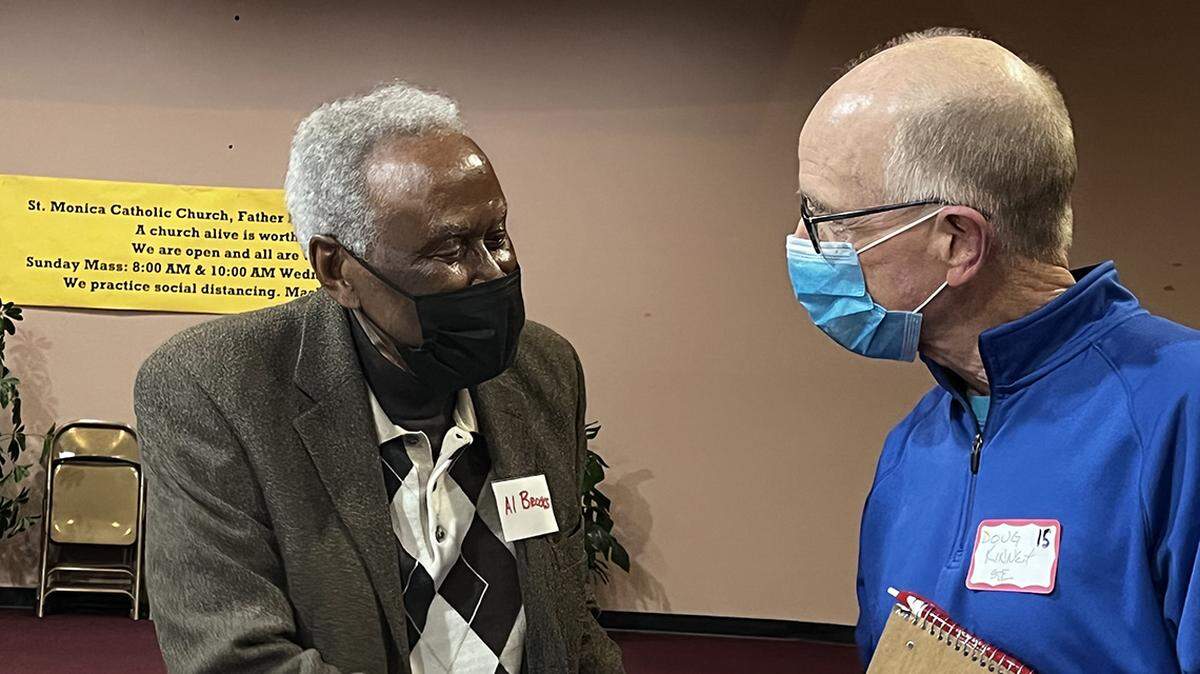
Thursday night, St. Monica, a largely Black Catholic Church on Kansas City’s East Side, and Visitation, a mostly white Catholic church near the Country Club Plaza, partnered to host a discussion on racial justice. The churches invited congregants from other parishes around town and the general public to join.
About 150 people filled St. Monica’s fellowship hall and found places at 19 tables, each seating a diverse group. Folks then were presented with three questions designed to generate talk about race. And it worked. Of course those who came had some idea in advance what they had signed up for and were willing to listen and engage.
One of Kansas City’s best-known civic leaders, Alvin Brooks — who turns 90 next month — got things started by talking about his recently published book, “Binding Us Together: A Civil Rights Activist Reflects on a Lifetime of Community and Public Service. ” Brooks asked everyone to consider this question: “What prohibits us from being bound together as a race?” Like it or not, he said, “We are brothers and sisters. … Don’t you think it’s time we act like it?”
And that was the overarching theme of the evening for Black and white attendees, many of whom came into the room as strangers. They got to know each other by sharing stories about how they grew up, raised their children and experienced racism or racial tensions in the community.
Teresa Albright, a pastoral associate at Visitation, recalled one Black man’s story about the racism he experienced as a U.S. soldier serving in Korea. “He said our white soldiers brought racism with them to Korea — they exported it,” Albright said. The man told one story of being beaten up by fellow soldiers who were white, and another about how a Korean woman asked him if he had a tail because that’s what she’d been told by white soldiers. An older man told a story closer to home about his Black family attending a predominantly white Catholic church in Kansas City and him remembering being made to take communion at the back door.
Since the events of 2020 when the murder of George Floyd by a white police officer set off anti-racism protests around the country, white congregants at Visitation have been hungry to hear personal stories and to have one-on-one conversations with Black churchgoers — talks needed for change to happen, Albright said.
Discussions on history under fire in public schools
Visitation’s racial justice committee formed from Visitation School parents “wanting to make sure their kids learn the history of racism in our country,” Albright said.
Sadly, opportunities for these kinds of racial discussions are under attack in public schools. Lawmakers in Kansas and Missouri have proposed legislation to ban teaching about issues of diversity and the role of racism in American history. Such learning is being falsely labeled as “critical race theory,” a concept that arose in higher education but has become a Republican catchphrase for denouncing discussions of racism or the history of U.S. race relations in primary or secondary schools.
Brooks was pleased so many showed up to Thursday night’s event. “I thought it was a good beginning for a dialogue that has not taken place since the riots of 1968, when the bishop at the time (Charles Herman Helmsing) set up social active committees, but there wasn’t a lot of participation,” Brooks said. “We’ve come a ways.”
Thursday night’s organizers want to see the conversations happening among the city’s Catholic congregations to become a movement that extends beyond their own church chapels and fellowship halls.
“The end goal is for us to … spread what we learn,” Albright said. A second similar gathering is being planned to occur in three months.
Kansas City Catholics have started something that needs to grow. Other area churches from all denominations should partner up — Black churches with white churches — for similar conversations.
After all, you can’t learn unless you open your ears.
“If we are serious about bridging the racial divide,” Brooks said, “we have to educate. What better way to start than with the church?”
After all, it is the church that has served, for Black people at least, a key role in the struggle for racial justice. A fight that continues to this day.
This story was originally published March 29, 2022 at 5:00 AM.