Missouri’s Lake of the Ozarks confronts growing pains, rising crime during tourism surge
READ MORE
Growing pains in Lake of the Ozarks
Lake of the Ozarks, Missouri, has experienced record numbers of tourists in recent years. The crowds of visitors, along with the booming population that has strained other resources, have left local law enforcement busier than ever.
Expand All

When he started as a rookie Camden County deputy over 30 years ago, Tony Helms would play solitaire as he struggled to stay awake on sleepy weekend overnight shifts.
But those days are long gone at the Lake of the Ozarks, which has experienced record numbers of tourists in recent years. The crowds of visitors, along with the booming population that has strained other resources, have left local law enforcement busier than ever.
For example: Helms, who is now the sheriff, recalls the moment last Memorial Day weekend when dispatch notified him about a shooting at Shady Gators, a huge lakeside bar. At the time, he was with three officers searching for someone in Climax Springs, about as far away as you can get in the county limits. He and the others quickly headed toward the bar. But on their way, the other deputies all got called off to respond to unrelated domestic disturbances and fights.
“There were so many calls for service going on the whole night up until about 5 o’clock in the morning,” he said. “It never stops. So you are constantly catching up.”
While shootings are still rare at the lake, the sheriff says the hustle of that night is commonplace as deputies struggle to respond to ever increasing calls for service. His 147-bed county jail frequently runs at capacity in the summertime.
The lake has always been a popular tourist destination, but it has experienced tremendous growth in the last two years. Helms believes population and visitors increased too quickly for local governments to keep up.
“My friend, it is different. When I started here, I never dreamed anything like this was happening. I was a simple sheriff in what I thought was a small county — it’s not,” Helms said. “It’s not just law enforcement. We’re totally behind the curve…The problem was we grew so fast that we’re behind.”
Since the lake went viral in the spring of 2020 for spurning pandemic restrictions, locals have welcomed record crowds. The growth has come at a cost, though.
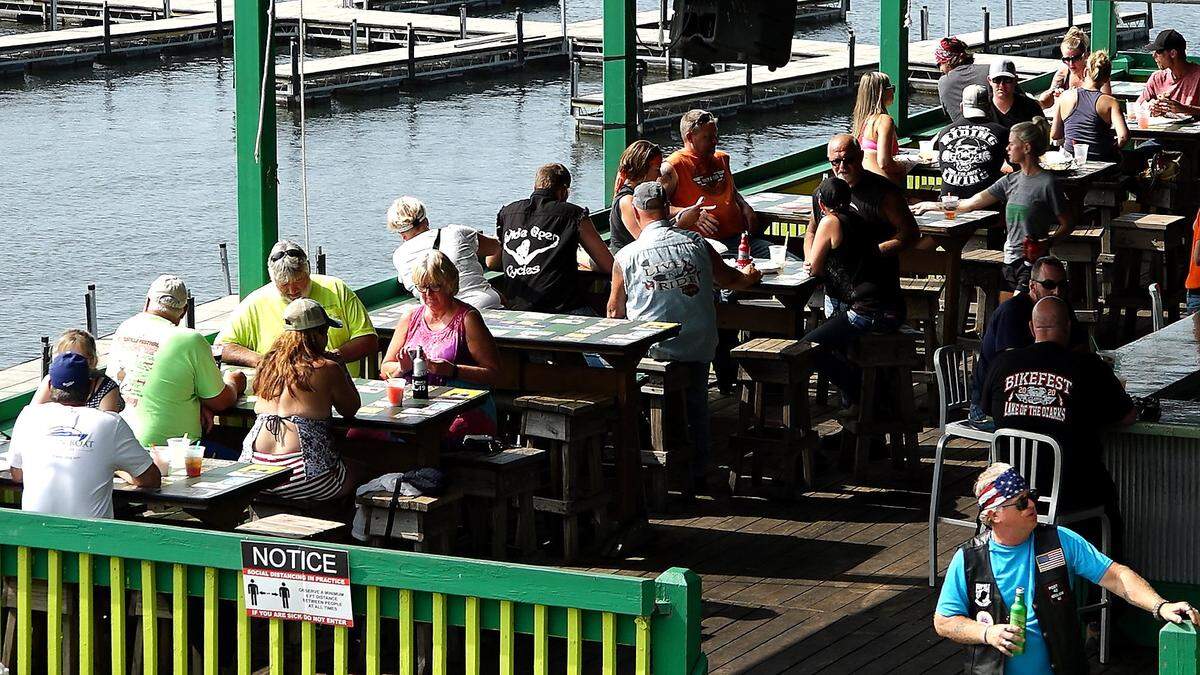
Crime is rising in some areas — felony cases in Camden County increased 300% in the last seven years. Locals complain of congestion on the roads and in the grocery stores. There aren’t enough workers to staff all the new businesses, let alone enough places for those workers to live. And some are beginning to worry that the infrastructure just wasn’t built for the sort of boom the lake is currently enjoying.
Still, leaders like Helms wouldn’t have it any other way in this part of Missouri that survives on sales taxes.
“Bring them on,” he said. “If I didn’t have the visitors coming to my lake, I wouldn’t need the help. It’s kind of a trade off.”
The sheriff is adamant that crime is not out of hand. Visitors are still safe here, he said. It’s just that crime is rising alongside the population and numbers of tourists.
But it’s still taxing on the sheriff’s office, which is the largest local law enforcement agency at the lake.
When Helms started, his office had no professional investigators. “You catch ‘em, you clean ‘em,” is how he described the role of deputy back then. And up until this year, starting deputy pay was around $26,000 per year.
Last year, Camden County voters approved a sales tax increase to improve the pay and numbers of deputies on staff. Helms is ecstatic about that, but applications have been slow. So even with new funds, he doesn’t expect to have a significant increase in officers on the street at the beginning of this year’s busy summer season.
“I don’t know how I’m going to do it,” he said.
When Rick Bryant first considered moving to the lake from southeast Iowa 17 years ago, he started by buying a local newspaper. He perused the crime reports, seeing only a few property crimes and misdemeanors.
“I thought, wow it’s a sleepy place,” he said. “It’s not the same.”
Bryant, who runs an auction company, said he’s increasingly concerned about crime at the lake. Especially last year’s high-profile violent crimes like the fatal shooting at Shady Gators and a shootout in Lake Ozark between rival motorcycle gangs.
“It worries the hell out of me,” he said. “I want to go to Walmart and leave my keys in the car. I don’t want that to change.”
Like others here, Bryant doesn’t believe crime is run amuck. Rather, it’s an organic consequence of a growing population. While it bothers him, he is reassured that crime is still relatively low considering the millions of travelers who come to the area each year.
“How do you pour 15 million people into a little community like this and expect everybody to love each other?” he said.
Some locals have blamed increasing crime on outsiders who bring drugs, weapons and problems with them on their lake getaways. But Bryant noted that locals are also making headlines. Last July, the deadly shootout on the Bagnell Dam strip involved local members of the Galloping Gooses and Midwest Drifters motorcycle clubs.
“Some of this crime we can’t point fingers at other people,” he said. “It came from our backyard.”
While the 2020 Census was completed just before the boom at the lake, people like Bryant see other evidence that the population has increased. In the real estate side of his auction business, he hears story after story of people from as far as California, Canada and England that want to relocate to the scenic lake area he adores.
He cheers that growth, but worries that the cities and counties aren’t prepared to deal with the consequences of it. The roads are basically the same as they were five years ago, he said. He doesn’t hear local officials talk about upgrading basics like water mains. And all the housing that goes up starts at prices above $250,000 — way more than someone serving beers or burgers here can afford.
“There’s some lethargic, laid-back let-me-see-what’s-going-to-happen mentality. And I don’t get that,” he said. “I’m not anti-growth, but I think we’ve got to be careful we don’t grow too fast where we can’t provide services. And I truly believe we are headed there in a year or so.”
The COVID bump
The turning point for Lake of the Ozarks came in May 2020 as many Americans were hunkered down in the earliest months of the coronavirus pandemic.
Kansas City, like countless other cities, was under a stay-at-home order. But on Memorial Day weekend, the pool at lakeside bar Backwater Jacks was packed with partiers.
Celebrity gossip site TMZ kicked off a string of national coverage by declaring it a “wild ozark lake party.” Despite an onslaught of negative press, local leaders defended their decisions to keep businesses open while many others across the country were limiting crowds or closed down altogether.
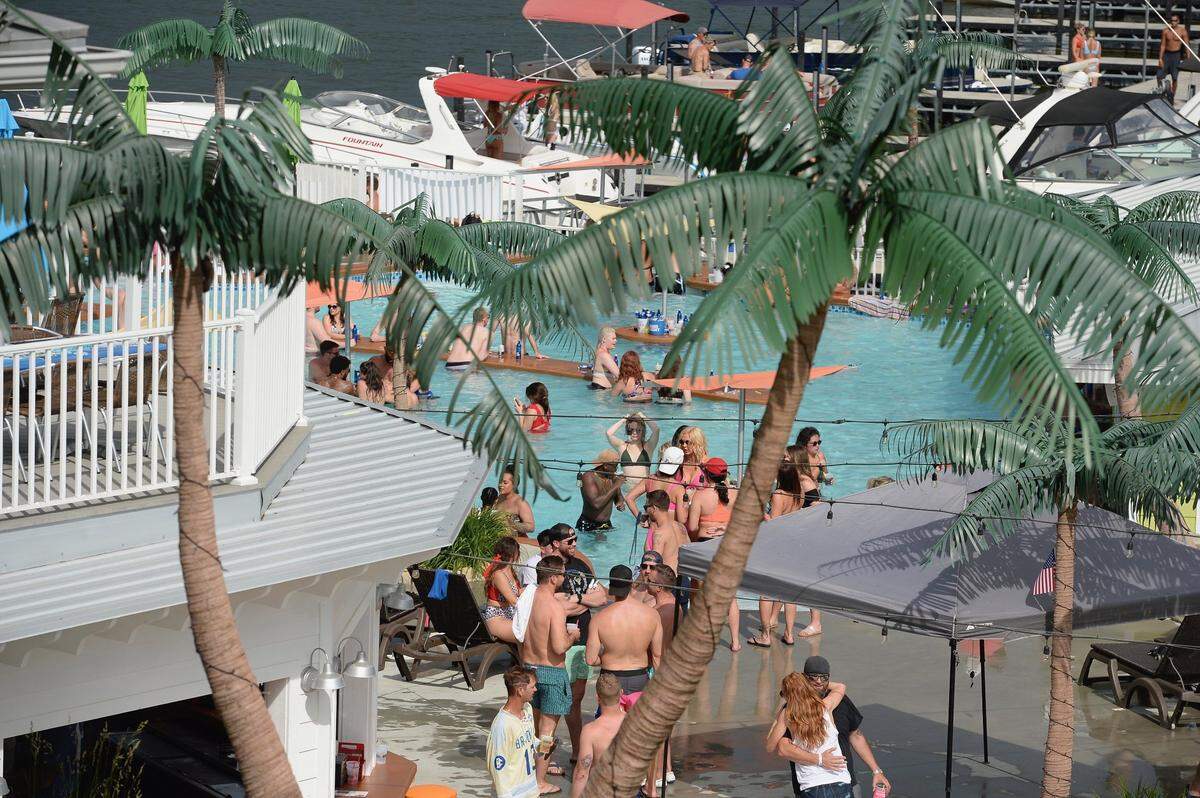
That set off a record summer as those sick of Covid restrictions flocked to the lake, some for a weekend, others full-time. No public data exists for tourism at the lake, but officials have estimated as many as 15 or 16 million people now visit the area each year.
“2020 was the record economy in the history of the lake,” said Camden County Presiding Commissioner Greg Hasty. “Then in 2021 we beat that by 19 percent. We’re working on our third record year in a row — not just by a little, but by a lot.”
That’s based on sales tax collections in Camden County. Between 2019 and 2020, sales tax revenue increased from about $4.7 million to $4.93 million. In 2021, collections reached nearly $5.9 million.
“I’ve talked to dozens of businesses who have all said they’ve had the best two years in their history,” he said. “We’ve kind of hit a critical mass at the Lake of the Ozarks where an avalanche of people are moving to us because they want what we’ve got.”
A transplant from Kansas City, Jim Bascue started his Playin Hooky Water Taxis & Charters 12 years ago and has been expanding the business since. The company offers water taxi services and barhop cruises. This season, he’s added a 55-foot offshore boat that can hold 45 passengers.
“This is a party lake,” he said. “People come down here to have a good time.”
But he’s not seen an unusual number of problems. Companies like his allow people to drink on the water and move between party hotspots without operating a boat or vehicle.
Rather, he notices all the new development popping up around the area: A racetrack just opened. A casino is in the works.
“We’re getting more and more attention so more things are coming in. So it kind of builds on itself,” he said. “It’s kind of a snowball.”
Rising crime rates
For years, Party Cove was the hotspot at Lake of the Ozarks. But that’s changed with increased water enforcement and the proliferation of lakeside bars and clubs.
“Party Cove is not what it was in the ’90s when it was in Playboy and things like that,” said Caleb Cunningham, the Camden County prosecutor. “It’s just not as prevalent or as popular with the current group that we have.”
Missouri Highway Patrol data show the number of incidents on the water has been declining in recent years. In 2019, water patrol officers issued 307 citations and more than 3,500 warnings. Last year, they only wrote 153 citations and 2,120 warnings.
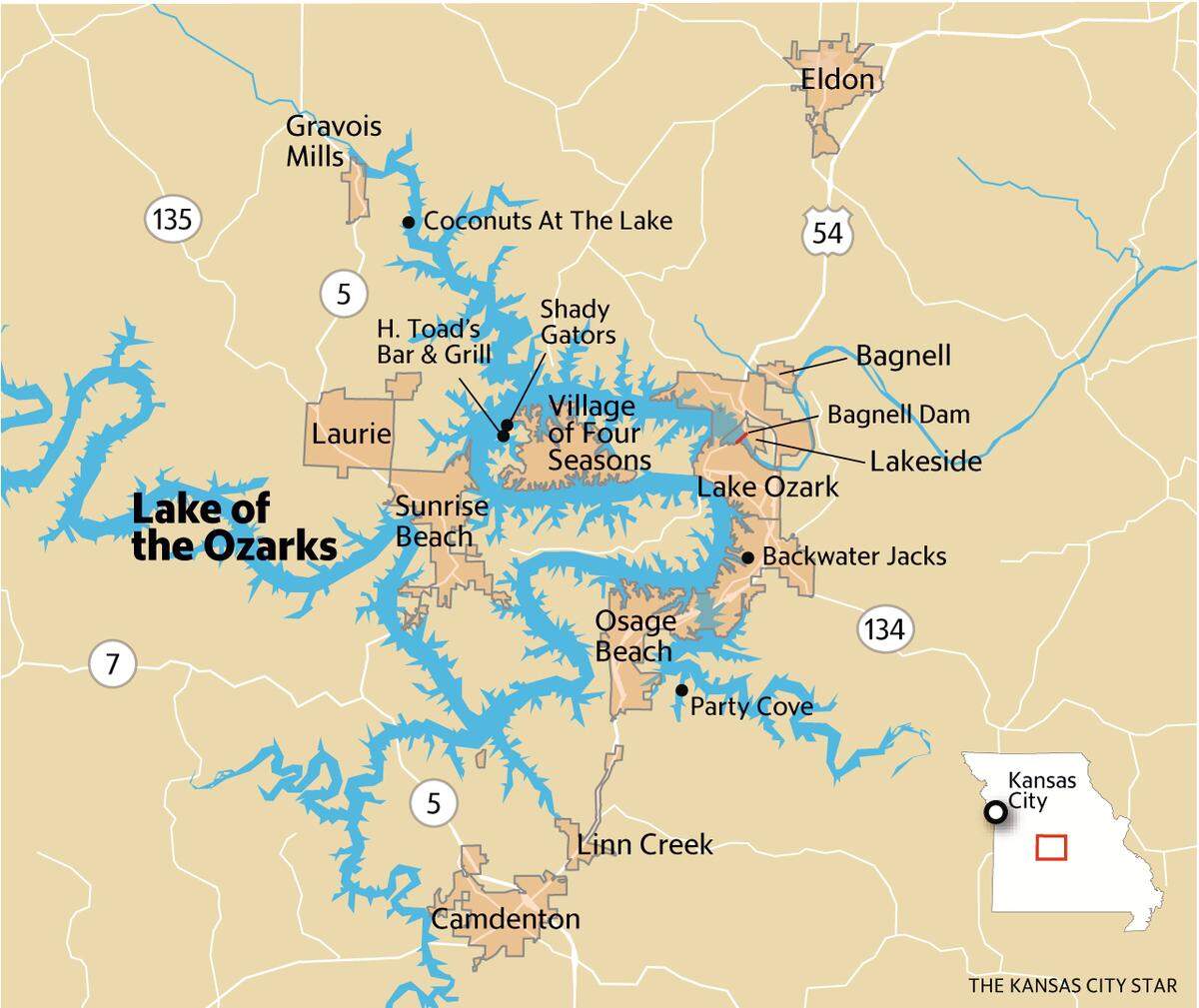
Instead, the partiers flock to places like Backwater Jacks, Coconuts and Shady Gators. By far the biggest challenge to law enforcement is the uber-popular Shady Gators, a double-decker bar and grill with an adjoining entertainment venue. That complex, which includes two swim-up bars and an amphitheater, can pack in thousands for weekend concerts and parties.
The sheriff says the bar owners have been cooperative, both with last year’s shooting and with improving regular security. The bar uses metal detectors and wands when customers arrive. They’ve increased security cameras and lighting outside the venue. And they pay two off-duty deputies $50 an hour to work security outside in addition to their own security staff inside the venue.
Shady Gators sits at the bottom of a narrow, steep road off of Bittersweet Road not far from the Village of Four Seasons complex. When the place shuts down at night, customers walk up the steep hill to catch shuttle buses, Ubers or taxis in a ritual that local law enforcement officers have dubbed the “zombie walk.”
“When they close the place, it’s done. There’s no lingering,” the sheriff said. “They push everybody out. So you’ve got 2,000 people walking up that hill.”
On May 29 of last year, deputies responded to that complex after receiving a report of a shooting just before 11 p.m. Helms said the venue was packed with thousands of people when Vonza Watson, a 27-year-old aspiring hip hop and visual artist who lived in Kansas City, was shot in the abdomen.
Based on witness interviews, officers quickly apprehended Chad Brewer, a Jefferson City man who is charged with first-degree murder.
During an April preliminary hearing in Camdenton, officers said the two men got into some kind of altercation at the bar. Cunningham then played video of the shooting shot by an uninvolved witness. A Kansas City man testified that he was taking video of the party to post on Snapchat but didn’t realize he captured the shooting.
While it was one of the most high-profile crimes to occur at the lake last year, Cunningham said these sorts of events are still rare. Since 1999, Camden County has usually seen at least one homicide case per year. Those numbers spiked from one in 2020 to five last year, though four of those were felony murder charges against drug dealers in overdose cases.
Drugs continue to plague lake area residents and visitors. As of late, officers have seen users mixing fentanyl with methamphetamine in a concoction known as “beans.” Similar to the cocaine and heroin speedballs in the 1980s, it contains a stimulant and a depressant.
“But this is meth and fentanyl,” Cunningham said. “So both ends are worse: the upper’s worse, the downer’s worse, the fatality is almost guaranteed.”
The prosecutor’s office has seen its annual caseload of more than 4,000 rise by more than 1,000 cases in the last several years. Numbers provided by the office show felony cases have spiked from 301 in 2014 to 1,226 last year — an increase of more than 300%.
Some of the rise was because of state legislative changes regarding felony crimes. But Cunningham said much of it is attributed to the growing numbers of people in the county.
“When you consider it relative to the growth, it’s to be expected,” he said. “If anything, it’s probably lower when you look at the sheer number of tourists that we’ve had.”
Adjacent Miller County has seen a similar spike in cases.
“That’s partly because the lake is sort of a year-round place now,” said Miller County Prosecutor Ben Winfrey. “In other words, I don’t even notice a big fluctuation when summer gets here. You would think there would be a big increase in the summer but the lake is a year-round destination now.”
Miller County also passed a new sales tax to increase law enforcement funding last year. But those dollars will only go to the sheriff’s office, not Winfrey’s office that investigates and prosecutes cases.
“All it means for me is more cases but fewer people to prosecute them,” he said.
Winfrey views the exploding tourism base as a natural driver of increased crime. But he said the effect of the drug epidemic can’t be underestimated, either.
“The lake’s always been a busy area because of methamphetamine and the drug epidemic. It has brought a lot of big city crime to us even before our recent growth,” he said. “I don’t know how or where you point the figure. It’s both growth in population and business, but also the drug epidemic continues to overwhelm small-town America.”
An evolving lake
Rocky Miller’s family has been in this area for nearly 200 years. Long before the Osage River was dammed, his ancestors settled here and founded Miller County.
So, he takes the long view when considering how the lake has evolved.
He’s watched clusters of fishing cabins give way to luxury vacation homes. He saw the proliferation of condominiums along the shore. In 1986, the outlet mall in Osage Beach ushered in a new era of restaurant, hotel and retail development. Then, a central sewer system that crosses city lines paved the way for even more development.
“Growth has always happened. We’ve made a living off of growth,” Miller said. “You know, some growth you worry about. But other growth you look at as just being the next piece of the pie.”
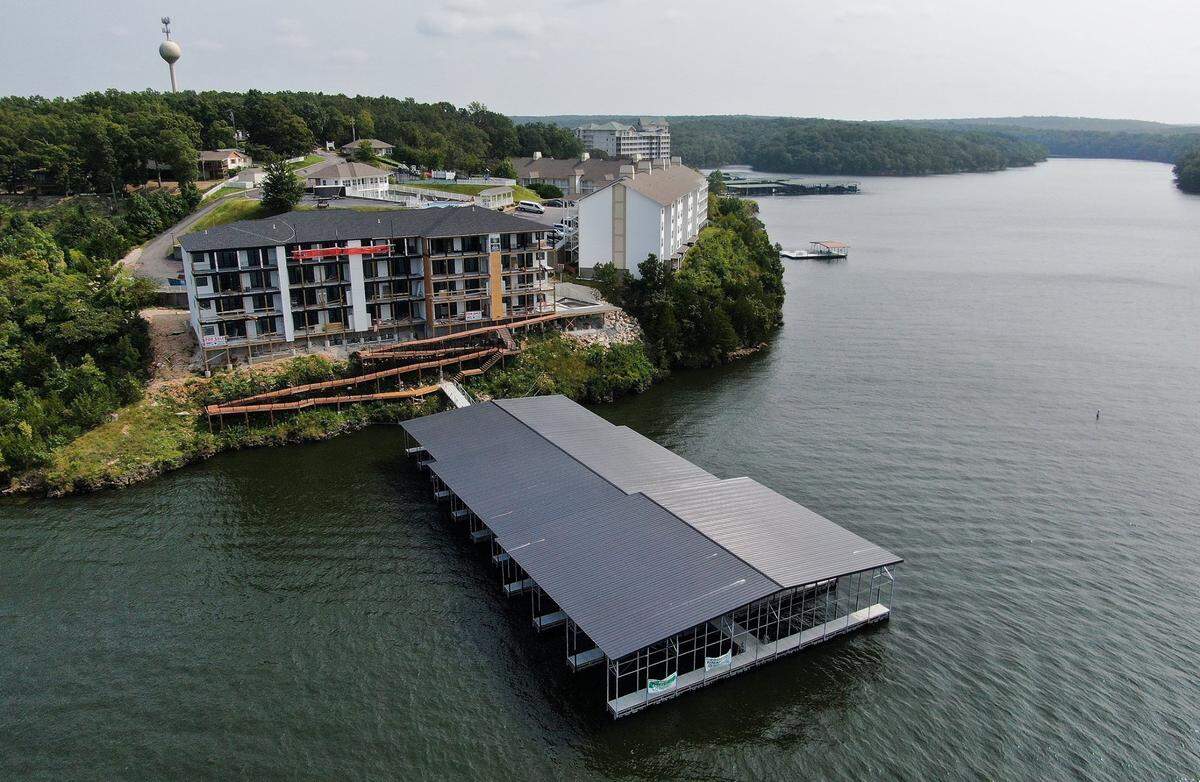
The lake has always had to adjust to growth. During his time in the Missouri House of Representatives, Miller was able to help add a third judge to the area’s judicial circuit. Years before the pandemic, the courts were overwhelmed by the number of cases involving tourists, he said.
While he sees crime going up, he’s confident local leaders will respond appropriately.
“We do have more crime with more people. But I think we’re in a better position now,” he said. “Instead of a fistfight, it seems to be a gunfight. But that’s happening across the United States.”
Miller, who is retired from running a family engineering and surveying firm, believes the lake itself is safer than ever. He was among a group of lawmakers that pushed for changes to the highway patrol’s enforcement efforts on the lake after Brandon Ellingson drowned in 2014 while in the custody of a state trooper who did not have experience on the water. And Miller said he’s seen firsthand how busy lakeside bars like Shady Gators have increased security measures since last year’s deadly shooting.
“Unfortunately, that took a tragedy, too, to get things to happen,” he said. “It’s sad that that stuff happens, but hopefully we can be more proactive.”
Similarly, Miller is confident that the market will respond to new needs that arise at the lake. Builders will bring new home supply online, while restaurants and entertainment venues will come on board if the demand is there.
“I know of very few places that are as market driven as the Lake of the Ozarks,” he said. “As the need arises, people show up.”
A new housing crunch
The last few years have brought announcement after announcement of new development efforts at the Lake of the Ozarks.
One of the biggest projects is a new $60 million casino planned by Oklahoma’s Osage Nation. A pair of local developers plan to build a mixed-use development on 2,000 acres in Camdenton. And the city of Osage Beach is working with a company that plans to demolish and redevelop its once-thriving outlet mall just off U.S. 54.
But Osage Beach City Manager Jeana Woods said local officials have been planning for such growth for years.
Still, she acknowledged that the last two years have put more work on city departments. A large share of homes in the town of about 5,000 people are second homes. But Woods said the pandemic pushed many owners to spend more time or move permanently to their lake houses.
And like all lake communities, her city is struggling with a major housing shortage. Many city employees have to commute 30 to 45 minutes into Osage Beach because of the lack of housing stock.
“There’s just not a lot of supply,” she said. “And construction can’t keep up with demand.”
Another challenge: the housing that does exist is generally far too expensive for the thousands of service workers who keep the lake’s bars, restaurants and stores running.
Mark Smetana, director of Lake Area Helping Hands, said the wages of many of those jobs start at $10 or $12 per hour.
“The economics don’t work,” he said. “It’s just the way people are nowadays: you’re a paycheck away from being homeless.”
Helping Hands is the only homeless shelter in the lake area, where Smetana has seen more and more residents struggle to afford a place to live.
“Homelessness has definitely increased due to the economy basically,” he said.
His organization requires shelter residents to work, putting aside a certain share of their earnings into a savings account for future housing costs. They used to stay for three or four months as they saved up to rent an apartment.
But that’s much more difficult with skyrocketing rents.
“What used to be a $500 apartment is now anywhere from $800 to $1,000,” Smetana said. “And now they’re staying here five to six months.”
The high costs and low inventory of housing make it all the more difficult for local businesses to hire in an already tight labor market. Some of the larger bars and venues here are so desperate they’ve bought entire motels to house their summer staff.
So far, Mark Waddington said he hasn’t had to go to such lengths. Instead, he focuses on finding seasonal staff who can live with friends or family already at the lake. Or, he houses some employees in his own rental properties.
He owns several businesses around the lake, including the high-end Performance Boat Center and Redhead Lakeside Grill.
“A big part of the strategy around hiring is housing,” he said. “I can find plenty of people from Kansas City, Columbia, and Springfield that want to come here and work (for the summer). But if they have nowhere to stay, then they can’t.”
A Nebraska native, Waddington opened his boat dealership at the lake in 2011. For the last few years, he said business was mostly constant: his restaurant and pool bar saw fairly steady sales figures summer after summer.
That all changed in 2020.
He plans to open his next business in June. Aptly named The Cave, the bar and restaurant will feature a swimming pool, 130 boat slips, a sandy beach and plenty of room for dining inside or outside the existing cave.
Waddington bought the commercial property about five years ago because of its 1,500 feet of prime waterfront.
“I thought about building it then and I wasn’t sure the lake economy was ready for that big of a project,” he said. “Now I’m very confident it’s ready for it.”
This story was originally published May 29, 2022 at 5:00 AM.