
Fact check: Will Missouri’s Amendment 3 enable sex trafficking? We examine the claims
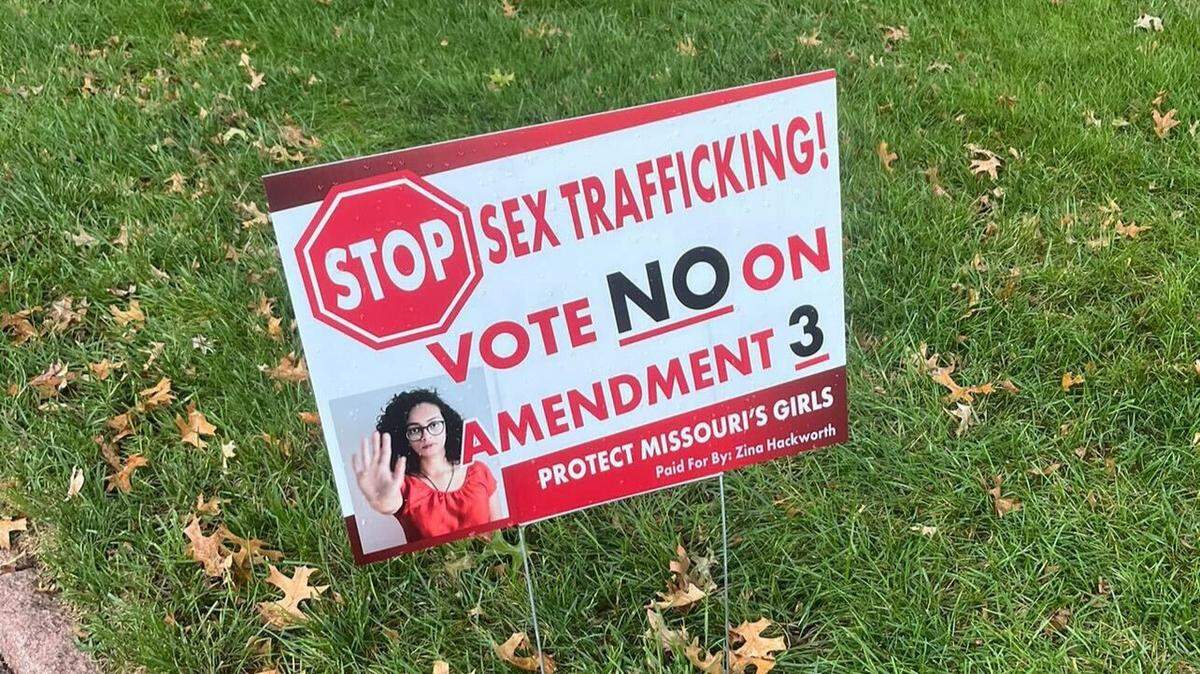
With just weeks remaining until Missourians vote on whether to restore abortion and other reproductive rights, lawn signs and billboards are appearing around the state falsely linking Amendment 3 to human trafficking and other alleged dangers to women and girls.
The narrative is being pushed by the Missouri Right to Life PAC, a conservative group that endorses candidates and funds anti-abortion messaging across the state. Some signs linking Amendment 3 to human trafficking are also credited to Zina Hackworth, a Missouri anti-abortion activist.
Among Missouri Right to Life PAC’s false claims is that the amendment would remove a requirement for medical professionals to report suspected cases of rape, incest or sex trafficking.
The group also claims that Amendment 3 would shield abortion providers from malpractice claims related to abortion care, allow minors to seek abortions without parental consent and allow unregulated abortions in the final months of pregnancy.
Let’s take a closer look at the claims being promulgated by anti-abortion activists.
What would Amendment 3 mean for sex trafficking survivors?
Claim: Amendment 3 would remove a requirement for medical providers to report suspected sex trafficking, shielding traffickers from culpability.
Fact Check: Missouri already does not require mandated reporters, including health care providers, to report suspected instances of human or sex trafficking unless the victim is a minor or a vulnerable adult, meaning a senior or a person with disabilities.
Sam Lee, an anti-abortion lobbyist with the self-created group Campaign Life Missouri, confirmed that the claim is likely related only to minors who providers suspect are victims of sexual abuse or exploitation.
But the text of Amendment 3 doesn’t preclude health care workers from immediately reporting suspected trafficking of minors. It merely prevents them from delaying or restricting their patients’ abortion care without a good reason.
“There’s a couple steps that you have to take to make that argument,” Lee said of the sex trafficking claim.
Even if Amendment 3 modified Missouri’s mandatory reporting laws — which it does not — federal law still requires health care providers to report any suspected trafficking of children under the Child Abuse Prevention and Treatment Act.
What would Amendment 3 mean for parental consent?
Claim: Amendment 3 would allow minors to get abortions without parental consent.
Fact Check: If abortion becomes legal again in Missouri, the laws that governed it before the 2022 trigger ban will still be on the books. This includes state statutes that require minors to get parental permission or a court order before obtaining an abortion, unless they are legally emancipated.
However, these laws could be challenged in court if Amendment 3 passes. That’s because the amendment would ban government interference in the right to make decisions about reproductive health care, including abortions.
If the law is challenged, it would be up to a judge to decide whether requiring parental approval or a court order constitutes government interference in decisions about this care.
What would Amendment 3 mean for malpractice lawsuits?
Claim: Amendment 3 would remove patients’ ability to sue for malpractice related to abortion care.
Fact Check: Amendment 3 contains a line that some critics have interpreted to mean it would nullify all future lawsuits related to reproductive care, including malpractice related to abortion, childbirth and even fertility treatments.
The line reads: “Nor shall any person assisting a person in exercising their right to reproductive freedom with that person’s consent be penalized, prosecuted, or otherwise subjected to adverse action for doing so.”
Lee, the anti-abortion lobbyist, argues that this means those who assist with abortions would not just be protected from government retaliation but also from personal lawsuits and malpractice claims.
But Missouri’s Western District Court of Appeals already ruled in October 2023 that abortion providers would remain liable for malpractice if abortion rights were restored in the state. Judge Thomas N. Chapman wrote that Missouri law already requires that abortion providers carry malpractice liability, and that the amendment would not take this requirement away.
“Disallowing health and safety regulations—including requirements that physicians perform abortions and that they maintain medical malpractice insurance— is not a probable effect of the initiatives,” he concluded.
“While the government may not restrict a person’s independent decision to obtain an abortion, it may impose health and safety regulation and require abortions be performed according to widely accepted medical standards.”
What would Amendment 3 mean for late-term abortions?
Claim: Amendment 3 would allow abortions in the final months of pregnancy for “completely subjective reasons.”
Fact Check: Amendment 3 explicitly gives the state permission to regulate abortions performed following fetal viability, which medical professionals believe begins around the 24th - 25th week of pregnancy.
The text of the proposed amendment reads: “The general assembly may enact laws that regulate the provision of abortion after Fetal Viability,” with the exception of care that a medical professional deems necessary to “protect the life or physical or mental health of the pregnant person.”
Far from “completely subjective,” as opponents claim, these exceptions must be needed “in the good faith judgment of a treating health care professional.”
Late-stage abortions are extremely rare, and generally only occur when a fetus is not viable or the pregnant person’s health is at risk. This includes mental health issues, which can be deadly — according to the National Institutes of Health, suicide is a leading cause of death among pregnant women.
A 2020 study by the CDC found that less than 1% of the abortions performed across 40 states occurred after 20 weeks of pregnancy — which is still a month or more before a fetus is viable. Amendment 3 ensures that these extreme cases are protected under state law.
The Star’s Kacen Bayless contributed reporting to this piece.
Do you have more questions about Missouri’s abortion amendment ahead of the 2024 general election? Ask the Service Journalism team at kcq@kcstar.com.
This story was originally published October 16, 2024 at 2:39 PM.
.jpg)