Court changes ballot language for effort to repeal Missouri maps — again
AI-generated summary reviewed by our newsroom.
- Appeals court removed language saying the map split fewer cities and is “more compact”.
- People Not Politicians sued the Secretary of State over the proposed ballot language.
- Missouri Supreme Court will hear major cases on the congressional map on May 16, 2026.
A Missouri appeals court on Thursday removed language from a proposed referendum that said the gerrymandered congressional map Missouri lawmakers passed last summer split fewer cities and is “more compact” than the current map.
The Missouri Court of Appeals for the Western District in Kansas City said that those two claims lacked evidence when they ordered that the wording be stripped from the ballot summary.
The measure, if approved for the ballot and passed by voters, would overturn the congressional map Missouri Republicans passed to oust Kansas City’s long-term Democratic Representative Emanuel Cleaver.
It’s the second time courts have pared down language on the ballot summary drafted by the Missouri Secretary of State’s Office. Previously, the Cole County Circuit Court removed language that called the original congressional map passed in 2022 “gerrymandered” to protect incumbents that “better reflects statewide voting patterns.”
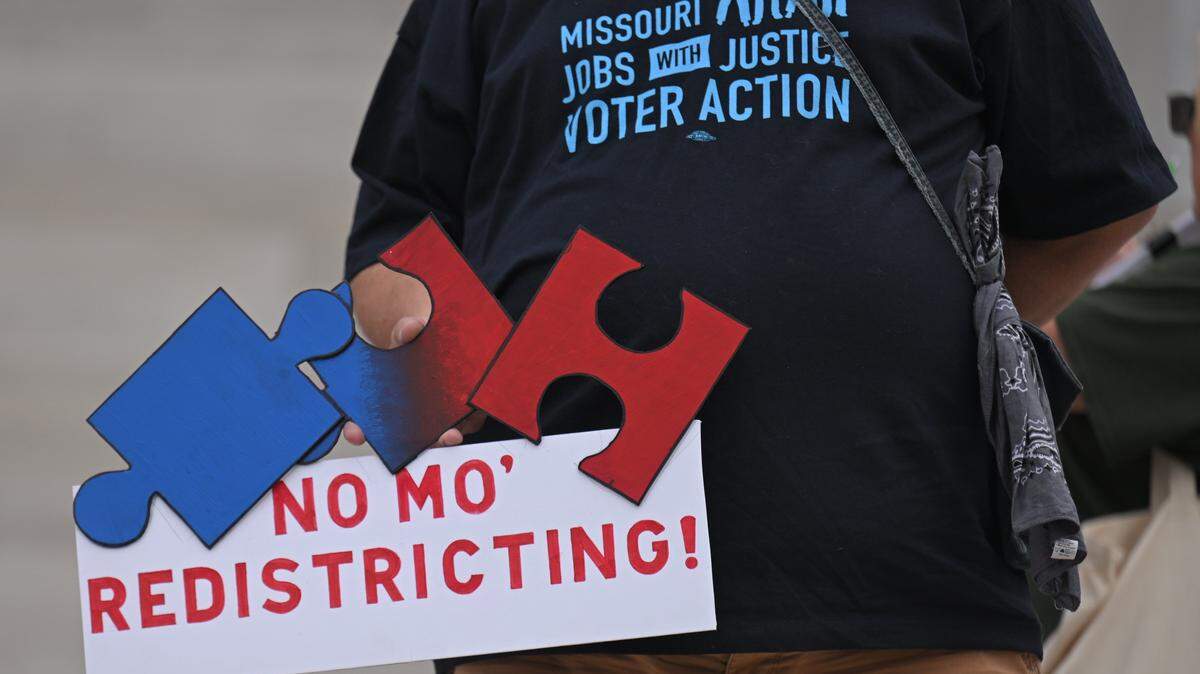
People Not Politicians, an anti-gerrymandering referendum campaign, sued Hoskins over the proposed language.
“I think this is a much more accurate description about what the question that voters are going to be asked when we vote on the referendum,” Richard Von Glahn, executive director of People Not Politicians, told The Star on Friday.
The campaign says it has collected more than enough signatures to qualify for the November election, but it is yet to be certified by the Secretary of State’s Office.
Missouri lawmakers targeted Cleaver by cutting Kansas City into three Republican leaning districts. In light of the U.S. Supreme Court decision gutting some provisions of the Voting Rights Act, some Missouri lawmakers have flirted with splitting St. Louis to make every district in the state favorable for Republicans.
“Hello 8-0 my old friend! We’ve come to introduce you again,” Sen. Nick Shroer, a Defiance Republican, posted on social media.
Missouri, following Texas’s lead, was one of three Republican states that heeded President Donald Trump’s call for mid-decade redistricting in an attempt to retain Republican congressional majorities in the midterm elections. Democratic states countered in what has become an ongoing redistricting battle between red and blue states.
Republicans in Texas, Missouri and North Carolina have been able to carve out seven additional Republican-leaning districts. Democrats in California and Virginia have added nine Democratic-leaning congressional districts.
Additionally, Ohio added two Republican-leaning districts when its map didn’t meet requirements in the Ohio Constitution and Utah was forced by the state’s supreme court to add one Democratic seat after it declared its map an unlawful gerrymander.
The opinion from the Missouri Appeals court ensures the final language on the ballot measure that will face voters in November, but there remain ongoing court cases that could change the trajectory of Missouri’s congressional districts.
Ongoing cases
On May 12, the Missouri Supreme Court will hear the most consequential court cases on the future of Missouri’s congressional map.
One case, brought by the American Civil Liberties Union and Elias Law Group, an elections law firm that supports Democratic causes, contends that the newly drawn congressional maps don’t meet constitutional requirements on compactness.
The ACLU case also argued that the state couldn’t redistrict more than once per decade, but the Missouri Supreme Court struck down that argument in a separate case.
Oral arguments for what has been informally called “the Maggard case,” named after its lead plaintiff, are scheduled for the same day. The decision could block the map pending the result of People Not Politicians’ referendum campaign.
The Missouri Secretary of State’s Office, which didn’t respond to a request for comment when this article was published, argued in court that the delivery of ballots isn’t enough to pause a law, despite decades of precedent.
With candidates filing deadlines passed, it could be a chaotic scenario where voters are asked to elect representatives in districts that won’t exist in 2028.
This story was originally published May 2, 2026 at 8:30 AM.