
Phil LeVota wants to lock in Jackson County tax rules. What would change?
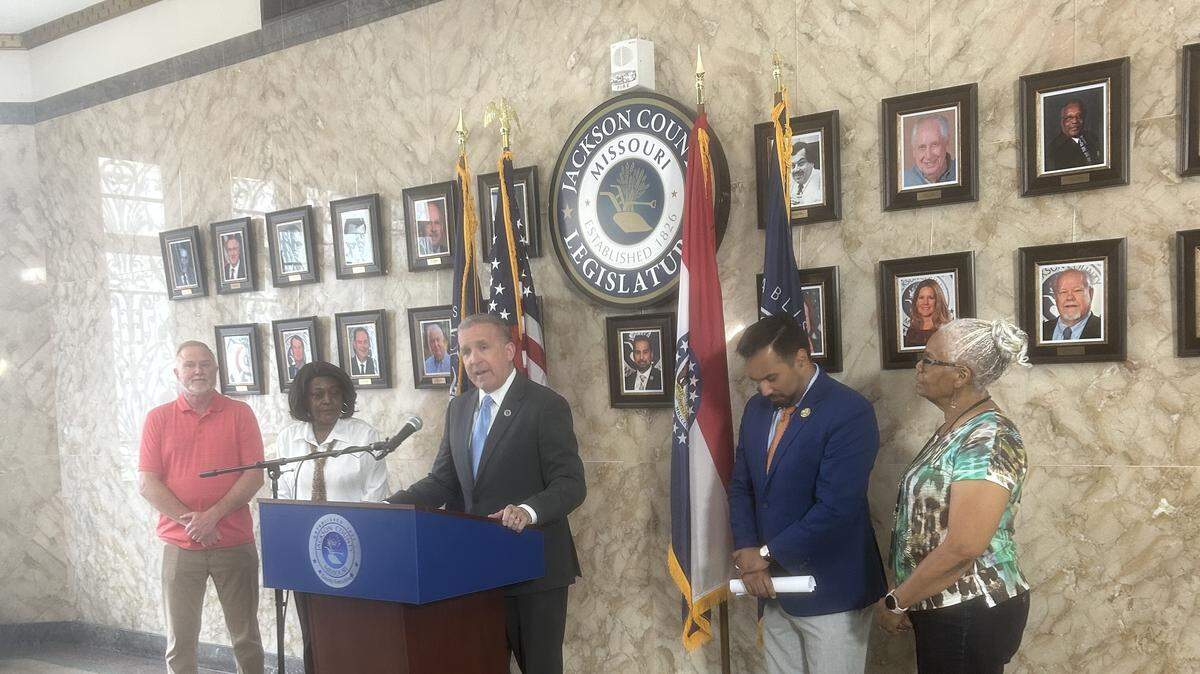
As he heads into the back half of his temporary run as Interim Jackson County Executive, Phil LeVota is seeking help from the legislature to formalize his tax policies into county law that cannot be immediately reversed at the conclusion of his 14-month term.
LeVota previously announced a set of tax policies intended to offset debts and damages from the last several Jackson County property assessment cycles, particularly the 2023 cycle. Under the policies, home and business value increases for the 2023 cycle were retroactively capped at 15% per property. Those who paid taxes in 2023 reflecting higher than a 15% increase will be issued credits split over their property tax bills throughout the next three years.
Getting commercial property values back down to a 15% increase ceiling entailed manually reviewing the assessed values of hundreds of properties countywide, targeting anything valued under $5 million in 2023. According to county data, the value of the average commercial property in Jackson County increased by around 24% in the 2025 assessment cycle.
LeVota announced Friday that Legislative Vice-Chair Sean Smith has sponsored a legislative ordinance that would codify all three acts by adding them to the Jackson County Code. The ordinance will appear on the agenda at the next legislature meeting, set for Monday afternoon.
Residents filed a total of 55,000 appeals with the county between the 2023 and 2024 property tax cycles, LeVota said. He pledged Friday that all outstanding appeals from those years will be addressed by June 15, and that the remaining 1,333 appeals from 2025 will be addressed by the second week of August.
“I think everybody understands that in 2023 we unlawfully over assessed an awfully large number of taxpayers,” Smith said Friday. “The net result of that was that many people overpaid, even when they sought relief.”
New Property Tax Pay-Ahead Program
LeVota also announced on Friday that the county departments of assessment and collection will be collapsed into a Department of Revenue in the fall, and that a Property Tax Pay-Ahead Program will be initiated July 1. Under the program, residents can pay their taxes ahead of time on “a schedule that works best for them” -- be it yearly, monthly, biweekly or weekly -- in order to avoid paying a lump sum in December.
Setting county tax policies to offset or reverse the impacts of previous property cycles has required significant cooperation between the Office of the County Executive and the state of Missouri. LeVota recently made a last-minute pitch to the Missouri State Tax Commission, petitioning state legislators to issue a two-year property tax freeze for all residential parcels in Jackson County.
The proposal came less than two weeks before the end of Missouri’s legislative session. It never made it out of Jefferson City.
“I thought it was a no-brainer for Jackson County,” LeVota said Friday. “I’m very frustrated about it.”
LeVota was joined Friday by Smith, Legislative Chair Manuel Abarca IV and Legislators Venessa Huskey and Donna Peyton. All four spoke to an increase in collaboration and cooperation between the legislative and executive branches of Jackson County government in the first half of LeVota’s term.
“We’ve had legislatures, we’ve had executives in the past that have sat on their hands,” Abarca said. “
Will Phil LeVota endorse a county executive candidate?
LeVota said Friday that the additional tax policies reflect the county’s “responsibility to use these next seven months wisely.”
“We are in the middle of an election cycle, but we still need to focus on working together, moving initiatives, solving problems and putting meaningful changes in place for the people of Jackson County,” LeVota said.
LeVota announced the updated tax policy plan at the halfway point of his 14-month term as Interim County Executive. An attorney by trade who never held an elected county office before his appointment, LeVota stepped into the county’s top seat last year to finish out the term of Frank White Jr., who was recalled in a landslide vote in September 2025.
LeVota beat out a dozen candidates for the temporary role in October 2025, winning over former Legislator Dan Tarwater III by a vote of 5-4. Tarwater is now in the running for a full four-year term as County Executive starting in 2027, along with Abarca and several others.
When he was appointed Interim County Executive, LeVota publicly pledged not to run for the permanent seat, going so far as to sign a public-facing “affidavit of non-candidacy.”
He briefly threw his hat in the ring for the permanent seat anyway, filing for the executive race within minutes of the deadline, but withdrew within four weeks, citing time constraints and personality conflicts within the county government.
When asked Friday if he would endorse a candidate for County Executive, LeVota said that he “plans to speak to any candidates that aren’t speaking the truth.”
An open letter from school superintendents
LeVota said Friday that the county’s ongoing series of property tax improvements, particularly the incoming three years of tax credits, have “provided relief to taxpayers, while also protecting our schools, cities, libraries, and other taxing jurisdictions from taking an immediate financial hit.”
However, school district leaders across Jackson County have been outspoken in recent months about the destabilizing impact of the retroactive value caps on their annual budgets.
In an April 8 open letter addressed to LeVota and obtained by The Star, a dozen superintendents wrote that LeVota’s cap and tax refund policies rely on “clawing back” money already allocated by Jackson County school districts.
The letter alleges that the policies will cost the 12 districts just over $196 million collectively, and notes that districts cannot go back and change how much they collected from residents and businesses no matter what changes the county tries to make to previous years’ taxes from previous years.
It also alluded to potential legal action if the county upholds the policies in question, which LeVota now seeks to codify and formalize through a legislative ordinance.
LeVota noted Friday that since the open letter was distributed, he has met with the superintendent of the Lee’s Summit School District.
“They understand my position is that tax credits kind of happen, so let’s talk solutions,” LeVota said.
He said that he does not plan to reach out to any of the other 11 districts voicing their concerns, but that “they’ve got [his] number.”
Instead, the legislative and executive bodies will prioritize the distribution of the remaining federal funding granted to Jackson County under the American Rescue Plan Act, as well as solidifying plans for the future of Truman Sports Complex.
During the first half of LeVota’s term, both the Kansas City Chiefs and Kansas City Royals indicated that they will move out of their respective stadiums by 2031, leaving behind a 400-acre plot in the heart of Jackson County.
A task force of members appointed by LeVota is currently working on a handful of plans for the future of the site, he said, with a public-facing selection process to come.