Could anti-tax voters complicate key Kansas City earnings tax vote?
AI-generated summary reviewed by our newsroom.
- Anti-tax sentiment exists but experts say the tax likely isn’t in serious danger.
- Earnings tax funds roughly 45–47% of the city’s annual general revenue fund.
- City leaders formed a coalition and are door-knocking ahead of the April vote.
An extraordinary push to eliminate Missouri’s income tax. Intense fury over Jackson County property assessments. Outrage over a publicly-financed stadium in Kansas. A proposed property tax cap in Platte County.
Over the last several years, general anti-tax sentiment has seeped into a constellation of political issues across the Kansas City metro. The upcoming April 7 vote over the renewal of Kansas City’s 1% earnings tax will mark one of the biggest tests of whether that opposition could risk ensnaring a critical resource for the city.
Kansas City voters will soon decide whether to keep the tax going for another five years, a key vote that could determine the fate of basic government operations. The earnings tax funds roughly 45% to 47% of the city’s annual general revenue fund, paying for a broad swath of services, including police, fire, ambulances, trash collection and street repairs.
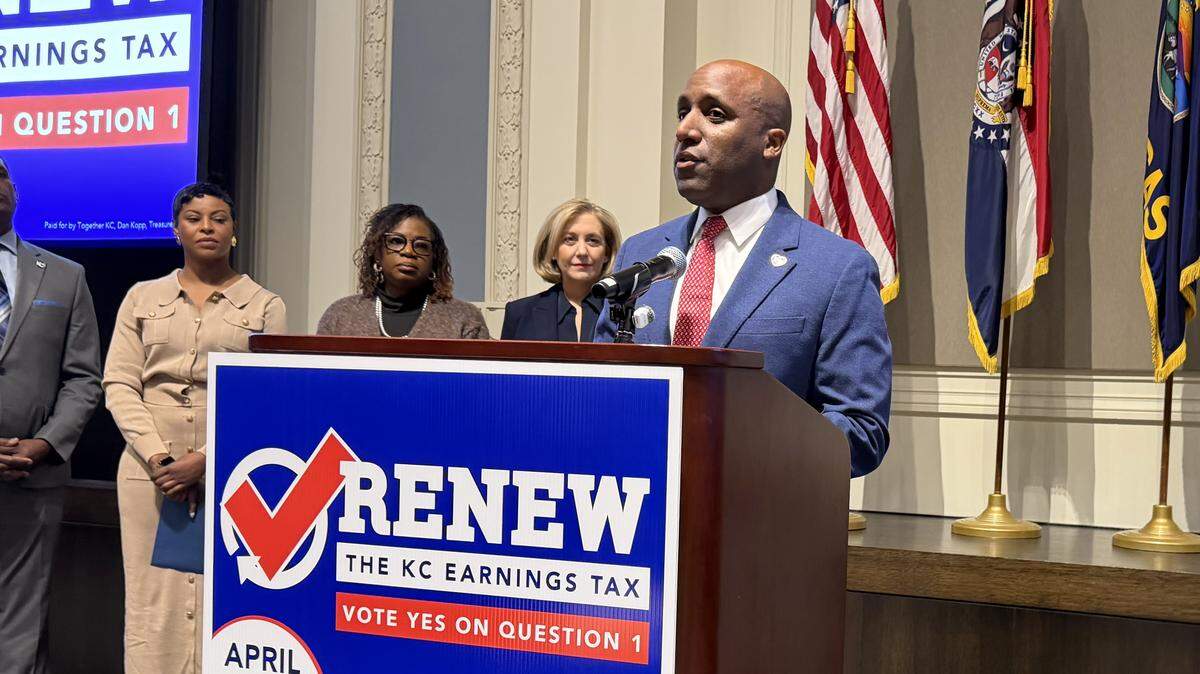
To illustrate the importance of the tax, a broad coalition of elected officials and civic leaders held a press conference on Tuesday to encourage residents to support it. That coalition included Mayor Quinton Lucas, Jackson County Prosecutor Melesa Johnson and the leaders of the local police and fire unions.
“Not worried,” Lucas said in response to a question from The Star. “But certainly dedicated to making sure we get our message out over the weeks ahead.”
In addition to the press conference, Lucas said that supporters of the measure were door-knocking in an attempt to highlight the fact that the tax paid for vital services and was not a new cost for residents.
“There are a lot of things that happen in the world — I’ll control what I can control,” Lucas said. “I would ask people in Kansas City to do the same and what we can control is making sure we’re taking care of our employees, making sure we’re taking care of basic services and our city by voting yes.”
There is no formal campaign against the earnings tax and the tax has historically passed overwhelmingly. But the main hurdle for supporters of the measure, called Question 1, will likely center on broad voter resistance to taxation amid a slew of hot-button issues in the metro.
Much of that resistance in recent years has come from Kansas City’s Northland, said Matt Harris, a political scientist at Park University. The bustling suburban area, which includes Clay and Platte counties, typically leans more conservative than the city’s urban core.
“People are upset about property taxes and I don’t think people necessarily differentiate,” Harris said. “When there’s an anti-tax sentiment, I think that kind of can cross boundaries and just go towards sort of taxes in general.”
Kansas City council member Nathan Willett, who represents a Northland district, was the sole council member who voted against placing the earnings tax measure on the ballot. Willett did not respond to a request for comment for this story.
In addition to general voter distaste for taxes, Missouri Republican lawmakers have in recent years pursued an overhaul of the earnings tax in Kansas City and St. Louis. A GOP-led committee in 2024 released a slew of recommendations, including a gradual phase-out of the tax tied to certain revenue increases.
Much of that energy was centered on anger over how St. Louis handled workers during the COVID-19 pandemic. But top Republican lawmakers at the time raised issues with the tax in both cities, arguing that it did not encourage people to want to live and work in Kansas City and St. Louis.
“It’s not good public policy as it relates to, you know, taxing folks in that way,” Caleb Rowden, then the top-ranking Republican in the Missouri Senate, told reporters at the time.
But opponents of the tax in 2024 did not provide clear answers about how the state’s two major cities would replace revenue generated from the tax. One Republican lawmaker at the time acknowledged that if residents voted against the tax, the cities would be stuck “with a big hole in their budget.”
Despite voter attitudes toward taxation, the earnings tax has passed in blowout elections in Kansas City. The measure received 77% of the vote in 2011, 78% in 2026 and 77%. A failure at the ballot box this year would mark a dramatic shift.
Harris, the political scientist, said the reason why there’s such a strong coalition behind the tax is the consequences of a failed vote. He acknowledged that he did not think the tax was “in that much danger.”
“It would be really devastating for the tax base in the city and they would have to radically alter — whether it’s property taxes or they would have to do something or sales tax — to make up that gap,” Harris said.
Kansas City’s mayor, for his part, signaled that he isn’t taking any chances.
“We’re doing lots of messaging, because every election is a time for us to share why this is so important,” Lucas said. “So I wouldn’t say necessarily that comes out of concern as much as our responsibility to make sure we’re sharing with the people of Kansas City what the earnings tax does.”
This story was originally published March 25, 2026 at 5:30 AM.