Mid-decade redistricting aimed at KC was legal, Missouri Supreme Court says
AI-generated summary reviewed by our newsroom.
- Missouri Supreme Court allows mid-decade redistricting, upholding GOP map.
- Ruling clears path to split Kansas City into three Republican-leaning districts.
- Decision raises stakes for 2026 races and possible referendum and new suits.
The Missouri Supreme Court, in a narrow decision on Tuesday, ruled that state lawmakers were legally allowed to redraw the state’s congressional districts in the middle of the decade, a key ruling that bolsters a Republican-backed map that slices through Kansas City.
The long-awaited decision found that while the Missouri Constitution requires lawmakers to redistrict after the release of U.S. Census Bureau data, it does not expressly prohibit them from redrawing map lines more than once a decade, an extraordinary acknowledgment that could result in future mid-decade redistricting battles.
“The obligation to legislate congressional districts once a decade does not limit the General Assembly’s power to redistrict more frequently than once a decade,” Judge Zel M. Fischer wrote in the majority opinion. Judge Paul C. Wilson wrote the dissenting opinion.
The ruling is likely to send shockwaves across Kansas City, clearing a path for Republicans to try to unseat U.S. Rep. Emanuel Cleaver, a Kansas City Democrat, in the 2026 election. It marks a win for President Donald Trump, who pressured Missouri officials to redraw the state’s map in an effort to ensure Republican control of Congress.
Republican Attorney General Catherine Hanaway, whose office defended the map in court, championed the ruling in a statement on Tuesday, saying it “reinforced what we’ve known all along.”
“Proud of our team that secured another win for Missourians,” Hanaway said.
Missouri Republican lawmakers approved the map last year during a chaotic special session called by Republican Gov. Mike Kehoe that thrust the state into a national redistricting frenzy. The map’s boundaries slice through Kansas City, splitting the city’s voters into three Republican-leaning districts in the hopes of pushing Cleaver out of office.
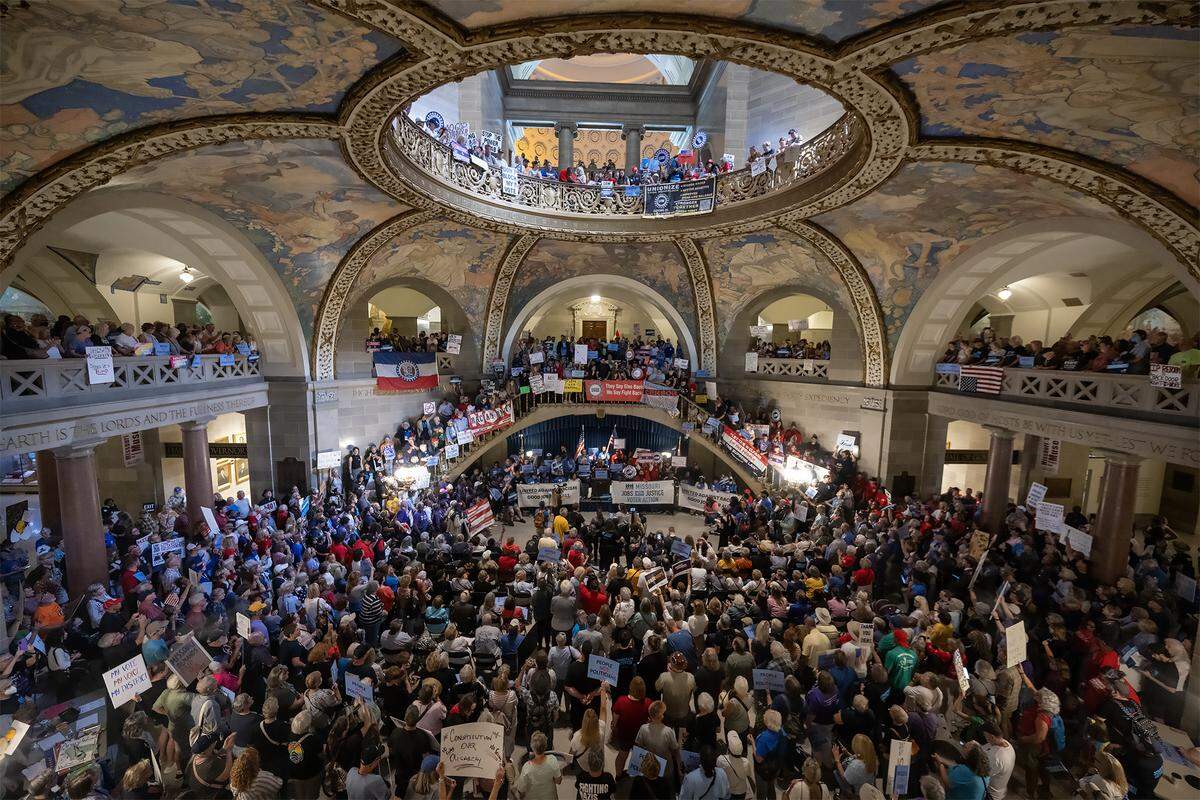
For opponents of the gerrymandered map, Tuesday’s ruling is likely to elevate the importance of a referendum campaign to strike down the map at the ballot box. Another outstanding case will decide whether the map should be paused ahead of the 2026 election, before Missourians have a chance to vote on whether the map should be struck down.
Chuck Hatfield, a prominent Missouri attorney who sued to strike down the map, on Tuesday acknowledged the heightened importance of the referendum campaign. He also pointed to the possibility of future mid-decade redistricting battles as a result of the ruling.
“Now, I guess we move on to the referendum discussion,” Hatfield said. “You know, now that the Supreme Court has said that the legislature can do this, I think we should expect in the future even more fights about redistricting.”
Later on Tuesday, the referendum campaign, called People Not Politicians, issued a statement saying it disagreed with the decision, adding that the intent of the constitution was not “to allow random redistricting at politicians’ whims.”
The statement went on to tout the potential upcoming statewide vote. Campaigners argue they should easily qualify for the ballot based on preliminary data from local election officials.
“The ultimate power lies with the voters of our state, with more than 300,000 having signed a petition to put this issue on the ballot,” said Richard Von Glahn, the campaign’s executive director. “In spite of the obstruction by state officials, we will continue the fight to let people, not politicians, serve as the final word.”
The 4-3 ruling on Tuesday was close. Wilson, in his dissenting opinion, wrote that if the framers of the state Constitution intended for lawmakers to be “free to redraw (districts) at any other time (or times) before the next census, they would have said so.”
While Tuesday’s ruling hands a loss to opponents of the map, there are still several interconnected issues that could decide the fate of the state’s gerrymandered congressional map. In one separate case, for example, a group of voters are seeking to appeal a lower court’s decision that found the map’s boundaries were constitutional.
Rebeca Amezcua-Hogan, a candidate for Kansas City City Council and one of the plaintiffs in the case, pointed to the other ongoing cases in a statement to The Star.
“This narrow defeat at the Missouri Supreme Court is a clear setback and disappointment, but not the end of Missourians fighting back for more fair representation,” Amezcua-Hogan said. “This map so clearly is meant to dilute the voices of Kansas Citians, the voices of my neighbors.”
In addition to the redistricting ruling, the state’s highest court also issued decisions on two other key cases ahead of the 2026 election.
In one case, the court upheld the state’s voter ID law, which requires Missourians to show a government issued photo ID at the ballot box. In another, the court struck down a series of restrictions on voter registration efforts, such as a requirement that people who solicit voter applications register with the state.
The Star’s Jack Harvel contributed reporting.
This story was originally published March 24, 2026 at 2:26 PM.