Missouri’s pushing to eliminate the income tax. KC leaders call it a ‘mistake’
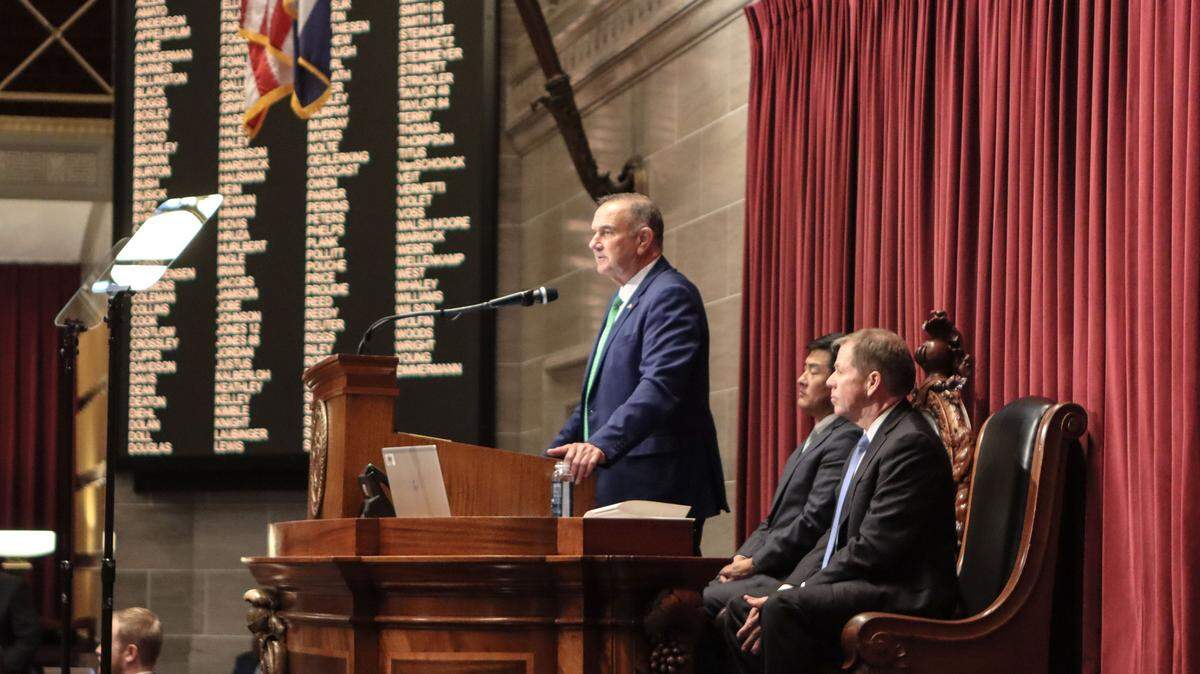
When Missouri Gov. Mike Kehoe unveiled his extraordinary plan to eliminate the state’s income tax in January, he framed the proposal as vital for the state’s economy and population growth.
“The issue at hand here is competitiveness. And competitiveness starts with our tax code,” Kehoe, a Republican, said during his annual State of the State address. “Missouri’s tax structure must evolve.”
Two months later, Missouri lawmakers are now poised to vote this week on the first phase of Kehoe’s multi-pronged plan. The eventual goal of the proposal would replace the income tax with expanded sales and use taxes over several years, a sweeping change that Republicans say would bolster the state’s economy.
But Kehoe’s plan has alarmed residents and officials in Kansas City, one of the state’s major cities and main economic drivers. Opponents, including Mayor Quinton Lucas, fear the effort will hurt low-income residents and force state and local governments to make drastic cuts to services.
“Shifting away from income taxes toward expanded sales and use taxes is a regressive approach that hits working families hardest and introduces dangerous volatility into state and local finances,” Lucas said in a statement on Monday.
Kehoe’s proposal has also sparked stark warnings from Kansas Citians who point to a budget disaster roughly a decade ago in Kansas, in which legislators enacted a series of tax cuts that were eventually rolled back.
“We watched Kansas pursue a nearly identical experiment a decade ago and the result was years of fiscal crisis and painful cuts to schools and core services,” Lucas said. “Missouri should not repeat that mistake.”
Kehoe’s plan, a top priority for Republican lawmakers this year, would likely force state and local officials to make difficult choices about the way in which government services are funded. Missouri generates about $9 billion in individual income taxes each year and those funds make up nearly two-thirds of the state’s general revenue.
If enacted, Missouri would join just nine other U.S. states that do not collect income taxes: Alaska, Florida, Nevada, New Hampshire, South Dakota, Tennessee, Texas, Washington and Wyoming.
Some officials in Kansas City said this week that they agreed with the argument that Missouri needed to remain competitive with other states. But they cautioned that Kehoe’s plan was not the way to go.
“It’s a lousy idea,” said Kansas City council member Wes Rogers, a former Democratic state lawmaker. “It’s going to raise people’s taxes and it’s not going to generate any kind of new economic activity.”
Inside the plan
Kehoe’s plan would not eliminate the income tax all at once, a key element touted by supporters. They argue the legislation allows the state to responsibly phase out the tax without major financial pains.
The Missouri House is poised to vote on the first phase, a proposed constitutional amendment, this week. The proposal is Republicans’ third attempt after two months of negotiations.
If approved, the measure would ask voters on a future statewide ballot to lift a prohibition on sales taxes for services, which are currently not subject to Missouri’s sales tax rate of 3%.
Approval from voters (either in November or an earlier election called by Kehoe) would give state lawmakers the authority to create a new sales tax system, likely raising the state’s sales tax rate and taxing other items, such as certain services, for the first time. Lawmakers would use those revenues to begin phasing out the income tax.
The Republican governor has said that he would not support expanded sales taxes on the agriculture, health care and real estate industries. The goal, Kehoe said, is to repeal the income tax within five years.
“Our plan includes safeguards to ensure fiscal responsibility and protect against economic downturns by requiring triggered reductions to the income tax rate,” Kehoe said in January.
But critics of the plan emphasize that the current version of the proposal would give lawmakers broad authority to raise taxes on Missourians. House Minority Leader Ashley Aune, a Kansas City Democrat, warned that Kehoe’s promise of certain exemptions — such as for health care — aren’t actually in the language of the legislation.
“He said that in his speech,” Aune said. “But there is absolutely no language in this (legislation) that exempts a single industry. There are no exceptions in this.”
One of the most vocal proponents of the effort is House Speaker Jonathan Patterson, a Lee’s Summit Republican who filed a version of the proposal this year. Patterson, in an interview, pointed to other states that have eliminated their income tax.
“What we know is that people are leaving places like California and New York and coming to no income tax states,” Patterson said. “I want people from those states to move to Missouri by the thousands.”
Kansas City schools
Back in Kansas City, the plan has sparked intense fear for its potential effect on teachers, schools and lower income families. Public school advocates and parents have urged state lawmakers to oppose the legislation.
David Price is the president of the Kansas City Federation of Teachers and School Related Personnel, AFT Local 691. In an interview, Price framed the legislation as detrimental to public schools in Kansas City and across the state.
“It’s just going to erode public schools everywhere — schools are going to have to close, counties are going to consolidate schools into one county,” he said. “It could completely dismantle public schools.”
The Missouri Budget Project, a state budget advocacy group, created an interactive map of projected losses at public school districts under the legislation. The group estimates that school districts in the Kansas City metro could lose between $200 and $2,000 of per-pupil spending.
The group found that Kansas City Public Schools would be more insulated from cuts than schools in surrounding suburban and rural areas. Schools in Independence and Grain Valley could face cuts upwards of 8%, while schools in North Kansas City, Blue Springs, Lee’s Summit, Raytown and Liberty could see their spending cut by more than 6%.
“We’re just shifting taxes to those who can least afford it, while also blowing a gigantic hole in the state’s budget,” Traci Gleason, a spokesperson for the budget advocacy group, told The Star in an interview.
As state lawmakers press forward with the plan, they included a line in the legislation designed to limit cuts to public schools. Supporters remain confident that revamping the state’s sales tax system — and eliminating the income tax — will put Missouri in a better financial position.
“We’re going to show Missourians that for families at multiple different income levels that they will benefit from this,” said Patterson, the Lee’s Summit Republican.
But for some of Kansas City’s local elected officials, the move would create a burden for residents.
“How are you going to balance the hole in the budget?” said Kansas City council member Johnathan Duncan. “You’re going to do it on the backs of the most vulnerable members of Missouri. You’re going to do it on the backs of poor and working-class Missourians.”
One of Duncan’s colleagues had similar questions.
“If you’re cutting a budget, that’s great, but what are you cutting with it?” said Kansas City council member Kevin O’Neill. “It sounds great to cut taxes, but what are you cutting with it?”
This story was originally published March 10, 2026 at 5:30 AM.