What happens if Chiefs’ STAR bond plan fails? Here’s what we know
AI-generated summary reviewed by our newsroom.
- Kansas will issue up to $2.75B in 30-year STAR bonds for stadium and development
- Officials set a vast two-county incentive district to redirect state sales tax.
- Experts warn sales-tax revenue can falter, risking state bailouts or bond default.
The Kansas Department of Commerce is defending its plan to heavily subsidize the Kansas City Chiefs’ next stadium against critics who say the deal’s terms could potentially leave the state in a financially precarious position.
Officials have projected confidence that the project would be a windfall for Kansas, repeatedly downplaying any risk the state would assume by financing 60% of the roughly $4 billion development with bonds backed by as-yet-unrealized sales tax revenue growth across a vast new incentive district.
“The Kansas City Chiefs making Kansas their new home, building a state-of-the-art stadium, headquarters and training center, and mixed-use facilities in Wyandotte County and Olathe present a monumental economic development opportunity that will create over 20,000 jobs during the construction phase alone and have over $1 billion in annual economic impact,” wrote Bob North, Commerce’s chief legal counsel, in an email response to The Star.
“These impacts are real reasons for Kansans to be excited about the project and are sound reasons to be confident in its success,” he continued.
In scope, the planned stadium development dwarfs the 23 other projects Kansas has realized through its sales tax and revenue, or STAR bond, program since 1999. Those bond issuances add up to around $1 billion, according to a 2024 Commerce report.
Kansas has agreed to issue $1.8 billion in 30-year bonds to fund construction of the stadium itself, and up to $975 million in bonds as construction milestones are achieved on the surrounding development.
“It’s very difficult to reliably say that you are going to have the sort of massive increase in sales tax collections that you need to be able to have to make a project like that pencil out,” said Justin Marlowe, a professor and the director of the Center for Municipal Finance at the University of Chicago.
A new stadium for a popular NFL franchise is “not nearly as speculative” as some of the projects Kansas STAR bonds have financed in the past, Marlowe noted. But he said there’s a reason why bonds backed by only one revenue stream, especially sales taxes, are rare. They can be unpredictable.
“There are plenty of places that have had versions of things like STAR bonds but have backed away from them, if nothing else, because they have been unsuccessful,” said Marlowe, who has served as an expert court witness on matters involving the municipal bond market, taxation and government accounting.
Who’s on the hook?
Some Kansas STAR bond projects have generated the incremental sales tax growth necessary to retire bonds early or on time. But others have struggled, like the Prairiefire museum in Overland Park that defaulted after failing to make a $15 million payment on time in 2023.
State officials and lawmakers of both parties who helped secure the supercharged stadium STAR bond deal have repeatedly said that Kansas taxpayers will be held harmless if the incentive-backed development doesn’t live up to expectations.
Legally speaking, in the event of a downturn in sales tax revenue, Kansas may not be required to intervene to prevent the stadium project from defaulting, Marlowe said. But in practical terms, officials would face a difficult choice.
“Do we default on the bonds and hope that the bondholders are willing to take a haircut, which they won’t be. Which they never are,” Marlowe said. “If it goes to court and there needs to be some sort of negotiated settlement, it’s fair to say that at some point, everyone will look to the state to provide some kind of relief to prevent the Chiefs from leaving, to prevent this otherwise potentially successful development from failing before it has a chance to succeed.”
North, the Commerce chief counsel, did not respond directly to The Star’s question about whether Kansas would use other state funds to bail out investors if the development were to flounder.
“The capital and bond markets will determine the financial viability of the project,” North wrote in an email.
Sales tax cannibalization
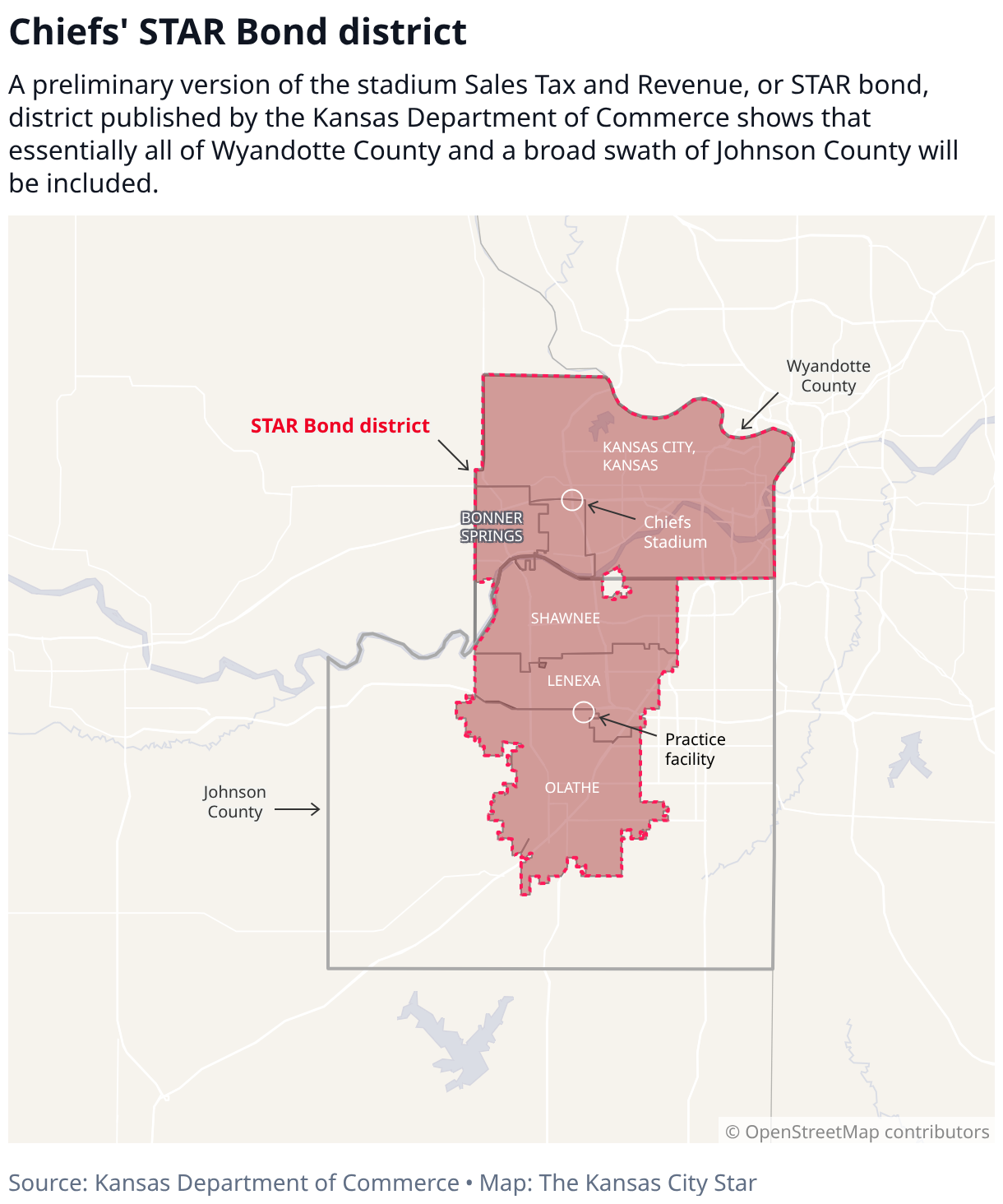
Typically, STAR bond districts only capture and divert sales tax revenue generated by anchor developments and other establishments in their immediate vicinity to pay off the debt associated with construction.
The official boundaries of the new stadium incentive district have not yet been finalized. But a preliminary map illustrating the mammoth district shows it will span nearly all of Wyandotte County and much of western Johnson County, excluding existing STAR bond districts.
It appears to have been drawn to maximize the likelihood that the district will collect enough tax revenue to prevent the bonds from defaulting.
The Department of Commerce will set a baseline sales tax revenue threshold for the STAR bond district. Until the debt is retired, any additional growth in state sales tax revenue will be diverted away from other government priorities it would usually fund, including K-12 education, health care services, public safety and the state highway fund.
Local governments will also weigh whether to contribute some of their own portion of sales tax growth to retiring stadium debt.
“You could be on the furthest southwest corner of Olathe buying a weedwacker just to mow your lawn or buying an alternator to replace in your Chevy, and the sales tax — the state portion of sales tax from those purchases are now going to the Chiefs,” said Geoffrey Propheter, a professor at the University of Colorado-Denver who has studied sports and urban affairs.
He said, considering the size and economic potency of the two-county STAR bond district, it’s misleading to say it will only capture “new” or “incremental” sales tax revenue.
“These are words that lawmakers use to convince people that these are dollars that they would not otherwise get,” Propheter said.
Sales tax revenue can be somewhat volatile, but it generally increases over time, in part due to inflation. It’s unclear which year’s data Commerce will use to set the revenue baseline.
Department of Revenue data shows that from 2014 to 2024, the state portion of the revenue generated by Kansas’ 6.5% sales tax in Wyandotte County and Johnson County collectively increased by about $250 million, despite both counties seeing a downturn in 2020 and 2024.
Johnson County consistently produces more sales tax revenue than any other Kansas county. Under the stadium STAR bond plan, any future growth unrelated to the stadium project could be monopolized for debt service payments.
“We believe that within the new district, a significant portion of sales tax revenue growth will be attributable to the Chiefs stadium and new economic activity generated by the mixed-use developments,” North wrote in an email.
Some lawmakers have doubts
Sen. Mike Thomson, a Shawnee Republican, sharply criticized the stadium-financing plan in a January interview, saying the Legislature abdicated too much control over stadium negotiations to the Department of Commerce.
He voted against the underlying incentive offer that lawmakers overwhelmingly approved during a June 2024 special session.
“I was very concerned then and even more concerned now as we run the numbers and see the significant amount of economic activity that’s going to be needed to produce the revenues to pay this thing off,” Thompson said.
Rep. Melissa Oropeza, a KCK Democrat, said her own 2024 vote against the incentive package was cast “in direct correlation” with the feedback she received from constituents.
“They wanted nothing to do with it,” Oropeza said, adding that she’s withholding judgment on the stadium plan until she can examine it more closely and discuss it with KCK Mayor Christal Watson, who has voiced her own skepticism about the deal’s tentative terms.
House Speaker Dan Hawkins, a Wichita Republican, told reporters on Monday that he believes the stadium proposal is financially responsible, despite what critics say.
“There’s so much misinformation out there, it’s pathetic,” Hawkins said. “It’s really surprised me the amount of misinformation and how little people understand, and the things that they say.
“I’m actually surprised that it’s still a news item.”
This story was originally published January 8, 2026 at 5:30 AM.