Much of Wyandotte, Johnson counties will pay for Chiefs stadium with sales tax
AI-generated summary reviewed by our newsroom.
- Preliminary STAR bond map sweeps nearly all Wyandotte and large parts of Johnson.
- State's share of new sales tax growth in the district will repay STAR bond debt.
- Experts warn the public funding shift creates opportunity costs and weak economic gains.
The $4 billion development anchored by a Kansas City Chiefs stadium will be made possible by a mammoth incentive district that spans two counties and will divert new sales tax revenue generated there for years to come.
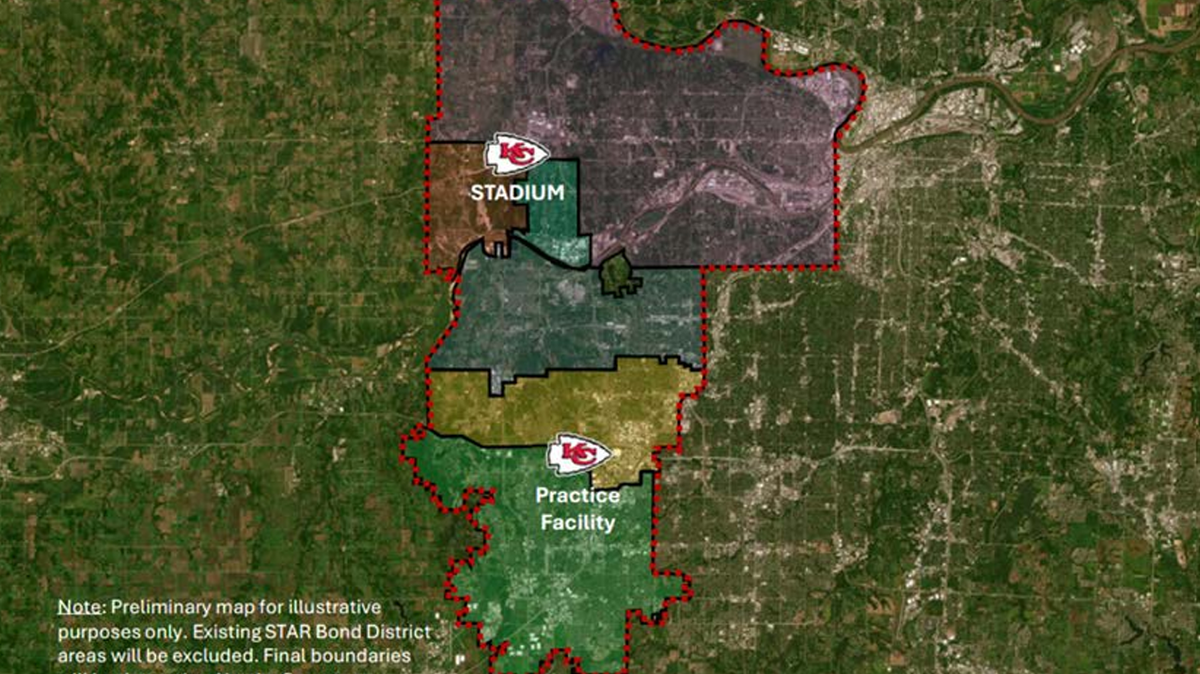
A preliminary version of the Sales Tax and Revenue, or STAR bond, district published by the Kansas Department of Commerce shows that essentially all of Wyandotte County and a broad swath of Johnson County will be included.
State documents note that the map published Monday is “for illustrative purposes only” and that official district boundaries will be determined by David Toland, Kansas’ lieutenant governor and commerce secretary, who led negotiations with the Chiefs.
“Existing STAR Bond District areas will be excluded,” reads text on the map, which is drawn onto an aerial photo and does not label cities.
Kansas City, Kansas; Bonner Springs; Edwardsville and Lake Quivira will all be included in the incentive district. The Star’s analysis of the map indicates that Olathe and parts of Shawnee, Lenexa, and Merriam will also be drawn in.
The state’s portion of any growth in sales tax generated across the vast STAR bond district will be diverted from other government priorities to help pay off debt and retire the bonds. The project is being primarily funded with public money through a 60-40 funding split that could also involve local governments contributing their own portion of new sales tax revenue.
“This agreement protects Kansas taxpayers, with the state’s portion coming from revenue generated by the stadium entertainment venues and the STAR bond district, as well as lottery funds,” Gov. Laura Kelly said at Monday’s announcement.
J.C. Bradbury, a professor at Kennesaw State University in Georgia who has studied sports economics, told The Star that even though taxes won’t be raised under the plan, giving public money to one cause necessarily means taking it from somewhere else.
In this case, incremental sales tax growth that would otherwise go towards state and local government priorities will be tied up in debt service stadiums on the STAR bonds.
“There’s no such thing as a free stadium,” Bradbury said. “If it’s a public entity and you are spending public money, the opportunity cost is coming from the public.”
Decades of research show that new sports stadium projects seldom provide the economic windfall that boosters and lawmakers promise.
“Building a stadium — there’s no channel for it to increase wealth,” Bradbury said. “There’s no channel for it to pay for itself because stadiums aren’t economic development catalysts, and so that money has to come from somewhere else.”
This story was originally published December 25, 2025 at 5:30 AM.