Why is Kansas town protesting high school sports complex? Inside the controversy
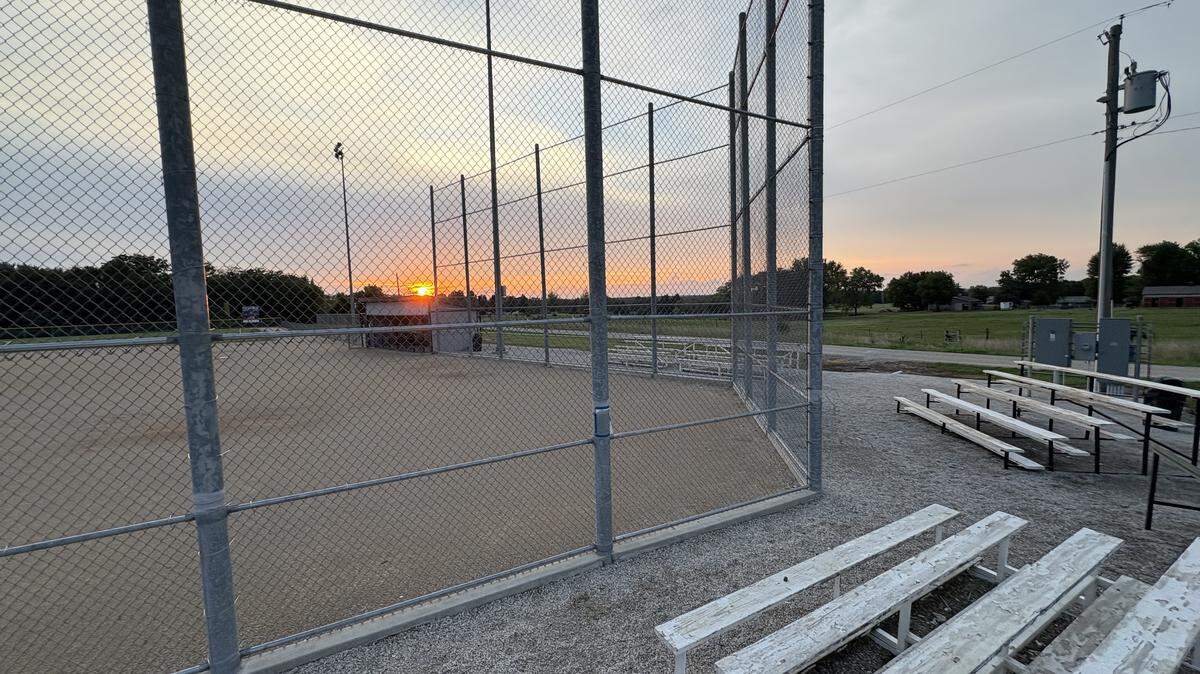
Twice in the past five years, supermajorities of voters have turned down proposals to build new high school baseball and softball fields in Louisburg, Kansas, home of the Wildcats.
The school board had no intention of asking again.
Its new plan was to fund a scaled-down version of the project by entering into a 10-year, $4 million lease-purchase agreement with First Option Bank. Adding in interest, the fields would cost about $4.8 million.
Unlike proposals before it, though, the annual payments of more than $400,000 would be funded entirely through the school district’s capital outlay budget, meaning construction wouldn’t require a property tax hike.
But 568 people signed a protest petition that was filed with the Miami County clerk in July — more than twice the threshold of Louisburg voters necessary to trigger a referendum vote on whether the project can proceed.
“I was not personally opposed to a baseball/softball project,” said Mark Mowrey, one of the volunteers who collected signatures to force a third vote on the proposed ballfields.
“I, and many others, did disapprove of the action by the school board to build something with our tax dollars that had been rejected twice by the voters within the last five years by a better than two-to-one margin each time.”
In August 2020, 69% of Louisburg voters opposed a school bond issue that included the construction of new ballfields. A smaller bond without the ballfields was approved later that year, but when the Louisburg Recreation Commission sought permission in 2021 to raise its levy in support of a $6.7 million baseball and softball complex, 69% of voters again rejected it.
Sarah Pfannenstiel, whose children attend Louisburg schools, said the proposed high school sports complex would be a valuable asset for students and the broader community.
“It’s incredibly disheartening to see such a well-thought-out plan to improve our town’s facilities — with no tax increase — met with so much negativity,” Pfannenstiel said. “This initiative has the full support of our elected school board members, the very individuals our community chose to represent us.”
Dispute over state law
Without dedicating time during a meeting for public input, board members directed Superintendent Brian Biermann to solicit a design and competitively bid the construction job last October.
In May, six out of seven board members voted to finalize the lease-purchase agreement and award the contract to Sands Construction. That’s when Miami County Attorney Kenton Harding stepped in to share his grave concerns about how the school board was conducting business.
At a special meeting the week after the agreement was authorized, Harding addressed the board in a crowded room full of parents and students, many of them decked out in purple Wildcats shirts and ballcaps.
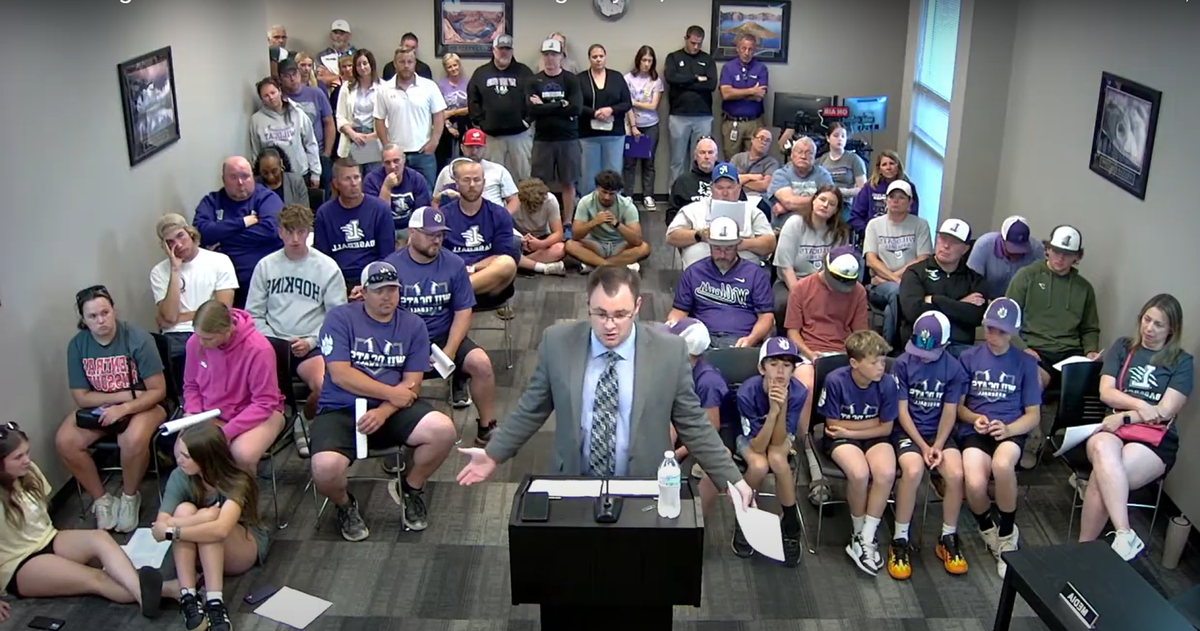
“I have never been as conflicted. I have never been in a more difficult room than this one right here and on this particular issue,” said Harding, a Louisburg graduate who played baseball at the city-owned fields where high school games are played. His mother teaches first grade for the district, and his brother is the head football coach.
“Most of the time, when there’s someone on the opposite side of me, my task is to beat them,” Harding said. “And that’s not what I’m here to do.”
But in his legal opinion, Harding said, the school board infringed on taxpayers’ due process rights by green-lighting the construction project without publishing notice in The Miami County Republic, the local paper of record. Doing so would have allowed residents the opportunity to lodge a protest petition and force a public vote on the spending.
Kansas law 10-1116c requires taxing entities entering into multi-year lease-purchase agreements to publish notice of their intent if the agreement “involves the acquisition of land or buildings” and if annual payments cost more than $100,000.
District officials initially said their own lease agreement was exempt from those requirements because they planned to erect the fields on land that the school district already owned, and because the scaled-down project didn’t include outdoor restrooms, a concession stand or any other buildings.
“Originally, we didn’t believe we were violating that statute because the land is ours, so we’re not acquiring land,” Superintendent Biermann told The Star in August. “And then, ‘and or buildings,’ our board and our legal interpreted that as like, you’re acquiring a building. You’re either building the building or you’re buying the building. We’re not doing that.”
Harding, who did not respond to The Star requests for comment, said in May that unless the board took corrective action by publishing the resolution in the paper, he would have to sue the district or turn the matter over to Attorney General Kris Kobach.
In the context of the state law, he said, “buildings” should be read as a verb. Otherwise, the district could theoretically spend as much money as it wanted on outdoor projects such as golf courses or amphitheaters without public oversight.
“In issues like this, especially in small towns, there may be a portion of this community that has a little bit of sticker shock at $4.8 million but they may be afraid to stand where I have to stand in front of you all today,” said Harding, who told board members he was personally supportive of the ballfield project and would even campaign in favor of it.
Plans for new ballfields
Biermann said Louisburg schools have successfully used lease-purchase agreements in the past for major capital projects, including buying new buses and laptops and resurfacing the football field. In each case, he said, the district paid off its leases ahead of schedule.
“It’s not like anything’s going on the back burner for this either,” Biermann said. “We have a very strategic capital improvement plan from parking lots to roofs to mechanical work. Teachers are still getting raises. We’re fully staffed.”
The project voters are now being asked to approve is two new artificial turf fields — one each for the varsity baseball and softball teams. The complex, situated near the middle and high school, would feature dugouts, a padded backstop, field lights, fencing and scoreboards, as well as a dual-lane batting cage.
The project would also include minor upgrades, including dugouts, bleachers and ADA-accessible pathways at the practice fields just across Wildcat Drive, which would be turned into junior varsity competition facilities.
The current varsity competition fields are at Lewis-Young Park in Louisburg on land that was donated to the city decades ago. School board President Jim Foote described those accommodations as “inadequate at best.”
“The scoreboards don’t always work. The fields are in poor condition. And there are no structures for inclement weather,” Foote said during the special meeting in May.
Because there are two softball fields at Lewis-Young Park, the junior varsity team can also play games there. But only having one baseball field creates logistical problems, the superintendent said.
“When we host, say Eudora, we have to take our JV to Eudora. So it splits our fans, splits our coaches, splits our student athletes,” Biermann said.
Head baseball coach Kade Larson, also a math teacher at Louisburg High School, said even for varsity home games, players have to leave class more than half an hour early and load into a bus to drive across town.
“Having our fields on school property where we can walk out the back door to our home games keeps our students in class,” Larson said in an email statement. “This keeps them from having to try to find time in their extremely busy schedule to make up class work.”
‘Really frustrated’
State Sen. Doug Shane, a Louisburg Republican, said he plans to vote against the ballfield proposal. He was also involved in collecting signatures for the protest petition.
“At the end of the day, people are just really, really frustrated with the amount of money that they perceive they put into the schools relative to how they’re treated and the outcomes they’re seeing,” Shane said.
Although the project wouldn’t require the district to raise its mill levy — USD 416 is already collecting the eight mills it’s allowed to under state law for capital outlay projects — Shane said the agreement doesn’t sit right with him.
“They said it in their open meeting that they intend on in perpetuity collecting eight mills, so that’s the legal maximum that they can collect for capital outlay,” Shane said. “If they commit to doing that and property values continue to rise, they are committing to tax increases year over year.”
The efficiencies the district proposed to save money, including the lack of outdoor restrooms and concessions, would make for a less-than-optimal fan experience, Shane said. He would prefer to see the city and school district partner with local benefactors to upgrade fields at Lewis-Young Park.
School officials said the proposed sports complex, which would be open to the public when not in use, could also be repurposed for physical education classes and co-curricular activities.
Zeb Tiedeman, Louisburg band director, said building new fields adjacent to the school would greatly improve rehearsal conditions for his own marching band students, who currently brave uneven ground and wet grass during first period.
“Right now, kids regularly soak their shoes doing morning marching rehearsals. I have to paint the configuration of the marching field just right to avoid lower areas that collect water,” Tiedeman said in an email.
“A new field would provide a level, dry surface every single time we use it.”
Ultimately, it will be up to voters to decide whether they trust the school district to move forward with the project.
This story was originally published September 2, 2025 at 6:00 AM.