A new earnings tax for WyCo? It’d provide homeowners much-needed relief, KCK officials say
One Kansas City Democrat has developed a plan that he believes could lower Wyandotte County homeowners’ tax bills and utility costs as division among Kansas Republicans threatens to undermine the relief lawmakers promised in 2025.
It’s not the first time Sen. David Haley has proposed giving counties the authority to impose a local earnings tax of up to 1%. But it is the first time his bill calls for 100% of new collections to help offset the property tax revenue that makes up most of local governments’ budgets.
Like in Kansas City, Missouri, where voters have renewed their support for a local earnings tax every few years since 1963, Haley’s bill would authorize local governments to tax both residents and people who commute to the county to work.
Soaring property values have resulted in higher tax bills for Wyandotte County homeowners in recent years. But county officials supporting Haley’s proposal say adopting an earnings tax would allow the Unified Government to significantly reduce its mill levy and the fees tacked on to residents’ water and electricity bills.
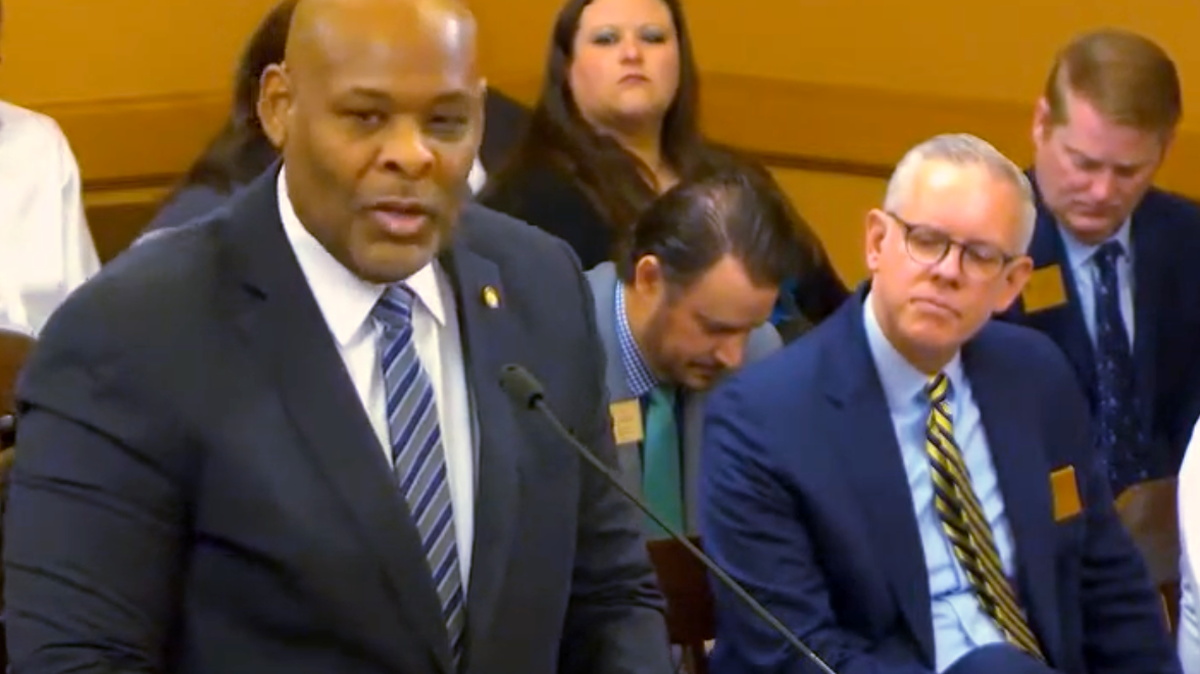
“We have some of the most distressed zip codes,” Kansas City, Kansas, Mayor Tyrone Garner recently told the Senate Tax Committee. “We’ve got a lot of high wage earners but they don’t live in Wyandotte County.”
Therefore, they don’t help fund essential services including road maintenance and public safety, he said.
Garner testified that a 1% earnings tax would generate an estimated $60 million for Wyandotte County, the lion’s share of which would come from people living elsewhere. According to the Wyandotte Economic Development Council, roughly 55,000 of the 92,000 jobs in the county are held by non-resident workers.
Some of the highest wage earners at major employers in KCK — including the University of Kansas Health System, the University of Kansas Medical Center and the Providence Medical Center — live in Johnson County or across the border in Missouri.
“I think there’s just a root-level issue of fairness,” said Marcus Winn, a community organizer who owns a home in KCK’s Cathedral Neighborhood and supports the earnings tax bill. “If you are working in Wyandotte County and you are benefiting from the work of the last several decades of economic development that has gone on to attract these high-paying jobs, and you’re benefitting from the infrastructure investments that make them possible, you should help pay for those infrastructures that make your job possible.”
‘Trying to sustain ourselves’
The total value of goods and services generated in Wyandotte County is higher than that of all but two of Kansas’ 105 counties. But when it comes to median family income, Wyandotte ranks 87th, according to National Institute of Health data.
“We have a lot of money driving out of the county that could go back in and help reduce our taxes and allow us (to) do other things,” said first-term Rep. Wanda Brownlee Paige, a KCK Democrat and retired teacher who worked for the Kansas City Public Schools and had 1% of her earnings deducted to fund roads, firefighters and law enforcement there.
“I just ask you would have mercy and at least allow it to come to the floor and be voted on so that we can — we’re trying to sustain ourselves and we need some help,” Paige told committee members during the bill hearing.
Haley’s proposal is one of the few Democrat-sponsored bills to receive a committee hearing so far during this year’s session, which has been dominated by the priorities of expanded Republican supermajorities in the House and Senate.
“I think one of the reasons it’s being heard in the committee at all is that we are really desperately and decisively, many of us, trying to do what we can to go back home and tell people that there are options for the ever-spiraling property taxes,” said Haley, who joined Senate Republicans last month in voting to pursue a constitutional amendment that would cap annual property tax appraisal increases at 3%.
“It’s frightening what’s happening to some communities, including Wyandotte County, where the appraisal rates are going up and people cannot afford it so they’re taxed out of living in their homes.”
Kansas property taxes are driven by three major factors — the property’s appraised value, the percentage of the appraised value that’s taxed (the assessed value) and the mill levy. Counties, cities, school districts and the state each set their mill levy, with one mill constituting $1 per $1,000 of a property’s assessed value.
Accountability concerns
Haley last introduced an earnings tax bill in 2021, when it received a hearing but didn’t generate enough support from lawmakers to go to a vote of the full Senate.
Not everyone is sold on the idea of empowering counties to impose a new tax.
Sen. Caryn Tyson, a Parker Republican who chairs the Senate tax committee, is among the skeptics. She told The Star she doesn’t plan to revisit Haley’s bill this year unless a majority of members on her committee signal an interest.
“It would just be another tax, and there’s no guarantee that they would use it to lower property taxes,” Tyson said. “It needs some more work as far as implementation to ensure that it would be for lower property taxes.”
The bill states that all new collections “shall be credited in the budget of the county to reduce the amount of revenue otherwise necessary to be derived from the ad valorem property tax.” But it doesn’t say what consequences a county would face for failure to cut property taxes or what would stop the government from building a larger budget than the previous year.
No earnings tax could be imposed without voter approval.
Sen. Jeff Klemp, a Lansing Republican on the tax committee whose district includes part of Kansas City, said he believes the bill is still “in its infancy stage.”
“I don’t want to see other taxes go up as a result of something coming down, but it’s worth taking a look at it,” Klemp said. “I would not look to kill that at this point. I would look to understand it further, to really understand the impact it could have.”
During the hearing, Sen. Stephen Owens, a Hesston Republican, questioned the Kansas City mayor about how an earnings tax would provide tangible relief for residents.
“I just want to understand this,” Owens said. “Based on your tax analysis, are you proposing that if this were to pass and be fully implemented, you would eliminate property taxes completely in your jurisdiction?”
“I think there’s an opportunity,” Garner responded. “If this is done right, that there could be a potential for us to reduce if it’s applied to property taxes and the amount of money that we bring in, we could potentially reduce property taxes in Wyandotte County and move away from property taxes in general just through this legislation alone.”
Economic impact and equity
Last July, the Unified Government voted to adopt a revenue-neutral budget, forgoing more than $14 million in potential property tax revenue and resulting in budget cuts across government departments and programs.
Greg Kindle, president of the Wyandotte Economic Development Council, said imposing an earnings tax to minimize the property tax burden wouldn’t solve the county’s revenue problem outright.
“It’s a complicated issue. If the earnings tax is just about dollar-for-dollar lowering the property taxes, we haven’t actually improved the pool of money,” Kindle said. “We’ve just changed who’s paying it. That doesn’t fix the infrastructure that is at the crux of the real problem here, which is that we need revenue to fix and improve infrastructure, in my opinion.”
Under Haley’s proposal, individual workers would not be responsible for paying their own local earnings tax. Instead, employers would be charged with remitting 1% of each employee’s earnings to the county. As compensation, employers would be allowed to pocket 1.5% of all earnings generated by their workers.
Although reducing the property tax burden could provide significant benefits to business owners and homeowners, there’s no guarantee that landlords would pass those savings on to their tenants.
Chenell Miller, a KCK renter who works as a contractor at General Motors, said she would probably vote against any proposal to make her earnings taxable at the local level without guaranteeing lower rental rates.
“Charges get passed on. What about the renters? What are we getting out of it? And they’re going to tax us more. That’s all we’re getting,” Miller said.
But she was intrigued by Mayor Garner’s claim that an earnings tax could help Wyandotte County finally do away with the unpopular PILOT surcharge that gets added onto utility bills.
“The utility bill is ridiculous in Wyandotte County. (Lowering) the utility bill, that would help because it stays high over here,” Miller said.
“Then maybe people would consider that.”