Struggling JoCo, WyCo homeowners await property tax relief as KS Republicans remain divided
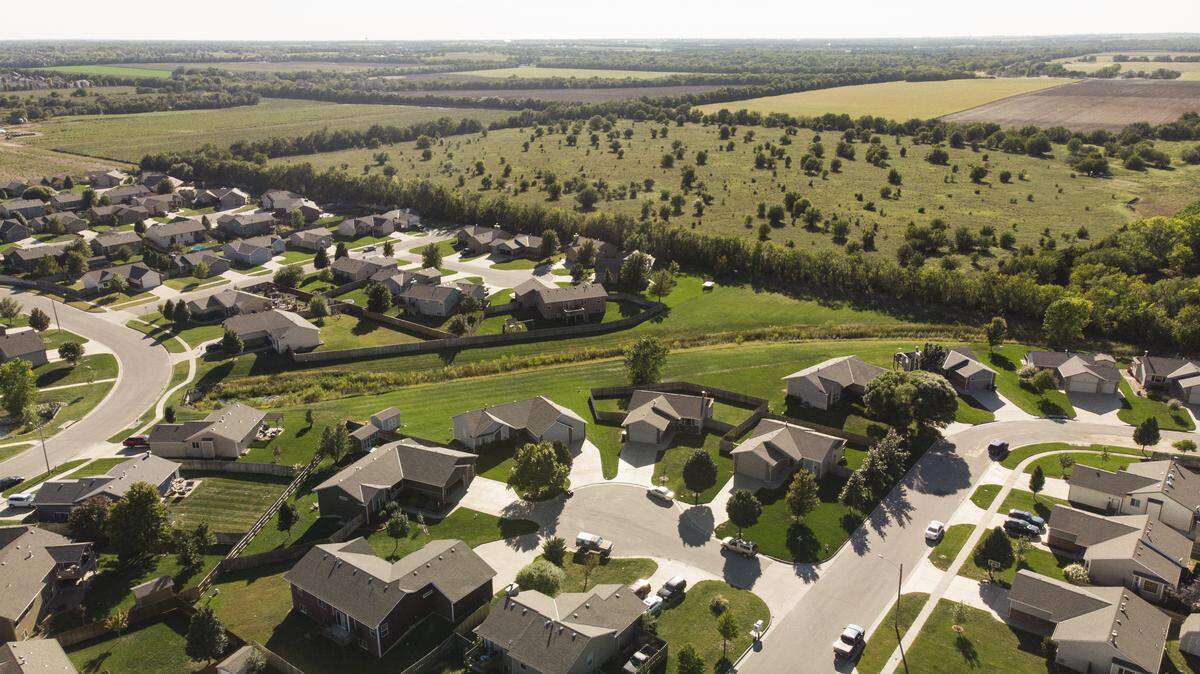
Sam Stillwell and his late father built the two-story Quindaro Bluffs house themselves, mixing concrete for the foundation by hand and buying the supplies they could afford out of each paycheck.
His parents needed an upgrade from the ramshackle 1940s home Stillwell calls “the shack on the hill” that they had lived in since moving to Kansas City, Kansas, property in 1984. Starting from scratch, they hoped it could become a source of generational wealth and security.
“One thing that I talked to my father about was just making sure that I left it to the boys so that they had a place,” said Stillwell, a 57-year-old middle school special education teacher and father of three.
But now he’s not sure if he’ll be able to keep the house in the family. Like many homeowners across Wyandotte and Johnson Counties, he’s struggling to pay his property taxes.
Republicans in the Kansas Legislature have vowed to provide property tax relief this year. They believe they have a mandate from the voters who delivered them expanded supermajorities in the House and Senate.
A spokesperson for Democratic Gov. Laura Kelly, Grace Hoge, said the governor is “willing to consider tax cut proposals that pay for themselves and don’t threaten Kansas’ long-term financial health.”
But so far, GOP lawmakers haven’t settled on how to deliver relief for property owners whose double-digit appraisal increases have driven up tax bills in recent years. And a familiar divide between House and Senate Republicans is threatening to derail meaningful reform.
Stillwell said if state lawmakers don’t intervene, he may have to sell the house he had hoped to pass on to his sons.
“To go somewhere else — I don’t know where to go. But leaving this debt to my children is the thing that resonates loudest with me.”
Finding the right approach
Kansas property taxes are driven by three major factors — the property’s appraised value, the percentage of the appraised value that’s taxed (the assessed value) and the mill levy. Counties, cities, and school districts each set their mill levy, with one mill constituting $1 per $1,000 of a property’s assessed value.
Last week, Senate Republicans passed a resolution proposing a constitutional amendment that would prevent residential property appraisals from increasing by more than 3% annually. That would force local governments that want to grow their budgets to raise mill levies rather than simply capitalizing on ever-rising appraisal values.
But Speaker of the House Dan Hawkins, a Wichita Republican, says that proposal won’t come to a vote in his chamber over concerns that it could distort the housing market and discourage the construction of new homes that would be taxed at full value.
House Republicans are in the process of rolling out their own proposal for a property tax constitutional amendment, which would need to win the support of two-thirds of lawmakers in both chambers to go to a vote of the people.
Rep. Adam Smith, a Weskan Republican who chairs the House Tax Committee, came up with a plan that would give lawmakers the authority to change the way residential property taxes are calculated.
Modeled after how property taxes are calculated for agricultural land in Kansas, each residential property would be taxed not based on its current market value but on a six-year rolling average of its market value.
“Essentially what we’re doing is we’re taking out some of the sharp spikes,” Smith said. “If the housing market goes crazy or something happens where there’s a sharp increase, that increase gets spread out over a period of six years.
“It really helps buffer the impact (of rising valuations) but it doesn’t cause some of the disparity problems and regressivity problems that you see with a flat rate fixed cap.”
If for some reason the current market value of a property dipped below its six-year rolling average, property owners would be taxed at the lower rate under Smith’s plan.
Sen. Caryn Tyson, a Parker Republican who chairs the Senate tax committee, said she hopes House members will reconsider the benefits of the valuation limit already approved by the higher chamber. But she’s optimistic about her party reaching an agreement on how best to reform the property appraisal process.
“We got the needle moving. They’re at least talking about it now,” Tyson said.
‘Something needs to be done’
Nearly 90% of residential properties in Johnson County increased in value in 2024. After two straight years of double-digit average increases for residential appraisals, valuations climbed 6.1% on average in 2024. Most residential property appraisals across Wyandotte County increased by around 10%.
“The reason why the property taxes are killing me is because they are using up all of my extra income, my discretionary income so that I don’t have any money to keep my house up,” said Carol Hein, who has lived in the same Roland Park home for 42 years. “That’s what usually happens to older people. They have to let their house go.”
Hein said she’s skeptical of city and county governments that keep their mill levies flat or even lower them slightly while soaring property valuations continue to pad municipal revenues.
“They say, ‘Well, we lowered the mill levy.’ Well, that’s not the problem. The problem is the value of our house keeps going up,” Hein said.
“Something needs to be done because Johnson County is redeveloping all their parks, their libraries. They’re spending this windfall on things that actually are not necessary. They’re nice but they’re not necessary,” she said.
Overland Park and Olathe both submitted written testimony opposing the Senate’s proposal to cap residential property valuation increases at 3%.
“At the end of the day, the state’s in charge of the appraisal system. We like a rolling average may be better than a cap, but we’re just glad they’re taking a look at it because we think some fixes need to be made,” said Spencer Duncan, government affairs director at the League of Kansas Municipalities.
He said the association of local governments would prefer for the Legislature to convene a task force of state and municipal officials, appraisers and tax professionals to discern the best approach to property tax reform before implementing it next year.
“Local governments are not trying to, nor do we want to continue to increase property taxes,” Duncan said. “But until there’s a little bit better look at the valuation system and until there’s a better look at all the other tax exemptions that the Legislature is putting in place that impact local levies, then it continues to put a burden on those property taxes.”
Other property tax ideas
Most property tax revenue goes to local schools and governments, but the state does have its 20-mill levy used to help fund public education that generates upwards of $800 million annually.
House lawmakers are working on a bill that would cut that mill levy from 20 to 18.5, and the Senate tax committee recently advanced a bill to eliminate another 1.5 mills that Kansas annually levies to help pay for building repairs at colleges, universities and other state institutions.
The proposed bills are designed to transfer state general fund money to keep funding levels for schools and building repairs consistent, although some education advocates have voiced concern about the long-term viability of switching funding sources. General fund money consists primarily of income and sales tax revenues.
Smith, the House tax committee chair, said pursuing both mill reductions this year isn’t feasible.
“That would be three mills off,” That’s probably about $120 million,” Smith said. “That’s about twice of what I was told we could budget for tax cuts this year.”
A 1.5 mill reduction would save the owner of a $300,000 home $51.75 on their property tax bill.
Democrats favor a different approach to relief that builds off of the one property tax provision included in last year’s tax cut package, which exempted the first $75,000 value of a home from the statewide mill levy. Previously, the first $40,000 was exempt.
House Democrats have introduced a bill to exempt the first $110,000 value of a home from the statewide mill levy, and Senate Democrats are aiming for the first $125,000.
House Minority Leader Brandon Woodard, a Lenexa Democrat, said another key reform he hopes to see implemented is the reinstatement of the Homestead Property Tax Rebate for renters, a program that was discontinued over a decade ago.
“We want to make sure that anything that we’re doing is not only addressing just homeowners but also the third of the state that are renters as well,” Woodard said.
In her State of the State address last month, Gov. Kelly cautiously opened the door to entertaining property tax cut proposals this year after repeatedly saying Kansas should wait to better evaluate the impact of the tax cuts passed in the 2024 special session.
If Kelly vetoes a bill, it will take two-thirds majorities in the House and Senate to override her. The governor has no veto on proposed constitutional amendments.
“As she always has, the governor will carefully review all tax proposals that are sent to her desk to determine if they are in the best interest of Kansas and Kansans,” Hoge said.
This story was originally published February 11, 2025 at 11:12 AM.