Missouri push to keep Chiefs, Royals reaches new pitch as Kehoe holds closed-door talks
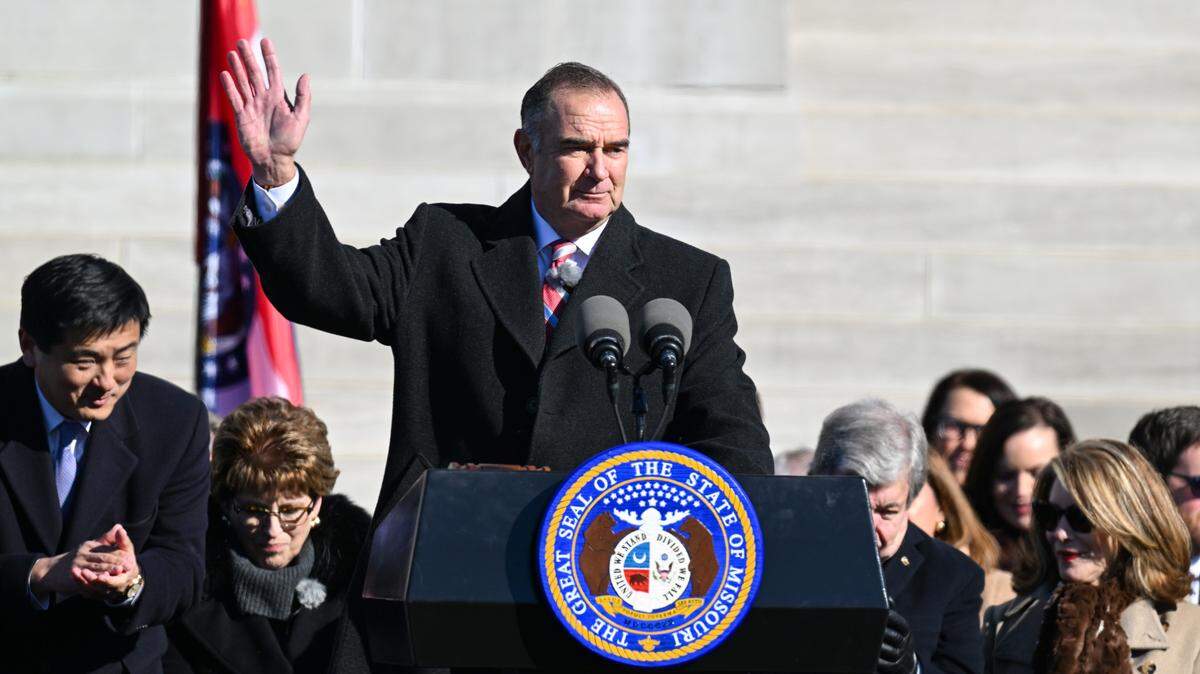
Eleven months after Jackson County voters rejected the Chiefs and Royals’ stadium proposals, the teams’ desire to cement their long-term futures has sparked some movement in a familiar location:
Back in Missouri.
Missouri and Jackson County politicians are engaging in a series of separate but related private meetings this week to discuss stadium options with the two teams, The Star has learned.
A Kansas City state senator on Thursday also filed legislation that would create an entertainment facility capital assistance program, offering a path for Missouri to partially finance new stadiums for teams.
The activity potentially marks the beginning of a more intense phase in the effort to keep the teams in Missouri after months of little public progress.
On Thursday, Royals leaders are scheduled to meet with Missouri Gov. Mike Kehoe, the governor’s office said.
And it’s not the only time this week Kehoe is discussing stadium plans for the two Kansas City teams.
At the Missouri Capitol, Kehoe and top Missouri lawmakers on Wednesday met with Jackson County Legislators Manny Abarca and Sean Smith and Kansas City Councilman Nathan Willett.
While the closed-door meeting centered on the future of the teams — mainly the Chiefs — it also featured discussions on solving issues with tax assessments, a long source of frustration within Jackson County. State and county leaders appear hopeful that if residents are more confident in the tax assessment process, they’ll be more likely to vote in favor of a future stadium funding package.
“We had a very productive discussion and we all understand that the citizens of Jackson County need property tax relief before they vote to keep the Chiefs at Arrowhead,” Missouri House Speaker Jonathan Patterson, a Lee’s Summit Republican, said after the meeting.
Patterson promised that lawmakers will debate legislation, likely next week, that would make Jackson County’s assessor — currently an appointed position — elected. The push comes amid intense outcry from homeowners after a dramatic increase in property assessments in 2023.
“I think people need to understand that the property tax problem is solved,” Smith said after the meeting. “I think voters understanding that this can never happen again, not just in Jackson County, but statewide, would be a huge change of context versus the last election.”
After the meeting, a Kehoe spokeswoman did not offer additional details but reiterated that the governor is committed to working with “local stakeholders” to keep the teams in Missouri.
“Retaining these businesses requires multiple stakeholders and discussing a variety of options—this was the purpose of today’s meeting,” the spokeswoman, Gabby Picard, said in a statement.
“The governor will explore the use of every tool at his disposal to protect jobs, economic growth, and investment in Missouri. However, any action taken must be a good return on investment for Missourians.”
The spurt of new energy surrounding the future of the teams comes as the Missouri General Assembly approaches a key deadline — this week marks the final opportunity for lawmakers to introduce new legislation this year. With each passing day of the session, any legislative component aimed at keeping the teams in Missouri becomes more difficult both logistically and politically.
At the same time, Kansas continues to offer an alluring option to the Royals and Chiefs in the form of a state law passed last year that authorizes state officials to approve publicly financing up to 70% of the cost of a new stadium for one or both teams. Kansas officials also face a ticking clock, with the legislation set to expire in June, though top lawmakers have the option to grant a one-year extension.
Predictions of plans and developments of a response from Missouri came and went. At one point last summer, then-Gov. Mike Parson said the Royals needed to have a new plan by the end of the year; no plan was ever released publicly.
That remains true.
But the series of conversations this week illustrates some possible momentum.
Inside the stadium fight
Since an April 2024 ballot measure to guarantee both teams’ residences would remain in Jackson County was rejected, the Royals’ downtown baseball talks have been led by the city, including Mayor Quinton Lucas, who continues to express his optimism both teams will remain in Kansas City, Missouri.
For six months those conversations have focused almost exclusively on a site at Washington Square Park, north of Crown Center. The team’s failed pitch centered on a location at The Star’s former press pavilion in the Crossroads District.
In the aftermath, the Royals have also explored additional stadium locations in Kansas, one of them at the former Sprint campus near 117th Street and Nall Avenue in Overland Park.
In fact, Kansas moved swiftly in the wake of the Jackson County vote. By June, the Kansas Legislature passed the supercharged financing plan, which relies on billions in Sales Tax and Revenue, or STAR bonds.
The bonds would be paid back by sales tax revenues from within any new stadiums and surrounding retail development, as well as future sports betting and Kansas Lottery revenues. A Chiefs stadium alone could cost at least $2 billion, and probably closer to $3 billion. A Royals stadium could be another $1.5 billion, if not more.
Some eight months after Kansas passed its STAR bond legislation, Missouri state Sen. Barbara Washington, a Kansas City Democrat, told The Star on Wednesday she was considering introducing a bill that would help finance new stadiums in her state.
After her conversation with The Star, Washington on Thursday filed the bill. The legislation would create a “Missouri Entertainment Facility - Capital Assistance Program.” The program would authorize Missouri to provide financial assistance for stadiums, similar to the Kansas program.
It could provide the team with the catchphrase on which they’ve latched since their failed vote:
Options.
Earlier this month, Royals owner John Sherman said he hoped the team would have its plans buttoned up by “mid-year.”
The Chiefs have kept close to the vest their preferred pursuit, even as land owners at metro locations pursue them. Days before Super Bowl LIX in New Orleans, team president Mark Donovan said the Chiefs are still analyzing options in both Kansas and Missouri. Their primary Missouri option remains a renovated Arrowhead Stadium.
“We’re obviously still down the path with both options,” Donovan said days before the Super Bowl earlier this month. “Renovation (of Arrowhead Stadium) is still very likely. (A new) dome is very possible.”
A year ago, the team’s ballot measure proposal included an $800 million renovation of Arrowhead Stadium. Those blueprints were met with mixed feedback, at best, and Donovan said any renovation plan would include a reboot.
A new build in Kansas would be far more expensive.
If either team uses the Kansas STAR bonds, the debt would be repaid over 30 years by a combination of tax revenue from the stadiums and surrounding development, sports gambling revenue and Lottery revenue. Annual Lottery revenues above $71.5 million each year are now redirected into a fund to help pay off the bonds, a change likely worth about $10 million a year.
Cities and the counties would have the option to pledge local tax revenue from inside the STAR bond district toward repaying bonds, but wouldn’t have to. But any local government that decides against pledging revenue would likely lose leverage during negotiations over the terms of a STAR bond agreement with one or both teams.
Researchers over several decades have consistently found that stadiums and arenas are not major drivers of economic development. A 2022 review of 130 studies over 30 years found that nearly all empirical studies found “little to no tangible impacts of sports teams and facilities on local economic activity” and that the level of subsidies typically provided for stadiums “far exceeds any observed economic benefits.”
‘We’re pushing back.’
While supportive of public funding for stadiums, Washington, the Missouri state senator, said that any stadium proposal would need to come from multiple sources.
“It can’t just be money from the state,” she said. “Jackson County and the city are going to have to chip in as well to do this.”
Washington said she hopes the state provides some type of funding to try to keep the teams. She pointed to the millions of dollars Missouri contributed to help Kansas City host World Cup matches next year.
The teams also help bolster businesses in the metro, she said.
“Let’s keep those entities in our city and in our county, in my district, that are bringing in revenue,” Washington said. “I know there’s a ton of studies that say professional teams don’t bring in revenue, but I do not agree with that.”
Under her bill, stadium projects would have to meet certain requirements to qualify for state assistance, such as costs at least $250 million, private funding that covers at least 33% of the costs, local government support and a binding commitment from any professional sports team that will occupy the stadium.
The legislation would set a series of requirements on the state as well, capping the total amount of funding Missouri can provide to stadium projects at 33% of the total project costs.
While Jackson County officials debate the teams’ futures, some lawmakers in Kansas City’s Northland are also pushing legislation that could attract a Chiefs training facility or a Royals stadium to Clay County.
Sens. Maggie Nurrenbern, a Kansas City Democrat, and Kurtis Gregory, a Marshall Republican, have filed bills that would allow Clay County to create a county sports complex authority, similar to the one in Jackson County that controls the leases for both teams.
The authority would be established “for the purposes of developing, maintaining, or operating…sports, convention, exhibition, or trade facilities.” The complex could open the door for a Chiefs headquarters and practice facility or a Royals stadium.
“We are certainly looking at a situation, I think, with both teams, that if we don’t help facilitate this conversation sooner than later, I think we’re at a real risk of losing one or both to the state of Kansas,” Nurrenbern said in an interview.
Both state senators made clear that the legislation wasn’t about enticing the teams to choose Clay County over Jackson County. It’s about keeping the teams in Missouri, they said.
Gregory, whose district includes a portion of Clay County, said he joined Nurrenbern’s effort because concerns over losing the teams was one of the top issues he heard from his constituents. He said it would be a “generational” change if either team left Kansas City.
“I just want it to be known that we’re pushing back,” Gregory said. “To at least have options.”
The Star’s Cayli Yanagida contributed reporting.
This story was originally published February 27, 2025 at 6:00 AM.