Confused about the Kansas abortion vote? Your most common amendment questions, answered
READ MORE
KCQ Votes: Answering questions on August primaries
The Star’s Service Journalism team is providing information you need to know about issues, voting laws and election procedures for Kansas, Missouri and the KC area.
Expand All
When Cynthia Wendt was 39 years old, she had a surprise pregnancy. An early screening revealed possible complications. While waiting on further results, Wendt said she realized how important it was that she had the right to choose an abortion, if that were in the best interest of her family.
“During the weeks of uncertainty, it made me realize that any decisions should have been between me, my husband and our doctor, and was not the business of any level of government,” she said. Her pregnancy ended up healthy and fine.
Now that abortion rights are on the ballot in Kansas on Aug. 2, readers like Wendt in Leawood have reached out to The Star with questions. She wants to know what health care options people would have if the abortion amendment is passed.
Readers like Ben, who chose not to disclose his last name, said the the phrase “Value Them Both,” the name that supporters gave the amendment, resonates with him. But after looking more into the subject, he wrote to The Star with questions about what abortion laws already exist in Kansas and what this amendment would actually change.
These are some of the most common reader questions we’ve received about the amendment, answered.
What does it mean that Kansans currently have a right to abortion?
In 2019, the Kansas Supreme Court ruled that the state constitution includes a right to bodily autonomy. That includes abortion, the justices said.
As a result, the Kansas Legislature is barred from passing laws that restrict access to abortion. Any abortion restrictions must clear an extremely high level of “strict scrutiny” from the court to become law, and most restrictions on abortion, including a total ban, would be considered unconstitutional in Kansas.
What is the exact language of the proposed amendment?
The amendment, which supporters have dubbed the “Value Them Both” amendment, would add the following language to the state constitution, if passed.
“Regulation of abortion. Because Kansans value both women and children, the constitution of the state of Kansas does not require government funding of abortion and does not create or secure a right to abortion. To the extent permitted by the constitution of the United States, the people, through their elected state representatives and state senators, may pass laws regarding abortion, including, but not limited to, laws that account for circumstances of pregnancy resulting from rape or incest, or circumstances of necessity to save the life of the mother.”
You can read the legislature’s summary of the amendment and what it would do online, where you can also see the full resolution that called for the amendment.
So run that back—what exactly does a yes vote mean?
If a majority of people vote yes on the ballot and the amendment passes, language would be added to the Kansas state constitution that would take away the right to abortion.
Since federal abortion rights were removed when Roe v. Wade was overturned, if voters choose to remove state level abortion protections with the amendment, the Kansas Legislature would be able to impose new restrictions on abortion. That includes the possibility of completely banning the procedure, without any exceptions for rape, incest or medical emergency.
What exactly does a no vote mean?
If a majority of people vote no and the amendment does not pass, the Legislature would continue to be barred from passing most legislation that impedes on a person’s access to abortion.
Kansas would continue to protect the right to abortion, despite the recent U.S. Supreme Court ruling that removed the right at the federal level.
With the constitutional protection, does Kansas regulate abortion at all?
Yes. Even with the right to abortion protected, Kansas heavily regulates the procedure.
Abortions after 22 weeks are strictly limited. Patients must receive mandatory state-written materials before going through with an abortion. An ultrasound is required, and so is parental consent for minors. Abortion clinics in Kansas face regulation from the state health department for safety, sanitation and cleanliness. Practicing clinicians must abide by license requirements and investigations by the state, just like all other medical professionals in Kansas.
If Kansans vote ‘no,’ could current abortion restrictions go away?
Not automatically. Any restriction in question would need to be legally challenged, and a state court would need to decide that the regulation is unconstitutional in Kansas.
The campaign advocating for the amendment warns that existing regulations could be struck down under the 2019 ruling that found the state right to abortion.
Last year two of Kansas’ abortion restrictions were deemed unconstitutional under this ruling, and a lawsuit challenging the state’s ban on telemedicine abortion is ongoing.
Abortion rights advocates could sue to block other existing abortion regulations in the future, but any actual changes would depend on Kansas courts ruling that the regulation in question violates the state’s constitution.
The Star published a guide with more information on what a no vote means, too.
Do state taxes pay for abortions?
Generally, no. Publicly funded health insurance plans like Medicaid will only cover the procedure in Kansas if it is necessary to save the life or a “major bodily function” of the patient.
If Kansans vote ‘yes,’ will the amendment ban abortion?
The amendment vote will not automatically ban abortion if passed. A total ban would require a few more steps and would not be immediate or guaranteed in Kansas.
This amendment vote will decide whether current right to abortion will remain in place.
If the amendment passes, the legal standard for what kinds of laws the Legislature can pass about abortion will change. Without the right to abortion in the state constitution, legislators would have fewer guardrails and would be able to pass more restrictive abortion laws, which could include a total ban without exception.
The Star published a guide with more information on what a yes vote means, too.
Will legislators ban abortion if the amendment is passed?
We don’t know for sure. Since Roe v. Wade was overturned, it is possible that lawmakers would introduce a bill that could either further restrict or ban abortion.
We can’t tell the future, but we do know that earlier this year, a state legislator introduced a bill that would have banned and criminalized nearly all abortions, except in cases of miscarriage, stillbirth or ectopic pregnancies. The bill didn’t get a hearing and died once the legislative session closed in May.
State lawmakers could hold a special session to discuss abortion rights, which is when lawmakers convene outside of the regular legislative session.
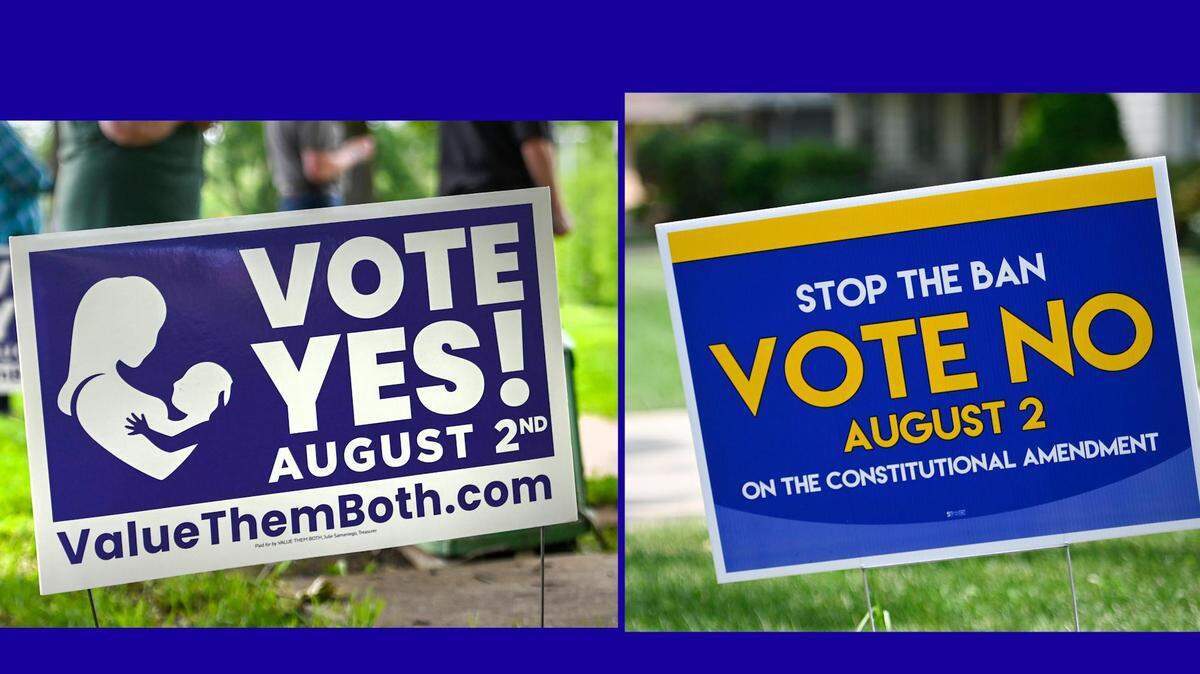
Are churches and nonprofits legally allowed to post ‘Vote Yes’ or ‘Vote No’ signs on their grounds?
Yes. Although nonprofits, including churches, are not supposed to engage in political campaigning, they are allowed to lobby for issues, according to Terry Mosteller, who is the founding attorney at Mission Counsel, a law firm that specializes in helping nonprofits.
It would be a violation of their 501(c)(3) status if a church or nonprofit had a sign that was endorsing a candidate for governor or mayor, but since the upcoming vote doesn’t involve a candidate nonprofits can have yard signs without being in violation of their nonprofit status.
If a nonprofit does contribute a substantial amount of time, money and resources to a certain issue or topic, the IRS can revoke their nonprofit status, but Mosteller said that rarely happens and can be difficult to prove.
The Star recently published a special report on how the Catholic Church in Kansas is pushing for the amendment.
What is the history behind this amendment?
In 2015, Kansas lawmakers attempted to ban dilation and evacuation abortion, which is a common procedure in second-trimester abortions that involves using surgical tools to remove the fetus.
A lawsuit to strike down that law led to the 2019 ruling when the state Supreme Court found that the Kansas constitution protects the right to abortion.
In 2021, state legislators voted to have the upcoming special election so Kansas voters could essentially vote on whether or not to overturn that 2019 ruling, which protects the right to abortion.
If the amendment language is added to the state constitution, lawmakers would have the ability to pass more restrictions on abortion.
How common is abortion in Kansas, and at what stage of pregnancy?
There were a total of 7,849 induced abortions in Kansas in 2021. This official count includes all surgical and medical abortions performed by doctors.
Nearly 70% of those were induced when the patient was less than nine weeks pregnant, and 30% were performed between nine to 21 weeks pregnant. There were zero abortions performed on women who were over 22 weeks pregnant in 2021, according to the Kansas Department Health and Environment.
About 44% of those abortions were performed on people traveling from Missouri, which had only one abortion provider in the state until June when Missouri’s trigger ban law went into effect. The total number of abortions on out of state residents comes out to about 50%, according to KDHE.
Over the past 10 years, the total number abortions performed in Kansas has gone down consistently. In 2001, there were more than 12,000 abortions performed in Kansas.
Who can vote on the amendment?
All registered voters can participate in the vote, regardless of party affiliation.
If you have more questions, email us at kcq@kcstar.com.
This story was originally published July 7, 2022 at 1:44 PM.